Also called: Obamacare switching scam · ACA marketplace fraud · unauthorized health plan switching · rogue agent enrollment scam · healthcare.gov switching scam
ACA marketplace fraud uses ads promising a free government cash subsidy to harvest a consumer's name, birthdate and income, then sells that lead to an agent who enrolls or switches their health coverage without consent to collect the resulting commission. US regulators logged more than 274,000 unauthorized enrollment and switching complaints in the first eight months of 2024 alone.
What it is
An ad promises free money, a monthly cash subsidy for rent, groceries or bills, sometimes framed as a
“Health Insurance Give Back Program.” Clicking it hands over a name, date of birth, state and income.
Weeks later, a health plan appears that the person never chose, replacing coverage they already had, or a
plan they already had is switched to a different one entirely, and an agent they have never spoken to is
now being paid a monthly commission for it.
This is not a fringe operation. In the first eight months of 2024, the Centers for Medicare & Medicaid
Services logged more than 183,000 complaints of unauthorized enrollment and over 90,000 complaints of
unauthorized switching on the federal ACA marketplace alone, and the Department of Justice has
convicted a company president and secured a $135 million resolution against an insurance brokerage
network for a version of exactly this.
How it actually works
The ad
A social media post, search ad or robocall promises a free government cash subsidy, a gift card, or
health coverage “for a dollar a day.” Some, per the FTC, used domains like ObamacarePlans.com and
GovernmentHealthInsurance.com and paid a doctor for a scripted “advertorial” segment to look official.
The landing page
The page asks for a name, date of birth, state and household income “to check eligibility.” On the
federally-facilitated marketplace used by 32 states, that is close to everything a licensed agent needs
to open or change a policy.
Where it could have stopped
Until July 2024, CMS did not require an agent to prove any relationship with a consumer before enrolling them or switching their plan through a direct enrollment platform. The agency closed part of this gap by requiring a three-way call with the consumer and the Marketplace Call Center for any unaffiliated agent making a change, a rule that exists because the lookup itself had no such check.
The lead is sold
Captured details are sold on to call centers and agents. Court filings in one case describe buyers
paying “tens of thousands of dollars a day” for lists of people who had just responded to a subsidy ad.
The unauthorized enrollment or switch
An agent with no prior relationship to the consumer enrolls them in a new ACA plan, or switches an
existing enrollment, sometimes, CMS’s own complaint data shows, five or more times to the same person
within weeks, capturing the resulting commission each time.
Income, adjusted
In the largest documented case on this page, DOJ alleges operators submitted false income figures to
qualify people for a fully subsidized plan, and deliberately triggered Medicaid denials to open a
special enrollment window outside the normal sign-up period.
The commission is paid
The insurer pays the agent or agency a recurring monthly commission for the policy now attached to
their license, the entire financial motive for the switch, independent of whether the consumer wanted
or even knew about the change.
The bill arrives
The consumer finds out when a pharmacy rejects the wrong insurance card, a doctor is no longer
in-network, or, months later, a Form 1095-A they never requested arrives at tax time, triggering an
IRS reconciliation that can turn an expected refund into a bill for the subsidy their real income never
qualified for.
Why it works
The offer answers a real need with real money. A promised cash subsidy for rent or groceries is not
an abstract prize; it is aimed at people already short on both, which is why regulators describe the
targeting as concentrated on low-income consumers.
Account access was built for convenience, not verification. A name, date of birth and state open a
door that, on the federal marketplace, was not locked with any further check until mid-2024, an
architecture built to let a consumer’s own agent help them quickly, repurposed by people who are not that
agent.
The commission incentive rewards the switch itself, not the outcome. An agent is paid for attaching a
policy to their license, whether the person keeps their doctor, can afford the deductible, or even knows
the change happened.
The harm is delayed and easy to misattribute. A pharmacy rejection or a tax bill arrives weeks or
months after the actual switch, disconnected enough in time that many people never trace it back to the
ad they clicked.
And the fee, when there is one, is invisible to the victim. Unlike a scam that asks for money
directly, the payment here flows from insurer to agent, the consumer’s only “payment” is the coverage
gap, the lost subsidy accuracy, or the eventual tax reconciliation.
Where it comes from
Entirely domestic, and run through the same regulated system it exploits rather than around it.
These are licensed US insurance agents, brokers, marketing affiliates and call centers, not an
offshore operation: DOJ’s case involved a subsidiary of a national insurance brokerage; the FTC’s
involved a Seattle-based telemarketer and a Los Angeles-based digital advertiser; a private RICO suit
named call centers operating out of Florida.
Scale runs from a single agent trolling accessible portals to coordinated marketing networks buying
consumer data at volume, one lead-generation defendant sold roughly 119 million consumer leads in 2024
alone, per the FTC.
Enforcement is a mix of criminal and civil. DOJ has pursued the most egregious version, falsified
income used to trigger full subsidies, as major fraud against the United States, with a 20-year prison
sentence for one company president. The FTC and private litigants have pursued deceptive marketing and
unauthorized switching as consumer-protection and racketeering claims, resolved through settlements
rather than trials.
CMS itself has had to change its own system rather than rely solely on enforcement after the fact,
suspending roughly 850 agents and brokers between June and October 2024 and requiring three-way
verification calls for any agent without an existing relationship to a consumer.
Real cases
2026 US Sentenced $141.5m
AP of South Florida (APSF), a subsidiary of national insurance brokerage AssuredPartners, fraudulently enrolled vulnerable people, including homeless individuals and those with substance abuse or mental health conditions, into fully subsidized ACA plans between February 2021 and September 2022 by submitting false income information and offering cash and gift cards. Its former president, Cory Lloyd, was convicted at trial in November 2025 and sentenced to 20 years in prison. AssuredPartners paid $107 million in a civil False Claims Act settlement and APSF agreed to plead guilty and pay $27.6 million in criminal restitution, for a combined resolution of over $135 million announced in April 2026.
Read the case file ·
1 source
2025 US Settled $145.0m
The FTC announced in August 2025 that Seattle-based telemarketer Assurance IQ, LLC and Los Angeles-based digital advertiser MediaAlpha, Inc. would pay a combined $145 million to settle charges that they misled consumers shopping for health insurance. MediaAlpha allegedly ran deceptive websites with names like ObamacarePlans.com and GovernmentHealthInsurance.com to imply a government affiliation and sold roughly 119 million consumer leads in 2024; Assurance IQ's telemarketers allegedly misrepresented short-term and limited-benefit plans as covering preexisting conditions and having no benefit caps, in violation of the FTC Act and the Telemarketing Sales Rule.
Read the case file ·
1 source
2024 US Settled
A federal class-action lawsuit filed in the Southern District of Florida in April 2024 accused TrueCoverage, Enhance Health, Speridian Technologies (owner of the Benefitalign enrollment platform) and lead-generation company Number One Prospecting (doing business as Minerva Marketing) of running a scheme that used misleading ads promising cash subsidies to harvest consumer data, then enrolled or switched people's ACA coverage without authorization to collect commissions. Named plaintiff Conswallo Turner said her coverage was switched five times in a matter of weeks. The parties filed a joint notice of settlement in April 2025.
Read the case file ·
1 source
Red flags
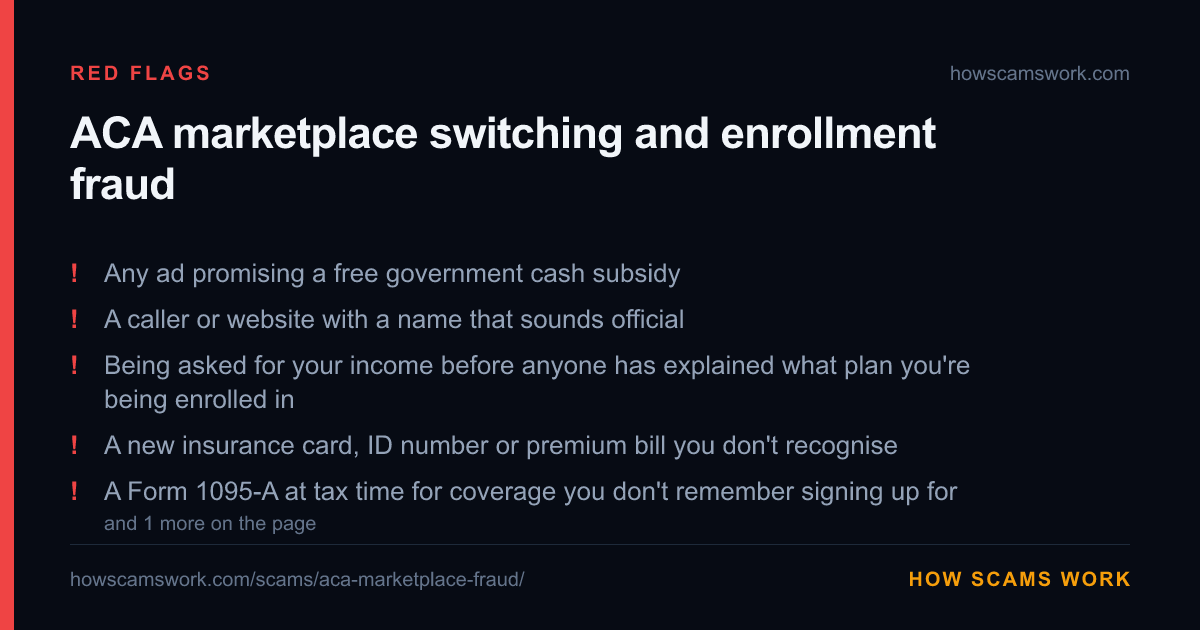
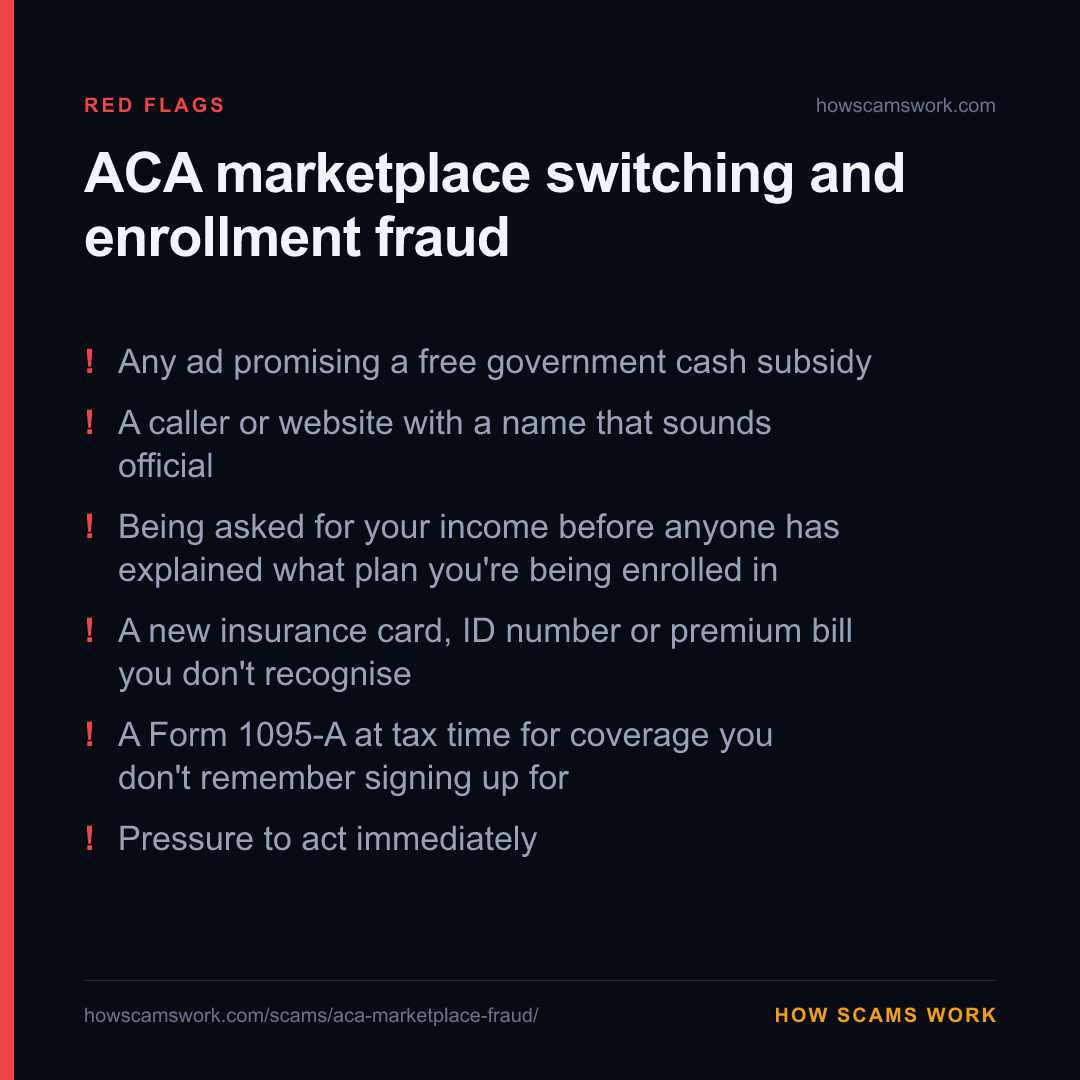
- Any ad promising a free government cash subsidy for groceries, rent or bills in exchange for your information, legitimate ACA subsidies reduce your premium, they are not cash payments.
- A caller or website with a name that sounds official (“ObamacarePlans,” “GovernmentHealthInsurance”) but is not healthcare.gov or your state’s own exchange.
- Being asked for your income before anyone has explained what plan you’re being enrolled in or what it costs.
- A new insurance card, ID number or premium bill you don’t recognise arriving in the mail.
- A Form 1095-A at tax time for coverage you don’t remember signing up for.
- Pressure to act immediately (“the subsidy ends today”) on a decision that should let you check your own account first.
If it’s happening to you
- Log into healthcare.gov yourself, or call the Marketplace Call Center at 1-800-318-2596, rather
than any number from a text, ad or the agent who contacted you. Ask exactly what plan is on file and
who is listed as the agent of record.
- If you were switched or enrolled without consent, ask the Marketplace to process a retroactive
cancellation or correction. Act quickly, tax specialists note some appeal windows run as short as
60 days from when the problem is discovered.
- Report the agent or broker to CMS through the Marketplace Call Center, which can investigate and
suspend a Marketplace Agreement for suspected unauthorized activity.
- If a Form 1095-A shows income or coverage you don’t recognise, file for an extension if needed
rather than filing with figures you know are wrong, and keep records of when you first discovered the
problem.
- Contact a tax clinic or Marketplace Navigator for help, many operate through legal aid
organisations and specialise in exactly this kind of reconciliation dispute.
- Report it to the FTC at ReportFraud.ftc.gov. See where to report for
other countries.
Where the money goes
No laundering chain, and very little of it ever touches the victim directly, the money moves entirely
inside the regulated insurance system, from the government’s premium subsidy to the insurer to the
agent’s commission.
The federal government advances a premium tax credit to the insurer on the consumer’s behalf, calculated
from whatever income was on the application, real or, in the worst documented cases, falsified. The
insurer, in turn, pays the enrolling agent or their agency a recurring monthly commission for the policy
now attached to their license, regardless of who actually wanted the coverage. The lead itself is the one
commodity sold outright for cash, in the tens of thousands of dollars a day in one case, before any policy
is ever written. The victim’s own loss shows up only later and indirectly, a coverage gap, a lost
subsidy accuracy, or an IRS bill for a credit they were never entitled to.
By the numbers
No published dataset breaks this scheme out as its own category yet, so there is no chart to show.
The data page explains which agency categories exist and why some schemes are
invisible in official statistics.
Every factual claim above traces to one of these. Statistics are reported losses; see
methodology for what that does and does not measure.