Also called: ATM cash-out malware · logical ATM attack · Ploutus attack · ATM hacking
ATM jackpotting is a theft in which a crew physically opens a cash machine, installs malware and makes it dispense its cash without debiting any customer account. Prosecutors in Nebraska allege a Tren de Aragua network stole at least $5.4 million from community banks and credit unions from January 2024 to August 2025. Banks, not customers, carry the loss.
What it is
An ATM is a computer in a safe. Jackpotting attacks the computer: a crew opens the machine, loads malware, and the ATM pays out its cash without a card
and without touching any customer’s account. In the cases here the money is the bank’s, so the victims are banks, credit unions and ATM owners rather than the people who use the machines.
It is on this site because it is the other half of the ATM story that card skimming tells. Skimming steals from customers. Jackpotting steals from the institution, and the cases show how an organized crew can scale it. The Nebraska prosecutors’ accounts also describe how cash is divided among participants and moved on afterward.
Most of what is known comes from indictments and sentencing reports. The large Nebraska indictments are allegations, and the people charged in them are presumed innocent.
How it actually works
A crew is organized and the proceeds are pre-divided
The January 2026 Nebraska indictment alleges the group split proceeds among participants in predetermined portions and that money was passed among members and associates to conceal it. The prosecutors tie the network to Tren de Aragua, a link The Record says outside threat-intelligence companies could not verify.
Machines are chosen
The Nebraska indictments allege the targets were primarily older ATM models owned by community banks and credit unions. Prosecutors listed 20 affected banks, mainly in the Midwest.
The crew gets physical access and watches for a response
The January indictment alleges groups opened a machine’s hood or door and then waited nearby to see whether an alarm or a police response followed.
Where it could have stopped
In Kansas in December 2025 two attempts set off police alarms, the men were caught on surveillance and arrested days later, and nothing was stolen. A security firm cited by American Banker also recommends non-standard locks, since many ATMs share identical keys, and full disk encryption.
Malware is installed in person
The indictments describe a variant of the Ploutus malware installed on the machine in person. The Lincoln sentencing report says it was designed to erase evidence of itself.
The machine pays out and no customer is debited
According to the indictments, the malware makes the ATM dispense cash without debiting customer accounts. The 2018 Connecticut and Rhode Island case reported $63,200 from one machine and $63,820 from another five days earlier.
The cash is moved and divided
The January indictment alleges the proceeds were transferred among members and associates, and a second charge, conspiracy to commit money laundering, is part of that indictment.
Arrests and sentences come years later
Lincoln police arrested two men at a jackpotting scene in October 2024. Indictments followed in December 2025 and January 2026, and sentences reported in 2026 ranged from time served to 96 months.
Why it works
The target is an old computer with a door. The Nebraska indictments allege the targets were primarily older machines, and a security firm told American Banker many ATMs share identical top-hat keys.
The loss is the institution’s, not a customer’s. According to the indictments the cash is dispensed without debiting customer accounts, so the people who use the machine have nothing to dispute.
It is repeatable. Prosecutors allege a 19-month conspiracy, and The Record reported the FBI had tracked more than 1,900 incidents since 2020.
The crew can scale up from a handful of people to a network. In 2018 a Springfield, Massachusetts man was sentenced for two machines in two states with “other partners.” By 2026 prosecutors had charged at least 119 people, according to The Record.
Where it comes from
The first case on this page is from 2018, the earliest this research found, and the cases are all US prosecutions. This page does not state an origin country. The Nebraska
prosecutors allege a Venezuelan criminal organization, the defendants in the 2026 sentencing and plea reports are described as Venezuelan nationals, and the 2018 case involved a Springfield, Massachusetts man and a Spanish citizen.
The scale is uneven in the sources. The Record reported the FBI had tracked more than 1,900 incidents since 2020, including over 700 in 2025 with more than $20 million in losses, and that FBI Director Kash Patel said losses exceed $58 million since 2021. The Nebraska indictments allege at least $5.4 million over 19 months.
One defendant, millions. A man sentenced in Omaha was held responsible for more than $3.5 million. In 2018, a single Connecticut machine yielded $63,200.
Real cases
2026 US Sentenced $3.5m
Juan Manuel Gouveia-Aguilera, 27, was sentenced in federal court in Omaha, Nebraska on August 20, 2026 to eight years (96 months) in prison, five years of supervised release and restitution to the affected banks. He had pleaded guilty to charges including bank fraud and computer fraud. Prosecutors said he was responsible for more than $3.5 million in ATM losses using the Ploutus malware.
Read the case file ·
2 sources
2026 US Convicted
Five Venezuelan nationals pleaded guilty to conspiracy to commit bank larceny after driving from Indiana to Kansas in December 2025 to jackpot ATMs in Wamego and Manhattan. Both attempts failed and triggered police alarms, the men were caught on surveillance and arrested days later, and no money was stolen. One, aged 27, has been sentenced to nine months in prison.
Read the case file ·
1 source
2026 US Sentenced
Carlos Javier Padron and Oddry Arnoldo Cabrera Torrealba were arrested by Lincoln police at an ATM jackpotting scene in October 2024. Both pleaded guilty to conspiracy to commit bank burglary, computer fraud and intentionally damaging a protected computer, and in June 2026 each was sentenced to 78 months in federal prison. A judge ordered them to pay more than $1.5 million jointly to the victim banks.
Read the case file ·
2 sources
2025 US Charged (allegation, not conviction) $5.4m
In December 2025 prosecutors in the District of Nebraska unsealed two indictments charging 54 people described as members or associates of Tren de Aragua, a Venezuelan criminal organization, over an alleged 19-month ATM jackpotting conspiracy. They allege at least $5.4 million was stolen from community banks and credit unions, with another $1.4 million attempted. A third indictment in January 2026 added 31 more defendants, and later reports put the total higher. These are allegations, and the defendants are presumed innocent.
Read the case file ·
4 sources
2018 US Sentenced
Argenys Rodriguez, 22, of Springfield, Massachusetts, pleaded guilty to conspiracy to commit bank fraud and in September 2018 was sentenced to 12 months and a day in prison and two years of supervision, with restitution of $121,355.38. The case involved $63,200 taken from an ATM in Cromwell, Connecticut and $63,820 from one in Rhode Island five days earlier.
Read the case file ·
1 source
Red flags
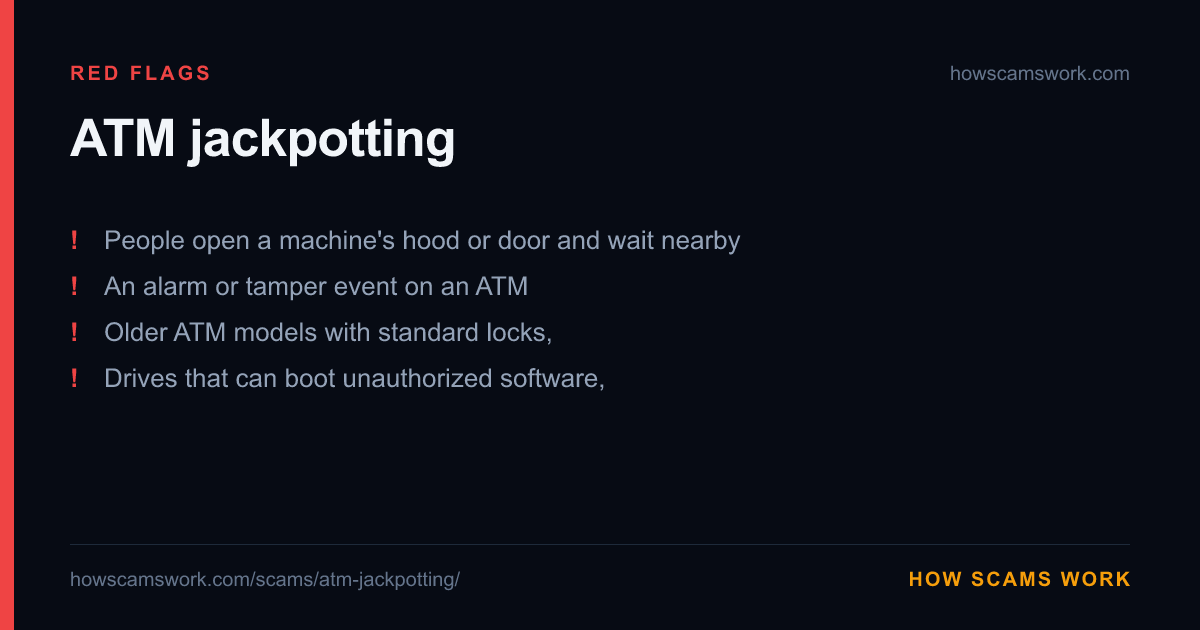
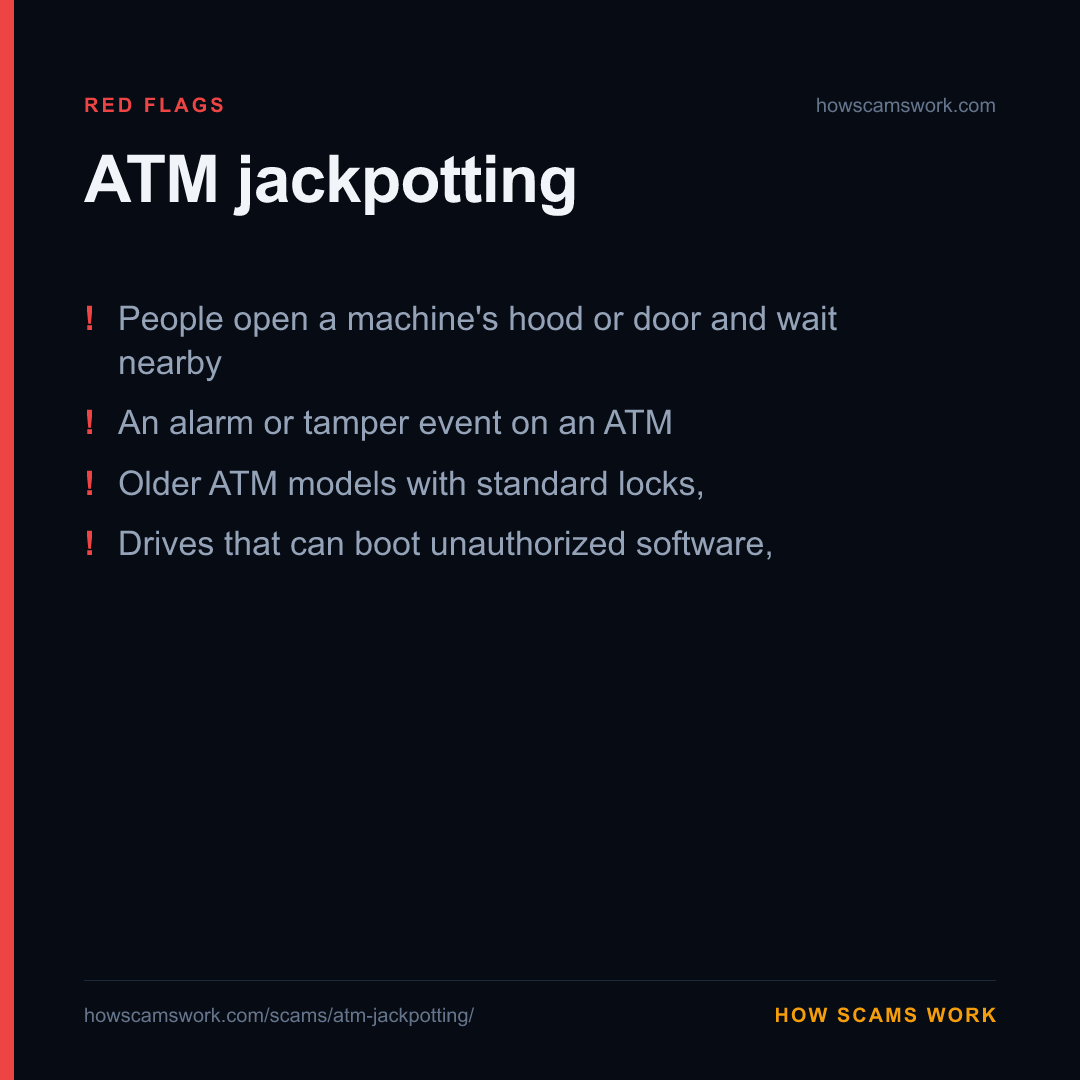
- People open a machine’s hood or door and wait nearby after doing so, as the January indictment alleges.
- An alarm or tamper event on an ATM with no service call scheduled. In Kansas, alarms led to arrests within days.
- Older ATM models with standard locks, where a security firm says many machines share identical keys.
- Drives that can boot unauthorized software, which full disk encryption is meant to block, according to the same firm.
If it’s happening to you
If you see it, or you run an ATM:
- Do not approach. Move away and call the police.
- Tell the bank or operator named on the machine, which is the party that can take it offline.
- If you operate ATMs, ask your vendor or security firm about the locks, the disk encryption and the alarm response that American Banker’s source recommended.
- Report it to your local police. See where to report for other countries.
Where the money goes
The documented money moves from a bank’s machine to a crew, then, according to the January indictment, among members and associates in predetermined portions.
Recovery comes through restitution orders: $121,355.38 in the 2018 case, $126,340 and $285,100 for two defendants reported sentenced in January 2026 (the court is not named), and more than $1.5 million jointly for the two Lincoln defendants.
The restitution amount for the 96-month sentence was not given.
By the numbers
No published dataset breaks this scheme out as its own category yet, so there is no chart to show.
The data page explains which agency categories exist and why some schemes are
invisible in official statistics.
Every factual claim above traces to one of these. Statistics are reported losses; see
methodology for what that does and does not measure.
Common questions
Does jackpotting take money from my bank account?
According to the Nebraska indictments, the malware makes an ATM dispense cash without debiting customer accounts, so the loss falls on the bank or credit union that owns the machine. Banks restock and absorb it. This page is not advice on your own accounts.
Is this only a Tren de Aragua crime?
No. Nebraska prosecutors allege a network tied to Tren de Aragua, and The Record reported that threat-intelligence companies could not verify the link. The 2018 Connecticut and Rhode Island case and the 2025 Kansas attempts on this page do not, in the sources read, connect their defendants to that group.
How many people have been charged?
The totals changed with each report and this page does not reconcile them. American Banker said 54 people were charged in two December 2025 indictments. In January 2026, 31 more were indicted and local reporting put the total at 87. KIRO reported in June 2026 that 96 more had been indicted since two arrests in October 2024, and The Record reported at least 119 charged.
Have any of them been convicted?
Yes, in separate matters. Two men arrested in Lincoln, Nebraska got 78 months each. A man held responsible for more than $3.5 million got 96 months in Omaha in August 2026. Five men pleaded guilty in Kansas, one of whom got nine months. The people charged in the large Nebraska indictments are presumed innocent unless convicted.
What can banks and ATM operators do?
American Banker quoted the security firm GuidePoint recommending that operators replace standard top-hat locks, since many ATMs share identical keys, and use full disk encryption so unauthorized drives cannot boot. Those are one firm's recommendations, not a standard. In Kansas, alarms and cameras led to arrests within days.
What should I do if I see someone tampering with an ATM?
Do not approach. Tell the bank or operator named on the machine and the local police. You can also use the page on where to report scams for other countries. This page is not legal or security advice.