Also called: binary options scam · fixed-odds trading fraud · all-or-nothing options fraud · binary options boiler room
Binary options fraud sells an all-or-nothing bet on whether an asset's price will rise or fall within minutes, through an unregistered platform that is itself the house, not a broker matching real trades. Operators use fake names, rig payouts and refuse withdrawals. One Israeli-run network alone took $145 million before its CEO was sentenced to 22 years.
What it is
An advert or a cold call offers a simple way to trade currencies, commodities or stock indices: pick
whether the price will be higher or lower in a fixed, often very short, window of time. Guess right and a
predetermined payout arrives. Guess wrong and the entire stake is gone. It is called a binary option
because there are exactly two outcomes, and a small number trade legally on registered US exchanges.
The version sold by the platforms on this page is not that. It is built and operated by the same company
taking the other side of every customer’s bet, marketed by call centre staff using invented names and
invented locations, running through websites with no US registration at all. When the CFTC and SEC issued
a joint investor alert about the product, their warning was blunt: verify a platform’s registration before
you send it anything, because in most of the cases they have brought, there was nothing to find.
One network alone took $145 million. Yukom Communications, the company behind the brands BinaryBook
and BigOption, defrauded investors for more than five years before its CEO, Lee Elbaz, was convicted at
trial and sentenced to 22 years in federal prison.
How it actually works
The pitch
An online ad, a YouTube video or a cold call from a “senior account manager” promises fast, simple
returns trading on a professional-looking platform, timed to reach people with savings to invest and no
background in trading.
A fake name, a fake location
The broker gives investors a false name and false credentials, and often claims to be calling from
London, New York or another major financial centre while actually working from an offshore call centre.
Where it could have stopped
The CFTC and SEC’s joint investor alert says to check a platform’s registration with the SEC, CFTC, FINRA or NFA before depositing anything. Every operator on this page, including one that falsely claimed a Wall Street address, was unregistered. That single search would have ended the pitch before the first deposit.
A bonus that becomes a trap
A “welcome bonus” is credited on the first deposit, attached to a trading-volume requirement that must be
met before any withdrawal is allowed, locking the money in long enough for the next stage to work.
An early win, on the house
A small payout arrives, or an account balance climbs on paper. Because the platform, not a market, decides
the result of every trade, an early win costs the operator almost nothing and reliably produces a larger
deposit next.
There is no exchange and no counterparty except the operator itself. The CFTC’s cases describe software
that could extend a losing trade’s countdown clock or shift the settlement price after the fact, so the
customer’s win rate is a setting, not an outcome.
Withdrawal blocked
Requests to cash out meet delay, a demand for an upfront “tax” or “release fee,” or a request for
photocopies of a driver’s licence and credit card before funds can supposedly be released. The documents
are rarely, if ever, followed by a payout.
Enforcement, years and borders later
Civil and criminal cases against these networks have taken four to seven years from the first complaint
to a final judgment, by which point the company has often rebranded, and some named defendants have simply
never appeared in a US court.
Why it works
The pitch is simple where real trading is not. A yes-or-no bet on a price is easier to understand,
and easier to feel confident about, than options pricing, spreads or leverage, which is exactly why it
appeals to first-time investors rather than experienced traders.
Borrowed prestige does the credibility work. A broker claiming to call from London or Wall Street,
with an invented name and biography, sounds like exactly the kind of professional a saver would trust with
retirement money, and there is no easy way to check the claim mid-call.
An early win is cheap to manufacture and expensive to doubt. Once a platform controls the outcome of
every trade, a small real payout is not evidence the system works, it is the least expensive way to make
someone believe it does.
The excuses for non-payment sound bureaucratic, not criminal. A “tax,” a “compliance fee” or an
identity check reads as ordinary friction to someone who has never withdrawn from a real brokerage before,
not as the final stage of the scheme.
And the business model survives its own prosecutions. Because most enforcement here is civil, and
because operators and their money are often outside the country by the time a court rules, a shut-down
brand’s staff, software and customer lists have a documented history of reappearing under a new name.
Where it comes from
Overwhelmingly run from outside the United States, aimed squarely at US customers.
Call centres cluster in Israel and Cyprus, the base of operations in every case documented on this
page: Yukom Communications and its BinaryBook and BigOption brands, the Cartu and Peretz network behind
BeeOptions, Glenridge Capital and Rumelia Capital, and Banc de Binary, whose founder Oren Shabat Laurent
ran the operation from Cyprus while claiming a Wall Street presence to US customers.
The corporate structure is built to separate the money from any one country’s regulator. Banc de
Binary alone operated through entities registered in Cyprus, Israel and the Seychelles at the same time;
the Cartu and Peretz network routed funds through a Seychelles company, Blue Moon Investments, alongside a
Texas-based business associate.
Scale ranges from tens of millions to well over a hundred million dollars per network. The CFTC’s
initial complaint against Yukom cited $103 million taken from customers; by the time of Elbaz’s criminal
case, prosecutors put the total nearer $145 million. The Cartu and Peretz network took in more than $165
million over five years.
And enforcement outcomes diverge sharply by who actually appears in court. Elbaz stood trial and was
sentenced to decades in prison. Jonathan Cartu, Leeav Peretz and Nati Peretz never appeared, and a federal
court entered a default judgment against them in 2024. Both are matters of public record; only one
resulted in anyone going to prison.
Real cases
2024 CA · IL · US Sanctioned $165.0m
The CFTC charged Canadian brothers David, Jonathan and Joshua Cartu, Canadian-Israeli brothers Leeav and Nati Peretz, Texas-based associate Ryan Masten, and four related companies in September 2020 with operating a binary options fraud that took in more than $165 million from US customers through the brands BeeOptions, Glenridge Capital and Rumelia Capital. None of the defendants appeared to defend the case, and in March 2024 a federal court entered a default judgment ordering over $204 million in disgorgement and penalties.
Read the case file ·
2 sources
2019 IL · US Sentenced $145.0m
Lee Elbaz, CEO of the Israel-based Yukom Communications, was convicted at trial in August 2019 of conspiracy to commit wire fraud and wire fraud for orchestrating a scheme that sold binary options to investors worldwide through the websites BinaryBook and BigOption, and was sentenced in December 2019 to 22 years in federal prison and later ordered to pay $28 million in restitution. Victims described at sentencing included retirees who lost their entire life savings, IRA funds and 401(k) accounts.
Read the case file ·
4 sources
2016 CY · IL · US Settled $11.0m
The SEC sued Cyprus-based Banc de Binary Ltd. and its founder Oren Shabat Laurent in 2013, alleging the company illegally sold unregistered binary options to US customers while falsely claiming a Wall Street presence. A parallel CFTC action followed. In February 2016 the company, Laurent and three affiliated entities settled for a combined 11 million dollars, split between an SEC Fair Fund for harmed investors and a CFTC civil penalty, with Laurent personally paying $150,000.
Read the case file ·
2 sources
Red flags
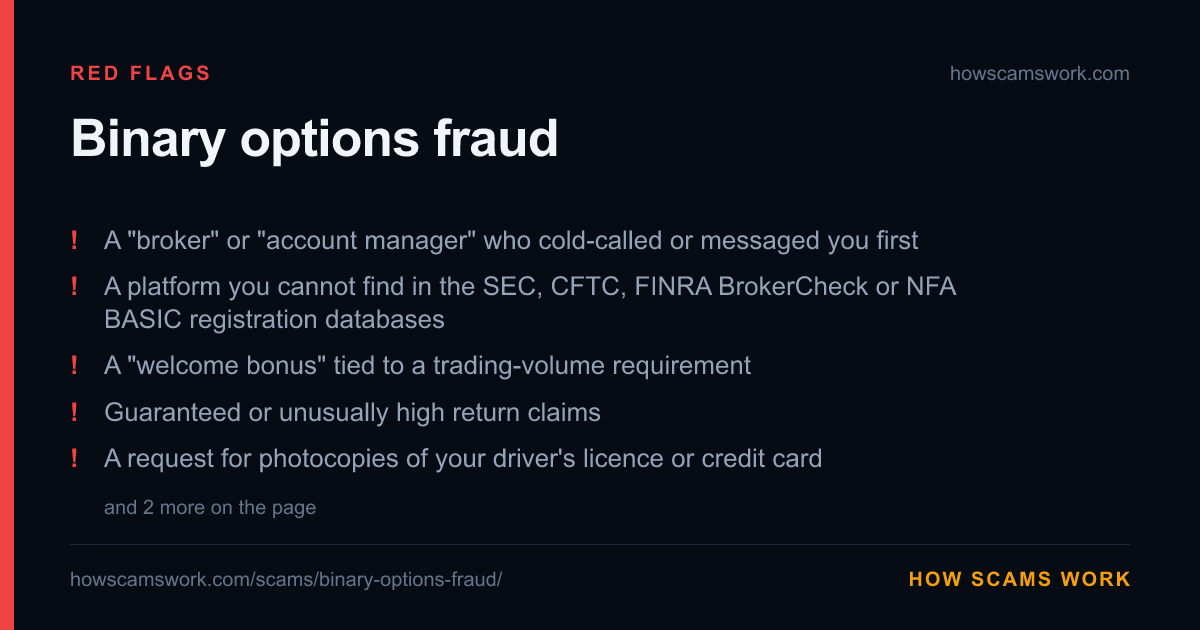
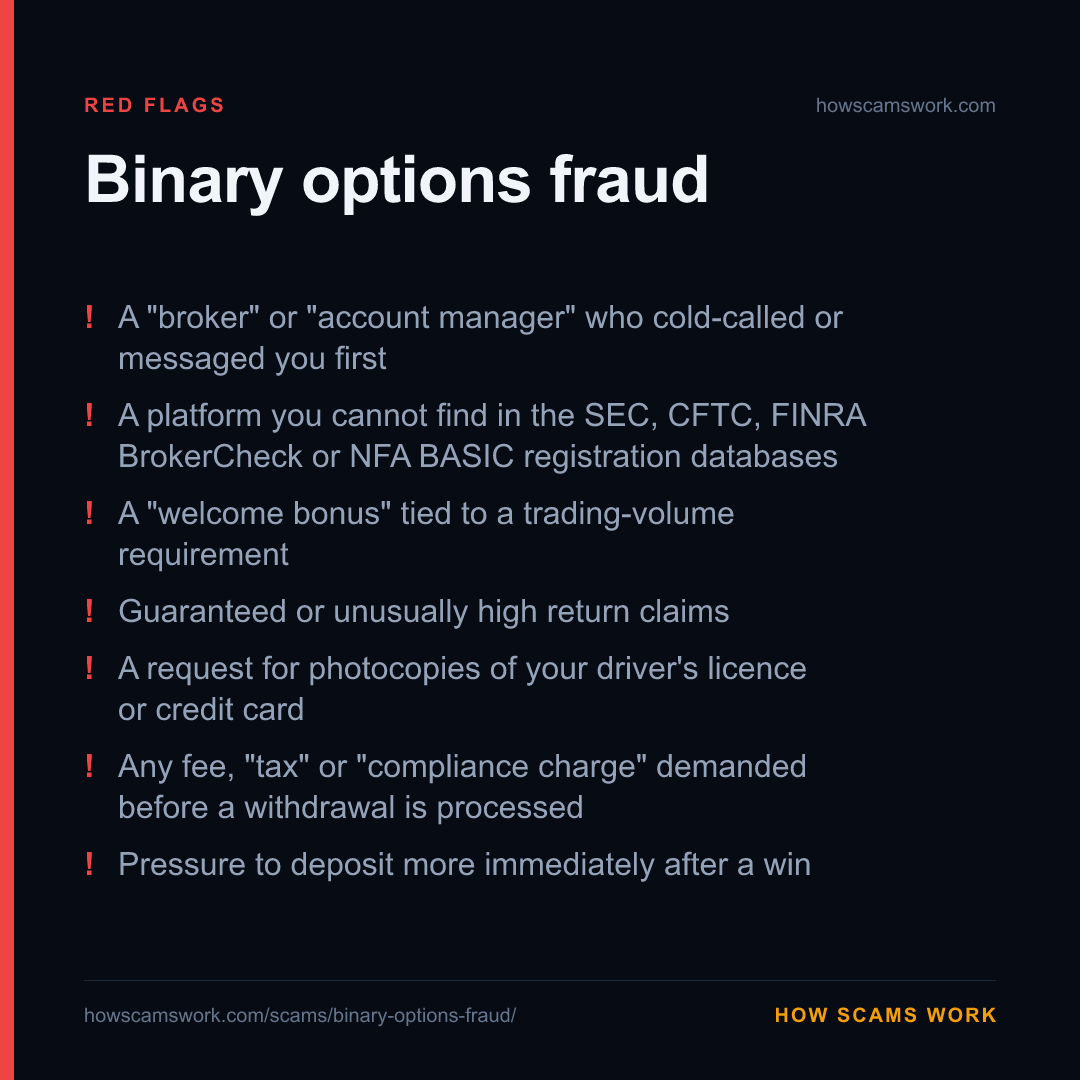
- A “broker” or “account manager” who cold-called or messaged you first, especially one claiming to work from a major financial centre.
- A platform you cannot find in the SEC, CFTC, FINRA BrokerCheck or NFA BASIC registration databases. Registered brokers are searchable; these platforms were not.
- A “welcome bonus” tied to a trading-volume requirement before any withdrawal is allowed.
- Guaranteed or unusually high return claims, such as the 60 to 85 percent returns promised in one documented case.
- A request for photocopies of your driver’s licence or credit card as a condition of using the platform or releasing funds.
- Any fee, “tax” or “compliance charge” demanded before a withdrawal is processed. A real broker never charges a fee to release your own money.
- Pressure to deposit more immediately after a win, especially a large or unusually well-timed one.
If it’s happening to you
Stop depositing immediately, and treat any demand for a fee, tax or identity documents before a
withdrawal as confirmation, not as a hurdle to clear.
- Verify the platform’s registration yourself, using the SEC’s EDGAR and BrokerCheck systems, the
CFTC’s registration lookup, or the National Futures Association’s BASIC database. If nothing comes up,
it is not authorised to solicit US customers.
- Save everything, screenshots of your account balance, every message from your “broker,” deposit
confirmations and any identity documents you sent, before the platform disappears.
- Do not pay a further fee to unlock a withdrawal. This is a documented tactic, not a real
requirement, in every case on this page.
- Report it to the CFTC at CFTC.gov/complaint, the SEC at SEC.gov/tcr, and the FBI’s IC3 at
IC3.gov. See where to report for other countries.
- Be wary of anyone who contacts you afterward offering to recover the money, for a fee. Victim
lists from failed platforms are a documented target for recovery scams.
- Check for an existing case or Fair Fund tied to the platform you used. The SEC and CFTC have
distributed partial restitution in more than one of the networks on this page, years after the losses
occurred.
Where the money goes
Out of the country almost immediately, through a company structure built to survive the loss of any one
piece of it.
A deposit goes by card or wire straight to the platform operator, not to a segregated customer account of
the kind a real broker is required to maintain. From there it is split across brand names and shell
entities, registered in jurisdictions such as the Seychelles, the Marshall Islands, Anguilla, Gibraltar and
Cyprus, in every documented case on this page, before reaching the operators personally. What regulators
eventually recover, a Fair Fund distribution, a restitution order, arrives years later and covers a
fraction of what was actually taken; the rest has typically moved beyond the reach of the court that
ordered it back.
By the numbers
No published dataset breaks this scheme out as its own category yet, so there is no chart to show.
The data page explains which agency categories exist and why some schemes are
invisible in official statistics.
Every factual claim above traces to one of these. Statistics are reported losses; see
methodology for what that does and does not measure.