Also called: ERC mill · ERC fraud · employee retention tax credit scam · COVID-19 tax credit fraud · pandemic payroll tax credit scheme
A promoter files a contingency-fee Employee Retention Credit claim for a business that never actually qualified, often inventing eligibility to a COVID-19 disruption that did not happen. The IRS pays the refund, then months or years later audits and claws it back from the business, not the promoter, with interest and penalties. One scheme alone filed over 8,000 false claims worth $600 million.
What it is
A company or individual, sometimes calling itself an “ERC specialist,” sometimes operating as a credit
repair or tax-prep business on the side, offers to file an Employee Retention Credit claim for a
business, for a cut of whatever refund comes back. The Employee Retention Credit itself was real: a
refundable payroll tax credit Congress created in the CARES Act to help businesses keep employees on
payroll during the COVID-19 pandemic, worth up to 70% of wages per employee per quarter by 2021.
The scam is not the credit. It is the claim. A promoter tells a business “everyone qualifies,” skips any
real eligibility review, and either invents the disruption that would have made the business eligible or,
in the most extreme documented cases, invents the business itself, filing for a company that “lacked any
employees or operations,” in the words of one federal indictment. The IRS pays the refund up front,
before the claim is reviewed in detail. The promoter has already been paid. Years later, when the IRS
audits, the business, not the promoter, owes the money back, with interest and penalties.
How it actually works
The pitch
A cold call, a direct-mail flyer, or a search ad promises a refund “in weeks” for a payroll tax credit
the business has “definitely” earned, often from a promoter with no prior relationship to the
business and no accounting credential.
No real eligibility review
The IRS’s own warning signs include promoters who claim they can determine eligibility “within
minutes,” who cite general OSHA or CDC guidance as if it were a qualifying government shutdown order,
or who never produce a written memo explaining why the business actually qualifies.
The contingency fee
Payment is a percentage of the claimed credit, commonly cited in IRS guidance as 15% to 30%,
collected once the claim is filed or the refund arrives, regardless of whether the IRS later disallows
it.
Where it could have stopped
The IRS lists a “nothing to lose” contingency-fee pitch, with no written eligibility determination, as one of its clearest Dirty Dozen warning signs. A legitimate preparer documents why a business qualifies before filing, not after being paid to file anyway.
Inflated, backdated, or invented claims
Real cases range from exaggerating a genuine but partial business disruption into a full-quarter claim,
to filing for businesses that, as one federal case put it, “lacked any employees or operations” for
the sole purpose of claiming the credit.
The refund lands
The US Treasury pays the claimed amount directly into the business’s account, sometimes tens of
thousands of dollars, sometimes far more, before the underlying claim has been closely reviewed.
The IRS starts asking questions
The IRS has sent more than 28,000 disallowance letters and, in a single 2024 sweep, up to 30,000
recapture letters addressing more than $1 billion in claims it now considers improper.
The business owes it back
Recapture and audit findings are addressed to the business that received the refund, not the promoter
who filed it and already kept the fee. Repayment can come with a 20% accuracy penalty, or up to 75% for
fraud, plus interest.
Enforcement, sometimes years later
IRS-Criminal Investigation has opened more than 400 criminal cases covering roughly $7 billion in
claims. The most serious promoter cases have produced sentences ranging from about four to eighteen
years in federal prison.
Why it works
The credit itself was real, which lends the pitch instant credibility. Unlike a scheme built on a
fictional program, an ERC promoter is selling access to a genuine, well-publicized federal tax credit,
making “you definitely qualify” sound like good news rather than a red flag.
The eligibility rules were genuinely complex. Whether a business qualified could turn on a partial
government shutdown order, a specific supply-chain disruption, or a quarter-by-quarter revenue test,
complicated enough that a business owner without a tax background had every reason to trust a
self-described specialist’s judgment.
The refund arrives before the claim is checked. The IRS paid claims quickly during the program’s
peak to get relief money to businesses fast, which also meant a fraudulent claim could clear and be
spent long before any review caught it.
The fee structure removes the appearance of risk. A contingency fee, paid only if a refund comes
through, makes the pitch sound like it has no downside, when the actual downside, a multi-year audit
and full repayment with penalties, falls entirely on the business, not the promoter.
And the promoter’s incentive is volume, not accuracy. A percentage-of-refund fee rewards filing as
many large claims as possible, as fast as possible, which is exactly the pattern IRS Criminal
Investigation found in the largest prosecuted cases, some running thousands of claims through a single
operation.
Where it comes from
Entirely domestic, and built directly on top of a genuine, well-known federal program rather than a
fabricated one.
A cottage industry formed during 2021 and 2022 once the ERC’s rules loosened and its value rose to
70% of wages per employee per quarter, with promoters flooding phone lines, mailboxes and search results
with “no risk, guaranteed” pitches, prompting the IRS to place ERC claims at the top of its 2023 “Dirty
Dozen” list of tax scams and to impose a moratorium on new claims that September.
Operations range from a single filer running shell businesses to organized, multi-defendant rings.
One Louisiana case involved a single operator filing for dozens of nonexistent companies; a Kingsport,
Tennessee case involved three co-defendants running at least eleven sham businesses together; the
largest documented case, out of Long Island, New York, charged seven defendants who filed more than
8,000 payroll tax returns through what the indictment describes as a “purported credit repair business.”
Enforcement is a mix of civil recovery and criminal prosecution. IRS-Criminal Investigation, the
Treasury Inspector General for Tax Administration and the Justice Department’s Tax Division have run the
criminal cases; the IRS itself has separately pursued disallowance letters, recapture letters and a
Voluntary Disclosure Program aimed at businesses that want to come forward before an audit starts.
And the money moves through the same channel the credit was designed to use. There is no offshore
network or cryptocurrency exchange in any of the documented cases here, proceeds went to shell
businesses’ US bank accounts, and from there into luxury vehicles, jewelry, casino gambling and mortgage
payments, all traceable through ordinary US financial records.
Real cases
2026 US Sentenced $44.0m
An indictment unsealed in January 2025 charges Keith Williams and six co-defendants with filing more than 8,000 fraudulent quarterly payroll tax returns between November 2021 and June 2023, seeking over $600 million in Employee Retention Credit and Sick and Family Leave Credit funds through a purported credit repair business called "Credit Reset." Prosecutors allege the defendants secured over $44 million and spent it on jewelry, designer clothing and luxury cars. One defendant, Tiffany Williams, pleaded guilty to wire fraud and was sentenced to 36 months in prison in May 2026; the outcomes for the other six defendants were not found, and they remain presumed innocent unless and until convicted.
Read the case file ·
2 sources
2026 US Sentenced $33.0m
Candies Goode-McCoy, formerly of Las Vegas, filed more than 1,200 tax returns between June 2022 and September 2023 for her own businesses and those of clients, falsely claiming the Employee Retention Credit and paid Sick and Family Leave Credit and seeking over $98 million in refunds. The IRS paid approximately $33 million; McCoy personally kept over $1.3 million and collected roughly $800,000 in fees from clients before her April 2026 sentencing to 54 months in federal prison.
Read the case file ·
1 source
2026 US Sentenced $1.8m
Ryan Glidewell, Alyssa Glidewell and Edward Zanes, all of Kingsport, Tennessee, created at least eleven phony businesses with no employees or operations to falsely claim the Employee Retention Credit and paid Sick and Family Leave Credit, filing false returns claiming over $3.4 million, of which the IRS paid $1.8 million. All three were sentenced to federal prison between 2025 and 2026 and ordered to pay $1,806,637 in restitution.
Read the case file ·
2 sources
2025 US Sentenced $4.4m
Damian R. Raby of Gonzales, Louisiana filed Employee Retention Credit claims for dozens of businesses in the Baton Rouge area that either did not exist during the pandemic or had no legitimate activity before it, causing the IRS to issue more than 30 checks totaling approximately $4.4 million. He was sentenced in November 2025 to 216 months (18 years) in federal prison after also obstructing the investigation into his conduct, and ordered to pay over $2.6 million in restitution.
Read the case file ·
1 source
Red flags
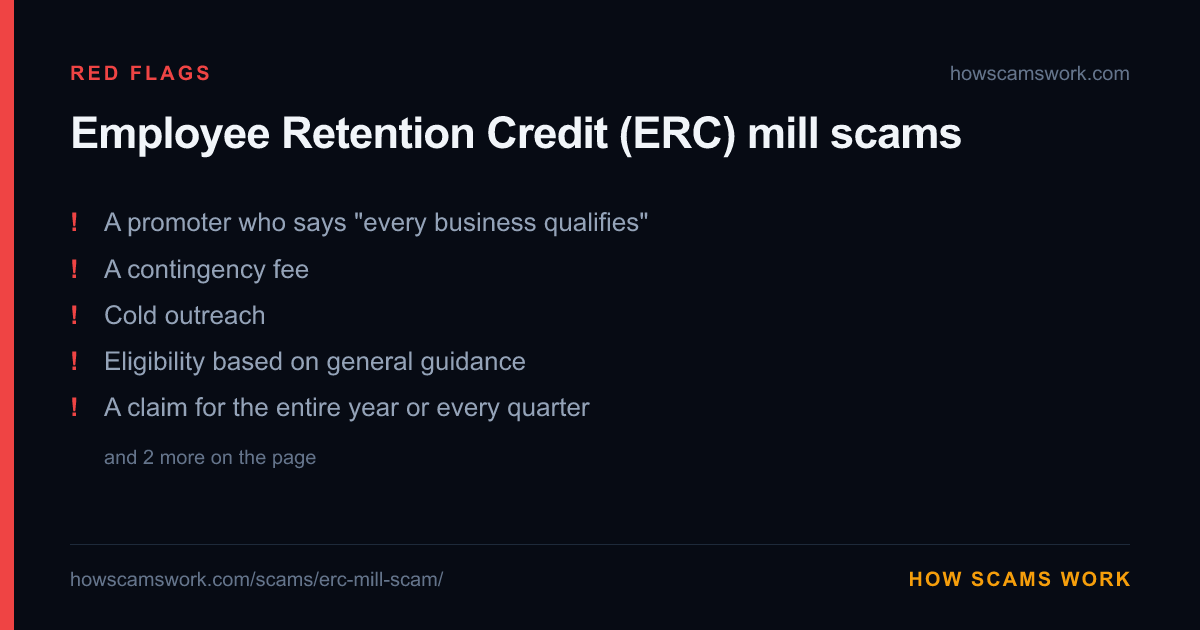
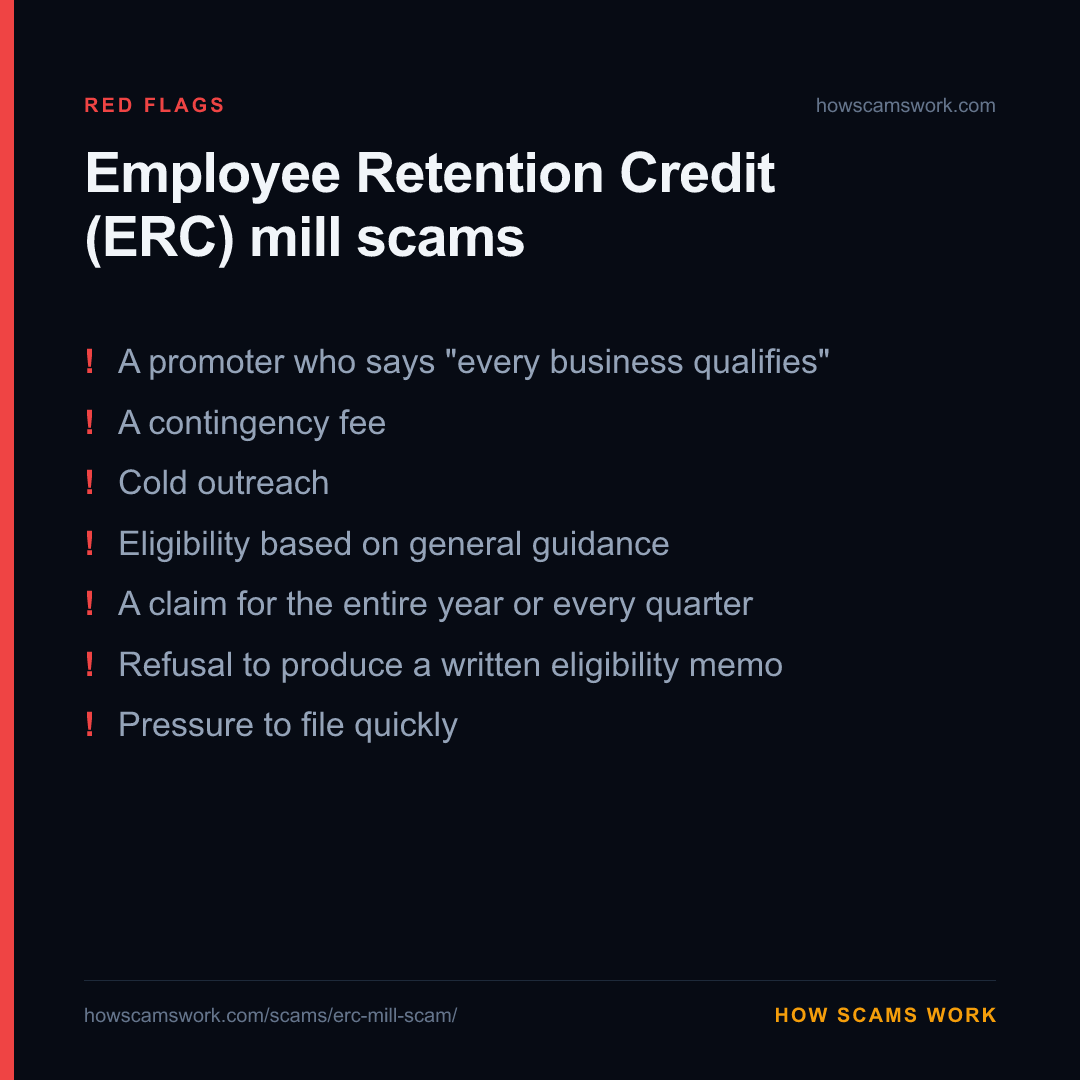
- A promoter who says “every business qualifies” or that eligibility can be determined “within minutes,” with no written analysis.
- A contingency fee, commonly 15% to 30% of the claimed credit, pitched as risk-free, with no explanation of who bears the risk if the IRS later disallows the claim.
- Cold outreach, an unsolicited call, mailer or ad from a company with no prior relationship to the business.
- Eligibility based on general guidance, citing OSHA or CDC recommendations, or supply-chain issues alone, rather than a specific government order that actually suspended operations.
- A claim for the entire year or every quarter, when the business’s actual disruption, if any, was partial or short-lived.
- Refusal to produce a written eligibility memo or the underlying calculations behind the claimed credit.
- Pressure to file quickly before a supposed deadline, without time to have the claim reviewed by the business’s own accountant.
If it’s happening to you
If you have not yet filed a claim through a promoter making these promises, stop and get an independent
review from your own accountant or tax attorney before signing anything.
- If you already filed and have not yet received a refund, the IRS has periodically allowed
businesses to withdraw an unpaid ERC claim as if it had never been filed, with no penalties or
interest, check directly with the IRS or a tax professional for the program’s current status.
- If you received a refund you now believe was improper, the IRS has periodically run a Voluntary
Disclosure Program letting businesses repay at a discount, before an audit starts, to avoid penalties
and interest, again, check its current availability rather than assuming it remains open.
- If you receive a disallowance or recapture letter, respond by its deadline. Ignoring it does not
make the claim go away and forecloses options that are only available if you respond promptly.
- Get a second, independent opinion on your original eligibility determination, ideally from a
licensed CPA or tax attorney with no financial stake in whether the credit was proper.
- Keep every document the original promoter gave you, including any eligibility memo, engagement
letter, and fee agreement. If the promoter’s conduct was itself fraudulent, this becomes evidence.
- Report a promoter you believe acted fraudulently to the IRS using Form 14242, and to the Treasury
Inspector General for Tax Administration. See where to report for other
countries.
Where the money goes
Almost entirely domestic, moving from the US Treasury to a US business bank account, then to whoever
controls it, no offshore network, no cryptocurrency exchange, in any of the documented cases here.
The contingency fee goes straight to the promoter, deducted or billed the moment the refund clears,
money that is not recoverable by the business later, even if the claim itself is disallowed. The rest of
the refund is spent, invested, or banked by the business, or in the most fraudulent cases, funneled by
the promoter into luxury vehicles, jewelry and casino gambling through shell businesses set up for the
sole purpose of receiving the check. Because the fraud happens inside the tax system itself rather than
through a separate laundering chain, the recovery mechanism is also built into that system: audits,
disallowance and recapture letters, restitution orders, and, for the most serious promoters, criminal
forfeiture.
By the numbers
No published dataset breaks this scheme out as its own category yet, so there is no chart to show.
The data page explains which agency categories exist and why some schemes are
invisible in official statistics.
Every factual claim above traces to one of these. Statistics are reported losses; see
methodology for what that does and does not measure.