Also called: laptop farm scheme · DPRK IT worker scheme · fraudulent remote IT worker scheme · North Korean remote worker fraud
A North Korean IT worker uses a stolen or borrowed American identity to get hired remotely at a US company, then pays a US-based facilitator to host the company's laptop at home and relay remote access overseas. One Arizona "laptop farm" alone generated more than $17 million before its host was sentenced to 102 months in July 2025.
What it is
A job listing is real. The interview happens. A laptop ships. Payroll runs every two weeks. Almost
everything about the hire looks exactly like a normal remote employee, except the person doing the work
is not who the company thinks it hired.
North Korea has deployed thousands of trained IT workers to pose as US citizens and residents online,
using stolen or “borrowed” American identities to get hired at ordinary US companies in remote software,
IT and help-desk roles. To get past the controls a US employer would normally rely on, address checks,
a US-based laptop, a US bank account, the workers pay a US-based collaborator, called a facilitator,
to supply exactly those things. The facilitator receives the company’s laptop at a real US address,
connects it to the internet, and sometimes installs remote-access software so the actual worker, often
in China near the North Korean border, can log in and do the job from there.
The money is real too. One Arizona host alone generated more than $17 million before she was caught;
a separate scheme run out of New Jersey moved $5 million and reached inside a defense contractor’s
network. The government’s own estimate is that 85 to 90 percent of what these worker teams earn
reaches the North Korean regime, funding weapons programs among its other activities.
How it actually works
Building a legend
A North Korean IT worker, or the broker supplying workers to them, obtains a real American’s name,
Social Security number and other identifying details, stolen outright or rented from someone willing
to be paid for the use of their identity.
The remote interview
The worker applies to a fully remote posting, sometimes directly, sometimes through a front business
that supplies “certified” contract IT workers to companies that never learn where the work is actually
performed.
Where it could have stopped
The FBI’s own guidance says no single interview red flag is reliable alone: an applicant who cannot answer basic questions about their claimed location, background noise suggesting they are not alone, or a video call that never quite shows a stable background. Verifying identity at E-Verify.gov, requiring a passport or multiple forms of ID, and live, in-person verification each raise friction a worker using a stolen identity usually cannot clear.
Hired
The company extends an offer, runs payroll setup, and ships a company laptop, believing its new remote
hire lives at the address on file. That address belongs to the facilitator, not the worker.
The laptop farm
The facilitator receives the laptop at a home address, sometimes dozens of laptops from dozens of
different US companies at once, and keeps it powered on and connected to the internet, exactly what
the job description asked of them in exchange for a fee.
Remote access, set up
Remote-desktop software, or a physical keyboard-video-mouse device plugged into the laptop, lets the
actual worker, overseas, control the machine as though they were sitting in front of it in the United
States.
Wages, laundered through a front
Paychecks land in a US bank account, sometimes one opened in a facilitator’s own name, sometimes one
held by a shell company created specifically to look like a legitimate American contracting business
with no real employees or operations of its own.
A cut kept, the rest moves overseas
The facilitator keeps an agreed fee or percentage. The remainder is wired to accounts overseas,
documented cases show repeated transfers to cities in China on the North Korean border, before
reaching the regime.
Exposed
Discovery usually comes from a security review after a data-exfiltration incident, a tip, or a federal
search warrant, not from the hiring process itself. By then the real identity owner may already have
false tax filings and employment-eligibility flags in their name to untangle.
Why it works
Fully remote hiring removed the one check that used to matter: being physically present. A company
that would once have met an employee in an office now has no equivalent moment where a false identity
and a false location are hard to maintain at once.
The facilitator supplies exactly what a background check cannot see past. A real US address for the
laptop, a real US bank account for the wages, sometimes a real US business name on the paperwork. None
of it is fabricated; all of it is rented.
The pitch to the facilitator rarely announces itself as criminal. “Receive a package, keep it
connected to the internet, get paid,” reads like dozens of legitimate gig postings, and the FBI says
operators deliberately target people under financial stress who are less likely to ask questions.
Identity theft does the final piece of lifting. A stolen Social Security number lets the worker clear
automated hiring and payroll checks that were built to verify a person exists, not to verify which
person is actually typing.
And no single signal is conclusive. The FBI describes detection as requiring “identity in depth,”
several weak, individually explainable signals, considered together, because aggressive filtering on any
one signal risks blocking legitimate remote workers and identity-theft victims along with the scheme.
Where it comes from
A state-directed effort, run through ordinary-looking US business relationships.
North Korea deploys thousands of trained IT workers specifically for this. A May 2022 US government
advisory states individual workers have been known to earn up to $300,000 a year, generating hundreds of
millions of dollars collectively for the regime each year.
Enforcement has accelerated sharply since 2025. The Justice Department’s “DPRK RevGen: Domestic
Enabler Initiative” announced the 7th and 8th US-based facilitator sentences within a five-month span as
of May 2026, following earlier rounds in January, June and November 2025, and February and March 2026,
a pace that itself indicates how many parallel schemes were running.
The work increasingly gets subcontracted further still. The FBI’s October 2026 guidance describes
North Korean workers who get hired, then pay freelancers in Pakistan, India, Nigeria or neighboring
countries a fraction of the salary to actually perform the job, adding another layer between the
regime and the paycheck.
And the facilitators themselves range from unwitting gig workers to professional brokers. Some US
hosts appear to have genuinely not understood who they were working for. Others, like a Ukrainian
national who ran a dedicated identity-rental website and managed laptop farms in at least three states,
built entire businesses around supplying the scheme with what it needed.
Real cases
2026 US Sentenced $5.0m
Kejia Wang, 42, of Edison, New Jersey, managed a scheme in which he and at least five other US-based facilitators hosted hundreds of laptops for North Korean IT workers, using shell companies with no real employees to receive the wages. Zhenxing Wang, 39, of New Brunswick, New Jersey, was one of the laptop-hosting facilitators. The scheme generated more than $5 million for North Korea at over 100 US companies and let an overseas worker access defense-controlled technical data at a California contractor. Both men were sentenced in April 2026, Kejia Wang to 108 months and Zhenxing Wang to 92 months.
Read the case file ·
1 source
2026 US · UA Sentenced $1.4m
Oleksandr Didenko, 29, of Kyiv, Ukraine, ran a website called Upworksell.com that let North Korean IT workers buy or rent stolen American identities, and paid US residents in Virginia, Tennessee, Arizona and California to host laptops as part of the scheme. Court documents say he had access to the identities of at least 871 Americans and helped North Korean workers obtain jobs at 40 US companies. He was extradited from Poland, pleaded guilty in November 2025, and was sentenced in February 2026 to five years in federal prison.
Read the case file ·
2 sources
2025 US Sentenced $17.0m
Christina Marie Chapman, 50, of Litchfield Park, Arizona, ran a "laptop farm" out of her home, receiving and hosting computers that more than 300 US companies shipped to a remote hire they believed lived at her address. The hire was actually a North Korean IT worker using a stolen or borrowed American identity. She pleaded guilty in February 2025 to conspiracy to commit wire fraud, aggravated identity theft and conspiracy to launder monetary instruments, and was sentenced in July 2025 to 102 months in federal prison.
Read the case file ·
1 source
Red flags
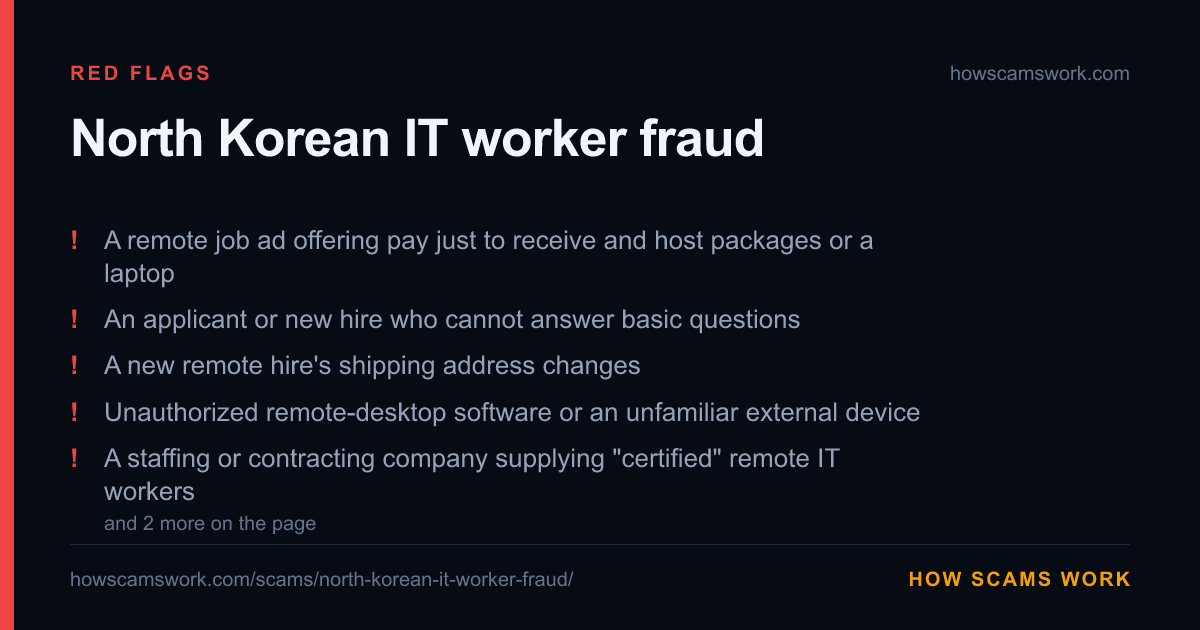
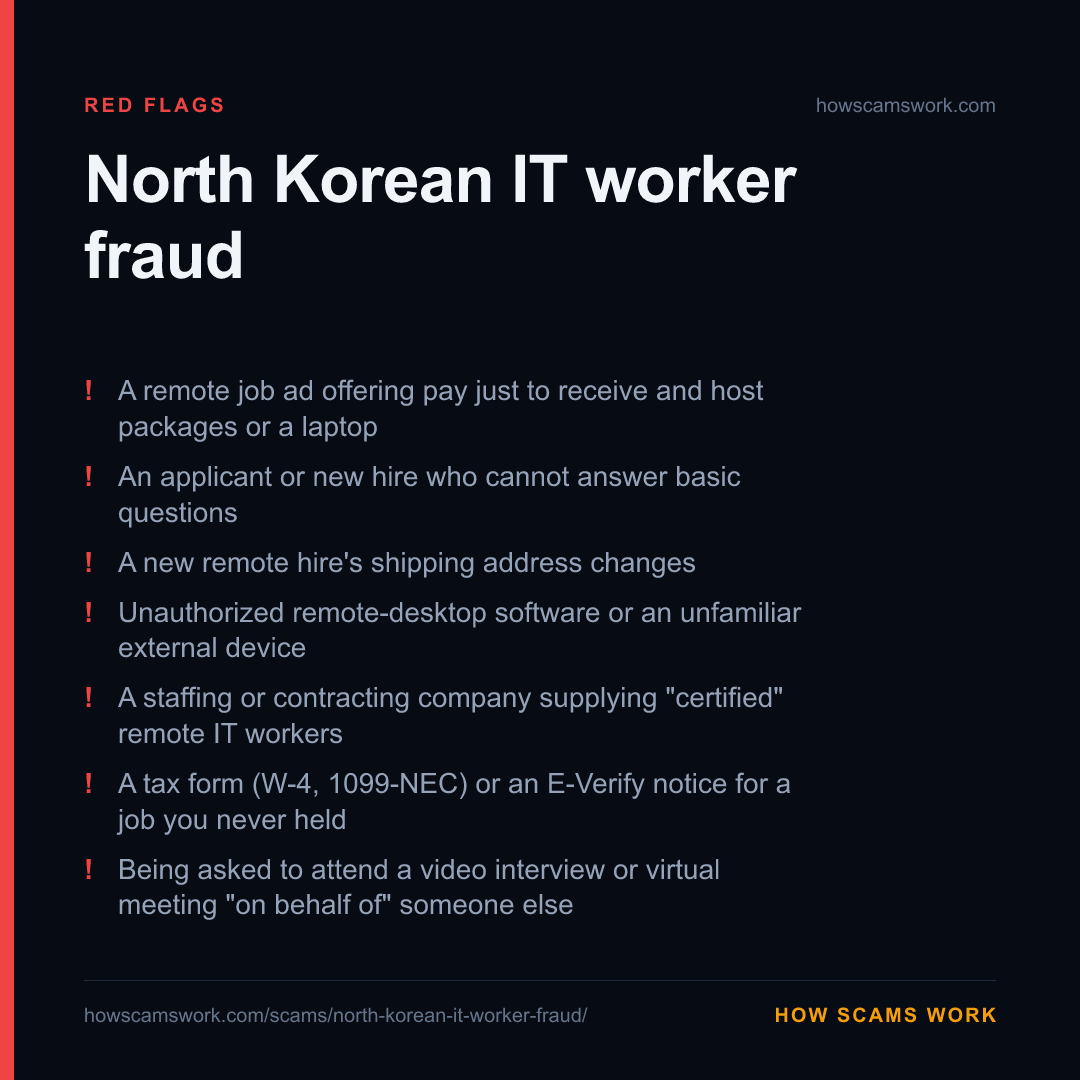
- A remote job ad offering pay just to receive and host packages or a laptop, with vague or no description of what work the “laptop” is actually for.
- An applicant or new hire who cannot answer basic questions about their claimed location, time zone or background during interviews or calls.
- A new remote hire’s shipping address changes shortly after hiring but before equipment is delivered.
- Unauthorized remote-desktop software or an unfamiliar external device (a small box plugged between keyboard, video and mouse) connected to a company laptop.
- A staffing or contracting company supplying “certified” remote IT workers that cannot confirm, or will not let a client confirm, exactly where those workers physically are.
- A tax form (W-4, 1099-NEC) or an E-Verify notice for a job you never held, a direct sign your identity is already being used.
- Being asked to attend a video interview or virtual meeting “on behalf of” someone else for pay.
If it’s happening to you
If you are a company and suspect you have hired into this scheme, do not simply fire the account and
move on, the device and network access need to be examined first.
- Preserve the device and the account’s access logs before taking any other action; evaluate network
activity from the suspected employee’s device with your security team or an outside incident-response
firm.
- Report it to the FBI’s Internet Crime Complaint Center at IC3.gov immediately, as the Bureau’s own
guidance recommends.
- If you are the person whose identity was used, contact the business that issued any W-4 or 1099
form in your name, and contact the FBI. Consider a Self-Lock through E-Verify.gov to reduce
further misuse of your identity for employment fraud.
- If you were paid to receive packages or host a laptop and now suspect why, stop immediately and do
not accept, forward or activate anything further. Participating further, even unknowingly, adds to
your own legal exposure; the conduct is a federal crime regardless of how small your cut was.
- Build identity verification into the entire employment lifecycle, not just hiring: E-Verify checks,
a government ID beyond a scanned copy, and periodic re-verification for fully remote roles, per the
FBI’s “identity in depth” guidance.
- Train HR, IT and security teams to compare notes. No single flag, one odd interview answer, one
address change, one unfamiliar remote-access tool, is meant to be conclusive alone.
Where the money goes
A US paycheck, laundered to look domestic for as long as possible, then moved overseas.
Wages are deposited into an ordinary-looking US bank account, sometimes a facilitator’s personal
account, sometimes one held by a shell company set up purely to receive this income and make it look
like it belongs to a legitimate American contractor. In the largest documented laundering structure on
this page, three such shell companies, with no employees or real operations, received millions of
dollars in combined wages before the money moved further.
The facilitator or broker keeps an agreed cut, sometimes a flat monthly fee as low as $100 per laptop
hosted, sometimes a larger percentage for a broker managing multiple farms and hundreds of identities.
The remainder crosses a border, with documented cases showing repeated wire transfers to accounts in
Chinese cities on the North Korean border. From there, the government’s own estimate puts North
Korea’s eventual cut at 85 to 90 percent of what its IT worker teams generate, funding its weapons
programs along with the rest of state spending.
By the numbers
No published dataset breaks this scheme out as its own category yet, so there is no chart to show.
The data page explains which agency categories exist and why some schemes are
invisible in official statistics.
Every factual claim above traces to one of these. Statistics are reported losses; see
methodology for what that does and does not measure.