Also called: gold IRA scam · silver IRA scam · precious metals fraud · gold and silver investment scam · self-directed IRA metals scam
A precious metals or gold IRA scam persuades people nearing retirement to roll savings into a self-directed IRA and buy gold or silver coins marked up 90 to 130 percent above cost, disguised as an ordinary bullion fee. The CFTC has ordered over $105 million in judgments against two networks since 2024, after a third allegedly took $30 million from hundreds of elderly victims.
What it is
A caller, a mailer or a social media ad tells someone near retirement that their savings are at risk,
from inflation, a banking crisis, or the dollar itself, and that gold or silver is the safe place to move
it. The pitch is built around a real, legal product: a self-directed IRA that can legally hold physical
precious metals. The fraud is not the product. It is the price.
In the three federal cases on this page, dealers quoted customers an honest-sounding markup, commonly
1% to 5% over the metal’s cost, and then sold them different coins entirely, marked up 92% to 130%
or more, or simply took the money and never delivered what was promised. The Commodity Futures Trading
Commission has pursued cases like this for over a decade, alleging more than $500 million in overpriced
metals sold to victims across dozens of actions, including a $185 million scheme charged in 2020,
before the three more recent cases documented here.
How it actually works
The approach
An unsolicited phone call, direct mail, online ad or social media post warns that a banking crisis,
inflation or a market crash could wipe out savings, and that precious metals are the safe alternative.
Regulators note some dealers specifically target religious or political communities, and have used stolen
images of celebrities and public figures for fake endorsements.
Building trust as a “wealth protection firm”
The dealer presents itself as a retirement specialist or “IRA expert,” not a commodities salesperson.
Fisher Capital’s marketing, the CFTC alleges, framed the company’s mission as safeguarding customers’
retirement savings.
The rollover
The customer is told to move money out of a 401(k), IRA or Thrift Savings Plan and into a self-directed
IRA, from which the metals will be purchased.
Where it could have stopped
A precious metals salesperson is typically not a licensed, fiduciary financial advisor and has no legal obligation to act in the customer’s best interest, commissions, not the customer’s outcome, usually drive the recommendation. Self-directed IRA custodians generally do not vet the promoter or the investment either. An independent, fee-only fiduciary advisor, contacted before any account is moved, is the check this scheme is built to route around.
The quote
A low, honest-sounding markup is discussed: Red Rock’s sales staff cited the 1%-to-5% markup on its
ordinary bullion products.
The bait-and-switch
The actual sale is steered toward “exclusive,” “limited” or “semi-numismatic” coins carrying markups far
above what was quoted: 92% to 130% over cost in the Red Rock case, and double or triple market value in
the Fisher Capital case.
False claims to justify the price
Sales staff allege a special relationship with a mint, a manufactured scarcity, or other invented facts
that would justify the premium. Red Rock salespeople falsely claimed a “direct relationship” with the Royal
Canadian Mint and marketed coins as “limited quantity” when no such limit existed.
The money doesn’t go where it was supposed to
Sometimes coins are delivered, just worth far less than what was paid for them. In the Regal Assets case,
the CFTC alleges the money was misappropriated outright, and forged documents were used to conceal that it
was missing.
Discovery, if it comes at all
An early-withdrawal penalty on self-directed IRAs discourages account holders from checking their balance
often, which regulators say gives these schemes more time to run undetected, sometimes for years, as in
the roughly three-year Red Rock scheme.
Why it works
The underlying product is real and legal. A self-directed IRA holding physical gold is not itself a
scam, which makes it much harder for a customer to spot the fraud than it would be with an obviously
fictional investment, the deception is entirely in the price and the claims, not the product category.
Fear is a more durable motivator than greed. Rather than promising extraordinary gains, these pitches
promise safety from a crisis, inflation, bank failure, a market crash, which plays on a different, often
stronger instinct than the hope of getting rich.
No fiduciary duty applies to the person making the recommendation. Unlike a registered investment
adviser, a precious metals salesperson is typically not legally required to act in the customer’s best
interest, and commissions can openly drive what gets recommended.
The self-directed IRA custodian looks like a safeguard, but usually isn’t one. Regulators specifically
warn that these custodians typically do not investigate the promoter or the asset, their role is
administrative, not protective, yet their involvement can read as third-party validation to a customer who
doesn’t know that.
Retirement accounts are built to be checked on infrequently. An early-withdrawal penalty that
discourages regular activity is a sound feature for genuine retirement savings and a gift to a fraud that
depends on not being noticed for months or years.
Where it comes from
Entirely domestic in the cases documented here, operating through ordinary US business entities rather
than an offshore network.
These are registered companies with sales floors, not anonymous callers. Fisher Capital, Red Rock
Secured and Regal Assets were all functioning Los Angeles-area or California businesses with named
executives, marketing materials and sales staff, closer to a boiler room than a criminal enterprise hiding
its identity.
Enforcement is civil, brought by financial regulators rather than prosecutors. Every case on this page
was pursued by the CFTC, sometimes jointly with the SEC or a state financial regulator such as California’s
DFPI or Hawaii’s Department of Commerce and Consumer Affairs, under the Commodity Exchange Act and
state securities and consumer-protection law, not as a criminal fraud prosecution.
The industry has been a recurring target for over a decade. The CFTC’s 2024 joint alert with FINRA and
NASAA points to more than $500 million in cases against overpriced-metals dealers going back roughly ten
years, including a $185 million scheme charged in September 2020, meaning the three cases on this page are
recent examples of a long-running enforcement pattern, not an isolated cluster.
Real cases
2024 US Settled $69.0m
Red Rock Secured, LLC and two of its salespeople convinced at least 950 people nationwide to pay over $69 million for gold and silver "Canadian Red-Tailed Hawk" coins that were worth only about $30 million, marking up the coins by 92% to 130% over cost while quoting customers a 1%-to-5% bullion markup. A federal court entered a consent order in April 2024 requiring the company and its CEO and senior salesperson to pay a combined $56.3 million and permanently banning them from the precious metals and investment-advice business.
Read the case file ·
2 sources
2024 US Sanctioned $21.0m
Regal Assets LLC solicited customers to move retirement savings into self-directed IRAs and buy precious metals, then misappropriated more than $21 million from over 120 of them, using forged documents to cover up the missing money, according to the CFTC and California's financial regulator. When the company, its CEO Tyler G. Gallagher and its former president Leah Donoso did not defend the case, a federal judge entered default judgments in October 2024 ordering them to pay a combined $49.2 million and permanently barring them from the industry.
Read the case file ·
2 sources
2023 US Ongoing $30.0m
The CFTC sued Los Angeles-based Fisher Capital LLC, an affiliated company and principal Alexander Spellane (also known as Alexander Overlie) in April 2023, alleging they used high-pressure telephone sales to persuade hundreds of elderly people nationwide to liquidate retirement accounts and invest more than $30 million in gold and silver coins priced at double or triple their real market value. The case remains an active civil enforcement action in discovery, with no judgment or settlement on the docket; a court order of 20 August 2026 refers to the death of the individual defendant, and the parties have reported progress toward a resolution. The allegations below are the CFTC's claims, not the findings of a court.
Read the case file ·
2 sources
Red flags
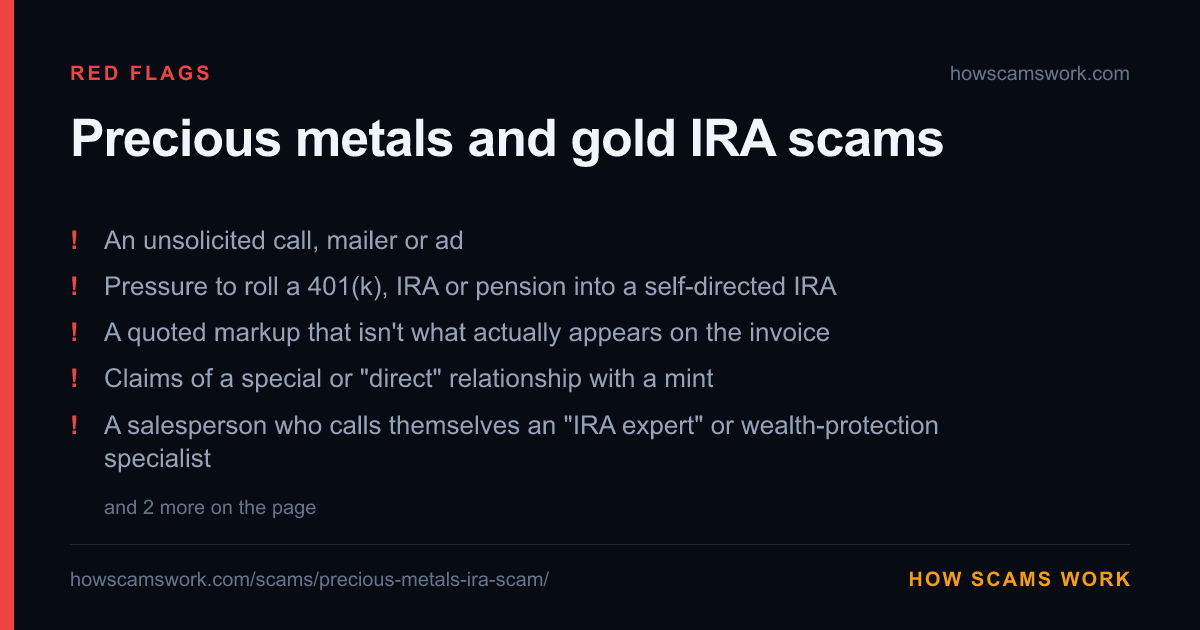
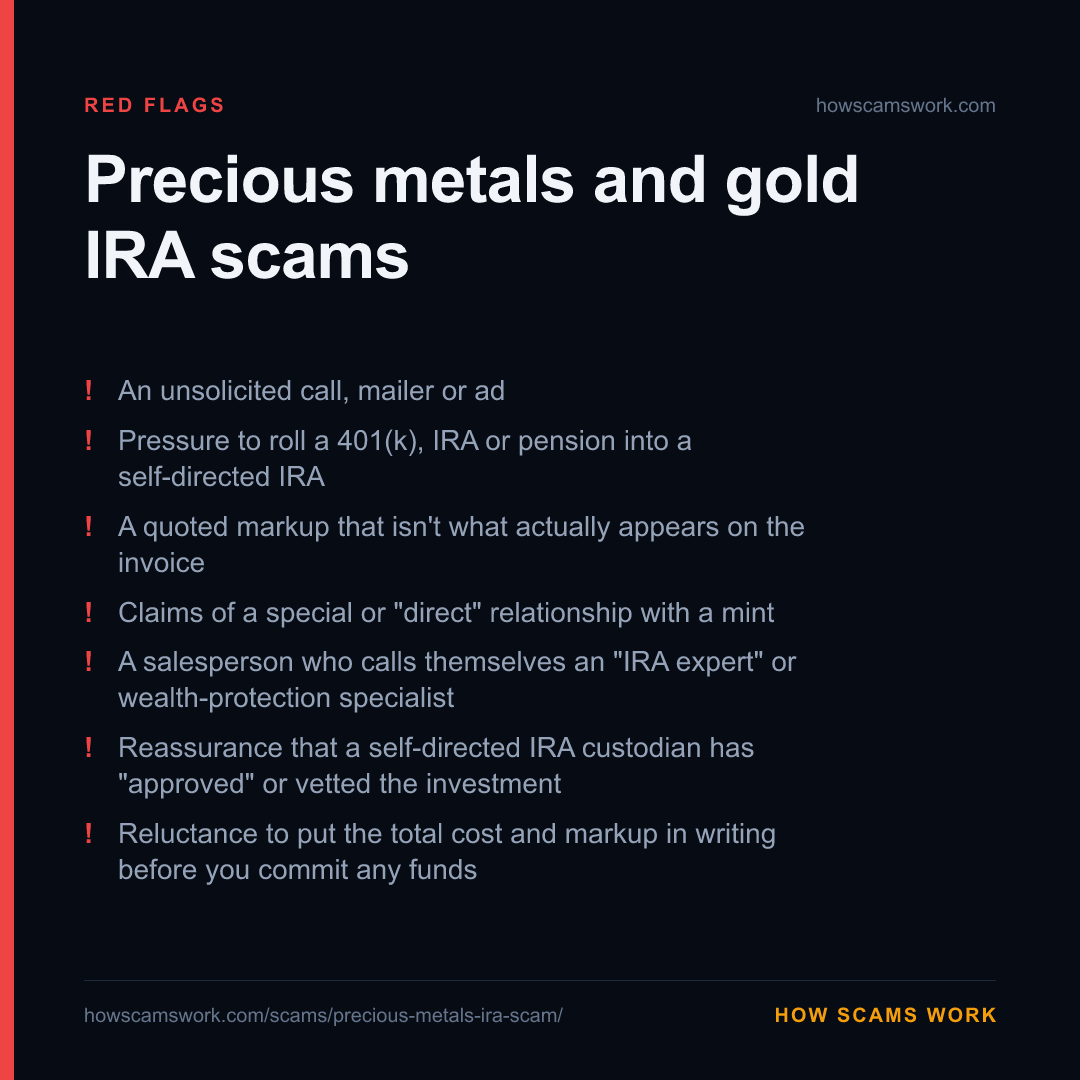
- An unsolicited call, mailer or ad warning that a banking crisis, inflation or a market crash makes your retirement savings unsafe.
- Pressure to roll a 401(k), IRA or pension into a self-directed IRA specifically to buy precious metals.
- A quoted markup that isn’t what actually appears on the invoice, or a pivot from “standard bullion” to “exclusive” or “collectible” coins mid-sale.
- Claims of a special or “direct” relationship with a mint, or that a coin is rare or limited when there is no independent way to confirm that.
- A salesperson who calls themselves an “IRA expert” or wealth-protection specialist but is not a registered, fiduciary financial adviser.
- Reassurance that a self-directed IRA custodian has “approved” or vetted the investment, most custodians do not do this.
- Reluctance to put the total cost and markup in writing before you commit any funds.
If it’s happening to you
Stop before any funds move, if you have not already sent money. A rollover, once completed, is far
harder to unwind than a phone call is to end.
- Talk to an independent, fee-only fiduciary financial adviser, one with no relationship to the
metals dealer, before rolling any retirement account into a self-directed IRA.
- Verify the dealer’s registration at NFA BASIC (the National Futures Association’s public database)
before sending any money, and be wary if the company is not registered.
- Get every fee and markup in writing before agreeing to a purchase, and compare it against the
price the dealer separately quoted for standard bullion.
- Check the dealer’s home-state attorney general for a history of complaints, and search independently
for reviews rather than relying on the dealer’s own materials.
- Report it to the CFTC at 866-366-2382 or through its website, and to the FTC at
ReportFraud.ftc.gov. See where to report for other countries.
- If you’ve already purchased, get an independent appraisal of the coins from a source unconnected to
the dealer, and keep every document, invoices, marketing materials, the account statements from before
and after the rollover.
- Watch for a CFTC or SEC redress notice if the dealer you used is later charged, restitution in
concluded cases here has taken a year or more to be ordered, and is not guaranteed to be collectible in
full.
Where the money goes
There is no offshore network or cross-border wire to trace in any of the three cases on this page, the
money moves through ordinary US bank accounts and business entities, in the open.
Most of it converts into an asset, not cash. In the Red Rock and Fisher Capital cases, customers did
receive coins, just worth a small fraction of what they paid, since the markup itself is where most of the
money went. Typical losses in the documented cases here run from roughly $40,000 to $175,000 per
victim, calculated from the restitution and misappropriation figures each regulator divided across its
own case’s customer count, a small-sample estimate, not a published per-victim average.
Some of it is allegedly simple theft. The Regal Assets case does not describe an inflated purchase at
all, the CFTC alleges the money was taken outright, with forged documents used to hide that customers’
metals had never actually been bought.
Recovery is partial, slow, and not guaranteed even after a judgment. The CFTC’s own releases caution
that an order requiring restitution does not mean the money is still there to collect, wrongdoers may no
longer have the assets, which is one reason enforcement here focuses as much on permanent industry bans as
on repayment.
By the numbers
No published dataset breaks this scheme out as its own category yet, so there is no chart to show.
The data page explains which agency categories exist and why some schemes are
invisible in official statistics.
Every factual claim above traces to one of these. Statistics are reported losses; see
methodology for what that does and does not measure.