Also called: tax relief scam · tax resolution scam · IRS debt relief fraud · offer in compromise mill · pennies on the dollar tax scam
A tax debt relief scam promises to settle your IRS or state back taxes for "pennies on the dollar," often after frightening you with claims your account is "red flagged," then charges thousands of dollars upfront and does little or nothing. The FTC's first tax-relief case, settled in 2013, alleged more than $100 million was taken from consumers.
What it is
Someone who owes back taxes hears, or reads, that a company can make the debt shrink, “pennies on the
dollar,” “a fraction of what you owe,” a “fresh start.” A “free consultation” leads to a sales
representative, an upfront fee of thousands of dollars, and then very little. Tax debt is different from
credit card debt in one important way: the only body that can agree to reduce what you owe is the IRS or
your state, and only the IRS or your state decides which relief programmes you qualify for.
The FTC’s first case against a tax relief company, settled in 2013, alleged that more than $100 million
was taken from consumers by falsely claiming the company could reduce their tax debts. A Texas jury found
against another operator in 2012, and the FTC and Nevada sued a third in 2025, different in size and
style, but each built on the same promise.
How it actually works
The hook
Television, radio and online adverts promise help with IRS problems. In the FTC’s 2025 case, the
defendants allegedly used direct mail resembling government correspondence, online advertising and inbound
telemarketing. In a separate pattern the FTC warned about in January 2026, scam callers invoke
made-up agencies such as a “Tax Mediation and Resolution Agency.”
The “free consultation”
The caller is routed to a commission-based sales representative. In the
FTC’s 2010 case against American Tax Relief, the “free consultation” was the front door to a paid service
costing $3,200 to $25,000 upfront.
The scare
The representative makes the debt sound more severe than it is. In the FTC’s 2025 complaint, some consumers
said they were told the IRS was investigating them, or had “red flagged” their account or marked it as
“high risk.”
The promise
The pitch arrives before anyone has reviewed the customer’s finances: the debt can be settled for “pennies
on the dollar,” or the customer “qualifies” for an IRS programme.
Where it could have stopped
Only the IRS or your state tax agency decides what relief you qualify for. The IRS says taxpayers who do qualify for an Offer in Compromise can get the same deal working directly with it, without the extra fees. A company promising a specific outcome before it has seen your finances has told you the one thing it cannot know.
The fee
Payment is taken upfront or quickly, and can be followed by more. The FTC alleged American Tax Service
targeted older consumers with fictitious add-on services costing tens of thousands of dollars.
Little or no work
The Texas Attorney General’s case against TaxMasters, in which the jury found for the state, alleged that
work was delayed until full payment was received, IRS proceedings were missed, and garnishments, levies and
liens were not prevented. The FTC alleged American Tax Service did little, if any, of the promised work and rarely obtained the
promised results.
Enforcement, and a fraction back
Regulators freeze assets and appoint receivers or halt operations, and later settle for suspended judgments
far larger than the money actually surrendered. The largest documented verdict on this page, $195 million,
came after the company had already filed for bankruptcy.
Why it works
The fear is real, and so is the deadline. IRS letters about liens, levies and garnishment are stressful,
and a phone call promising to make them stop sounds like relief. Scare tactics do not need to be subtle
when the underlying debt is genuine.
Almost everyone has heard of an IRS settlement. The Offer in Compromise programme exists, and the
“pennies on the dollar” phrase is a distortion of something true. The IRS’s own warning about “OIC mills”
exists because the real programme is narrow and the IRS warns that these mills charge big fees to prepare applications they know
the IRS will deny.
Nobody outside the IRS can guarantee an outcome upfront. Because the result depends on the IRS’s
decision, a company can promise a result it does not control, which is why the FTC’s guidance lists
demands for full fees upfront and guaranteed outcomes as red flags.
The marketing borrows government authority. The FTC alleged American Tax Service impersonated the IRS and
state tax agencies through letters designed to look official. Late-night television advertising in the
TaxMasters case leaned on claims of employing “former IRS agents and tax professionals.”
The sales process is built around commission. In the FTC’s 2010 case, the “free consultation” calls were
routed to commission-based sales representatives.
Where it comes from
Domestic, run by registered companies with named owners, and pursued in civil court.
Every case here is a US company with a named owner. TaxMasters was a Houston-based company that
advertised extensively on late-night television; American Tax Service had Nevada and California offices
identified in the Nevada Attorney General’s filing; American Tax Relief was sued in federal court in Chicago.
The pattern recurs across decades. The FTC’s first tax-relief action was brought in 2010 and settled
in 2013; a Texas jury reached a verdict against another operator in 2012; and the FTC and Nevada filed
another case in October 2025. The same core claim, “we can settle your tax debt for far less”, appears in
each.
Enforcement is civil, not criminal, in the cases documented here. Outcomes are judgments, asset
surrenders and industry bans. The FTC’s 2010 release notes a criminal search warrant in April 2010 connected to American Tax Relief,
but the FTC’s own materials describe a civil settlement.
Judgments are much larger than what is collected. The FTC’s 2013 settlement had a $103.3 million
judgment against American Tax Relief and its principal, but the operators surrendered more than $15
million in cash and assets. The 2026 American Tax Service judgment of $77.7 million was suspended, apart
from over $8 million in cash and assets, unless the defendants were found to have misstated their finances.
Real cases
2025 US Settled
In October 2025 the FTC and the State of Nevada sued American Tax Service LLC, seven affiliated entities and operators Terrance Selb and Tyler Bennett, alleging they impersonated the IRS and state tax authorities, promised to settle back taxes for "pennies on the dollar," and pocketed tens of millions of dollars while doing little of the promised work. A federal court froze the operation; in June 2026 Selb and Bennett settled, surrendering over $8 million in cash and additional assets against a suspended $77.7 million judgment.
Read the case file ·
4 sources
2012 US Sanctioned
On March 30, 2012 a Travis County, Texas jury returned a $195 million verdict against Houston "tax resolution" company TaxMasters and its founder-CEO Patrick Cox in a Deceptive Trade Practices Act case brought by the Texas Attorney General. The state had alleged the company took upfront payments and then failed to show up for customers at the IRS, and the company had filed for bankruptcy protection the day before the trial began.
Read the case file ·
2 sources
2010 US Settled $100.0m
In September 2010 a federal judge in Chicago froze the assets of American Tax Relief LLC and its principal Alexander Seung Hahn at the FTC's request, after the FTC alleged the company had collected more than $60 million by falsely claiming it could reduce consumers' tax debts. By the time the case settled in January 2013, the FTC alleged consumers had been bilked of more than $100 million; the defendants surrendered more than $15 million in cash and assets against a $103.3 million judgment.
Read the case file ·
2 sources
Red flags
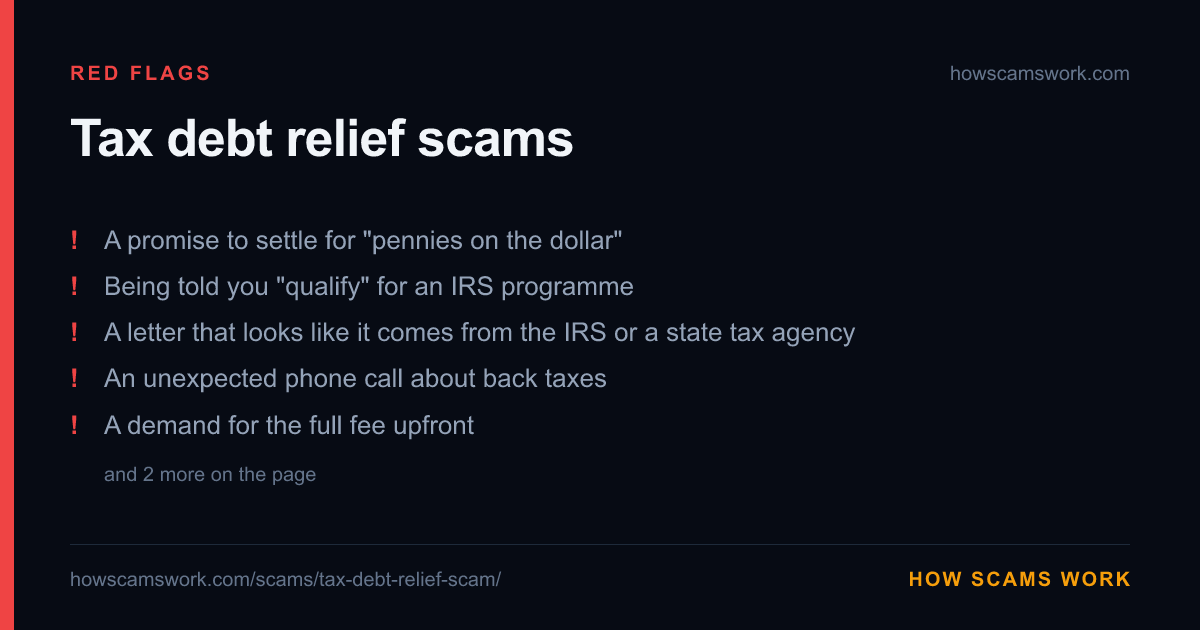
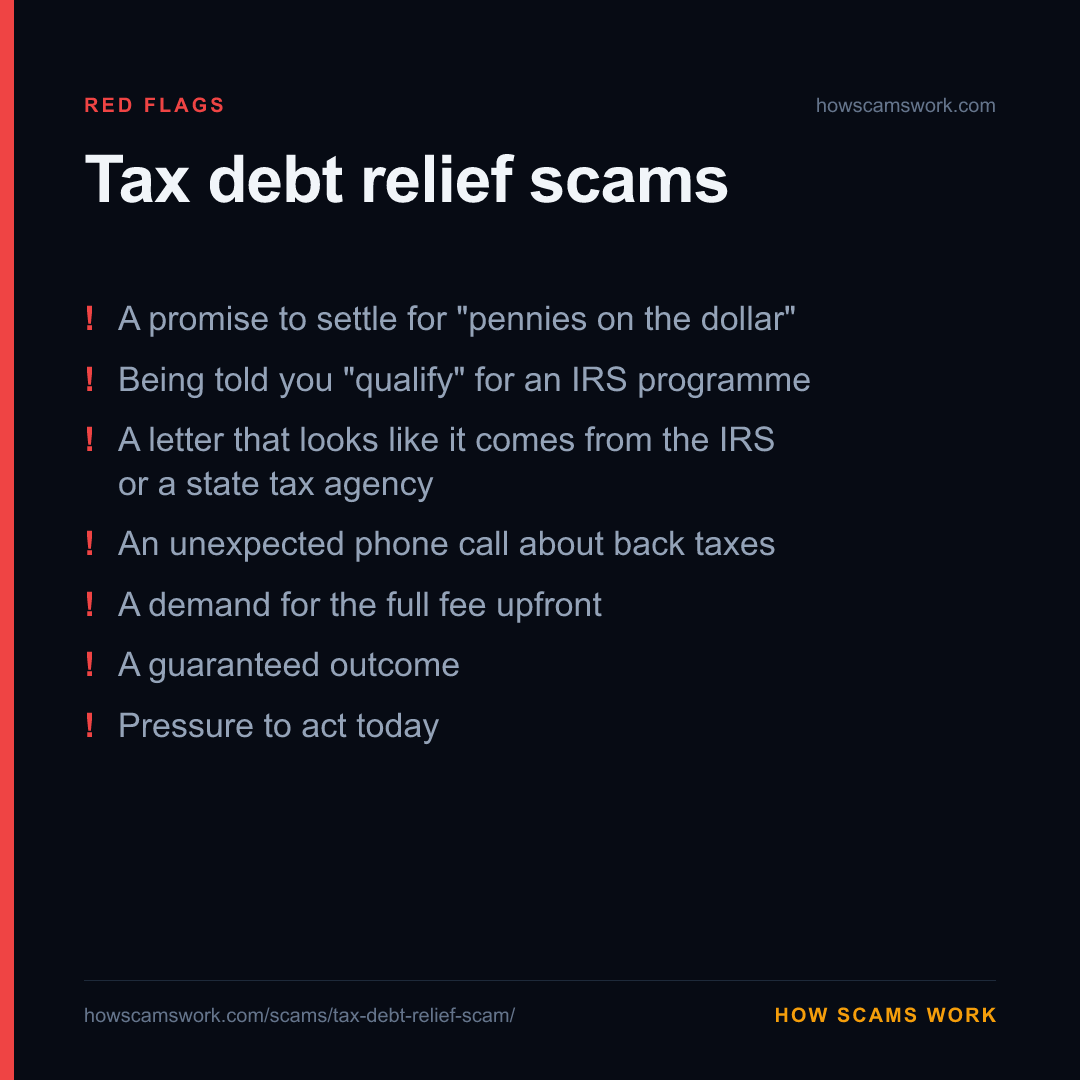
- A promise to settle for “pennies on the dollar” or a “fraction” of what you owe, made before anyone has reviewed your finances.
- Being told you “qualify” for an IRS programme by someone who cannot know, only the IRS decides.
- A letter that looks like it comes from the IRS or a state tax agency, but is actually a sales pitch from a private company.
- An unexpected phone call about back taxes from someone claiming to work for an agency you have never heard of. The IRS’s first contact will always be by mail.
- A demand for the full fee upfront, or a fee of thousands of dollars before any work has been done.
- A guaranteed outcome, or a claim that your account has been “red flagged” and only they can fix it.
- Pressure to act today, or to stop opening mail from the IRS.
If it’s happening to you
Stop paying and stop sharing account details if you have signed up with a company that has not delivered.
- Do not stop dealing with the IRS. Unopened notices do not go away, and deadlines to respond or appeal
are real. Read every letter and check the deadline.
- Contact the IRS directly through the numbers on your IRS notice or IRS.gov, not a number a company
gave you. The IRS says qualifying taxpayers can get the same deal working with it directly.
- Use the free tools. The IRS offers an Offer in Compromise pre-qualifier tool and a directory of
credentialed tax return preparers, and the FTC points to the IRS Taxpayer Advocate Service for help with
federal tax problems you cannot resolve on your own.
- Dispute the charge. If you paid by card, ask your card issuer about disputing a charge for services
not delivered. If you paid by debit or transfer, tell your bank promptly.
- Report it to the FTC at ReportFraud.ftc.gov and to your state attorney general, the Nevada and
Texas Attorneys General both brought cases documented on this page. See where to
report for other countries.
- Check any company before you hire it. Look up complaints and any regulatory actions, and confirm
the credentials of anyone claiming to represent you before the IRS.
Where the money goes
Stays inside the US, moves from consumers to the operators’ company accounts, and is recovered only in part, and only after regulators intervene.
The money in these cases follows a short path: consumers pay fees: $3,200 to $25,000 upfront in the 2010
American Tax Relief case, to the company, and the individuals behind it are later ordered to surrender
what they can. When the FTC settled with American Tax Relief in 2013, the
assets surrendered included cash, a Beverly Hills home, a Los Angeles condominium, jewellery, gold items and a
2005 Ferrari, more than $15 million in total against a $103.3 million judgment. In the American Tax Service
case, the FTC said over $8 million in cash and other assets was surrendered against a suspended $77.7
million judgment, with default-judgment proceedings against the corporate defendants pending as of May 2026.
The TaxMasters verdict shows the limit of a court victory alone: the company filed for bankruptcy protection
the day before the trial testimony began, and this page has not verified how much of the $195 million was
ultimately collected.
No dataset this site draws on, FTC, IC3, CAFC, Scamwatch or UK Finance, reports tax-debt-relief fraud as
its own category, so this page’s “By the numbers” section does not show a dedicated dataset until one
becomes available.
By the numbers
No published dataset breaks this scheme out as its own category yet, so there is no chart to show.
The data page explains which agency categories exist and why some schemes are
invisible in official statistics.
Every factual claim above traces to one of these. Statistics are reported losses; see
methodology for what that does and does not measure.