Also called: fake USPTO invoice · trademark renewal scam · patent and trademark bureau scam · IP register scam · misleading IP invoice · trademark monitoring scam
Trademark solicitation scams mail or email trademark owners official-looking notices demanding fees for renewals, publication or monitoring that the real patent office never charges this way. They work because filings are public. A Latvian operator was sentenced in 2021 for defrauding more than 2,900 U.S. registrants of over $4.5 million.
What it is
A business files a trademark. Within days or weeks, a letter or email arrives that looks like it came from the
government: a heading with “Patent” and “Trademark” in it, the mark’s exact name and serial number, a
deadline, and a sum due. The sender is a private company. The government does not send it, and often the
service it describes is not needed, is overpriced, or is never delivered at all.
The mechanism depends on one fact: trademark filings are public. Anyone can build a list of people who just
paid to register a mark. The USPTO itself notes that these notices often resemble invoices, cite public
records and put “U.S.” or “United States” in the sender’s name.
Some solicitations are only misleading. The ones on this page are the ones prosecutors treated as crimes: a
Latvian national who sent fake renewal notices to more than 2,900 registrants, two Californians who sold a
monitoring service that never monitored, and three defendants in Munich convicted over “European IP
Register” invoices.
How it actually works
A list built from public records
A mailing list is compiled from public trademark databases: the owner’s name, address, the mark and often
its status. Nothing is hacked, because the register is designed to be searched.
A name borrowed from the real office
The sender registers a company, or several, with a name that echoes the real agency: “Patent and Trademark
Office, LLC”, “Trademark Compliance Center” or “European IP Register”. A prestigious-looking address, in
some documented cases a virtual office, sits on the letterhead.
The letter
The letter cites the owner’s real mark and states a deadline and a “total due”. In one documented case the
deadline was September 15, 2021 for a registration that was not due until 2024. In another, the note that it
was only a proposal appeared in print too small to read.
The payment
The owner pays a few hundred to a couple of thousand dollars, often by cheque or bank transfer to the
address on the letter. A documented victim sent $1,850; the monitoring service in the second case cost $385.
Where it could have stopped
The real deadline is one lookup away: the owner’s own record in the USPTO’s status system (or the EUIPO’s register) shows every actual due date and every official document. If the letter’s deadline or fee is not there, it is not from the office.
Nothing, or almost nothing, is delivered
The “renewal” the company had no authority to perform never happens, or the monitoring and customs recording
promised for $385 is never done. The owner may not find out until the real deadline nears.
The cash is moved on
Payments land in bank accounts. In the Californian case, prosecutors described accounts opened using other
people’s identities to launder the proceeds. In the South Carolina case, investigators later found almost
$2.3 million in accounts and $1.28 million in uncashed cheques.
Enforcement arrives, sometimes
The trademark office lists complaints, and a few operators are prosecuted. The Latvian operator ran for about
three years before conviction; the Munich scheme was reported to prosecutors in December 2020 and produced
convictions in September 2024.
Why it works
The recipient just did something official. A fresh filing makes people expect paperwork, so a letter
about a “requirement” feels routine rather than suspicious.
The stakes feel real. Losing a registration is a genuine fear, and a deadline turns a small fee into an
easy decision.
The details are correct. The mark’s name, filing date and owner address all match, because they came from
the official record. Accuracy passes for authenticity.
The price is low. $385 or even $1,850 is small for a business, well below the effort of investigating it.
And the disclaimers are technically present. As the Munich case shows, the “this is an offer” wording can
exist in the letter, just not where anyone will read it.
Where it comes from
Mostly commercial mailings, with operators in the countries the cases document.
The US cases involved a defendant abroad and one at home. One was a Latvian citizen prosecuted in South
Carolina; the other two named defendants in the monitoring case were Californians.
Europe has its own version. The EU’s intellectual property office has published a database of misleading
payment requests, and Munich’s 2024 convictions followed a 2017 Swedish one, according to the EUIPO.
The UK reports the same pressure. The trade mark attorneys’ body CITMA cited a 63% increase in unsolicited
payment requests reported by the UK IPO.
Phone and text impersonation is a newer branch. In September 2025 the FTC warned about calls, texts and
emails using spoofed caller ID and real USPTO employee names.
Real cases
2024 DE Sentenced
In September 2024 the Munich court found three defendants guilty of commercial gang fraud for sending letters under the name "IP Register UG" that closely resembled official European Union Intellectual Property Office (EUIPO) fee invoices. Each was sentenced to one year and ten months, suspended for three years' probation, and the court ordered confiscation of about €200,000. The EUIPO called it an important legal precedent.
Read the case file ·
3 sources
2021 US · LV Sentenced $4.5m
Viktors Suhorukovs, a citizen of Latvia, pleaded guilty to four counts of mail fraud and was sentenced in September 2021 in the District of South Carolina to more than four years in federal prison, with more than $4.5 million in restitution ordered. Through two companies called "Patent and Trademark Office, LLC" and "Patent and Trademark Bureau, LLC" he sent trademark owners fake renewal notices demanding inflated fees. More than 2,900 registrants were affected.
Read the case file ·
4 sources
2016 US Convicted $1.7m
In December 2016 the U.S. Department of Justice announced the case of two Glendale, California men, Artashes Darbinyan and Orbel Hakobyan, who pleaded guilty to mail fraud and money laundering charges over a mass-mailing scam run under the names Trademark Compliance Center and Trademark Compliance Office. For $385 the companies promised to monitor for infringing marks and to record registrations with U.S. Customs and Border Protection. About 4,446 people paid roughly $1.66 million, and the services were never performed.
Read the case file ·
1 source
Red flags
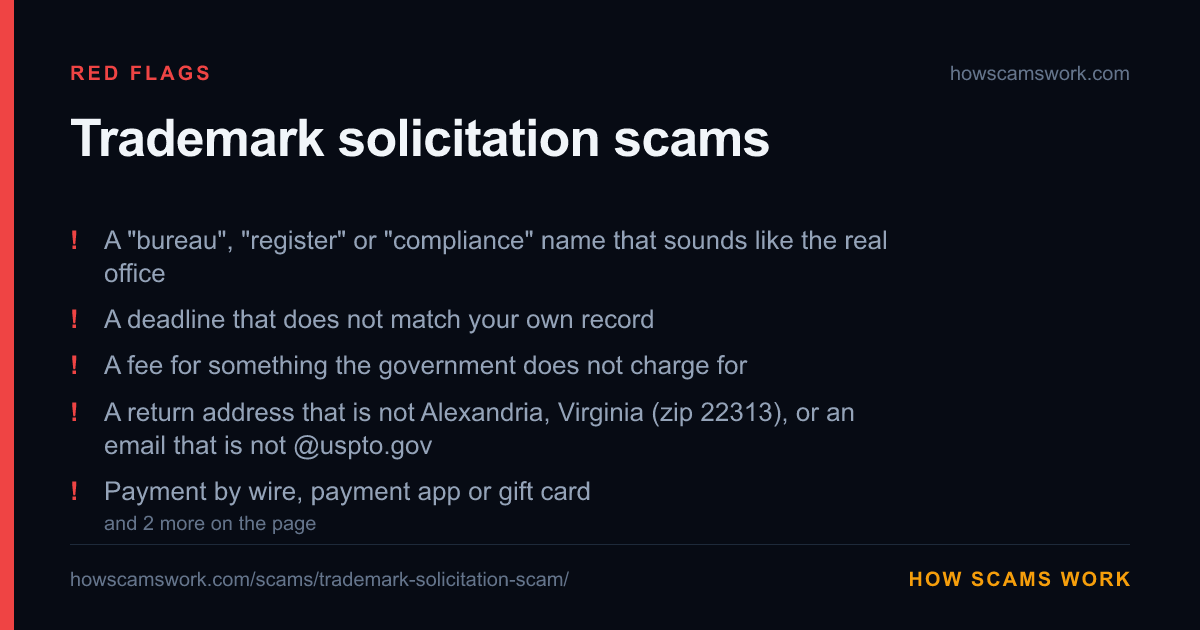
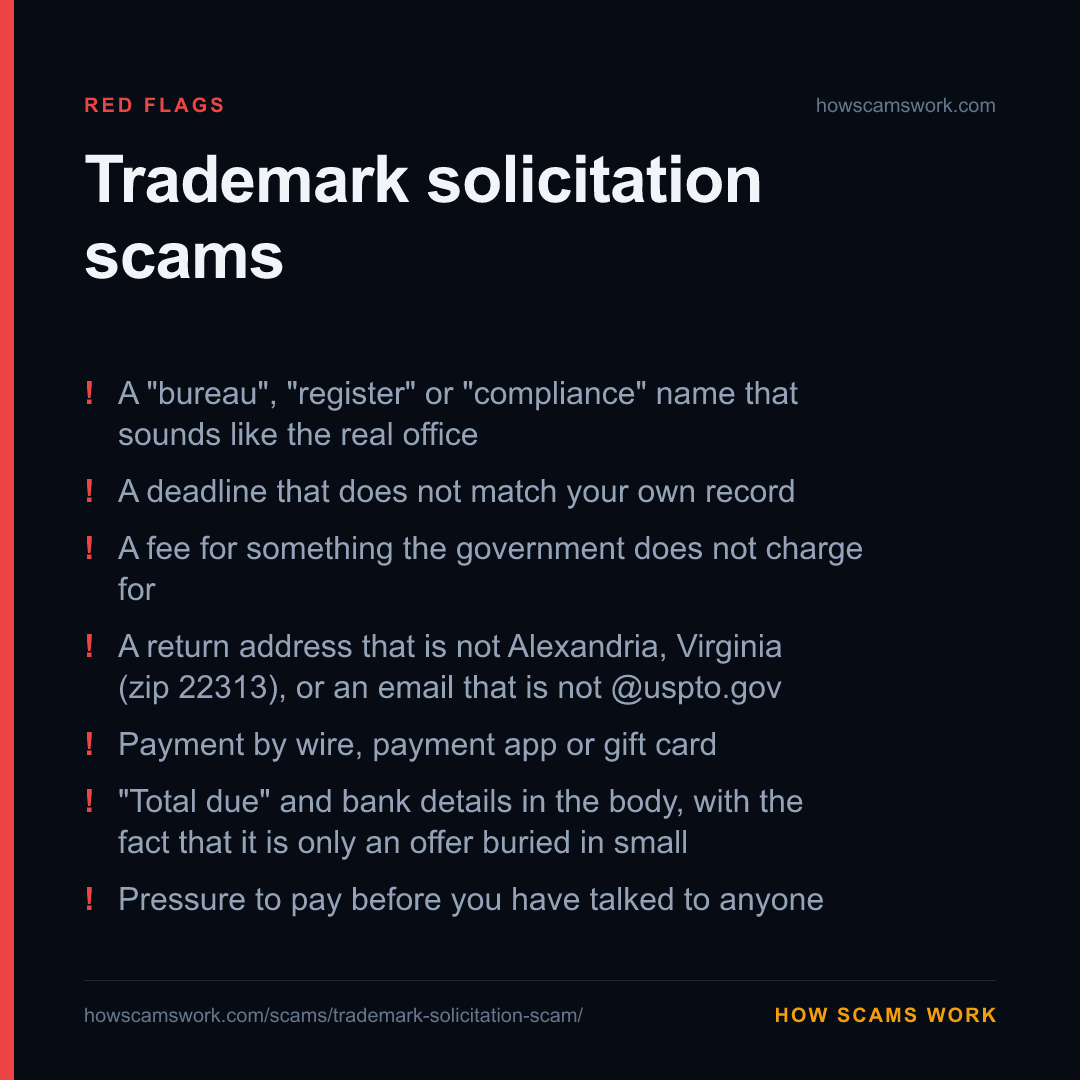
- A “bureau”, “register” or “compliance” name that sounds like the real office but is a private company.
- A deadline that does not match your own record in the official status system.
- A fee for something the government does not charge for, such as “publication”, “monitoring” or “registration” from an unknown sender.
- A return address that is not Alexandria, Virginia (zip 22313), or an email that is not @uspto.gov.
- Payment by wire, payment app or gift card, or a request for payment by phone, text or email.
- “Total due” and bank details in the body, with the fact that it is only an offer buried in small print.
- Pressure to pay before you have talked to anyone, especially before your attorney has seen it.
If it’s happening to you
Do not pay a notice until you have checked your own record in the official status system.
- Look up your mark yourself. Use the USPTO’s TSDR (or the EUIPO’s register) and read the actual
maintenance dates and documents.
- Compare the sender with the official examples. The USPTO publishes a list of solicitations it has
received complaints about, and EUIPO publishes a searchable database.
- Send it to your attorney. A licensed trademark attorney can tell a real notice from a solicitation in
moments.
- If you paid, dispute the charge. Contact your bank or card issuer, and keep the letter, envelope and
receipt.
- Report it. Email the notice to [email protected], file at reportfraud.ftc.gov and ic3.gov, and report
mailed notices to the Postal Inspection Service. See where to report for other
countries.
- Tell the EUIPO if your notice concerned an EU trade mark; it collects these to support prosecutions.
Where the money goes
Into ordinary bank accounts, usually under company names designed to look official.
In the Californian case, prosecutors said the operators used other people’s identities to open virtual
offices and bank accounts, so the letterhead’s Washington address led nowhere. In the South Carolina case,
investigators found almost $2.3 million in accounts and $1.28 million in cheques that were never cashed.
Recoveries after conviction are ordered as restitution or confiscation: more than $4.5 million was ordered in
South Carolina, and about €200,000 was ordered confiscated in Munich, but the amount actually returned to
victims is not stated in the sources read for this page.
By the numbers
No published dataset breaks this scheme out as its own category yet, so there is no chart to show.
The data page explains which agency categories exist and why some schemes are
invisible in official statistics.
Every factual claim above traces to one of these. Statistics are reported losses; see
methodology for what that does and does not measure.
Common questions
Does the USPTO ever send an invoice for a trademark?
The USPTO's own guidance is that its correspondence comes from Alexandria, Virginia, zip code 22313, or from an @uspto.gov email address. The FTC's 2025 alert adds that the real USPTO never asks for payment by phone, text, email, wire transfer, payment apps or gift cards. Notices from a private company with a name including 'Patent', 'Trademark' or 'Bureau' are not the government.
How do I check whether a notice is real?
Look up your own application or registration in the USPTO's Trademark Status and Document Retrieval system (tsdr.uspto.gov). It shows the actual maintenance deadlines and every official document. If the deadline in the letter does not match, or the letter names a fee that does not appear there, treat it as a solicitation.
Is every unsolicited offer a crime?
No, and this page does not claim that. Many are legal but misleading, charging more than the real fee or selling a service you do not need. The cases here are the ones a court or prosecutor treated as fraud: a false expiry claim and a fake renewal, a monitoring service never performed, and letters whose 'invoice' status was disclosed only in tiny print.
I already paid. What now?
The USPTO advises collecting the notices, emails and receipts, emailing them to [email protected], asking your bank or card issuer to dispute the charge, and filing reports with the FTC, the FBI's IC3 and the Postal Inspection Service if it arrived by mail. A licensed trademark attorney can check that your real filings are in order.
Why does this keep happening?
Trademark filings are public by design, so anyone can build a mailing list of people who have just spent money on a mark. The USPTO publishes a list of solicitations it has received complaints about, but new names appear faster than they can be prosecuted; the 2021 South Carolina conviction described here was, at the time, unusual enough to be widely reported by law firms.