Also called: fake kidnapping scam · virtual kidnapping for ransom · phone kidnapping scam · proof-of-life scam
A virtual kidnapping scam is a phone call or text falsely claiming a family member has been abducted, demanding ransom while keeping the victim on the line so they cannot verify the story. No kidnapping has occurred. US callers have run it from inside a Mexican prison and from random-dialed call centres, and the FBI warned in December 2025 that AI-altered photos now serve as fake proof of life.
What it is
A virtual kidnapping scam is a phone call, or increasingly a text message, claiming a family member has
been abducted and is being held for ransom. Nobody has actually been taken. The entire scheme depends on
one mechanic: keeping the victim talking, frightened and unable to hang up long enough to call the
supposed captive and find out they are fine.
That single design choice is what separates it from a confidence trick that unfolds over weeks. There is
no relationship to build and no story to maintain past the length of one phone call. The caller needs a
believable crying or screaming voice, a plausible reason the real relative cannot be reached, and a way to
collect money fast, by wire transfer, by a cash drop at a named location, or occasionally by buying
electronics and handing them over.
Three documented US cases show how far the method travels: a random-dialing ring working the Tijuana
border in the late 2000s and early 2010s, a woman in Houston working with a caller in Mexico in 2015, and
a Los Angeles gang member who ran the scheme from inside a Mexican prison cell from 2015 to 2018. In
December 2025 the FBI’s Internet Crime Complaint Center warned that the newest version uses AI-altered
photos pulled from a target’s own social media as fake “proof of life.”
How it actually works
A call or text arrives claiming a relative is being held
The contact can be targeted, timed to when a relative is believed to be travelling or crossing a border,
or entirely random. The San Diego ring dialed up to 5,000 calls a day from roughly 30 phone numbers with
no information at all about who would answer or whether they even had a relative who might be missing.
A frightened or screaming voice is put on, or a photo is sent
Yanette Rodriguez Acosta’s co-conspirator called victims claiming their child had been kidnapped; one
family was threatened that the child’s fingers would be cut off. The FBI’s December 2025 warning
describes a newer variant: a photo or video, altered from images the victim’s family had posted publicly,
sent through a messaging feature timed to limit how long the recipient has to examine it before it
disappears.
Where it could have stopped
The FBI’s advice is to try to reach the supposedly kidnapped relative directly, on their own phone, a different number, or through someone physically with them, before paying anything. A family code word agreed in advance works here exactly as it does against the grandparent scam. Altered proof-of-life photos often carry a visible flaw, a missing tattoo or scar, or distorted proportions, that a moment’s close look can catch.
The caller refuses to let the line go dead
Keeping the victim on the phone, or demanding an immediate reply to a text, removes the one window in
which a call to the real relative would end the scheme in seconds. Investigators in the Acosta case said
callers threatened victims and their families if they tried to report the crime or hang up.
A ransom is demanded, usually $1,500 to $4,000 per family
The San Diego ring told victims to wire $1,500 to $4,000 through MoneyGram or Western Union to locations
in San Diego and Los Angeles. Reyes Zuniga’s operation also asked some victims to buy electronics, such as
iPhones or iPads, and hand them to a contact instead of sending cash.
The money is collected, in the country where the victim lives
Acosta herself drove to drop-off points in Houston and picked up cash, $13,000 in one instance and
$15,000 in another, after victims withdrew it from their own banks on instructions from the caller still
on the phone. In the San Diego case, two of the four defendants physically collected wired funds in San
Diego before moving them toward Tijuana.
The proceeds move toward Mexico, and the caller keeps a cut
The San Diego couriers kept roughly 10% as a commission before passing the rest to conspirators across the
border. In Reyes Zuniga’s case, people in Mexico delivered the collected proceeds to him inside the
prison where he was serving a murder sentence.
A second demand sometimes follows
The structure invites repeat payments from a family that has already shown it will pay once, the same
dynamic that drives a second ransom call in the grandparent scam, before the caller moves on to the next
number.
Why it works
It denies the one check that would end it. A kidnapping, unlike almost any other emergency claim, can
be disproven with a single phone call to the person supposedly missing. The entire design of the scheme,
the screaming on the line, the refusal to hang up, the instruction not to call anyone, exists to prevent
that one call.
It needs no real information about the target. The San Diego ring proved this: random-dialed numbers,
no name, no relationship, no research, and it still collected $500,000 from 124 families. A caller who
guesses “your daughter” at the right household, among thousands dialed, finds someone who genuinely has a
daughter who might be travelling.
A real, plausible absence gives the lie cover. Families with a relative crossing a border, travelling
internationally, or hard to reach for any ordinary reason are especially vulnerable, because the premise,
“they can’t come to the phone right now,” is already true for an innocent reason.
Fear narrows the decision to one choice. A victim told their child’s fingers will be cut off is not
weighing probabilities. They are trying to end the threat in the next five minutes, which is exactly the
window in which a wire transfer or a cash drop can happen before anyone stops to think.
AI-altered images raise the ceiling on the lie. The FBI’s December 2025 warning describes photos built
from a family’s own social media, altered and sent through a disappearing-message feature, which gives a
visual “confirmation” that a voice alone cannot.
Where it comes from
Every case documented on this page traces back to Mexico, though the method inside the US differs. The
San Diego ring was based across the border in Tijuana and worked US phone numbers at industrial volume.
Yanette Rodriguez Acosta’s co-conspirator, identified as Ismael Ramirez, called from Mexican phone numbers
while Acosta handled cash collection inside Houston. Julio Manuel Reyes Zuniga ran his version from
Santa Martha Acatitla Prison near Mexico City, where he was already serving a sentence for two murders,
using smuggled cellphones and contacts who delivered proceeds to him.
Enforcement reaches the domestic end first, and takes years to reach the organisers. The San Diego
ring was indicted in November 2013 for a scheme running since 2007 and sentenced in January 2015. Acosta
was indicted in July 2017 for conduct in 2015 and sentenced in September 2018. Reyes Zuniga’s scheme ran
from 2015 to 2018, but he was not extradited from Mexico until November 2020 and not sentenced until
August 2023, a gap explained by his having to first finish an unrelated Mexican murder sentence before
extradition could proceed.
The scheme has not gone away. The FBI’s December 2025 Internet Crime Complaint Center warning shows the
same core method, a call claiming a kidnapping, a demand kept moving fast enough to prevent verification,
now reinforced with AI-manipulated images as evidence.
Real cases
2023 US · MX Sentenced
Julio Manuel Reyes Zuniga, a reputed member of the Rancho San Pedro street gang, ran a virtual kidnapping extortion scheme from September 2015 to June 2018 using smuggled cellphones from inside Santa Martha Acatitla Prison near Mexico City, where he was already serving a sentence for two murders. He and associates called families, mostly in Southern California, falsely claiming a loved one had been kidnapped and demanding wire transfers, cash drops or purchased electronics such as iPhones and iPads; contacts in Mexico delivered the proceeds to him in prison. He was charged in a 31-count federal indictment in September 2019, extradited from Mexico to Los Angeles in November 2020 after completing his Mexican sentence, and initially pleaded not guilty. In August 2023 he pleaded guilty to two conspiracy counts, extortion and money laundering, and was sentenced to 40 months in federal prison, credited as time already served.
Read the case file ·
3 sources
2018 US Sentenced $28,000
Yanette Rodriguez Acosta, also known as Yanette Patino, 35, of Houston, worked with a co-conspirator in Mexico, identified as Ismael Ramirez, who called 39 families across Texas, California and Idaho between August 20 and October 21, 2015, falsely claiming their children had been kidnapped and demanding ransom. One family was threatened that their child's fingers would be cut off if they did not pay. Acosta travelled to drop-off points in Houston, where victims had been instructed to leave cash after withdrawing it from their banks, and personally collected $13,000 at one drop and $15,000 at another; other victims were told to wire money to Mexico. She was indicted in July 2017 on eight counts of wire fraud, conspiracy to commit wire fraud and conspiracy to commit money laundering, pleaded guilty to the conspiracy counts in February 2018, and was sentenced on September 20, 2018 to 88 months in federal prison by U.S. District Judge Lee H. Rosenthal. No kidnappings had actually occurred.
Read the case file ·
3 sources
2015 US Sentenced $190,000
Ruth Graciela Raygoza, of Chula Vista, California, Maria Del Carmen Pulido Contreras, of East Los Angeles, and brothers Adrian Jovan Rocha and Jonathan Rocha, both American citizens living in Tijuana, Mexico, ran a virtual kidnapping ring from 2007 using roughly 30 San Diego phone numbers to place up to 5,000 calls a day, falsely telling families, largely in the Washington, D.C. area's Central American immigrant community, that a relative being smuggled into the United States had been kidnapped. Victims were told to wire $1,500 to $4,000 through MoneyGram or Western Union to San Diego or Los Angeles, where the four defendants collected it, kept roughly a 10% commission, and sent the rest to co-conspirators in Mexico. An undercover Homeland Security Investigations operation, in which an agent posed as a victim's son, led to Adrian Jovan Rocha's arrest after he picked up a $700 ransom payment. The four were indicted in November 2013, pleaded guilty in July 2014 to conspiracy to commit wire fraud and conspiracy to launder money, and were sentenced in January 2015 to prison terms of three years and four months, one year and nine months (two defendants), and one year and three months. Prosecutors said the ring collected at least $500,000 overall since 2007, with $190,000 tied to the 124 families named at sentencing.
Read the case file ·
3 sources
Red flags
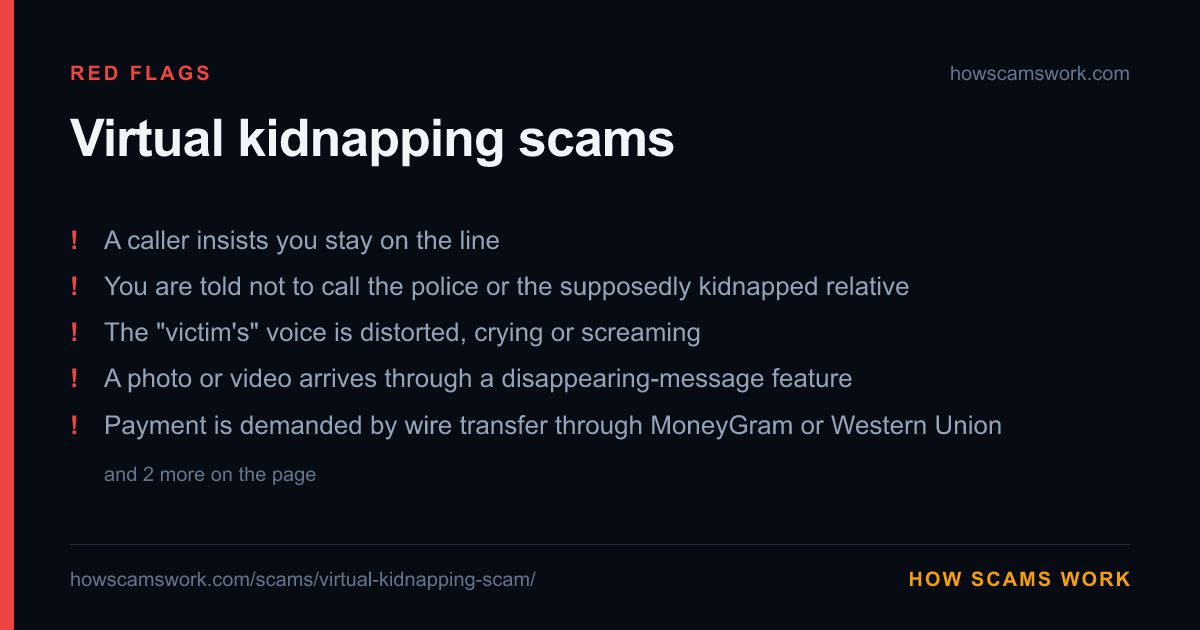
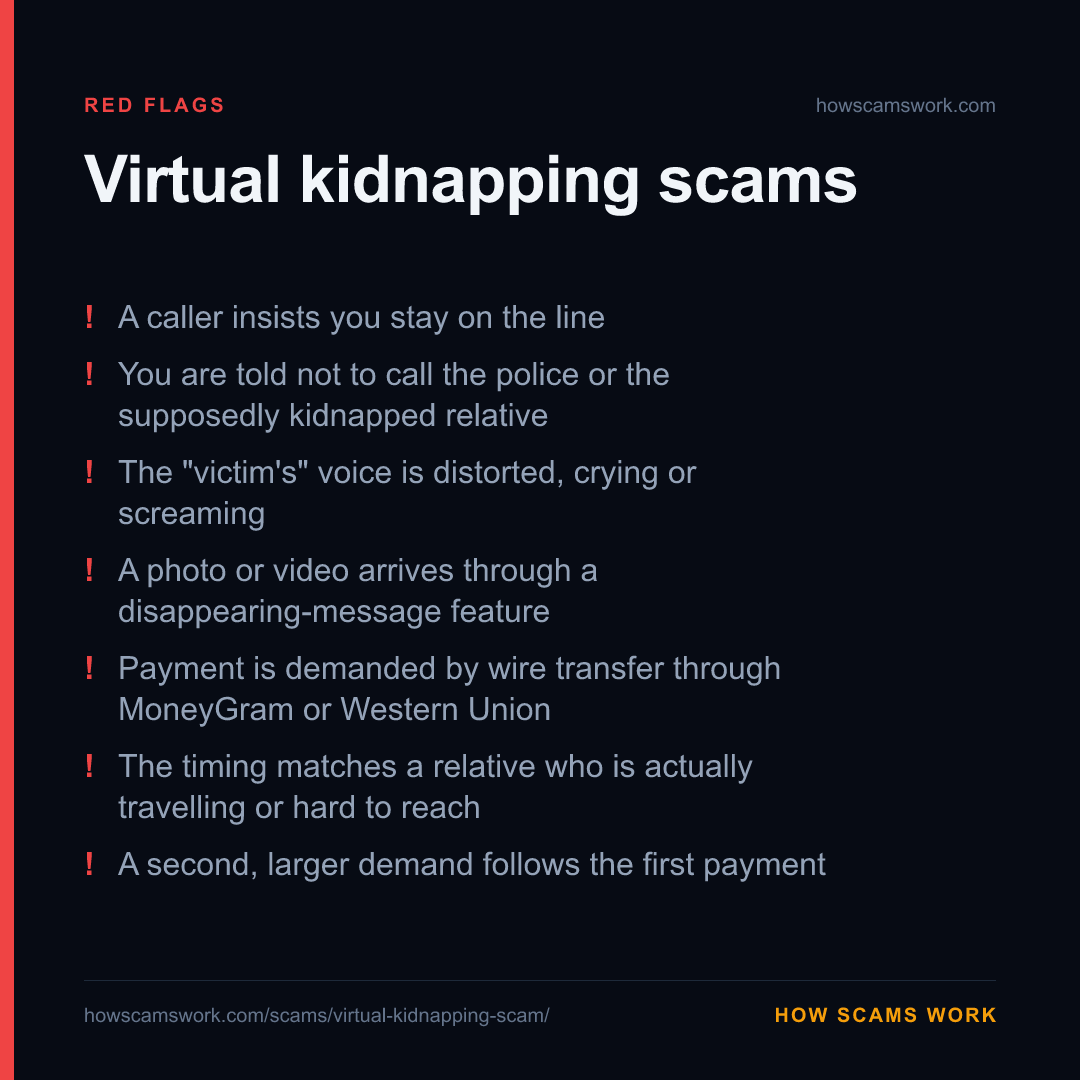
- A caller insists you stay on the line and refuses to let you hang up to call anyone else.
- You are told not to call the police or the supposedly kidnapped relative, often paired with a threat of violence if you do.
- The “victim’s” voice is distorted, crying or screaming in a way that makes it hard to confirm who it actually is.
- A photo or video arrives through a disappearing-message feature that limits how long you can look at it.
- Payment is demanded by wire transfer through MoneyGram or Western Union, or as a cash drop at a specific location, rather than any method that can be reversed.
- The timing matches a relative who is actually travelling or hard to reach, which the caller is relying on to make the story plausible.
- A second, larger demand follows the first payment.
If it’s happening to you
On the call now. Try to put the caller on hold, or hang up, and call or text the supposedly kidnapped
relative directly on their own number, or ask someone who is with them to confirm they are safe. The FBI
says this single step resolves the overwhelming majority of these calls in minutes.
If you cannot reach them immediately, keep trying through another channel, a workplace, a friend, a travel
companion, rather than treating silence as confirmation. Do not go to a bank or wire transfer location
while the caller is still demanding you stay on the phone.
If you are asked for a proof-of-life photo or video, look closely for the flaws the FBI describes:
missing tattoos or scars, or body proportions that look wrong. Screenshot or save the image before it can
disappear.
If money has already been sent.
- Call your bank or the wire service immediately. MoneyGram and Western Union transfers can
sometimes be stopped if reported within minutes of being sent, though the window is short.
- Report it to the FBI’s Internet Crime Complaint Center at ic3.gov, with the phone numbers used, any
images sent, and payment details, as the FBI’s December 2025 alert specifically requests.
- Call local police if a cash drop location or a courier was involved; that physical collection point
is where these cases have historically been broken.
- Warn family members, especially anyone who travels internationally or across a border regularly, so
the next call targeting the same household is recognised immediately.
Where the money goes
Cash and wires move first, and mostly domestically before crossing the border. In the San Diego case,
victims wired $1,500 to $4,000 at a time through MoneyGram and Western Union to locations in San Diego and
Los Angeles, where two of the four defendants collected it. In Houston, Acosta drove to drop-off points
after victims withdrew cash from their own bank accounts on the caller’s instructions, personally
collecting $13,000 and $15,000 on two occasions.
A domestic courier takes a cut before the rest moves to Mexico. The San Diego defendants kept roughly
10% of what they collected as a commission before passing the remainder to co-conspirators across the
border. Reyes Zuniga’s contacts in Mexico delivered proceeds to him directly inside the prison where he
was incarcerated.
How the loss range was derived. The typical-loss figures shown for this scheme come from the two cases
with dollar totals: the San Diego ring’s documented $1,500-to-$4,000 individual ransom demands, and its
reported total of at least $500,000 collected since 2007, of which $190,000 was tied to the 124 families
named at sentencing. The Reyes Zuniga case gives no total, only that families paid “thousands of dollars”
on average, and the Acosta case documents two specific cash collections, $13,000 and $15,000, rather than
a scheme-wide total. The $1,500 figure is the lowest individual demand documented; $190,000 is the largest
case total documented. This is an estimate from a small number of cases, not a national figure.
By the numbers
No published dataset breaks this scheme out as its own category yet, so there is no chart to show.
The data page explains which agency categories exist and why some schemes are
invisible in official statistics.
Every factual claim above traces to one of these. Statistics are reported losses; see
methodology for what that does and does not measure.