Advance-fee loan scams

Also called: guaranteed loan scam · advance fee loan fraud · loan broker scam · upfront fee loan scam

An advance-fee loan scam promises a personal, business or commercial loan, sometimes for tens of millions of dollars, in exchange for an upfront fee paid before any funds are released. The loan never arrives; the fee is not refunded. A federal rule has banned charging for a "guaranteed" loan before delivery since 2010.

Key facts

Category
Other
First documented
2010
Typical loss
$7000k–$17000k USD, per victim
Main channels
cold calls, telemarketing, online loan-matching ads, search ads, referrals from a first fraudulent lender to a second
Who is targeted
Small-business owners seeking a large commercial or 'hard money' loan, often after being turned down by a bank; Individual consumers with poor credit responding to 'bad credit? no problem' ads or cold calls; Anyone who has already been rejected for credit elsewhere and is actively searching online for a lender; People asked to pay a 'processing,' 'insurance,' 'appraisal,' 'commitment' or 'collateral' fee before a loan closes
Documented origins
United States
Main targets
United States
Case files
3 documented cases
Last reviewed
2026-09-22
Anatomy of an advance-fee loan scamAnatomy of an advance-fee loan scam. A guarantee, then a fee, the one sequence a real lender never uses. 1. The search or the pitch: A borrower already turned down elsewhere searches for a lender, or is cold-called by one, with a pitch matched to what they were rejected for. 2. A guarantee that is itself the violation: The caller represents a high likelihood, or an outright guarantee, of approval, sometimes regardless of credit history. 3. The fee, dressed as paperwork: A 'processing,' 'insurance,' 'appraisal,' 'commitment' or 'collateral' fee is requested before closing, sometimes up to 5% of the requested loan amount. 4. Fabricated proof the lender is real: Larger operations back the fee request with falsified bank statements or brokerage balances built to survive a skeptical borrower's questions. 5. Stalling once the fee clears: A fabricated reason for the delay follows, sometimes repeated for months, while the fee is spent or used to quiet an earlier victim. 6. No loan, and the fee is not coming back: The loan never funds. Operators typically stop responding, or keep stringing the borrower along rather than issue a refund. 7. A variant that skips the wire transfer: Instead of a fee, some operations collect bank account and routing numbers 'to process the loan,' then withdraw funds directly. 8. Enforcement, after the fact: Criminal charges typically follow years of operation and millions in losses; restitution, where ordered, recovers only a fraction of what was taken. The diagram marks stage 2 as the point where the scheme can still be stopped: The FTC's Telemarketing Sales Rule (16 CFR 310.4(a)(4)) bans requesting or receiving any fee in advance of a loan once a seller has guaranteed or represented a high likelihood of arranging one. A legitimate lender never combines a guarantee with an upfront fee request.Anatomy of an advance-fee loan scamA guarantee, then a fee, the one sequence a real lender never uses.1The search or thepitchA borrower already turneddown elsewhere searches fora lender, or is cold-calledby one, with a pitchmatched to what they wererejected for.Minutes to days2A guarantee that isitself the violationThe caller represents ahigh likelihood, or anoutright guarantee, ofapproval, sometimesregardless of credithistory.The first call3The fee, dressed aspaperworkA 'processing,''insurance,' 'appraisal,''commitment' or'collateral' fee isrequested before closing,sometimes up to 5% of therequested loan amount.Days4Fabricated proof thelender is realLarger operations back thefee request with falsifiedbank statements orbrokerage balances built tosurvive a skepticalborrower's questions.Days to weeks5Stalling once the feeclearsA fabricated reason for thedelay follows, sometimesrepeated for months, whilethe fee is spent or used toquiet an earlier victim.Weeks to months6No loan, and the feeis not coming backThe loan never funds.Operators typically stopresponding, or keepstringing the borroweralong rather than issue arefund.Ongoing7A variant that skipsthe wire transferInstead of a fee, someoperations collect bankaccount and routing numbers'to process the loan,' thenwithdraw funds directly.Days8Enforcement, afterthe factCriminal charges typicallyfollow years of operationand millions in losses;restitution, where ordered,recovers only a fraction ofwhat was taken.YearsWhere it can still be stopped: stage 2The FTC's Telemarketing Sales Rule (16 CFR 310.4(a)(4)) bans requesting or receiving any fee in advance of a loan once a seller has guaranteed or represented ahigh likelihood of arranging one. A legitimate lender never combines a guarantee with an upfront fee request.Stages from the FTC's Telemarketing Sales Rule and three prosecuted US advance-fee loan schemes documented on this site's case pages, spanning 2017–2025.howscamswork.com
The stages of the scheme, in order, with the point where it can still be stopped.

What it is

Someone promises you a loan. Personal, business, “hard money” against real estate, the pitch varies, but the sequence never does: you are told approval is all but certain, then asked to pay a fee before the money arrives. The fee has a dozen names, “processing,” “insurance,” “appraisal,” “commitment,” “letter of intent,” “collateral”, and none of them change what actually happens next: no loan, no refund.

This is not a grey area. The FTC’s Telemarketing Sales Rule specifically bans collecting any payment in advance of a loan whenever a seller has represented a high likelihood of getting one arranged for you. A company that guarantees your approval and then bills you before funding has told you, in the sequence of its own pitch, that it is not a real lender.

The scale runs from a few hundred dollars targeting someone with bad credit, to seven figures targeting a small-business owner chasing a nine-figure commercial loan, the same mechanism, applied to two very different wallets.

How it actually works

  1. The search or the pitch

    A borrower who has already been turned down elsewhere searches online for a lender, or is cold-called by one. The pitch matches whatever they were rejected for, bad personal credit, or a commercial loan a bank wouldn’t underwrite.

  2. A guarantee that is itself the violation

    The caller represents a high likelihood, sometimes an outright guarantee, of approval, often regardless of credit history: “bad credit, no problem.”

    Where it could have stopped

    The FTC’s Telemarketing Sales Rule (16 CFR 310.4(a)(4)) bans requesting or receiving any fee in advance of a loan once a seller has guaranteed or represented a high likelihood of arranging one. The guarantee and the fee request, taken together, are the offence, a legitimate lender never combines the two.

  3. The fee, dressed as paperwork

    A “processing,” “insurance,” “appraisal,” “commitment” or “collateral” fee is requested before closing, prosecutors say Anna Kline asked business-loan clients for up to 5% of the requested loan amount, often itself in excess of $100 million.

  4. Fabricated proof the lender is real

    Larger operations back the fee request with falsified financial documents. Federal investigators allege Carlos Manuel da Silva Santos’s company, Ethos Asset Management, pointed one victim to a brokerage account holding $359,088,190.22 that did not exist, inducing a single payment of more than $8 million.

  5. Stalling once the fee clears

    A fabricated reason for the delay follows, sometimes repeated for months, while, in the Ethos and Kline cases, the money is spent on personal expenses or used to quiet an earlier victim demanding a refund.

  6. No loan, and the fee is not coming back

    The loan never funds. Operators typically stop responding, or keep stringing a victim along with new excuses rather than issue a refund.

  7. A variant that skips the wire transfer

    Instead of asking a victim to send a fee, some operations collect bank account and routing numbers “to process the loan,” then withdraw funds directly, federal prosecutors allege this is how Samuel Selmar and associates took nearly $1 million from dozens of victims.

  8. Enforcement, after the fact

    Cases on this page reached criminal charges only after years of operation and millions in losses: Kline’s shell companies ran for over two years before her 2022 arrest; Santos’s for longer still. Restitution, where ordered, is a fraction of what was actually taken.

Why it works

The guarantee answers a problem the target is already living with. Someone who has been turned down for credit once is primed to believe the next offer that doesn’t ask hard questions.

The fee is framed as routine, not risky. “Appraisal fee,” “processing fee,” “commitment fee”; these are real terms used by real lenders for real, much smaller charges, which makes the same words attached to a much larger, earlier payment sound unremarkable.

Falsified paperwork answers the one objection a careful borrower would raise. A skeptical business owner asking “how do I know you actually have the money” is shown a bank statement or brokerage balance built to answer exactly that question, and built specifically because that question gets asked.

Ponzi-style repayment buys time. Using a new victim’s fee to placate an earlier one who is asking questions, alleged in the Ethos Asset Management case, keeps complaints quiet and the operation running longer than a single-victim scheme would survive.

The dollar amounts scale with the target. A borrower asking for a $100 million commercial loan does not blink at a $5 million “collateral” fee the way an individual would blink at $500, the fee is calibrated as a percentage, so it never looks disproportionate to what’s supposedly being unlocked.

Where it comes from

Domestic and outwardly professional, not hidden or foreign-run.

These operate as registered or semi-registered US businesses, not offshore call centres. Global Capital Partners Fund, Ethos Asset Management and Kline’s shell lending companies all presented themselves as ordinary finance firms, with names, websites and, in Ethos’s case, an apparent office presence.

Losses documented here run from mid six figures to eight figures per operation. The scale depends entirely on who is targeted: individual consumers lose hundreds to a few thousand dollars per the FTC’s general guidance; the business-lending version documented in this page’s own sourced cases produced single scheme totals of $7 million and $17 million, driven by percentage-based fees on much larger requested loan amounts.

Both criminal and civil tools are used. Every case on this page was prosecuted criminally as wire fraud (and, for Santos, aggravated identity theft) rather than pursued only as a civil FTC matter, a contrast with credit repair and debt settlement scams, which are overwhelmingly handled civilly.

Real cases

A Nevada woman's shell 'lenders' collected 5% advance fees on loans that never existed

2025 US Sentenced $7.0m

Anna Kline, also known as Jordana Weber, of Sparks, Nevada, operated multiple shell companies from April 2017 to July 2019 that falsely claimed to offer high-value business loans, often exceeding $100 million, to small-business owners. Victims were told to pay advance fees of up to 5% of the requested loan amount, then given fabricated bank statements and stalling excuses once they paid. At least six victims sent Kline and a partner, Jason Torres, approximately $7 million; Kline was sentenced in 2025 to 120 months in federal prison and ordered to pay $3.4 million in restitution, after also being convicted of obstructing the investigation with falsified evidence.

Read the case file · 2 sources

A fabricated $359 million brokerage account behind a $17 million loan-fee scheme

2025 US Sentenced $17.0m

Carlos Manuel da Silva Santos, a Portuguese national and founder/CEO of San Diego-based Ethos Asset Management, Inc., ran an advance-fee loan scheme that collected upfront fees calculated as a percentage of requested loan amounts, then used falsified financial documents, including a brokerage account claimed to hold $359,088,190.22 that did not exist, to convince victims the loans were coming. One victim alone was induced to pay more than $8 million. Arrested in November 2023, Santos pleaded guilty in January 2025 to wire fraud conspiracy and aggravated identity theft, and was sentenced in May 2025 to 87 months in federal prison.

Read the case file · 2 sources

A Long Island man's fraudulent lending companies allegedly drained dozens of victims' bank accounts

2025 US Charged (allegation, not conviction)

Samuel Selmar, 46, of Cedarhurst, New York, is charged with conspiracy to commit wire fraud for allegedly operating fraudulent lending companies with associates between March and December 2021. Prosecutors say the group collected victims' bank account information under the premise of processing loans, then withdrew thousands of dollars from each account without ever issuing the promised loans, defrauding dozens of victims of nearly $1 million. Selmar surrendered to face the charge and was presented before a federal magistrate judge in the Southern District of New York in April 2025; he is the third defendant charged in the scheme.

Read the case file · 1 source

Red flags

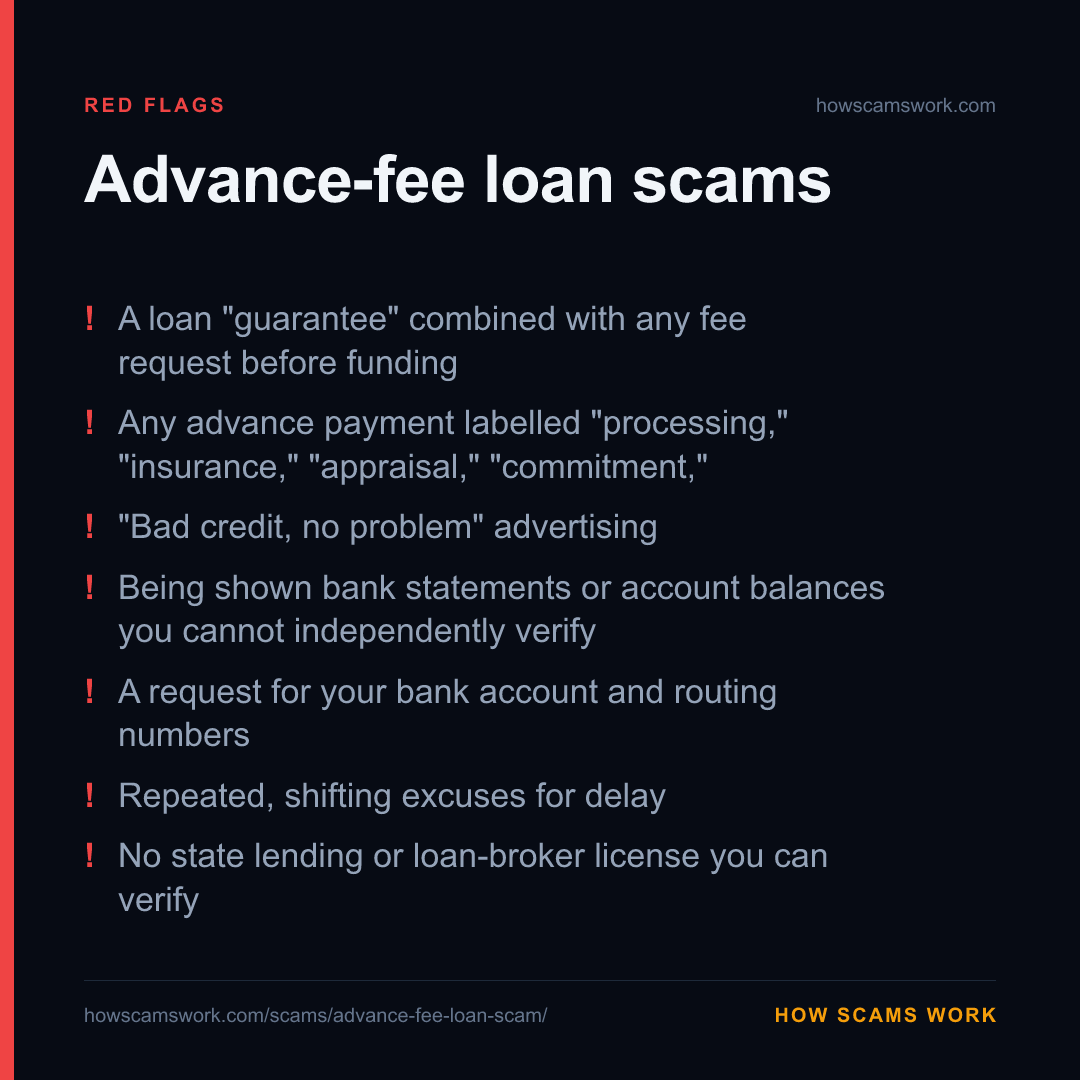
  • A loan “guarantee” combined with any fee request before funding. This exact combination is what federal telemarketing rules ban.
  • Any advance payment labelled “processing,” “insurance,” “appraisal,” “commitment,” “collateral” or “letter of intent.” These are legitimate terms attached to an illegitimate sequence.
  • “Bad credit, no problem” advertising paired with pressure to pay quickly.
  • Being shown bank statements or account balances you cannot independently verify with the institution named.
  • A request for your bank account and routing numbers “to process” the loan, rather than a lender pulling your credit report.
  • Repeated, shifting excuses for delay once a fee has already been paid.
  • No state lending or loan-broker license you can verify, most US states require one, and most advance-fee loan operators don’t have it.

If it’s happening to you

Stop any further payment immediately, and do not provide bank account or routing numbers to a lender you have not independently verified.

  1. Check the lender’s license. Most US states require a lender or loan broker to be licensed; your state’s Department of Financial Institutions or equivalent regulator can confirm one in minutes.
  2. Call your bank if you’ve already wired money or shared account details. Ask about a wire recall or a block on further withdrawals from the account you disclosed.
  3. Do not pay a second fee to “release” the first loan. Requests for follow-on fees after a delay are a documented pattern in these cases, not a path to recovery.
  4. Report it to the FTC at ReportFraud.ftc.gov, and to your state’s financial regulator or attorney general, who can pursue loan-broker-licensing violations directly. See where to report for other countries.
  5. Keep every document the “lender” sent you, fabricated bank statements and account balances have been central evidence in the cases on this page.

Where the money goes

Held domestically, spent quickly, and only sometimes shared with earlier victims to keep the operation running.

There is no cross-border laundering chain documented in any case on this page, the fee goes directly from the victim’s bank account to the operator’s, by wire or ACH withdrawal. From there, prosecutors describe two patterns: personal spending (luxury vehicles, artwork and vacations, in Kline’s case), and Ponzi-style redistribution, where a new victim’s fee quiets an earlier victim’s complaint rather than being banked outright. Both patterns mean the money is typically gone, not merely hidden, by the time a case reaches prosecutors, restitution orders in these cases recover a fraction of what was taken.

The other half of this story

Our sibling site Clean on Paper explains why a fake lender is built out of several shell companies instead of one, the same structuring pattern used to make a fabricated lending operation look like an ordinary finance business.

By the numbers

No published dataset breaks this scheme out as its own category yet, so there is no chart to show. The data page explains which agency categories exist and why some schemes are invisible in official statistics.

Sources

Every factual claim above traces to one of these. Statistics are reported losses; see methodology for what that does and does not measure.
  1. What To Know About Advance-Fee Loans. US Federal Trade Commission. Accessed 2026-09-22. Supports: The general mechanism, the Telemarketing Sales Rule ban, common fee labels, and red flags.
  2. 16 CFR 310.4(a)(4): Abusive telemarketing acts or practices. Cornell Law School, Legal Information Institute. Accessed 2026-09-22. Supports: The exact rule text banning advance fees for a guaranteed loan, and the 2010 Federal Register citation (75 FR 48516) for this provision.
  3. Sparks woman charged in $7 million Ponzi scheme. KOLO 8 News Now. Accessed 2026-09-22. Supports: Anna Kline's charges, the shell companies, the 5% advance-fee structure, and the falsified bank statements.
  4. Woman Gets 10-Year Sentence for $7M Ponzi Scheme. NewsBreak, reproducing Morristown Minute / US Attorney's Office for the District of New Jersey reporting. Accessed 2026-09-22. Supports: Kline's sentence, restitution, victim count and how the fee money was spent.
  5. HSI San Diego case results in CEO of San Diego financial firm charged in loan scam. US Immigration and Customs Enforcement, Homeland Security Investigations. Accessed 2026-09-22. Supports: Carlos Manuel da Silva Santos's charges, the fabricated $359 million brokerage account, and the single $8 million victim payment.
  6. San Diego Entrepreneur Sentenced to 87 Months for $17 Million Advance-Fee Loan Scam. Hoodline. Accessed 2026-09-22. Supports: Santos's sentence, the $17 million total, the Ponzi-style victim-to-victim fund movement, and the official quote.
  7. Third Defendant Charged with Orchestrating Nearly $1 Million Loan Fraud Scheme. US Secret Service. Accessed 2026-09-22. Supports: Samuel Selmar's charges, the bank-account-harvesting variant, and the dozens-of-victims scale.

Common questions

Is it ever legal for a lender to charge a fee before giving me a loan?

Legitimate lenders can charge fees, an appraisal, credit check or origination fee is normal, but only when they have not guaranteed you the loan first. The FTC's Telemarketing Sales Rule specifically bans collecting payment before a loan is delivered whenever the seller has represented a high likelihood of getting you approved. If a caller promises the loan and then asks for money, that sequence itself is the violation, regardless of how the fee is described.

Why did the fake lender show me real-looking bank statements?

Because it is the easiest way to make a shell company look solvent to someone about to wire six or seven figures. In the Ethos Asset Management case, prosecutors say Carlos Manuel da Silva Santos induced one victim to pay more than $8 million by pointing to a brokerage account holding $359,088,190.22 that did not exist. Falsified financials are a documented, recurring feature of the larger cases in this scheme, not an unusual embellishment.

Is a $7 million or $17 million loan-fee scam the same kind of scam as a 'bad credit, no problem' robocall?

Same mechanism, different scale. This page's documented cases happen to be the commercial-loan version, where a 5% fee on a nine-figure requested loan produces a seven-figure victim payment. The FTC's own consumer guidance describes the identical structure, guarantee first, fee first, no loan ever, running against individual borrowers for a few hundred to a few thousand dollars at a time. Both versions are illegal for the same reason.

The company said my loan was just 'delayed.' Is that normal?

Delay is the documented holding pattern once a fee has been paid, not an unusual hiccup. Every case on this page describes the same follow-up: a fabricated reason for the wait, sometimes repeated over months, while the operator either spends the money or uses it to pay off an earlier victim's complaint. A real lender that has your money and your signed loan documents does not need weeks to explain why funding hasn't happened.

I was asked for my bank account and routing number to 'process' the loan, not a wired fee. Is that different?

It's a variant of the same scheme, not a safer one. Federal prosecutors allege Samuel Selmar and associates collected victims' bank account information under the premise of processing a loan, then withdrew thousands of dollars directly rather than asking for a wire transfer first. Handing over account access to an unverified 'lender' carries the same risk as wiring a fee, the money moves the same way, just initiated from their end instead of yours.

Where the advance fee actually goesWhere the advance fee actually goes. No offshore network to disrupt, the fee moves directly, and is usually already spent by the time a case is prosecuted. Where the advance fee actually goesNo offshore network to disrupt, the fee moves directly, and is usually already spent by the time a case is prosecuted.Someone who wires anadvance fee, or sharesbank details for adirect withdrawalThe advance fee, wireddirectly, or fundswithdrawn by ACH afteraccount details weresharedThe fake lendingcompany's account, oneof several shellentities in the largercasesSpent on personalexpenses, or usedPonzi-style to repayan earlier victim'scomplaintSpent on personalexpenses, or used torepay an earliervictim demanding arefundA restitution order,where one is made,recovering a fractionof what was actuallytakenRestitution, if thecase is everprosecuted, a fractionof the total, yearslaterReversibilityA recall is realistically possible only at the first hop, and only in the first hours. After the money is converted it becomes an investigation, not a refund.Why a fake lender is built out of several shell companies instead of one: Clean on Paper, our sibling sitehttps://cleanonpaper.com/techniques/shell-companies/All three documented cases on this page kept the fee inside the United States, the fraud is the business model itself, not a cross-border laundering chain, which is also why criminal wire-fraud charges, not just civil FTC action, appear in every case here.howscamswork.com
Where the money goes after it leaves, and where it becomes hard to recover.

Report it

Reporting is what produces the enforcement data on this page. Find the right agency and phone number for your country on the report page. If money moved in the last few hours, call your bank first.