Also called: Operation Varsity Blues · the college admissions scandal · the side door · admissions bribery scheme
A college admissions consultant sells parents a "side door" into elite universities: bribing a test administrator to fix SAT or ACT scores, or a coach to list an applicant as a recruited athlete who never played, disguised as a tax-deductible donation to a sham charity. Architect William "Rick" Singer collected over $25 million before his 2023 sentencing.
What it is
A private admissions consultant tells wealthy parents there is a third way into an elite university,
not the “front door” of grades and scores alone, and not the long-odds “back door” of a huge, no-guarantee
building donation, but a guaranteed “side door.” William “Rick” Singer sold that side door through two
outfits he ran for close to a decade: Edge College & Career Network LLC, his for-profit consulting
business known as “The Key,” and the Key Worldwide Foundation (KWF), a nonprofit he controlled.
The side door worked one of two ways. A corrupt test administrator fixed a child’s SAT or ACT score. Or
a bribed coach or athletics official labeled the applicant a recruited athlete, regardless of whether
they had ever played the sport. Either way, the payment didn’t look like a bribe on paper. It looked like
a charitable donation or a consulting fee.
Between 2011 and 2019, Singer took in more than $25 million from clients this way. The scheme became
public in March 2019 as “Operation Varsity Blues,” when 55 people, parents, coaches, test administrators,
a university athletics administrator and Singer himself, were charged in federal court in Boston.
How it actually works
The pitch
A private consultant tells a parent there is a guaranteed “side door” into a specific university, distinct
from ordinary admissions or a long-odds mega-donation. Singer ran this pitch through two entities: a
for-profit consulting business, and a nonprofit foundation he controlled.
The fee disguised as a donation
Clients paid $15,000 to $75,000 per rigged test, or far more for an athletic recruiting slot, up to $6.5
million in one documented case. The payment was routed as a “donation” to the foundation or a “consulting
fee” to the business, not a line-item bribe.
Where it could have stopped
The IRS only treats a payment as a deductible charitable gift if the donor receives nothing of substantial personal value in return. A payment made specifically to get a child admitted fails that test on its face, and it was an IRS review of the foundation’s own nonprofit filings that eventually helped pull the scheme apart.
Buying extra time and a captured test center
Singer told clients to get their child diagnosed with a learning disability to qualify for extended,
untimed testing, then moved the exam to one of two locations he controlled, a public high school in
Houston or a private prep school in West Hollywood, where corrupt administrators took $5,000 to $10,000
bribes per test to look away.
The proctor who already knows the answers
A hired test-taker, paid $10,000 a test by Singer, either sat the exam himself using a fake photo ID
bearing the real student’s name, or posed as the room’s proctor and corrected the student’s wrong answers
afterward. Over eight years this inflated the scores of 24 students across 27 exams, several of whom never
knew their own parents had arranged it.
A fabricated athlete
For families aiming at a specific school rather than a specific score, Singer instead bribed a coach or
an athletics administrator to designate the applicant a recruited athlete. Staff built fabricated
athletic honors and résumés, in at least one case pasting a client’s child’s face onto a photo of someone
else performing a sport the child had never played.
The one review step built to catch it, skipped
A “recruited athlete” label is supposed to mean a coach has personally vetted the applicant’s ability, so
an admissions office waives much of its own scrutiny and defers to the coach’s word. The bribes targeted
exactly that handoff, the one step in the process a forged transcript or a faked diagnosis couldn’t reach
on its own.
An audit unravels the cover story
After the IRS began examining the foundation’s nonprofit filings, Singer started cooperating with federal
investigators in 2018, wearing a wire and recording hundreds of calls with roughly 30 co-conspirators,
calls prosecutors later used to charge 55 people when the case became public in March 2019.
Sentencing, years apart
Guilty pleas came quickly for most defendants, but sentencing stretched out for years. Parents Lori
Loughlin and Mossimo Giannulli were sentenced in August 2020; the hired test-taker, Mark Riddell, waited
until April 2022; Singer himself, credited for cooperating but also found to have tipped off some of his
own clients, wasn’t sentenced until January 2023, the longest term of anyone in the case.
Why it works
Admissions offices trust the coach, not the file. A “recruited athlete” designation is supposed to
mean a coach has personally vetted the applicant, so the rest of the admissions process waives much of
its own scrutiny and defers to that one person’s word. A bribe at that single handoff defeats layers of
review all at once.
Testing accommodations are a legitimate process that isn’t re-verified at the door. Extended time is
granted on medical documentation the College Board and ACT don’t independently re-confirm at the test
center itself, so a fabricated diagnosis is enough to move a child into a smaller, more controllable
testing environment.
Routing the money through a nonprofit makes a bribe look like philanthropy. On paper, a payment to a
registered charity reads as ordinary, deductible generosity, right up until an audit of that charity’s own
books starts asking why one “donor’s” child was separately admitted to the school the donation happened to
benefit.
Wealth bought distance from the actual fraud. Parents paid a consultant, who paid the coach or the
test administrator; the client never had to bribe anyone directly. About two-thirds of the more than 50
Varsity Blues defendants received three months or less in prison, while the people who personally carried
out the cheating and bribery received longer terms, a gap in outcomes that followed the gap in who actually
touched the fraud.
Some of the children had no idea. In several documented cases the admitted student never knew their
score had been fixed or their athletic profile fabricated, which meant the person who benefited most
directly was not always a willing participant in the crime committed on their behalf.
Where it comes from
Entirely domestic, and run as an openly commercial private business rather than hidden organized crime.
Singer operated The Key and the Key Worldwide Foundation in the open for nearly a decade, advertising
admissions consulting services from 2011 until the case became public in March 2019.
The scale was large and the outcomes were uneven. Fifty-five people were charged: parents, nine
coaches, two SAT or ACT exam administrators, one proctor, one university athletics administrator, and
Singer himself. Fifty-three were convicted. Collections included $10,668,841 in IRS restitution from
Singer alone, plus $8,880,802 in forfeiture, $5,682,954 in fines and $96,960 in restitution across the
wider case.
Universities named in the case include Georgetown, Stanford, UCLA, USC, the University of Texas, Wake
Forest and Yale. None of them were accused of institutional wrongdoing; the fraud targeted individual
coaches, administrators and test centers rather than the schools themselves.
The investigation, publicly known as Operation Varsity Blues, was led jointly by the FBI, IRS Criminal
Investigation and the Department of Education’s Office of Inspector General, and became public on March
12, 2019, when the original indictments were unsealed in federal court in Boston.
Outcomes split sharply by role. Most parents received short sentences or none at all. The hired
professionals who personally delivered the fraud, and the man who built and ran the operation for nearly
a decade, received the longest terms, with Singer’s own sentencing delayed nearly four years past the
case becoming public.
Real cases
2023 US Sentenced $25.0m
William "Rick" Singer ran a nationwide college admissions bribery operation from about 2011 to February 2019 through two entities he controlled: Edge College & Career Network LLC, a for-profit consulting business, and the Key Worldwide Foundation, a nonprofit used to disguise bribes as charitable donations. He took in more than $25 million from clients, paid over $7 million of it onward in bribes to coaches, athletics administrators and test proctors, and used more than $15 million for himself. He pleaded guilty in March 2019 to racketeering conspiracy, money laundering conspiracy, conspiracy to defraud the United States and obstruction of justice, and after years of cooperating with investigators was sentenced on January 4, 2023 to 42 months in prison and ordered to pay $10,668,841 in restitution to the IRS.
Read the case file ·
4 sources
2022 US Sentenced $239,449
Mark Riddell conspired with William "Rick" Singer from 2011 to February 2019 to cheat on college entrance exams, either taking the SAT or ACT in a student's place using a fake photo ID, or posing as the exam proctor and correcting a student's wrong answers afterward. Singer paid him $10,000 per test; across eight years Riddell inflated the scores of 24 students on 27 exams, earning just under $240,000. He pleaded guilty in April 2019 to conspiracy to commit mail fraud, honest services mail fraud, and money laundering, and was sentenced on April 8, 2022 to four months in prison, a $1,000 fine and $239,449 in forfeiture.
Read the case file ·
2 sources
2020 US Sentenced $500,000
Actress Lori Loughlin and her husband, fashion designer Mossimo Giannulli, agreed with William "Rick" Singer in 2016 and again in 2017 to have their two daughters designated as USC crew-team recruits, despite neither daughter having rowed competitively, paying $500,000 combined, routed partly as payments to a USC athletics account and partly as "donations" to Singer's sham charity. Both pleaded guilty in May 2020. A federal judge sentenced Loughlin to two months in prison and Giannulli to five months on August 21, 2020, making them the 21st and 22nd parents sentenced in the wider case.
Read the case file ·
1 source
Red flags
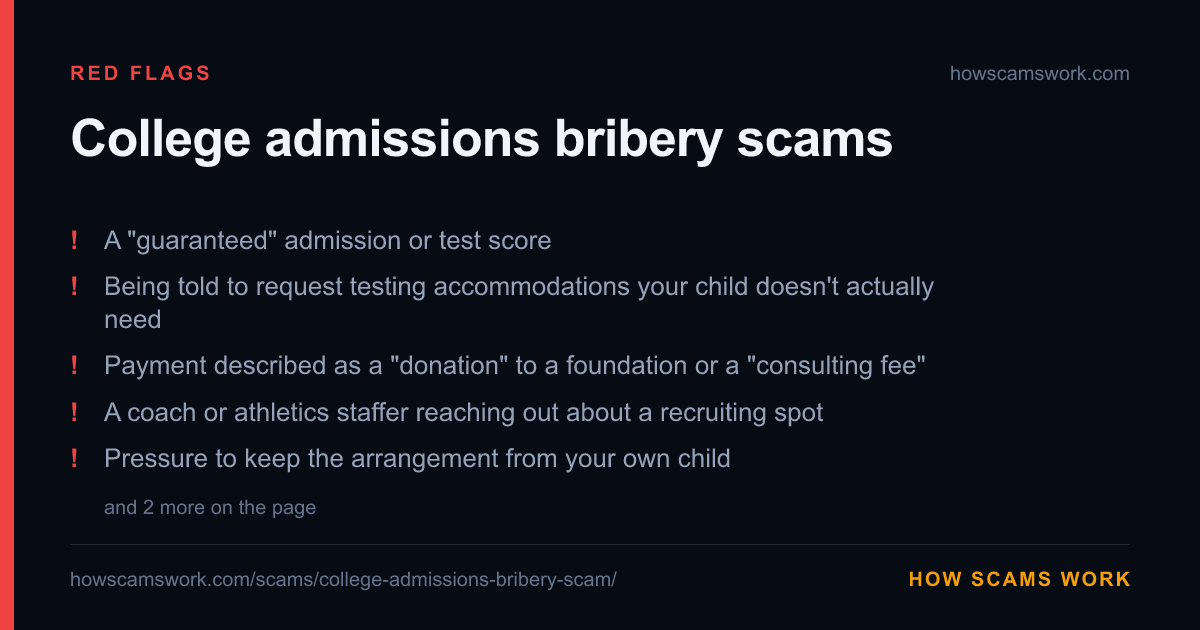
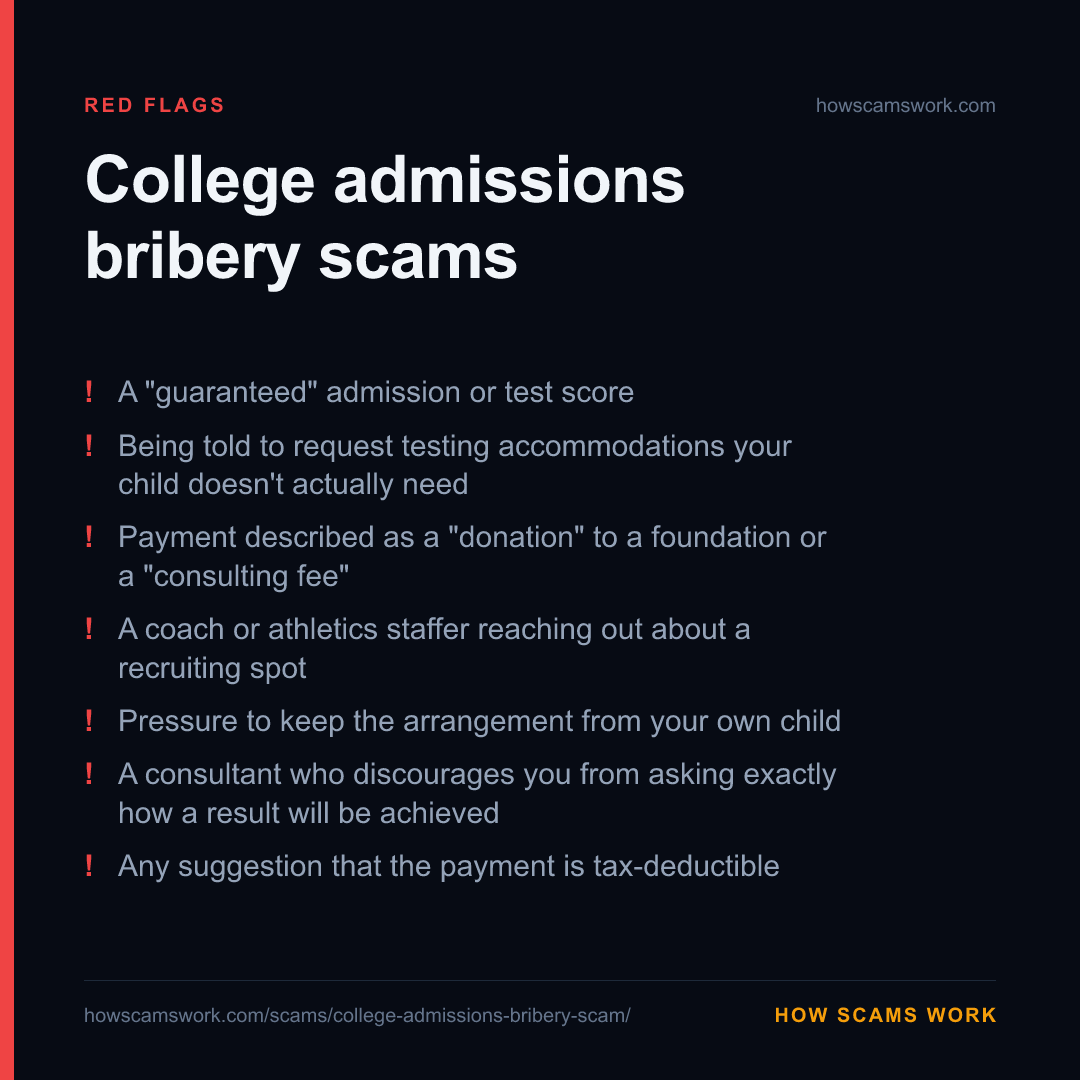
- A “guaranteed” admission or test score, not merely better odds. No legitimate consultant, coach or school employee can lawfully guarantee a specific outcome at a specific university.
- Being told to request testing accommodations your child doesn’t actually need, in order to move the exam to a different time or location.
- Payment described as a “donation” to a foundation or a “consulting fee”, routed anywhere other than the university’s own admissions, financial aid or development office.
- A coach or athletics staffer reaching out about a recruiting spot for a sport your child doesn’t seriously compete in.
- Pressure to keep the arrangement from your own child.
- A consultant who discourages you from asking exactly how a result will be achieved.
- Any suggestion that the payment is tax-deductible because it directly benefits your own family.
If it’s happening to you
Stop before any money changes hands. A guaranteed outcome at a specific school is not something any
legitimate consultant, coach or employee can lawfully deliver.
- Ask directly whether the payment goes to the school itself, acknowledged through its own recorded
gift process, rather than to a separate company or foundation. A genuine donation is receipted by the
university’s own development office.
- Refuse any request to claim a disability or accommodation your child doesn’t have. Falsely
obtaining extended testing time is a separate fraud on top of whatever else is being arranged.
- If you’ve already paid and suspect fraud, talk to a lawyer before amending anything yourself. Your
own exposure can include conspiracy and tax charges if a bribe was deducted as a donation.
- Report it. In the US, the FBI (tips.fbi.gov) and the Department of Education’s Office of Inspector
General (oig.ed.gov) both took reports in this exact case. See where to report
for other countries.
- If you are the student and suspect your own application was falsified without your knowledge, ask
your school’s registrar or dean of admissions directly about its process for reviewing an admission
obtained this way.
Where the money goes
A short chain, almost entirely domestic, with one laundering step built in on purpose.
The parent pays a business or a foundation, not a person. The fee or “donation” goes to The Key or the
Key Worldwide Foundation, giving the transaction the paper trail of a legitimate consulting fee or
charitable gift rather than a bribe.
The operator keeps the majority. Of the more than $25 million Singer collected, he used more than $15
million for himself and paid roughly $7 million onward in bribes, keeping well over half of everything
clients paid him.
A cut reaches whoever delivers the fraud. Test administrators were paid $5,000 to $10,000 per exam to
accept a hired test-taker or look away; the test-taker himself was paid $10,000 a test; coaches and
athletics staff were paid directly or through the foundation for each fabricated recruiting slot.
Recovery came mostly from the operator, not the clients. Singer alone paid $10,668,841 in IRS
restitution plus forfeiture of assets and a money judgment together worth roughly $8.7 million. Across the
wider case, forfeiture, fines and restitution totaled a few million dollars more, a small fraction of the
more than $25 million that moved through the scheme in the first place.
By the numbers
No published dataset breaks this scheme out as its own category yet, so there is no chart to show.
The data page explains which agency categories exist and why some schemes are
invisible in official statistics.
Every factual claim above traces to one of these. Statistics are reported losses; see
methodology for what that does and does not measure.