Also called: ghost students · straw student fraud · student aid fraud ring · FAFSA fraud ring · fake student scam · Pell Grant fraud ring
Ghost student fraud uses stolen or fake identities to enroll in online college courses and apply for federal student aid, then collects the refunds and disappears. A Detroit ringleader submitted claims for more than 1,200 individuals at over 100 schools; a Texas former professor got 78 months. Real people can be left with loans they never took.
Key facts
Category
Identity theft
First documented
2015
Typical loss
$921k–$10000k USD, per victim
Main channels
stolen personal information used on aid applications, online and distance education programs, open-enrollment community colleges, prepaid debit cards and accounts that receive credit balance refunds, master promissory notes signed in victims' names
Who is targeted
People whose identities are used to create student aid accounts, applications and loans they never knew about; Community colleges and other schools that accept almost all applicants and must find the fake ones; The Department of Education and taxpayers, who fund the grants and loans; Legitimate students, who may face delays and verification burdens as schools tighten checks
Documented origins
United States
Main targets
United States
Case files
3 documented cases
Last reviewed
2026-10-21
The stages of the scheme, in order, with the point where it can still be stopped.
What it is
A ghost student is not a person. It is an identity, stolen or made up, that is enrolled in online college
classes so that someone can claim the federal grants and loans that come with enrollment. The Education
Department’s inspector general describes fraud rings as groups of criminals, often large or loosely
affiliated, who exploit distance education programs to get their hands on federal student aid award
balances. A ringleader enrolls straw students for the sole purpose of obtaining aid. The money is the refund of
what remains after tuition, and the loans stay in the identity’s name.
How it actually works
The identities
A ringleader obtains identities. According to the inspector general, some participants join willingly, but
fraud rings often steal the personally identifiable information of others. In the Texas case, the defendant
used victims’ personal information, and in a Michigan ring recruits were asked to provide theirs.
The straw student
The identity is enrolled in an online program, often at a school with open enrollment. The inspector general’s
profile of a straw student: a low expected family contribution, making them eligible for Pell Grants, a credit
balance refund, no class attendance once the refund arrives and no approved transfer credits.
The aid application
Federal student aid applications and master promissory notes are prepared and signed in the identity’s name. In
the Detroit case, claims were submitted for more than 1,200 individuals at over 100 schools in 24 states.
The controlled contact points
The ringleader sets up addresses, phone numbers and email accounts to intercept messages from the Education
Department and the schools. In the Texas case, the defendant did this and altered some straw students’ first
names while keeping their real Social Security numbers and dates of birth.
Where it could have stopped
The inspector general’s red flags for schools include multiple students with the same or similar mailing address, phone number, email address, deposit account, class schedule or IP address, and a mailing address or account changed just before a credit balance is disbursed.
Coursework that keeps the aid coming
In the Detroit complaint against Michelle Hill, it is alleged that she completed the coursework herself, so the
students appeared to progress and stayed eligible across semesters. That is an allegation.
The refund
The refund of the credit balance is paid out. In the Texas case it came through electronic transfers, checks and
prepaid debit cards sent to addresses and accounts under the defendant’s control. In a Michigan ring, the
inspector general says, members acted as runners, withdrawing aid funds from debit cards in straw students’ names.
The victims find out, and the ring is prosecuted
The people whose identities were used find accounts, loans or enrollments they never created. Cases in this
page were sentenced or charged between 2025 and 2026, for conduct that began as early as 2015.
Why it works
Online enrollment at open-enrollment schools. According to ABC News, community colleges accept almost all
applicants through open enrollment and often carry the burden of identifying fake applications, which requires
resources and expertise many institutions lack.
Remote learning opened the door. An Education Department inspector general official told ABC News that when
the pandemic hit and everyone went to online learning, it opened the door to more widespread fraud.
Technology. ABC News reported that scammers have realized that remote learning provides an opportunity to
use artificial intelligence to expand their reach and get around identity verification controls.
The warning signs show up before the refund. The inspector general’s sheet lists an account or mailing
address changed just before a credit balance is disbursed as a red flag, a moment when school staff can look.
The identity owner may not know. The inspector general official said the loans are assigned to people who
do not know they have a debt until the Internal Revenue Service says they owe the Department of Education money.
Where it comes from
Domestic in the cases here: each is a US ring or individual using US identities and US schools. ABC News
reported that some scammers operate from overseas, which investigators say presents a special challenge, but
that many ghost students operate within US borders.
Scale. An Education Department inspector general official told ABC News that over the past five years the
government has investigated more than $350 million in ghost student fraud, that the office has more than 200
investigations open nationwide, and that some schemes are suspected of racking up more than a billion dollars.
That is the official’s account, and the officials said it covers only what is known and has been adjudicated.
Earlier cases. ABC News reported that a father and son in Arizona made off with more than $7 million from
ghost student scams before their arrests in 2018 and 2019 and served 12-month prison sentences after pleading
guilty, and that a Maryland man who used the identities of 60 people to take in more than $6.7 million was
sentenced in 2023 to four years.
Emmanuel Olugbaike Finnih, 43, of Richmond, Texas, a former adjunct professor at Texas Southern University, was sentenced by US District Judge Andrew Hanen to 78 months in federal prison and three years of supervised release. For about five years he submitted more than 100 fraudulent financial aid applications to the Department of Education using the stolen identities of straw students at colleges across Texas. He sought more than $1.3 million in grants and loans and $921,189.08 was disbursed. He pleaded guilty on March 20 to theft of government funds, fraud, unlawful use or transfer of identity documents and aggravated identity theft.
Brandon Robinson, 42, of Detroit, pleaded guilty on May 6, 2026 to wire fraud and aggravated identity theft for leading a decade-long scheme to obtain Federal Student Aid for so-called straw students enrolled for the primary purpose of receiving it. Between January 2015 and February 2024 he submitted fraudulent claims for more than 1,200 individuals at over 100 schools in 24 states. More than $16 million in aid was awarded and more than $10 million disbursed. He also admitted to filing over 100 fraudulent unemployment insurance claims that paid out over $1 million. Sentencing was scheduled for September 1, 2026, and this page did not find the outcome.
A federal complaint announced in September 2025 charged Michelle Hill, 48, of Detroit, with wire fraud in connection with a Federal Student Aid scheme. Court documents say that between July 2015 and July 2025 she obtained fraudulent aid involving more than 80 individuals, predominantly enrolled at Wayne County Community College, who were enrolled in the same or similar degree programs and taking the same or similar online courses. It is alleged that Hill often completed the coursework herself to make it appear the students were progressing and to prolong their eligibility. She is alleged to have caused more than $3 million in aid to be awarded, with more than $2.5 million disbursed. These are allegations. Hill is presumed innocent unless a court finds otherwise.
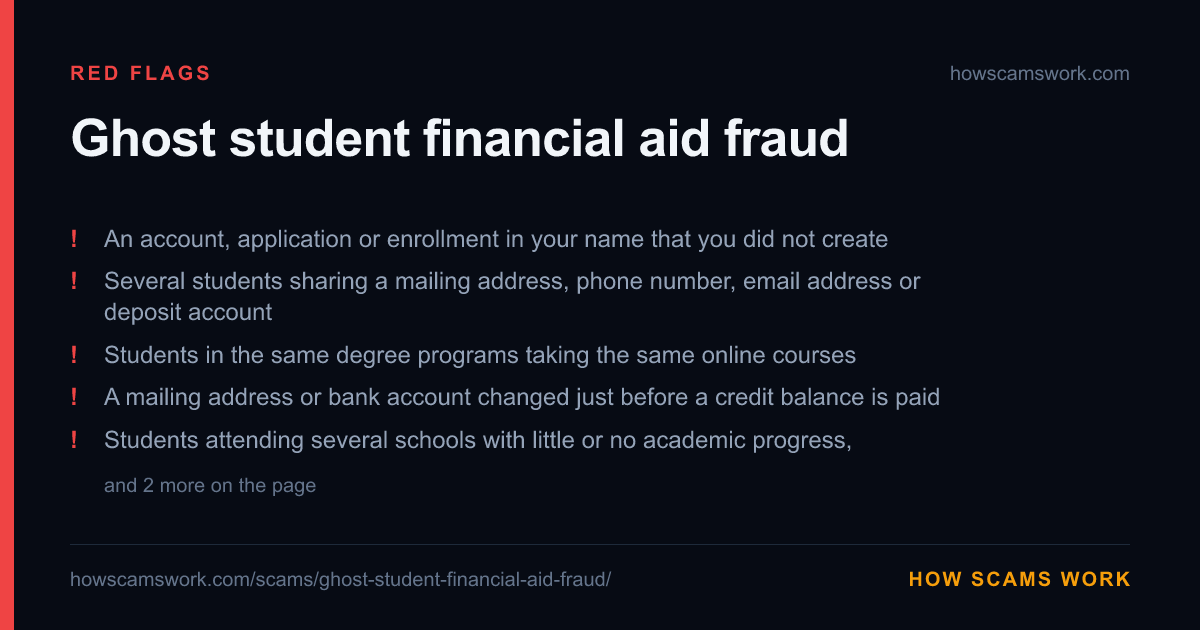
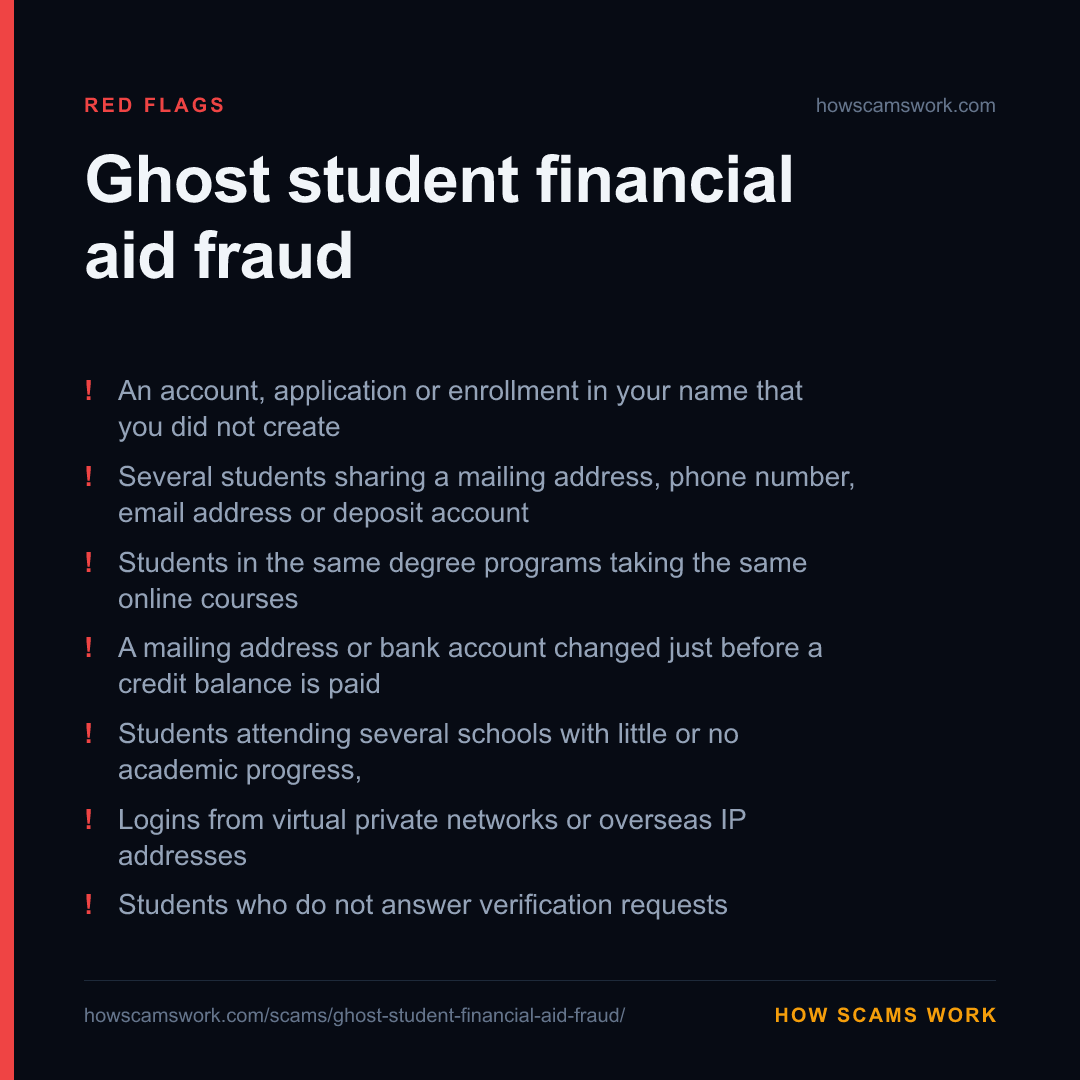
An account, application or enrollment in your name that you did not create, or a school telling you that you enrolled when you did not.
Several students sharing a mailing address, phone number, email address or deposit account.
Students in the same degree programs taking the same online courses.
A mailing address or bank account changed just before a credit balance is paid.
Students attending several schools with little or no academic progress, or who stop attending once the refund arrives.
Logins from virtual private networks or overseas IP addresses.
Students who do not answer verification requests.
If it’s happening to you
If you think your identity was used to enroll in college or take out aid:
Do not ignore a notice from a school or the Education Department about an application or enrollment you
did not make.
Tell the school and ask what was submitted, including the address, phone and email on file.
Treat it as identity theft. The people described in the reports on this page worked with the colleges and
law enforcement to be cleared.
Watch for loans you did not take. The inspector general official says they can surface when the Internal
Revenue Service says you owe the Department of Education money.
Report it. See where to report for agencies and for countries outside the
United States.
Where the money goes
Entirely domestic: from the Education Department to the school, then as a credit balance refund to accounts and cards the ring controls.
The aid is awarded and disbursed to the school, which pays the credit balance to the student. In the documented
cases, those payments went to addresses, accounts and prepaid debit cards controlled by the ringleader, and the
inspector general says runners withdrew funds from debit cards in straw students’ names. In the Detroit
case more than $10 million was disbursed of more than $16 million awarded, and in the Texas case $921,189.08 was
disbursed of more than $1.3 million sought.
No published dataset breaks this scheme out as its own category yet, so there is no chart to show.
The data page explains which agency categories exist and why some schemes are
invisible in official statistics.
Sources
Every factual claim above traces to one of these. Statistics are reported losses; see
methodology for what that does and does not measure.
Student Aid Administrators: Help Spot and Stop Student Aid Fraud Rings.
US Department of Education, Office of Inspector General. Accessed 2026-10-21. Supports: The definition of a student aid fraud ring and a straw student, the profile of a straw student, the red flags and the detection checklist.
FraudGram, July 2026, Issue 6.
US Department of Education, Office of Inspector General. Accessed 2026-10-21. Supports: The inspector general's July 2026 summaries of a Michigan ring that targeted more than $16 million in aid at some 100 schools in 24 states, a Michigan ringleader who submitted applications for more than 80 individuals, and a Wisconsin ringleader who obtained the personal information of nearly 300 people and enrolled them at a university without their knowledge.
Detroiter Pleads Guilty in $16M Federal Student Aid Fraud Scheme.
US Department of Labor, Office of Inspector General (reproducing a US Attorney's Office release). Accessed 2026-10-21. Supports: Brandon Robinson's straw student scheme, the more than 1,200 individuals and 100 schools in 24 states, the $16 million awarded and $10 million disbursed, the May 2026 plea and the US Attorney's quote.
Feds Say Detroit Man Fabricated 1,200 Students to Steal $16M.
Townhall (Scott McClallen). Accessed 2026-10-21. Supports: The September 2025 complaints against Robinson and Michelle Hill, including the allegation that Hill completed students' coursework herself and the more than $3 million awarded and $2.5 million disbursed.
Richmond man sentenced to 78 months for student aid fraud.
KPRC Click2Houston. Accessed 2026-10-21. Supports: Emmanuel Finnih's scheme, the stolen identities, the controlled contact details, the refunds, the $921,189.08 disbursed, the effect on victims and the 78-month sentence.
Inside the 'ghost student' scam that uses identity theft to steal college loans and financial aid.
ABC News, via WTOP. Accessed 2026-10-21. Supports: The description of ghost students, the Education Department inspector general's figures of more than $350 million investigated over five years and more than 200 open investigations, the effect of online learning, the burden on community colleges, the Arizona and Maryland examples and the identity verification measures.
Common questions
What is a ghost student?
According to reporting by ABC News, ghost students are fraudsters who use stolen or fake identities to enroll in classes online and sign up for Pell grants and loans, then disappear once they get the money. The Education Department's inspector general uses the term straw students for the fake or stolen enrollments that a fraud ring's ringleaders facilitate for the sole purpose of obtaining student aid.
Who ends up with the debt?
In the Texas case, the reports say some victims were left with tens of thousands of dollars in student loans in their names, damaged credit and trouble enrolling in legitimate programs. An Education Department inspector general official told ABC News that the loans are not being repaid and are assigned to people who may not know they have a debt until the Internal Revenue Service says they owe the Department of Education money.
What are the signs a school looks for?
The inspector general's information sheet lists, among others, multiple students with the same or similar mailing address, phone number, email address, deposit account, online class schedule or IP address, a mailing address or financial account changed just before a credit balance is disbursed, attending multiple schools with little to no academic progress, and accessing school systems from virtual private networks or overseas IP addresses.
How is this different from the student loan forgiveness scam on this site?
The student loan forgiveness scam targets borrowers, who are tricked into paying fees or giving up account credentials. Ghost student fraud targets the aid system itself, using identities, often those of people who are not students, to claim aid and loans. A person can be a victim of the second without ever having applied for aid.
What should I do if I think my identity was used?
The reports on this page describe people who discovered an account or enrollment they did not create, and who had to clear it with the colleges and law enforcement. If a school or the Education Department tells you that you enrolled somewhere you never applied, treat it as identity theft. See <a href="/report/">where to report</a>.
Where the money goes after it leaves, and where it becomes hard to recover.
Share the red flags
A card made from this page's red flags, for anyone you think might be targeted. Send it to a parent, a neighbour or a group chat.
Reporting is what produces the enforcement data on this page. Find the right agency and phone
number for your country on the report page. If money moved in the last
few hours, call your bank first.
Before you continue to How Scams Work
We use browser storage to remember this choice, and nothing else is needed to read the site. If you choose
Accept all, we also let Google Analytics set cookies (_ga, _ga_*) to count
visits and see which pages are read.
Accept required gives you the whole site with no analytics cookies. There is no advertising
here and no other tracking. You can change your choice at any time from "Cookie choices" in the footer.