Credit card interest rate reduction scams

Also called: Rachel from Cardholder Services · Card Member Services scam · card services scam · cardholder services scam · interest rate reduction scam

A credit card interest rate reduction scam robocalls or cold-calls consumers, falsely claims to be affiliated with their card network or issuer, and charges $500 to $5,000 upfront to permanently lower their interest rate, then delivers little or nothing. Three US cases from 2010 to 2023, worth over $40 million combined, show the same operators rotating company names to resume calling after each shutdown.

Key facts

Category
Other
First documented
2007
Typical loss
$500–$26k USD, per victim
Main channels
robocalls, cold calls, telemarketing, boiler rooms
Who is targeted
Anyone carrying a credit card balance at a high interest rate, named directly by the FTC as the target of this calling pattern; People who answered a robocall claiming to be 'Cardholder Services' or 'Card Member Services' without checking who was actually calling; Older adults and financially distressed consumers, named specifically as targets in the FTC's 2022 case against GDP Network; Anyone who gave out the last four digits of a Social Security number, a zip code or a card balance to a caller who already seemed to know it; People told a reduced rate came with a refund guarantee if it didn't work out
Documented origins
United States, Canada
Main targets
United States
Case files
3 documented cases
Last reviewed
2026-10-19
Anatomy of a credit card interest rate reduction scamAnatomy of a credit card interest rate reduction scam. A robocall claims it works with Visa or Mastercard and charges hundreds of dollars upfront for a rate cut your own card issuer gives for free. 1. The robocall: A prerecorded message, often introduced as "Rachel" or "Card Member Services," offers an important opportunity to cut the recipient's credit card interest rate. 2. Borrowed brand authority: The caller claims to be a "licensed enrollment center" for Visa or Mastercard. No such relationship exists in any documented case; issuers told the FTC they had no part in the calls. 3. The promise: A guaranteed, permanent rate cut, in one case enough to pay off debt three to five times faster, with a full refund promised if $2,500 in savings doesn't materialise. 4. The upfront fee: The consumer pays $500 to $5,000 before any rate change has actually happened. 5. Little or nothing delivered: At most, a new card is opened with a temporary low introductory rate, something the consumer could do directly and for free. Often no call to the issuer is made at all. 6. A dozen company names on hand: The same small group of operators runs the business through interchangeable shell LLCs: 13 behind one Orlando operation, at least 10 names used by another since 2007. 7. A court shuts one name down: A temporary restraining order freezes assets under whichever entity was operating. Years later, a partial refund arrives, averaging $117 per person in one 2023 round. 8. The pitch resumes under a new name: Nothing about the tactic requires the shut-down entity specifically. The FTC's own consumer alerts on this exact script are dated April 2010 and April 2026. The diagram marks stage 4 as the point where the scheme can still be stopped: The Telemarketing Sales Rule classifies this pitch as a debt relief service. A company selling it by phone cannot collect a fee until it has actually reduced at least one debt, the consumer has approved the new terms in writing, and a payment has been made under them. Charging on enrollment instead of on a result is already illegal.Anatomy of a credit card interest rate reduction scamA robocall claims it works with Visa or Mastercard and charges hundreds of dollars upfront for a rate cut your own card issuer gives for free.1The robocallA prerecorded message,often introduced as"Rachel" or "Card MemberServices," offers animportant opportunity tocut the recipient's creditcard interest rate.Seconds2Borrowed brandauthorityThe caller claims to be a"licensed enrollmentcenter" for Visa orMastercard. No suchrelationship exists in anydocumented case; issuerstold the FTC they had nopart in the calls.Minutes3The promiseA guaranteed, permanentrate cut, in one caseenough to pay off debtthree to five times faster,with a full refund promisedif $2,500 in savingsdoesn't materialise.One call4The upfront feeThe consumer pays $500 to$5,000 before any ratechange has actuallyhappened.The first payment5Little or nothingdeliveredAt most, a new card isopened with a temporary lowintroductory rate,something the consumercould do directly and forfree. Often no call to theissuer is made at all.Weeks6A dozen company nameson handThe same small group ofoperators runs the businessthrough interchangeableshell LLCs: 13 behind oneOrlando operation, at least10 names used by anothersince 2007.Ongoing7A court shuts onename downA temporary restrainingorder freezes assets underwhichever entity wasoperating. Years later, apartial refund arrives,averaging $117 per personin one 2023 round.Years8The pitch resumesunder a new nameNothing about the tacticrequires the shut-downentity specifically. TheFTC's own consumer alertson this exact script aredated April 2010 and April2026.Years laterWhere it can still be stopped: stage 4The Telemarketing Sales Rule classifies this pitch as a debt relief service. A company selling it by phone cannot collect a fee until it has actually reducedat least one debt, the consumer has approved the new terms in writing, and a payment has been made under them. Charging on enrollment instead of on a result isalready illegal.Stages drawn from the FTC's 2010 case against the operation later known as AFL Financial Services, its 2016-2018 case against Kevin Guice and Life Management Services of Orange County, and its 2020-2022 case against GDP Network LLC (YF Solution). All three were resolved by consent order, default judgment or summary judgment in the FTC's favour; none went to a criminal trial.howscamswork.com
The stages of the scheme, in order, with the point where it can still be stopped.

What it is

A call, usually a prerecorded robocall, claims to work with your credit card company or network and promises to permanently and substantially cut your interest rate, saving you thousands of dollars and getting you out of debt three to five times faster. All of that is marketing. What actually happens is an upfront fee of $500 to $5,000, and in the FTC’s largest documented case, consumers rarely got any rate reduction at all.

Regulators call this a form of debt relief service, which puts it squarely under the FTC’s Telemarketing Sales Rule: a company selling debt relief by phone cannot legally collect a single dollar until it has actually renegotiated or reduced at least one enrolled debt, the customer has approved the new terms in writing, and a payment has been made under them. Every case on this page was charged under that exact rule, and every case still happened anyway.

This is not a new or rare scam. The FTC issued a dedicated consumer alert about it in April 2010, sued an operation that had been running it since at least 2007, and issued another consumer alert about the identical pitch in April 2026. Different company names, same calling script, for close to two decades.

How it actually works

  1. The robocall

    A prerecorded message, often introduced as “Rachel,” “Cardholder Services” or “Card Member Services,” tells the recipient there is an important opportunity to reduce their credit card interest rate. The FTC’s cases describe this reaching consumers nationwide, including seniors and people already behind on debt.

  2. Borrowed brand authority

    The caller claims to be a “licensed enrollment center” for Visa or Mastercard, or otherwise implies a direct relationship with the consumer’s own card issuer. No such relationship exists in any of the cases on this page; issuers told the FTC they had no part in the calls.

  3. The promise

    The pitch guarantees a large, permanent rate cut, in the FTC’s 2010 case against AFL Financial Services, enough to pay off debt three to five times faster, and promises a full refund if the consumer doesn’t save at least $2,500 within a set period.

  4. The upfront fee

    The consumer pays $500 to $5,000, by card or bank transfer, before any rate change has happened.

    Where it could have stopped

    The Telemarketing Sales Rule classifies a credit card interest rate reduction pitch as a debt relief service. A company selling that by phone cannot collect a fee until it has actually reduced at least one of the consumer’s debts, the consumer has approved the new terms in writing, and a payment has been made under them. Charging on enrollment instead of on a result is already illegal, before anything else happens.

  5. Little or nothing delivered

    At most, the FTC’s cases describe a company opening a new credit card with a temporary low introductory rate and transferring an existing balance onto it, something a consumer could do directly and for free. In many documented instances, no call to the issuer was made at all, or the issuer simply declined to participate.

  6. A dozen company names on hand

    To keep calling after a shutdown, state suspension or wave of complaints, the same small group of operators run the business through shell LLCs with interchangeable names. The FTC’s 2016 case named 13 affiliated shell companies behind a single Orlando operation; its 2010 case found the same individuals had used at least 10 different company names since 2007.

  7. A court shuts one name down, years pass, a partial refund arrives

    A temporary restraining order freezes assets and halts the calls under whichever name was operating. Years later, the FTC mails refund checks representing a small fraction of what was actually taken, an average of $117 per person in one 2023 round, out of fees that ran into the thousands.

  8. The pitch resumes under a new name

    Nothing about the underlying tactic requires the shut-down company specifically. The FTC’s consumer alerts on this exact pitch are dated April 2010 and April 2026, 16 years apart, describing the same robocall script both times.

Why it works

The debt is real, and the fix sounds procedural rather than desperate. Someone carrying a high-interest balance already knows they’re paying too much; a caller offering to “negotiate” that rate down sounds like a service, not a gamble, especially when it claims institutional backing.

Borrowed brand authority defeats the normal check. A caller who claims to represent Visa, Mastercard or the consumer’s own bank has pre-empted the one question most people would otherwise ask: who exactly am I talking to? The FTC’s 2026 alert notes scammers go further, opening with a partial Social Security number, a zip code or an exact balance to sound even more credible before asking for anything.

A refund guarantee removes the obvious objection. Promising a full refund if the savings don’t materialise makes the upfront fee feel reversible. In practice, the FTC’s cases describe consumers who complained simply being ignored, or the company disappearing under that name entirely.

The product is something consumers could get for free, which makes the pitch hard to disprove quickly. Interest rate reductions genuinely happen, issuers do sometimes grant them, so a caller claiming special access to that process isn’t making an obviously impossible claim, only a false one.

Where it comes from

Entirely domestic to North America, run from telemarketing boiler rooms rather than overseas call centres, and enforced exclusively through FTC civil actions rather than criminal prosecution in every documented case here.

The earliest documented version ran from Toronto and upstate New York into Orlando. The operation later known as AFL Financial Services used at least 10 company names from 2007 until a federal court froze its assets in November 2010, after taking in nearly $13 million from nearly 13,000 consumers at a flat $995 fee. Ontario’s Attorney General pursued a parallel action for the Canadian side of the operation.

The largest documented version ran a 13-shell-company structure out of Orlando for five years. Life Management Services of Orange County and its affiliates took in more than $23 million from over 10,000 consumers between 2011 and a 2016 court-ordered halt; its ringleader, Kevin Guice, was found liable on summary judgment in 2018 after contesting the case through the Eleventh Circuit.

The most recent documented version, a decade after the first, ran the identical script from the same city. GDP Network and its owners, operating as “YF Solution” among other names, were sued by the FTC and Florida’s Attorney General in 2020 and settled in 2022, after allegedly charging consumers $995 to $4,995 and, in some cases, opening new credit cards in their names without consent.

The shell-company structure is the throughline, not the product being sold. Different company names, a near-identical pitch, and the same underlying choice: spin up another LLC rather than stop calling once one entity is shut down.

Real cases

Gino de Paz, Grace de Paz and Shabana Khublal permanently banned after running the same credit card rate-reduction pitch a decade after the FTC first warned about it

2020 US Settled

The FTC and Florida's Attorney General sued Gino de Paz, Grace de Paz, Shabana Khublal, and their companies GDP Network LLC, G & G Success LLC (doing business as YF Solution) and G & N Squared LLC in July 2020, alleging a sham credit card interest rate reduction operation that charged financially distressed consumers and older adults $995 to $4,995 upfront. The individual defendants settled in February 2022, agreeing to permanent bans from the debt relief industry and a $5.3 million judgment suspended to $425,000 in surrendered assets; the FTC mailed more than $557,000 in refunds to 611 consumers in May 2023.

Read the case file · 2 sources

Kevin Guice ordered to pay $23 million after running a 13-shell-company robocall operation from an Orlando boiler room

2016 US Sanctioned $23.1m

The FTC and Florida's Attorney General sued Kevin W. Guice and a web of 13 shell companies in June 2016, alleging his Orlando operation used illegal robocalls from "Bank Card Services" and "Credit Assistance Program" to charge consumers $500 to $5,000 for a credit card interest rate reduction that rarely materialised, plus a further "debt-elimination" fee of $2,500 to almost $26,000. A federal court froze the operation's assets in 2016 and, in December 2018, granted summary judgment against Guice personally, ordering him to pay $23,099,878 and permanently banning him from telemarketing and debt relief. The FTC mailed refund checks to thousands of victims in 2023, averaging $117 each.

Read the case file · 3 sources

AFL Financial Services ran the same robocall under 10 company names from Toronto and Orlando for three years before a $13.1 million settlement

2010 US · CA Settled

The FTC alleged that Baird B. Fisher, Jacqueline M. Fisher and six other defendants ran a credit card interest rate reduction scheme from at least 2007, using more than 10 company names including "AFL Financial Services" and telemarketing boiler rooms in Orlando, Florida, directed from Toronto, Canada and the Rochester, New York area. A federal court froze the operation's assets in November 2010 after the FTC said it took in nearly $13 million from nearly 13,000 consumers at a flat $995 fee. Four defendants settled with the FTC in February 2012, agreeing to a $13.1 million judgment suspended to $159,000 and permanent bans from telemarketing and debt relief sales.

Read the case file · 2 sources

Red flags

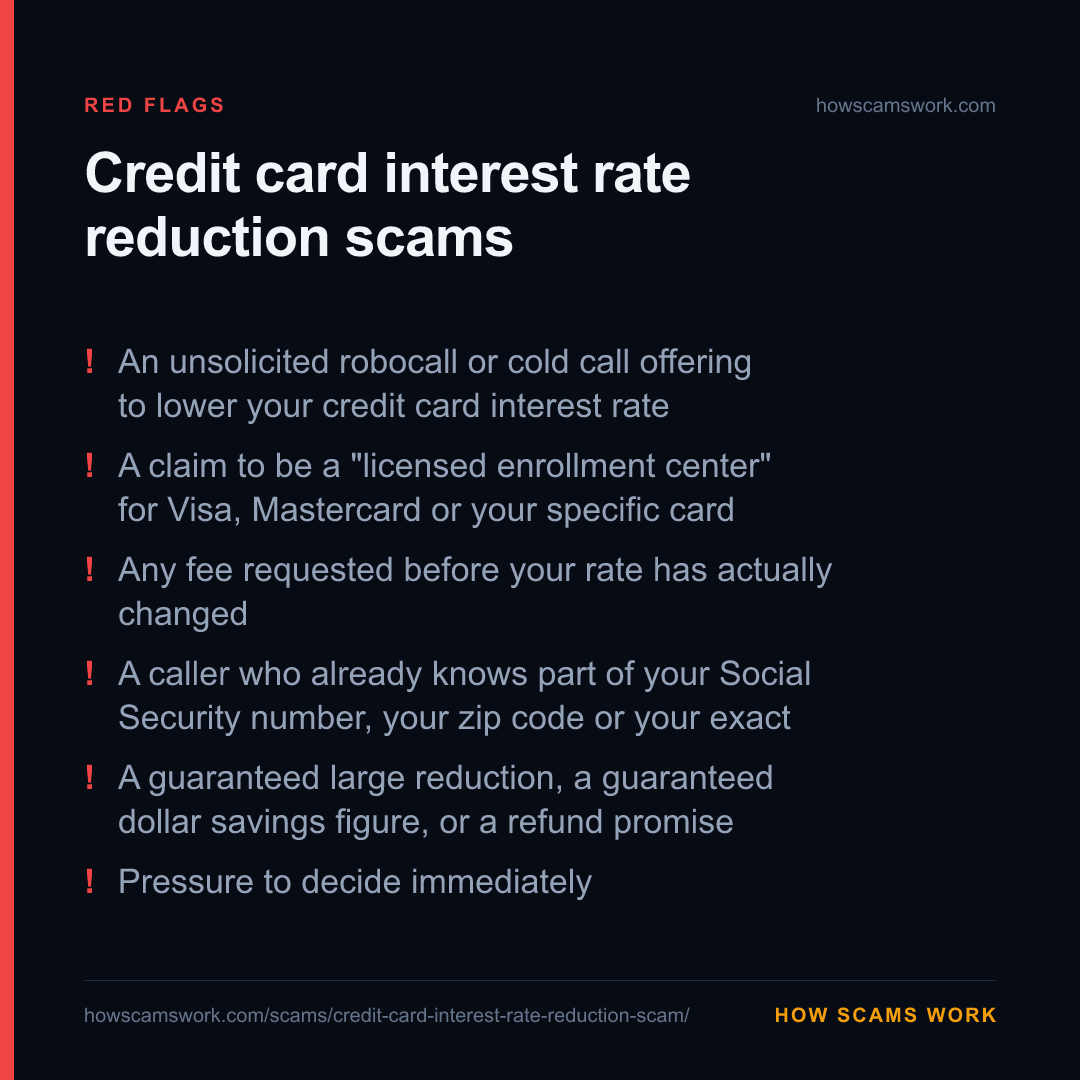
  • An unsolicited robocall or cold call offering to lower your credit card interest rate. Legitimate issuers do not cold-call to sell this; you can ask them directly, for free.
  • A claim to be a “licensed enrollment center” for Visa, Mastercard or your specific card issuer. No such affiliated enrollment centers exist in any case documented on this page.
  • Any fee requested before your rate has actually changed. This alone violates the Telemarketing Sales Rule’s advance-fee ban on debt relief services sold by phone.
  • A caller who already knows part of your Social Security number, your zip code or your exact balance. The FTC’s 2026 alert names this as a specific trust-building tactic, not proof of a real relationship.
  • A guaranteed large reduction, a guaranteed dollar savings figure, or a refund promise made before anyone has reviewed your actual account or attempted to negotiate anything.
  • Pressure to decide immediately, often framed as a limited-time or one-call-only offer.

If it’s happening to you

  1. Hang up and don’t pay. If you haven’t paid yet, no legitimate step requires you to send money before any rate change has occurred.
  2. Call the number on the back of your own card and ask your issuer directly whether you qualify for a lower rate or a hardship program. The FTC’s own advice, unchanged since 2010, is that this works at least as often as the paid version and costs nothing.
  3. If you already paid, document everything: the company name used, the amount charged, the date, and exactly what was promised. Company names in this scam change often, so the name on your statement may not match later coverage of the same operators.
  4. Check your credit card and credit report for unauthorised new accounts. The FTC’s GDP Network complaint alleged this happened to some consumers who gave out card details over the phone.
  5. Report it to the FTC at ReportFraud.ftc.gov and to your state attorney general. See where to report for other countries.
  6. Watch for a refund notice if the company is later sued. The FTC mailed partial refunds in both of the two most recent cases on this page, years after the original complaint.

Where the money goes

Directly into the telemarketing operation’s own US bank accounts and, in the largest documented case, into personal luxury assets, not into an overseas laundering chain.

The upfront fee moves from the consumer straight to whichever shell LLC took the call that day. In the Guice case, proceeds funded a 55-foot ocean yacht and a luxury watch collection, both later surrendered to a court-appointed receiver. What eventually reaches consumers is a small fraction of what was taken, years later: the FTC’s 2023 refund rounds averaged $117 per person against fees that ran as high as $5,000, and the frozen-assets settlement in the earliest documented case recovered $159,000 against a $13.1 million judgment.

The loss range on this page is drawn directly from the fees documented in these three cases, not estimated: it runs from the $500 low end of Life Management’s interest-rate-reduction fee up to the almost $26,000 some consumers paid for that same operation’s separate “debt-elimination” add-on service.

The other half of this story

Our sibling site Clean on Paper explains why the same operation keeps a dozen company names on hand, the same structuring logic used across the schemes on this site, applied here to keep a shut-down robocall script running under a different letterhead.

By the numbers

No published dataset breaks this scheme out as its own category yet, so there is no chart to show. The data page explains which agency categories exist and why some schemes are invisible in official statistics.

Sources

Every factual claim above traces to one of these. Statistics are reported losses; see methodology for what that does and does not measure.
  1. FTC and State of Florida Win Summary Judgment: Court Orders Ringleader of Debt-Relief Scam to Pay $23 Million and Imposes Industry Bans. US Federal Trade Commission. Accessed 2026-10-19. Supports: The Kevin Guice case: the $23,099,878 judgment, the 10,000-plus consumers, the $23 million taken in, the permanent bans, the yacht and watch-collection surrender, and the Andrew Smith quote.
  2. Life Management, Inc.. US Federal Trade Commission. Accessed 2026-10-19. Supports: The case docket number, the full list of corporate and individual defendants, the 13 shell-company structure, and the 2016 complaint and temporary restraining order.
  3. FTC Sends Checks to Consumers Harmed by Credit Card Interest Rate Reduction Scam. US Federal Trade Commission. Accessed 2026-10-19. Supports: The 611 GDP Network/YF Solution refund checks totalling more than $557,000 sent in May 2023.
  4. GDP Network LLC (YF Solution). US Federal Trade Commission. Accessed 2026-10-19. Supports: The GDP Network case docket number, the named defendants (Gino de Paz, Grace de Paz, Shabana Khublal), the three dba shell companies, and the February 2022 stipulated and default orders.
  5. FTC's Request, Court Shutters International Robocall Operation. US Federal Trade Commission. Accessed 2026-10-19. Supports: The AFL Financial Services operation: the 2007 start date, the 10-plus aliases, the Toronto and Orlando locations, the $995 fee, the nearly $13 million from nearly 13,000 consumers, and the November 2010 temporary restraining order.
  6. AFL Financial. US Federal Trade Commission. Accessed 2026-10-19. Supports: The February 2012 settlement terms: the $13.1 million judgment suspended to $159,000, the permanent telemarketing and debt-relief bans, and the Ontario Ministry of the Attorney General's parallel action.
  7. FTC Warns Against Credit Card Interest Rate Reduction Scams. US Federal Trade Commission. Accessed 2026-10-19. Supports: The scheme already being widespread enough by April 2010 to warrant a dedicated consumer alert, and the FTC's core advice to negotiate directly with your card issuer.
  8. Say No Thanks to Unexpected Offers to Lower Your Credit Card Interest Rate. US Federal Trade Commission. Accessed 2026-10-19. Supports: The scam still being active as of April 2026, the specific personal details (partial Social Security number, zip code, exact balance) scammers use to sound legitimate, the illegality of upfront fees, and the advice to contact your card issuer directly.
  9. Complying with the Telemarketing Sales Rule. US Federal Trade Commission. Accessed 2026-10-19. Supports: The Telemarketing Sales Rule's advance-fee ban on debt relief services sold by phone, and the three conditions that must be met before a fee can be charged.

Common questions

Can a company legally lower my credit card interest rate for a fee?

Not by charging you first. The FTC's Telemarketing Sales Rule treats a credit card interest rate reduction pitch as a debt relief service, which means a company selling it by phone cannot collect any fee until it has actually renegotiated or reduced at least one of your debts, you have agreed to the new terms in writing, and you have made at least one payment under them. Every case on this page was charged under exactly that rule.

Is it true I can get a lower rate myself for free?

Usually, yes, which is the FTC's own repeated advice on this scam since at least 2010: call the number on the back of your card and ask. Issuers sometimes grant a temporary promotional rate or a permanent reduction depending on your payment history, at no cost, which is exactly the leverage these companies charge hundreds or thousands of dollars to pretend to use on your behalf.

Why do these callers seem to already know my balance or part of my Social Security number?

The FTC's April 2026 consumer alert warns that scammers use a handful of details, like the last four digits of a Social Security number, a zip code, or an exact card balance, obtained from a prior breach, a data broker or an earlier call, specifically to sound legitimate and get a target to share more. It is a trust-building tactic, not evidence the caller is really affiliated with your bank.

What actually happens to the money after I pay the upfront fee?

In the three documented cases on this page, it went straight into the telemarketing operation's own accounts, sometimes split across a web of same-day shell LLCs. The FTC's 2018 case against Kevin Guice recovered a yacht and a luxury watch collection from the proceeds; its 2023 refund to Guice's victims averaged $117 each, out of upfront fees that ran as high as $5,000.

If this scam has been shut down so many times since 2010, why is it still happening?

Because shutting down one company rarely reaches the people running it. The FTC's November 2010 complaint against the operation later known as AFL Financial Services found the same individuals had used at least 10 different company names since 2007; its 2022 case against GDP Network found a different small group of Orlando operators doing the same thing a decade later. The FTC's own consumer alert on this exact scam is dated April 2026.

What should I do if I already paid?

Treat it the same as any advance-fee billing: document what you were promised, what you paid and to which company name, then report it. If your card information was given over the phone, also contact your card issuer directly to check for unauthorised charges or new accounts opened in your name, something the FTC's GDP Network complaint alleged happened to some consumers.

Where the upfront fee actually goesWhere the upfront fee actually goes. Straight into the telemarketing operation's own accounts, then, in the largest case, into a yacht and a watch collection. Where the upfront fee actually goesStraight into the telemarketing operation's own accounts, then, in the largest case, into a yacht and a watch collection.Someone paying anupfront fee for apromised rate cutAn upfront fee of $500to $5,000, paid beforeany rate change hashappened, illegalunder theTelemarketing SalesRule on its ownA dozeninterchangeable shellLLCs taking the callProceeds split acrosswhichever shell LLCtook the call, in thelargest documentedcase converted into a55-foot yacht and aluxury watchcollectionThe operators' ownaccounts and personalassetsRegulators recover afraction years later:$159,000 against a$13.1 million judgmentin the earliest case,$117 per person onaverage in the largestA fraction mailedback, years later, ifregulators catch itReversibilityA recall is realistically possible only at the first hop, and only in the first hours. After the money is converted it becomes an investigation, not a refund.Why the same operation keeps a dozen company names on hand: Clean on Paper, our sibling sitehttps://cleanonpaper.com/techniques/shell-companies/There is no overseas laundering chain in any of this scheme's documented cases; the fee stays onshore in US (and, in the earliest case, Canadian) accounts, which is also why civil enforcement, not criminal prosecution, is the tool used against it in every case on this page.howscamswork.com
Where the money goes after it leaves, and where it becomes hard to recover.

Report it

Reporting is what produces the enforcement data on this page. Find the right agency and phone number for your country on the report page. If money moved in the last few hours, call your bank first.