Also called: gold bar scam · courier fraud · gold bar courier scam · elder gold scam · bulk cash courier scam
A gold bar courier scam convinces a victim, usually a retiree, that their money is compromised or under federal investigation, then instructs them to liquidate savings into cash or gold and hand it to a courier who arrives in person to collect it "for safekeeping." The FBI says Florida victims alone lost more than $33 million in a single year to this exact scheme, which has produced dozens of US federal prosecutions since 2024.
What it is
A caller, often layered through several fake personas in a single conversation, tech support, then a
bank, then a government official, convinces a victim that their money is compromised or that they are
under federal investigation. The fix they offer is always the same: withdraw the money, convert it into
cash or physical gold and silver, and hand it over in person to someone who will come and collect it
“for safekeeping.” That someone is a courier, and once the gold or cash is in their hands, it is gone.
This is not a phone scam that happens to mention gold. It is a distinct, currently escalating US crime
pattern with its own FBI public warning, issued in January 2024, and its own wave of federal
prosecutions since: couriers and coordinators sentenced to between roughly five and eighteen years in
prison across cases in Florida, Missouri, Michigan and Texas alone. The FBI’s Jacksonville field office
said Florida victims lost more than $33 million in a single year to this exact scheme.
How it actually works
The hook
A pop-up on the victim’s computer, often placed there by malware already running on the machine,
displays a fake “tech support” number, or a cold call arrives claiming to be from Microsoft, a bank, or
a government agency.
Layered impersonation builds trust
The same conversation moves through several fake identities in succession, a tech company, then a
bank’s fraud department, then a federal agent, each one appearing to confirm the last and escalating
the threat until the victim believes multiple institutions agree their money is at risk.
The instruction to liquidate
The victim is told their identity has been compromised, their accounts are under investigation, or their
bank itself is unsafe, and that the only way to protect their money is to withdraw it and convert it into
cash, gold or silver.
Where it could have stopped
The FBI’s own public warning states this without qualification: “the US Government and legitimate businesses will never request you purchase gold or other precious metals.” No bank, police department, court or federal agency has ever had a legitimate process that requires converting savings into precious metal. Any call that reaches this instruction has already identified itself as a scam.
An authentication ritual that feels official
Scammers sometimes direct victims to verify the handoff with the courier using a passcode, such as the
serial number of a dollar bill, a detail that mimics a real security procedure and makes the exchange
feel formal and legitimate rather than like handing valuables to a stranger.
The in-person pickup
A courier, in several documented cases someone who had flown or driven across multiple states, arrives
at the victim’s home or a public meeting place and collects the cash or gold directly.
Repeat visits
The same victim is often visited more than once. One courier made at least 33 separate trips to
different elderly victims’ homes over four months before his arrest; the pattern works because each
successful handoff deepens the victim’s trust that the arrangement is real.
Up the chain, then overseas
Couriers deliver what they collect to a US-based coordinator, who in at least one documented
$150-million network shipped the proceeds onward to Los Angeles and New York before it was laundered
overseas, often toward call centers that prosecutors say operate from India.
Enforcement catches the courier, rarely the organiser
Nearly every US arrest and sentence to date has landed on couriers and coordinators physically present
in the country, not on the call-center operators overseas who never have to show up to collect anything.
Why it works
It borrows the language of real fraud protection. Banks really do call customers about suspicious
activity, and government agencies really do investigate financial crime. The scam’s entire script is a
counterfeit of a process victims already know exists, right up to the point where the instruction (buy
gold, hand it to a stranger) breaks from anything a real process would ever ask.
Layering personas manufactures corroboration. Hearing “tech support,” then “your bank,” then “a
federal agent” each independently confirm the same emergency feels like three sources agreeing, not one
scammer performing three roles in the same call.
Gold defeats the safeguards built around bank transfers. Years of anti-fraud effort have trained
banks to flag unusual wires and trained some customers to be suspicious of them. Converting the same
money into a physical asset and handing it to a person in your driveway routes around every one of those
safeguards at once.
The in-person ritual manufactures legitimacy. A phone call asking for a wire transfer can feel like
an obvious scam. A uniformed-sounding process, a passcode, a scheduled pickup, a receipt-like exchange,
feels procedural, and procedure reads as trustworthy.
And it is built to repeat. Because each visit succeeds without the courier identifying themselves to
anyone outside the scheme, the same victim can be, and often is, visited again weeks later with a new
reason to convert more savings.
Where it comes from
US prosecutions describe an organised, cross-border division of labour. Call-center operators,
described in court documents as based in India, work the phones; couriers inside the United States,
in the cases on this page largely Indian nationals on student or spousal visas or present illegally,
handle the physical pickups; coordinators receive what couriers collect and route it toward
international laundering.
The FBI first issued a dedicated public warning in January 2024, after its Internet Crime
Complaint Center tracked more than $55 million in aggregated losses to this specific pattern between
May and December 2023 alone, a sharp enough rise to warrant a standalone alert separate from the
agency’s earlier warnings about “safe account” wire-transfer scams and tech-support pop-ups.
Losses scale from tens of thousands to tens of millions per network. A single Michigan courier was
tied to roughly $525,000 taken from 14 victims; a single Texas-based coordinator was tied to more than
$150 million moving through one India-linked call-center operation.
Enforcement to date has reached couriers and coordinators, not the organisers. Every sentence and
conviction documented on this page belongs to someone who was physically present in the United States
collecting or receiving valuables. The call-center operators who identify and groom victims by phone are,
in every case read for this page, described only as unnamed co-conspirators operating from overseas.
Real cases
2026 US Sentenced $6.0m
Syed M. Makki, 38, a citizen of India, was sentenced in federal court to fifteen and a half years in prison for his role as a courier in a nationwide conspiracy that convinced elderly victims to liquidate retirement and savings accounts and convert the money into gold bullion. Prosecutors identified 12 victims with combined losses of more than $6 million, and arrested Makki in Illinois while he was still in possession of 16 one-kilogram gold bars worth more than $1 million that he had just collected from two victims over two consecutive days.
Read the case file ·
1 source
2026 US Sentenced $6.6m
Atharva Shailesh Sathawane, an Indian national who had overstayed his US student visa, was sentenced on January 26, 2026 in the Northern District of Florida to 18 years in prison for conspiracy to commit wire fraud and conspiracy to commit money laundering. Over a four-month period he personally travelled to elderly victims' homes at least 33 times to collect cash and gold they had been talked into liquidating, and was finally arrested by an undercover officer posing as a victim.
Read the case file ·
2 sources
2026 US Convicted $150.0m
A federal jury in Austin, Texas convicted Bhavesh Kumar Thakkar, 45, an Indian national on a spousal visa, on two counts of wire fraud and money laundering on October 5, 2026, for serving as the US-based coordinator who received cash and gold that couriers collected from elderly victims across the country on behalf of call-center scammers based in India. Prosecutors tied him directly to more than $150 million in fraud proceeds, which were shipped to Los Angeles and New York before being laundered overseas. Two of his co-defendants, the couriers who did the in-person pickups, had already been sentenced to 97 and 63 months.
Read the case file ·
2 sources
2025 US Sentenced $524,947
Kaushalkumar Chaudhary, 30, of India, was sentenced on July 7, 2025 in the Western District of Michigan to 63 months in federal prison for conspiracy to commit wire fraud, after acting as a "money mule" courier who collected cash, gold and silver from at least 14 victims, including $70,000 in gold bars picked up from one elderly Southwest Michigan woman. He was ordered to pay $524,947 in restitution and will be deported once his sentence is served.
Read the case file ·
2 sources
Red flags
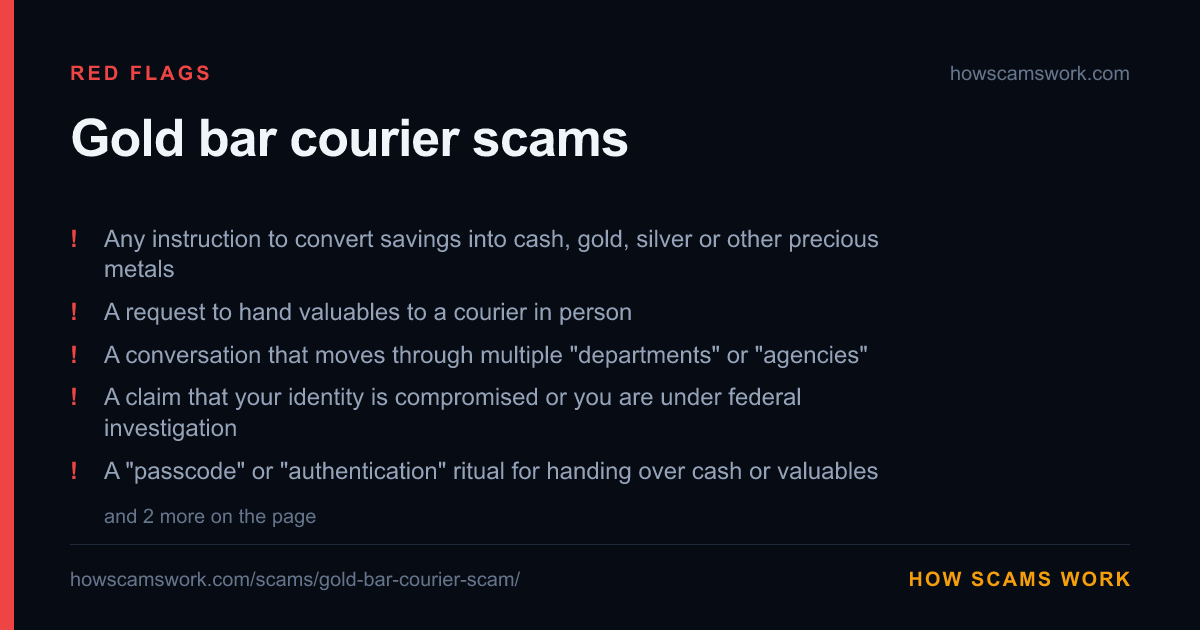
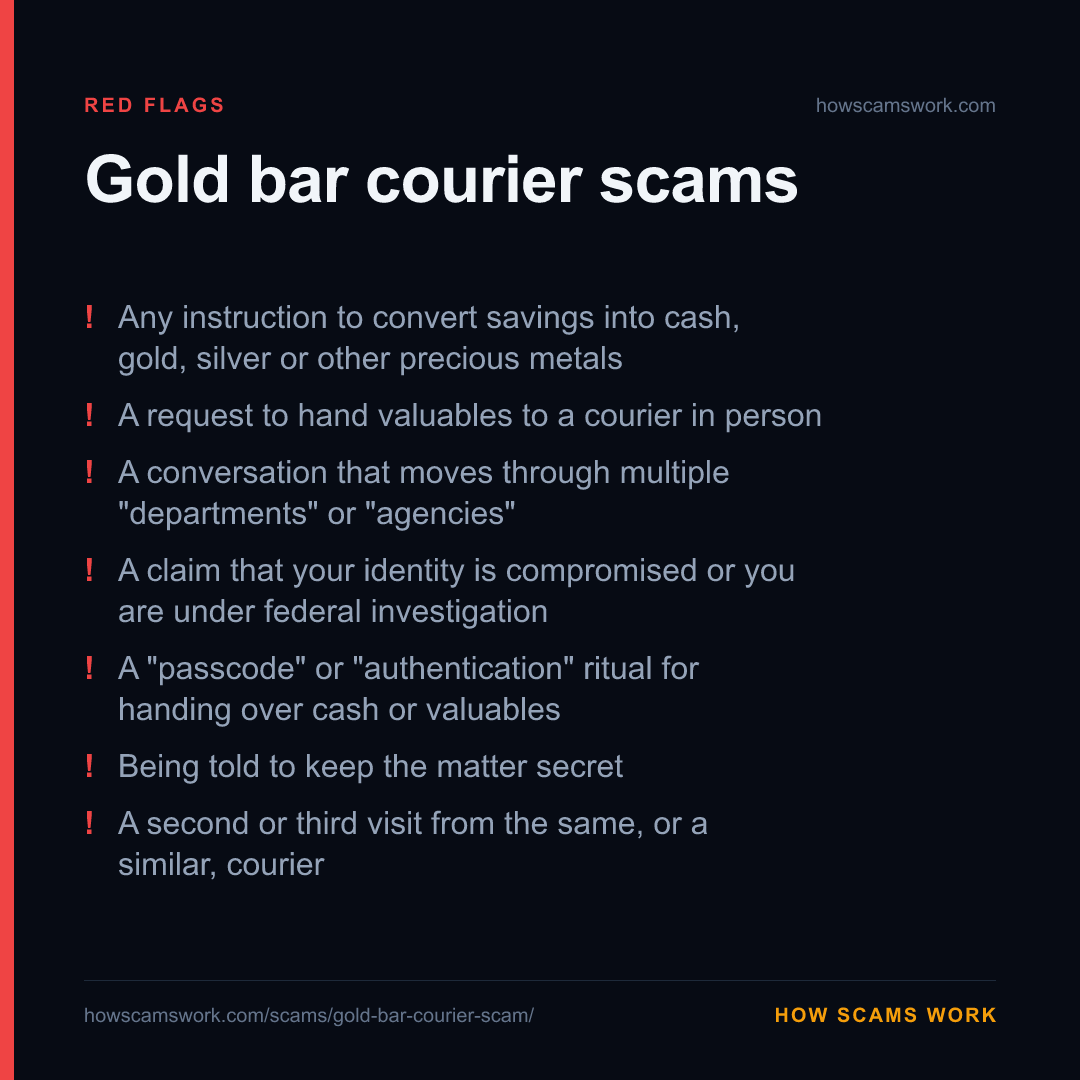
- Any instruction to convert savings into cash, gold, silver or other precious metals. The FBI states flatly that no legitimate government agency or business will ever ask for this.
- A request to hand valuables to a courier in person, especially someone you have never met who arrives at your home or a public location.
- A conversation that moves through multiple “departments” or “agencies” in succession, tech support, then a bank, then law enforcement, each one appearing to confirm the last.
- A claim that your identity is compromised or you are under federal investigation, paired with urgency to act before you can verify independently.
- A “passcode” or “authentication” ritual for handing over cash or valuables, mimicking a security procedure that does not actually exist for this purpose.
- Being told to keep the matter secret, including from family members or your own bank’s staff, “for the investigation.”
- A second or third visit from the same, or a similar, courier after an earlier pickup.
If it’s happening to you
Stop before any gold is purchased or any courier arrives, if you possibly can. If a pickup is already
scheduled, do not keep the appointment.
- Call your bank directly, using the number on your card or statement, not any number given to you
during the suspicious call, and tell them you believe you are being targeted by a gold bar scam.
- Call the police, especially if a courier visit has already happened or is scheduled. Several of
the cases on this page were broken by an undercover officer taking the place of the intended victim at
a scheduled pickup.
- Report it to the FBI’s Internet Crime Complaint Center at ic3.gov with as much detail as you have:
names used, phone numbers, any bank accounts involved, and the name of any precious-metals dealer you
were directed to.
- If you are 60 or older, or reporting on behalf of someone who is, call the Department of Justice’s
Elder Justice Hotline at 1-833-372-8311 for help filing the report and connecting to other victim
resources. See where to report for other countries.
- Tell family members, even if you were told to keep it secret. Secrecy is part of the scheme, not a
genuine security requirement, and a second set of eyes is one of the most effective ways this scheme
gets interrupted before more money moves.
- If gold or cash has already been handed over, document everything immediately: dates, descriptions
of the courier and any vehicle, and every phone number or account used, while the details are still
fresh.
Where the money goes
A physical asset, not a bank balance, which is exactly the point.
The money leaves a victim’s account as cash, or is spent on gold and silver from a dealer, before it ever
reaches a scammer. From there a courier carries it, sometimes across state lines within days, to a
coordinator inside the United States. In the largest documented network on this page, proceeds were then
shipped to Los Angeles and New York before being laundered overseas, toward call-center operations
prosecutors describe as based in India.
Every traceable step in that chain depends on a human being physically carrying something. That is also
why enforcement to date has caught couriers and coordinators, who have to show up in person to collect or
receive the gold, while the call-center operators who groom victims by phone have not, in any case read
for this page, been named or charged.
By the numbers
No published dataset breaks this scheme out as its own category yet, so there is no chart to show.
The data page explains which agency categories exist and why some schemes are
invisible in official statistics.
Every factual claim above traces to one of these. Statistics are reported losses; see
methodology for what that does and does not measure.