Also called: model search scam · talent scout scam · modeling school scam · photo shoot scam · child talent scam
A modeling and talent agency fee scam sells aspiring models, and often their parents, a path to paid work, then earns its money from photo shoots, photo packages and contracts instead of placing anyone. State and federal cases found here, from 1999 to 2016, describe open-call screenings, flattery and large upfront fees. None of them is recent.
Key facts
Category
Job & task
First documented
1999
Typical loss
$600–$1k USD, per victim
Main channels
television and radio ads for open-call screenings, scouts and sales staff in malls and amusement parks, a contract signed after the tryout, a photo shoot sold by the studio, photographs and cards sold at a markup, introductions and web pages in place of placement
Who is targeted
Aspiring models and actors recruited from open calls advertised on television and radio, as in the North Carolina case; Parents approached in shopping malls and amusement parks, as New Jersey alleged, and customers who said they paid for children's modeling careers, as in Florida; People who pay a studio for a photo shoot and a photo package on the strength of being told they have 'the look'; Customers far from the studio: the North Carolina agency sold contracts in cities across the country
Documented origins
United States
Main targets
United States
Case files
4 documented cases
Last reviewed
2026-11-10
The stages of the scheme, in order, with the point where it can still be stopped.
What it is
Wanting to model or act is a real ambition, and there are real agencies. This scheme sells the ambition. A business advertises an open call, tells nearly everyone
they have what it takes, and earns its money from what it sells to the hopeful: a photo shoot, a photo package, a contract, a course. The work it promises is the part that
does not arrive in volume.
The cases here are civil and old, from 1999 to 2016, and none of them is a conviction. They are useful because officials described the pitch in detail. This page does not say how common the scheme is now, and a
search for recent cases did not turn any up.
How it actually works
An open call, or a scout in a mall
North Carolina’s Attorney General said the agency advertised its screenings on television and radio. New Jersey alleged the studio stationed employees in malls and amusement parks, and that parents said they were pressured into contracts. The FTC’s 1999 order bars one
agency from “mass scouting”, in-person solicitation away from its office by scouts or sales staff paid commissions on enrolling people.
The verdict is always yes
The North Carolina Attorney General’s Office said nearly every hopeful was told they had “the look”. The FTC’s 1999 complaint alleged the companies presented themselves as highly selective in scouting, screening and reviewing consumers when they were not.
A contract is signed, and the fees are not clear
After a tryout the North Carolina agency asked people to sign a contract and schedule a photo shoot. New Jersey alleged parents were pressured into contracts without being told the fees and misled about costs and contract terms.
Where it could have stopped
The remedies in these cases name what was missing: New Jersey’s consent order requires disclosure of costs and a cancellation policy, and the FTC’s 1999 order requires a three-day cooling-off period and caps a non-refundable fee at $50. A buyer who asks for every fee and the cancellation terms in writing before signing has the facts the alleged tactics left out.
The photo shoot is the product
North Carolina’s Attorney General said the agency charged about $600 for a photo shoot that complainants called disorganized and unprofessional. Florida alleged customers paid large upfront fees for little more than photo shoots and introductions to industry professionals.
Photographs and cards are sold at a markup
The North Carolina Attorney General said models were asked to buy almost $400 in photographs and cards that cost less than $40.
The promised work does not arrive
New Jersey alleged the studio only provided photo shoots and web access to post photos. In North Carolina people were said to expect print and runway work at $150 per hour but were placed in promotional work at $15 per hour less commission, and the report cites about 8,000 customers who wanted to be models and fewer than 800 jobs.
Enforcement comes years later
The FTC’s complaint was filed in 1999 and settled the same year. North Carolina’s action was reported in 2006. New Jersey sued in 2011 and settled in 2013. Florida’s settlement was announced in 2016, with a $22 million restitution figure, the rest of which was to be pursued after judgment because of the defendants’ claimed insolvency.
Why it works
The pitch is flattering and personal. The North Carolina Attorney General said nearly everyone who tried out was told they had “the look”, so hearing it feels like a verdict rather than a sales line.
The first contact is where families already are. New Jersey alleged staff were stationed in malls and amusement parks.
The cost is split into pieces. A shoot, a photo package and a contract each look like a separate purchase. In North Carolina the shoot was about $600 and the photographs and cards almost $400.
The product is real, the result is not. The shoot happens and the photographs exist. What the cases describe as missing is the work: Florida’s Attorney General said customers got photo shoots and introductions, and New Jersey said the studio provided shoots and web access.
A new company can carry on. New Jersey’s case names a successor, InterFACE1, LLC, to the original studio.
Where it comes from
A US scheme in the cases found here. The earliest is the FTC’s 1999 action, which alleges the owner of the Erickson agency was paid to evaluate consumers and let other companies use her name and client list. North Carolina’s agency sold contracts
in cities across the country from 2001, and Florida’s defendants were a New Jersey-based company.
The money is small per customer and large in total. In North Carolina the shoot and photographs came to about $1,000 for a customer who bought both, on the Attorney General’s figures. The refunds came to about $135,000 for an estimated 512 customers and New Jersey’s restitution
was $99,590 for 104. Florida’s judgment set $22 million in restitution, $3.5 million in penalties and $500,000 in fees and costs, after more than 200 complaints.
What this page could not find. No case from the last several years turned up in the search. The FTC’s own consumer advice page on modeling scams could not be reached, so the red flags below come from the cases.
In February 2016 Florida Attorney General Pam Bondi announced a settlement with the entities doing business as InterFACE Talent and its president, alleging they falsely promised to help Florida consumers get modeling and acting jobs while taking large upfront fees for little more than photo shoots and introductions. The consent judgment includes $22 million in restitution, $3.5 million in civil penalties and $500,000 in fees and costs, and bans the defendants from talent services in Florida. More than 200 complaints were received.
In July 2011 New Jersey sued Industry Model and Talent Studios, LLC, its successor InterFACE1, LLC and their owner, alleging they misled consumers into thinking they were a model or talent agency that could place people in the industry when they only provided photo shoots and web access to post photos. On February 13, 2013 the State announced a settlement: $400,000, made up of $99,590 in restitution to 104 past customers and $300,410 in civil penalties and costs. The defendants did not admit wrongdoing.
In 2006 (reported August 3) North Carolina's Attorney General's Office announced that Face National Models & Talents of Charlotte and its two managers were permanently barred from running a modeling business and must refund about $135,000 to an estimated 512 customers. The Attorney General's Office said the agency told almost everyone who tried out that they had "the look", charged about $600 for a photo shoot and almost $400 for photographs and cards that cost less than $40, and then placed few people in work.
In May 1999 the FTC charged several companies with misrepresenting their ability to get high-paying jobs for consumers who signed up for modeling and acting courses, and with claiming to be highly selective when they were not. Two companies settled in August 1999. On October 21, 1999 the FTC announced the settlement with The Erickson Agency and its owner: a $25,000 judgment, a ban on assisting others in selling such programs and limits on fees and scouting if they run their own program.
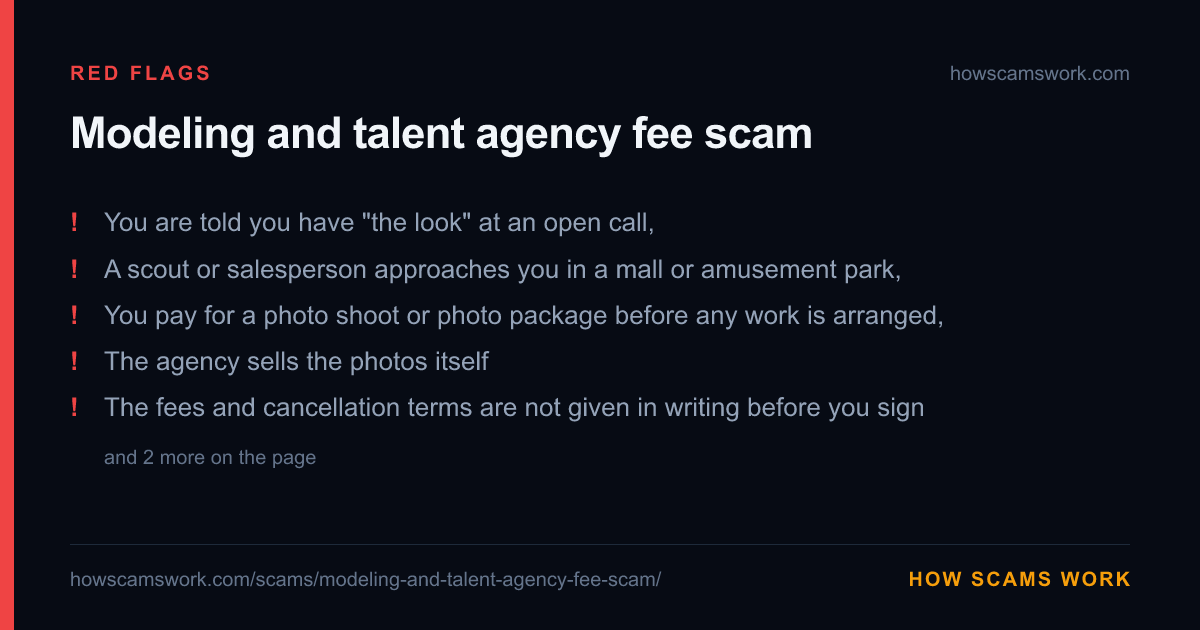
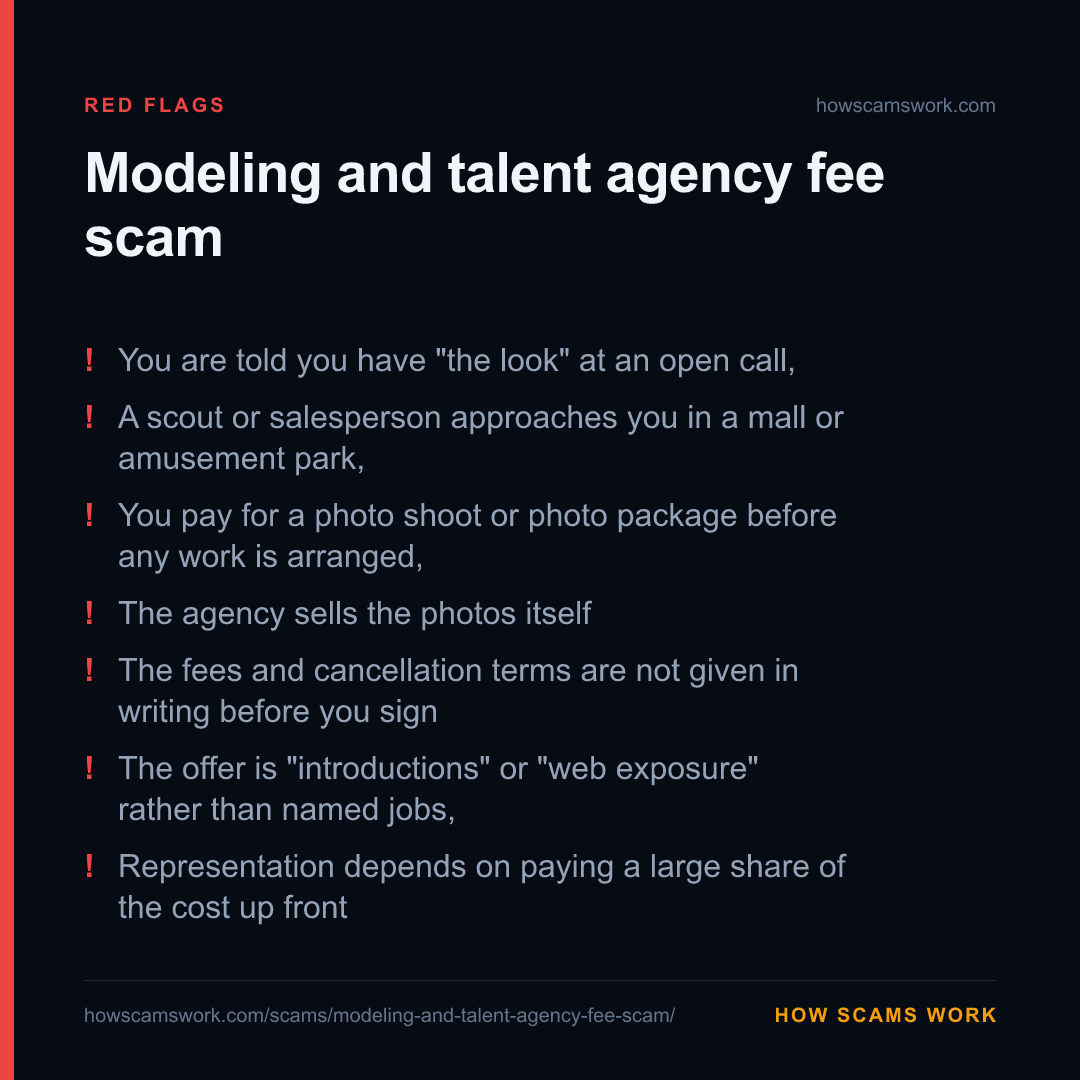
You are told you have “the look” at an open call, and nearly everyone is, as the North Carolina Attorney General said.
A scout or salesperson approaches you in a mall or amusement park, as New Jersey alleged.
You pay for a photo shoot or photo package before any work is arranged, in the amounts reported: about $600 and almost $400.
The agency sells the photos itself. In North Carolina the Attorney General compared almost $400 charged with a cost of less than $40.
The fees and cancellation terms are not given in writing before you sign. New Jersey’s order requires both disclosures.
The offer is “introductions” or “web exposure” rather than named jobs, as in the New Jersey and Florida cases.
Representation depends on paying a large share of the cost up front. The FTC’s 1999 order limits that to 50 percent for the agency it covers.
If it’s happening to you
Ask for every fee and the cancellation terms in writing before you sign or pay, and take time to read them.
Ask who the agency has placed and for what, and check what you are told with the clients it names, not with the agency.
Search the company name with “complaint” or “attorney general” before paying.
Keep the contract, receipts and photographs, and note what was promised and by whom.
Report it to the FTC and your state attorney general’s consumer protection office. See where to report for other countries.
Where the money goes
The documented money moves from the customer to the studio as a shoot fee, a photo package and contract payments. Recovery comes later and is partial: about $135,000 ordered refunded in North Carolina, $99,590 in New Jersey restitution,
and in Florida a $22 million restitution judgment that the defendants’ claimed insolvency left to post-judgment proceedings, with partial refunds from frozen assets. The FTC’s 1999 order was a $25,000 judgment.
No published dataset breaks this scheme out as its own category yet, so there is no chart to show.
The data page explains which agency categories exist and why some schemes are
invisible in official statistics.
Sources
Every factual claim above traces to one of these. Statistics are reported losses; see
methodology for what that does and does not measure.
FTC Ends Erickson's Supporting Role.
Federal Trade Commission (October 21, 1999). Accessed 2026-11-10. Supports: The May 1999 allegations, the settlements, the $25,000 judgment, the $50 non-refundable fee cap, the three-day cooling-off period, the 50 percent limit and the bar on commission-paid mass scouting.
Attorney General Closes Down Alleged Modeling Agency Scam.
WRAL.com (posted August 3, 2006). Accessed 2026-11-10. Supports: The North Carolina agency, its screening ads, the 'look' pitch, the $600 shoot, the almost $400 in photographs and cards, the hourly rates, the bar and the $135,000 refund to an estimated 512 customers.
State Secures Restitution for Over 100 Customers, Under $400,000.
New Jersey Office of the Attorney General and Division of Consumer Affairs (February 13, 2013). Accessed 2026-11-10. Supports: The 2011 lawsuit, the allegation that the studio provided only photo shoots and web access, the mall and amusement park sales, the $400,000 settlement and the terms.
$22 Million Dollar Settlement Over Model Company Talent Case.
LawFuel (February 25, 2016). Accessed 2026-11-10. Supports: The Florida settlement, the allegations of upfront fees for photo shoots and introductions, the more than 200 complaints and the $22 million, $3.5 million and $500,000.
No. The cases here concern businesses that, according to state and federal officials, sold photo shoots, photo packages and courses on false promises of work. They do not describe the industry as a whole, and this page is not advice on any particular agency.
What is the usual red flag?
In the cases here it was payment before work: large upfront fees for photo shoots, photo packages or courses, paired with a promise of jobs. New Jersey alleged the studio only provided photo shoots and web access to post photos. The FTC's 1999 order for one agency capped a non-refundable fee at $50 and required a three-day cooling-off period.
Were the people behind these businesses convicted?
Not in the cases on this page. All four are civil: a 1999 FTC consent order, a North Carolina action, a New Jersey consent order and a Florida consent judgment. In New Jersey the defendants did not admit wrongdoing, and the FTC said its 1999 order was not an admission of a violation.
Is this still happening?
This page cannot say. The cases found date from 1999 to 2016, and a search for recent ones did not turn up any. An older case shows how the pitch was described by officials, not how common it is now.
How much did customers lose?
The figures that exist are partial. North Carolina's Attorney General said one agency charged about $600 for a photo shoot and almost $400 for photographs and cards that cost less than $40, and ordered about $135,000 refunded to an estimated 512 customers. New Jersey's settlement included $99,590 in restitution for 104 customers. Florida's judgment set $22 million in restitution.
Where do I report one?
Report to the FTC and to your state attorney general's consumer protection office. See where to report for other countries.
Where the money goes after it leaves, and where it becomes hard to recover.
Share the red flags
A card made from this page's red flags, for anyone you think might be targeted. Send it to a parent, a neighbour or a group chat.
Reporting is what produces the enforcement data on this page. Find the right agency and phone
number for your country on the report page. If money moved in the last
few hours, call your bank first.
Before you continue to How Scams Work
We use browser storage to remember this choice, and nothing else is needed to read the site. If you choose
Accept all, we also let Google Analytics set cookies (_ga, _ga_*) to count
visits and see which pages are read.
Accept required gives you the whole site with no analytics cookies. There is no advertising
here and no other tracking. You can change your choice at any time from "Cookie choices" in the footer.