Also called: ERAP fraud · emergency rental assistance fraud · rental assistance fraud · pandemic rental assistance scheme · fake landlord COVID relief fraud
Emergency Rental Assistance Program fraud files a false application, often inventing or borrowing a landlord identity, to collect federal COVID-19 rent relief that was never owed. Treasury's $46.55 billion programme let applicants self-attest eligibility instead of proving it, and the fund's ringleader case, in Seattle, personally kept more than $2 million before being sentenced to 5 years in March 2024.
What it is
The Emergency Rental Assistance Program was a real federal relief programme, not a pretext. Congress gave
the US Treasury $46.55 billion in December 2020 and March 2021 to help renters who had fallen behind
on rent or utilities during the COVID-19 pandemic, paid out through state, local and tribal grantees, many
of whom contracted the actual casework to nonprofits.
To get that much money out fast, Treasury let grantees accept a renter’s or landlord’s own written
self-attestation of eligibility, income or a tenancy, in place of a pay stub, lease or tax record. The
Government Accountability Office told Treasury directly, while the programme was still running, that this
flexibility “increases risks of noncompliance, improper payments, and fraud.” Every documented case on
this page is a version of the same move: inventing or borrowing a landlord identity for a tenancy that
was fictional, overstated, or simply not the applicant’s to claim, then letting a grantee’s own self-
attestation process do the rest.
How it actually works
A real pandemic programme, built to move fast
Treasury’s Emergency Rental Assistance Program pays rent and utility arrears for tenants hit by COVID-19,
through state, local and tribal grantees under pressure to disburse a fixed, one-time pool of money
quickly.
Self-attestation instead of paperwork
A grantee can accept a renter’s or landlord’s written statement of eligibility instead of requiring a pay
stub, lease or tax record, a flexibility Treasury adopted deliberately and GAO warned, in writing, increases
fraud risk.
A landlord relationship that does not exist
The applicant invents or borrows a landlord identity: a purported charitable organization claiming to
manage properties it has no lease for, a family member named as a landlord with no real ownership role,
or, in the largest documented ring, dozens of associates posing as both the fake tenant and the fake
landlord on the same application.
The application reaches a grantee racing a deadline
Thousands of applications moved through local housing agencies and nonprofits working against a hard,
one-time funding deadline, with little practical time to verify who actually owned or managed a named
property before approving payment.
Where it could have stopped
A single check confirming the named landlord actually owned or had a management agreement for the property, before the payment went out rather than in an audit years later, is the control every documented case on this page exploited the absence of. It is also the exact gap GAO raised publicly in February 2022, while the programme was still accepting applications.
The payment lands with the fraud, not the renter
ERAP pays the landlord of record directly rather than the tenant, so the money goes straight to whatever
landlord identity the application named, real or fabricated, the moment the grantee approves it.
The proceeds move into ordinary spending
Documented cases show the money converted into cash withdrawals, luxury vehicles, jewellery, cosmetic
surgery and designer goods, and, in the largest ring, kickback payments to the dozens of associates who
supplied more fake tenant and landlord identities.
The fund runs out, and the clawback comes years later
ERAP’s one-time money is gone long before most of these cases are discovered. The FBI, the Treasury Office
of Inspector General and the US Secret Service have brought sentencings in 2024 and 2025, years after the
underlying applications were filed and well into the programme’s own wind-down.
Why it works
Self-attestation was a deliberate trade-off, not an oversight. Getting $46.55 billion to renters
facing eviction during a national emergency meant accepting a renter’s or landlord’s own word over
documentation Treasury knew many households could not quickly produce. GAO’s own review said as much:
the flexibility that made the programme reach people fast is the same flexibility every documented case
here used to get paid.
The money pays the landlord, not the tenant, which makes the landlord the only identity worth faking.
A fraudulent applicant does not need to convince anyone they are a struggling renter; renters were the
sympathetic, undocumented half of every application. The entire fraud turns on one invented or borrowed
fact: who the landlord is.
A grantee processing thousands of time-pressured applications has little room to investigate any one
of them. Local housing agencies and the nonprofits they contracted with were built to disburse money
quickly during a crisis, not to run property-ownership checks on every applicant, which is exactly the gap
a fabricated landlord identity, a family member, or a purported charity slipped through.
Insider access removed even the self-attestation check. Valencia Franklin worked for the nonprofit
Merrillville, Indiana trusted to administer its own ERAP funds; she did not need to fool a stranger’s
review process, only her own employer’s.
And enforcement runs years behind disbursement. The underlying applications in the cases documented
here were filed in 2020 and 2021; the sentencings landed in March 2024, December 2024 and June 2025, long
after the programme itself had stopped taking new applications.
Where it comes from
Entirely domestic, and built directly on top of a real, well-publicized federal relief programme rather
than a fabricated one.
Scale runs from a single insider to a ring of more than fifty. Valencia Franklin fabricated
applications naming her own family members as landlords from inside the Merrillville, Indiana nonprofit
that administered the funds; Dora Boyd used a purported charitable organization to file at least 30
fraudulent applications on her own; Paradise Williams enlisted more than 50 associates, including five
codefendants, to pose as fake tenants, landlords and small-business owners across not just ERAP but also
the Paycheck Protection Program, the Economic Injury Disaster Loan programme and CARES Act unemployment
benefits, in what prosecutors called the largest such ERAP theft case in the nation.
The documented mechanism is always a fabricated or borrowed landlord identity, never a fake property
listing. Unlike a vacation-rental or apartment-hunting scam aimed at an individual consumer, nobody here
is tricked into paying a deposit; a government grantee is tricked into paying a landlord who was never
real, or never actually that tenant’s landlord.
Enforcement is criminal, and it is still landing years after the programme’s own deadline passed. The
FBI, the Treasury Office of Inspector General, the US Secret Service and local housing-agency investigators
have run these cases; ERA2’s period of performance, the deadline for grantees to spend the money at all,
ended September 30, 2025.
And the money, once it moves, stays almost entirely inside the ordinary US financial system. There is
no offshore network or cryptocurrency exchange in any of the documented cases here. Proceeds went into US
bank accounts, vehicles and retail purchases, traceable through conventional financial and bank records
once investigators started looking.
Real cases
2025 US Sentenced $352,300
Valencia Franklin, 52, of Lynwood, Illinois worked for a Merrillville, Indiana nonprofit entrusted with administering federal Emergency Rental Assistance Program funds for local residents affected by COVID-19. In 2021, she defrauded her own employer by preparing fraudulent ERAP applications that falsely claimed her family members were landlords for certain properties they had no actual connection to, causing hundreds of thousands of dollars in fraudulent payments to be issued to herself and others. She pleaded guilty to wire fraud and was sentenced on June 3, 2025 to 24 months in prison and ordered to pay $352,300 in restitution.
Read the case file ·
1 source
2024 US Sentenced $166,292
Dora T. Boyd, 33, of Fort Wayne, Indiana used a purported charitable organization to file at least 30 fraudulent applications to the City of Fort Wayne's federally funded Emergency Rental Assistance Program between March and November 2021, falsely claiming to be the landlord for numerous tenants with whom she had no actual landlord-tenant relationship, and backing the applications with fake leases and fake tax documents. She attempted to steal more than $400,000 and received $166,292. She pleaded guilty to wire fraud and was sentenced on December 12, 2024 to 50 months in prison and ordered to repay the full amount in restitution.
Read the case file ·
1 source
2024 US Sentenced $6.8m
Paradise Williams, 29, of Seattle led a ring that from June 2020 to February 2022 submitted more than 125 fraudulent applications to King County's federally funded Emergency Rental Assistance Program, the Paycheck Protection Program, the Economic Injury Disaster Loan program, and CARES Act unemployment benefits, a scheme prosecutors called the largest such ERAP theft case in the nation. She enlisted over 50 associates, including five codefendants, to pose as fake tenants, landlords and small-business owners, fabricating bank statements, tenant ledgers and landlord attestations. The ring sought to steal more than $6.8 million; Williams personally obtained over $2 million, spending it on luxury cars, cosmetic surgery, jewellery and designer goods, and received more than $1.2 million in kickbacks from associates for facilitating their fraudulent submissions. She pleaded guilty to wire fraud and money laundering and was sentenced on March 5, 2024 to 5 years in prison.
Read the case file ·
1 source
Red flags
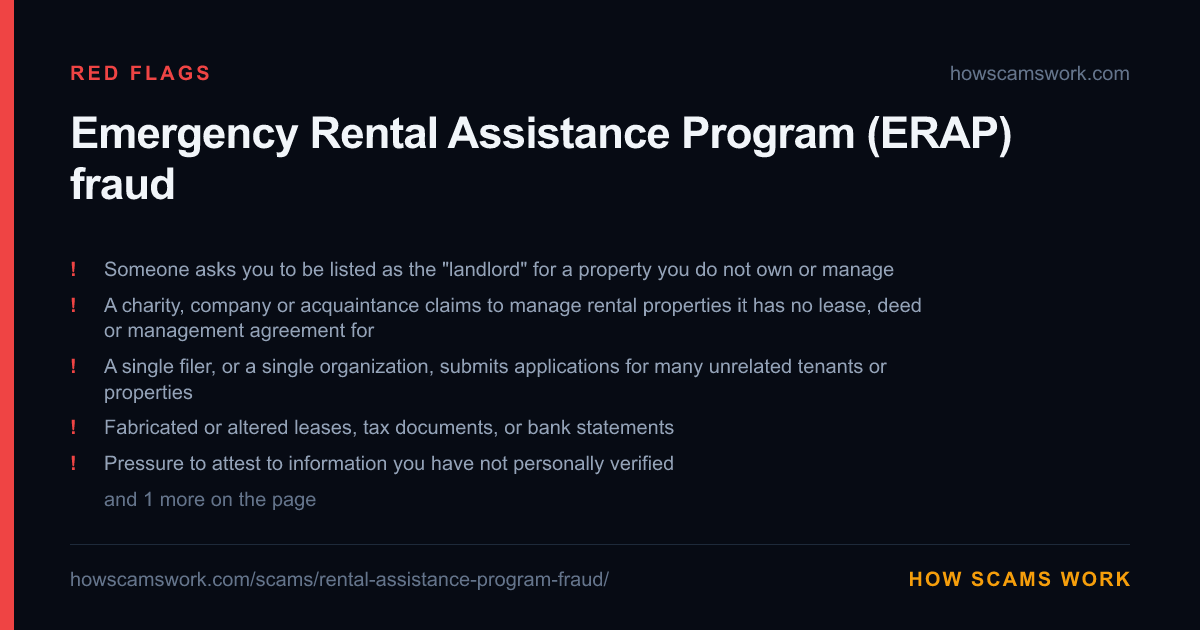
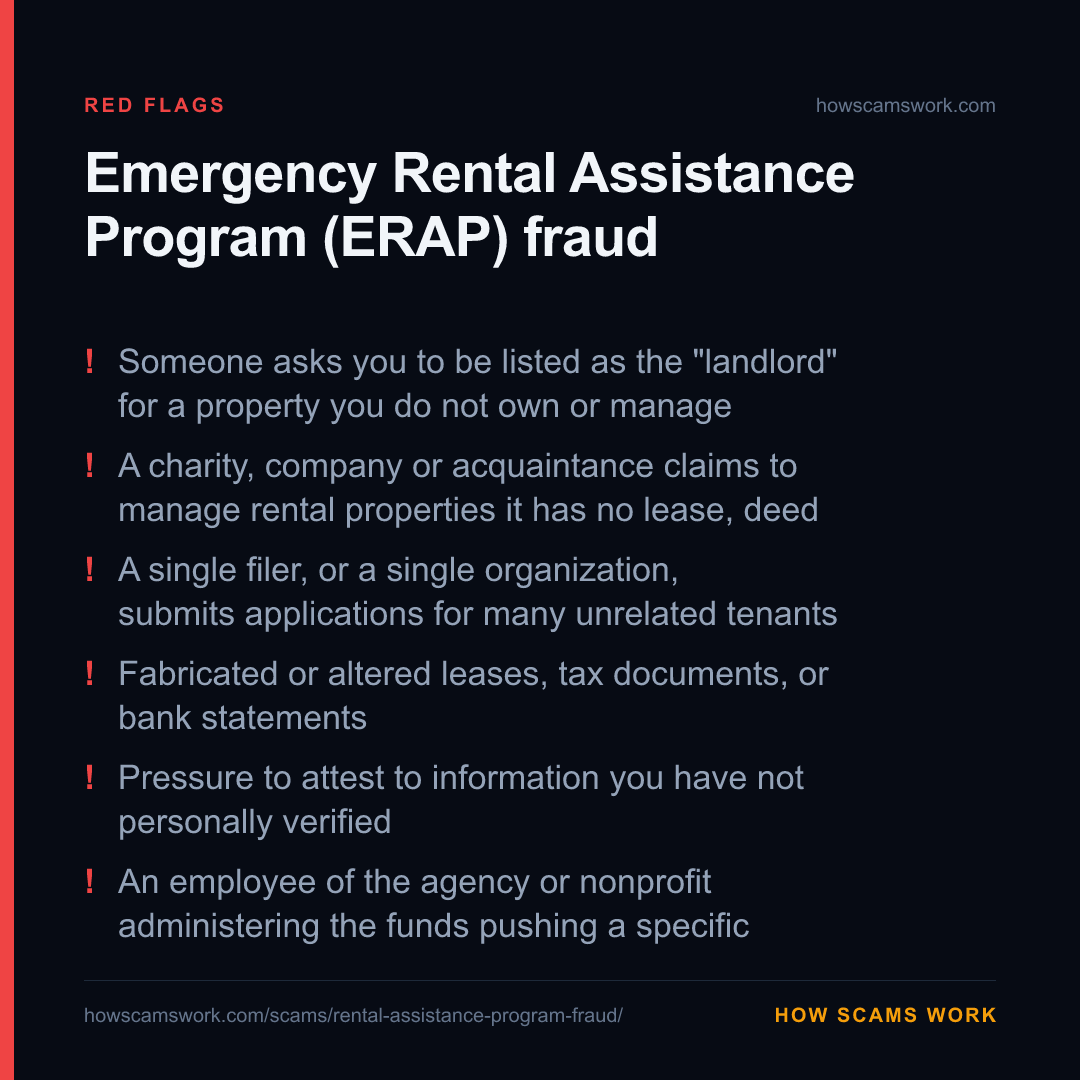
- Someone asks you to be listed as the “landlord” for a property you do not own or manage, in exchange for a cut of the payment or simply as a favour.
- A charity, company or acquaintance claims to manage rental properties it has no lease, deed or management agreement for.
- A single filer, or a single organization, submits applications for many unrelated tenants or properties with no plausible shared ownership or management relationship.
- Fabricated or altered leases, tax documents, or bank statements submitted “to speed up” an application.
- Pressure to attest to information you have not personally verified, especially tenancy or ownership facts, because a deadline is approaching.
- An employee of the agency or nonprofit administering the funds pushing a specific application through, or urging you to name someone specific as your landlord.
If it’s happening to you
If someone is asking you to be listed as a landlord or tenant for a relationship that is not real, decline and do not sign anything, whatever reason is given for the request.
- If you discover your name was used on an ERAP application you never filed, contact the agency or
nonprofit that administered the programme in your area and the US Treasury Office of Inspector General.
- If you are a legitimate landlord and discover someone filed in your name, request the agency’s
records on the application and put your dispute in writing immediately; a paper trail matters if the
case is later investigated or prosecuted.
- Keep every document connected to any rental-assistance application you were asked to sign or
support, including who approached you and what you were told the money was for.
- Do not spend or move funds you now have reason to doubt while you seek advice; documented cases
show continued spending after an investigation begins being treated as further evidence, not a defence.
- Report suspected rental-assistance fraud to the Department of Justice’s National Center for
Disaster Fraud Hotline at 866-720-5721 or through its web complaint form, and to your local housing
agency’s inspector general. See where to report for other countries.
- If you were asked to participate without being told what the application was actually for, that
distinction, misled versus knowing, is exactly what a defence attorney needs to assess early, not
after a federal referral has already been made.
Where the money goes
Almost entirely domestic, moving from the US Treasury through a state, local or tribal grantee straight
to whatever landlord identity the application named, with no offshore network or cryptocurrency exchange
in any of the documented cases here.
Because ERAP pays the named landlord directly rather than the tenant, the fraud only has to control that
one identity, a fabricated charity, a family member, or an alias, and the payment arrives with no further
step required. What remains after the schemer’s own cut moves into ordinary assets and spending: vehicles,
jewellery, cosmetic surgery, designer goods, and, in the largest documented ring, kickback payments to the
dozens of associates who supplied more fake tenant and landlord identities. Because the money stays inside
the conventional US financial system, recovery is also conventional: restitution orders and criminal
forfeiture, imposed years after the underlying applications were filed and the one-time relief funds were
already spent.
By the numbers
No published dataset breaks this scheme out as its own category yet, so there is no chart to show.
The data page explains which agency categories exist and why some schemes are
invisible in official statistics.
Every factual claim above traces to one of these. Statistics are reported losses; see
methodology for what that does and does not measure.