Also called: reverse mortgage fraud · HECM fraud · home equity conversion mortgage scam · reverse mortgage equity theft
A reverse mortgage scam uses a legitimate, federally insured loan, open only to homeowners 62 and older, as the vehicle for theft: a contractor, loan officer or trusted fiduciary talks a senior into borrowing against their home equity, then diverts the proceeds. Three documented US cases show losses from $530,000 to $7 million, and prison sentences of up to 17 years.
What it is
A reverse mortgage lets a homeowner aged 62 or older borrow against their home’s equity without making
monthly payments; the loan, plus interest and fees, becomes due only when the borrower dies, sells the
home or moves out permanently. It is a real, federally insured product, most commonly a Home Equity
Conversion Mortgage, backed by the FHA, and most of the industry that sells it operates lawfully.
The scheme documented on this page is not the loan itself. It is what a contractor, loan officer or
someone a senior has trusted with their finances does once that loan closes and a check is cut.
Three federal cases, spanning a Chicago home-repair operation, a Florida loan-officer ring, and a
Tacoma attorney acting as trustee, show the same underlying move: get an eligible homeowner into a
reverse mortgage, then take the money that was supposed to be theirs.
The product’s own design is part of what makes this durable. Because repayment is deferred, often
for years, until the borrower’s death or move, theft from the proceeds does not surface the way a
drained checking account would. In the Tacoma case on this page, an attorney used a 2018 reverse
mortgage to quietly refill a trust account he had already been stealing from, and the theft was not
caught until the account held $15.
How it actually works
Finding someone who qualifies
The target is specific: a homeowner 62 or older with meaningful equity. Public property records,
mortgage-payoff history and, in the Chicago case, direct door-to-door canvassing of a neighborhood make
that person easy to find.
A reason to borrow that isn’t the real one
A contractor frames the loan as the only way to pay for needed repairs. A loan officer frames it as free
money with no monthly bill. A trustee or someone holding power of attorney simply arranges it as part of
“managing” the victim’s finances. None of these pitches mention that the money is about to go somewhere
else.
Where it could have stopped
Every Home Equity Conversion Mortgage borrower must meet with an independent, HUD-approved counselor before closing, specifically so someone outside the sales relationship can ask whether the loan actually serves the borrower. That protection only works if the counseling is genuine: an operator who schedules it, sits in on it, or has already told the borrower what to say has defeated the one safeguard built into the product for exactly this situation.
Paperwork built to clear underwriting
In the Florida case, that meant altered appraisals inflating home values so borrowers who had too little
equity to qualify qualified anyway. In the Chicago case, it meant documents presented as required repair
authorizations. Genworth approved, and the FHA insured, more than $2.5 million in loans built this way.
The loan closes and proceeds are disbursed
A Home Equity Conversion Mortgage can pay out as a lump sum, in monthly payments, or both. Whichever
form it takes, the cash now exists, often routed through or alongside an account the operator already
controls.
The money goes somewhere other than the borrower
In the Chicago case, homeowners paid for repair work that was never substantively performed. In the
Florida case, more than $998,000 moved into an account controlled by two of the loan officers. In the
Tacoma case, reverse mortgage proceeds went into a trust the attorney was already draining for personal
transfers he disguised as fees he was owed.
The debt against the home keeps growing regardless
Interest and fees accrue on the full loan balance whether or not the borrower ever saw the benefit of
the money. The homeowner, or eventually their estate, remains on the hook for repaying it.
Years before it surfaces
The Tacoma trust was not down to its last $15 until roughly a decade after the theft began. The Florida
ring ran from May 2009 to November 2010 before charges followed. Sentences in the cases on this page
came one to fifteen years after the underlying conduct, long after whatever the money bought was gone.
Why it works
The victim is, by definition, eligible and often isolated. A reverse mortgage requires exactly the
profile predators look for anyway: an older homeowner with a paid-down or low-balance mortgage and real
equity, frequently someone already depending on a caregiver, contractor or fiduciary for help managing
money.
No monthly payment means no immediate red flag. A traditional loan scam shows up the first month a
payment is missed. A reverse mortgage has no such payment to miss, so proceeds can be diverted for years
without triggering a late notice, a collections call, or anything else that would prompt a family member
to ask questions.
The one real safeguard can be captured. Independent HUD counseling exists precisely to put a
disinterested third party between the borrower and the sale. When the person arranging the loan is also
present for, or has coached the borrower through, that counseling session, the safeguard becomes a
formality rather than a check.
A real federal insurance program backs the paperwork. FHA insurance on the underlying loan makes the
transaction look, and in a narrow technical sense be, completely legitimate. The fraud lives entirely in
who ends up holding the cash, not in whether the loan itself exists.
And the delay in repayment is also a delay in discovery. Because nothing is due until the borrower
dies, sells, or moves, the clearest evidence that something is wrong, an unaffordable payment, a
foreclosure notice, often does not arrive until the person best positioned to explain what happened is
no longer able to.
Where it comes from
Entirely domestic, and run by people the homeowner had reason to trust before the theft, not strangers
cold-calling from overseas.
Every documented case on this page is a US federally insured loan product, misused by someone with an
existing relationship to the victim. A contractor they hired. A loan officer who solicited them. A
lawyer managing their trust. This is not an offshore call-center operation; it is a small number of
people exploiting a specific trust relationship and a specific federal program at the same time.
Scale runs from a single trusted individual to an organized ring. The Tacoma case involved one
attorney acting alone over a decade. The Florida case involved four coordinated defendants, loan
officers and a title agent, working through a single mortgage company and a single title company. The
Chicago case involved a contractor and four co-conspirators who together affected more than 100
households in one part of one city.
Enforcement is criminal, and it is slow. Every case on this page ended in federal wire fraud
convictions and prison time, not just a civil fine, which distinguishes it from several other schemes on
this site. But every sentence also landed years after the underlying conduct: the Florida ring’s
2009-2010 scheme was sentenced in 2011 and 2012; Chicago’s scheme, documented back to 2008, was
sentenced in 2025; the Tacoma attorney’s decade of theft ended in an 18-month sentence handed down in
2025.
Real cases
2025 US Sentenced $7.0m
Mark Diamond, a Chicago contractor, ran a home repair and reverse mortgage fraud scheme that targeted elderly and disabled homeowners, overwhelmingly Black, on Chicago's West Side, convincing them to take out reverse mortgages to pay for repairs he then failed to substantively perform. Prosecutors said the scheme ran back to 2008, defrauded more than 100 homeowners aged 62 to 98 out of at least $7 million, and ended with a 205-month federal prison sentence in January 2025.
Read the case file ·
2 sources
2025 US Sentenced $880,000
Colby Parks, a Tacoma, Washington attorney, became trustee of a disabled client's living trust in 2010 after she received a $1.66 million settlement from a motorcycle accident. Over roughly a decade he transferred more than $880,000 of her trust funds into his own accounts, and in 2018, as the trust neared depletion, had her take out a reverse mortgage on her home and used the proceeds to keep the trust account looking solvent while he continued diverting funds. He pleaded guilty to wire fraud in May 2025 and was sentenced to 18 months in federal prison.
Read the case file ·
2 sources
2012 US Sentenced $2.5m
From May 2009 through November 2010, Louis Gendason and three co-defendants at a Florida mortgage company and a Pennsylvania title company solicited homeowners aged 62 and older into reverse mortgages, using appraisals Gendason altered to fraudulently inflate home values so borrowers who did not actually have enough equity would qualify. Genworth Financial Home Equity Access approved, and the FHA insured, more than $2.5 million in loans built on the falsified paperwork. All four defendants were convicted and sentenced to federal prison between November 2011 and January 2012.
Read the case file ·
3 sources
Red flags
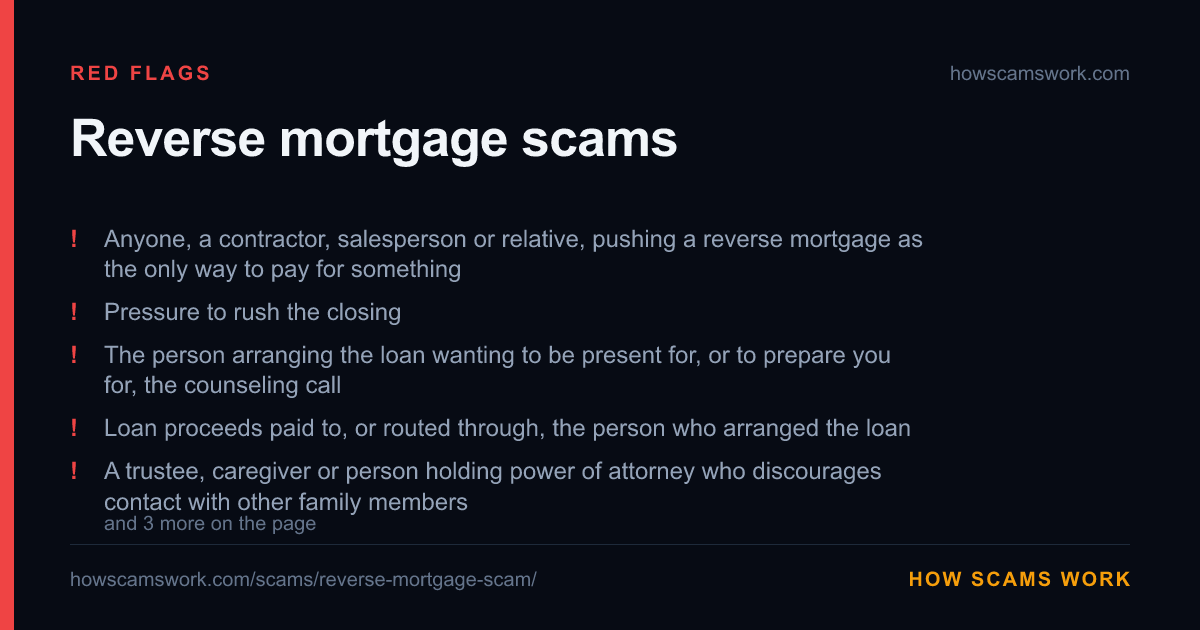
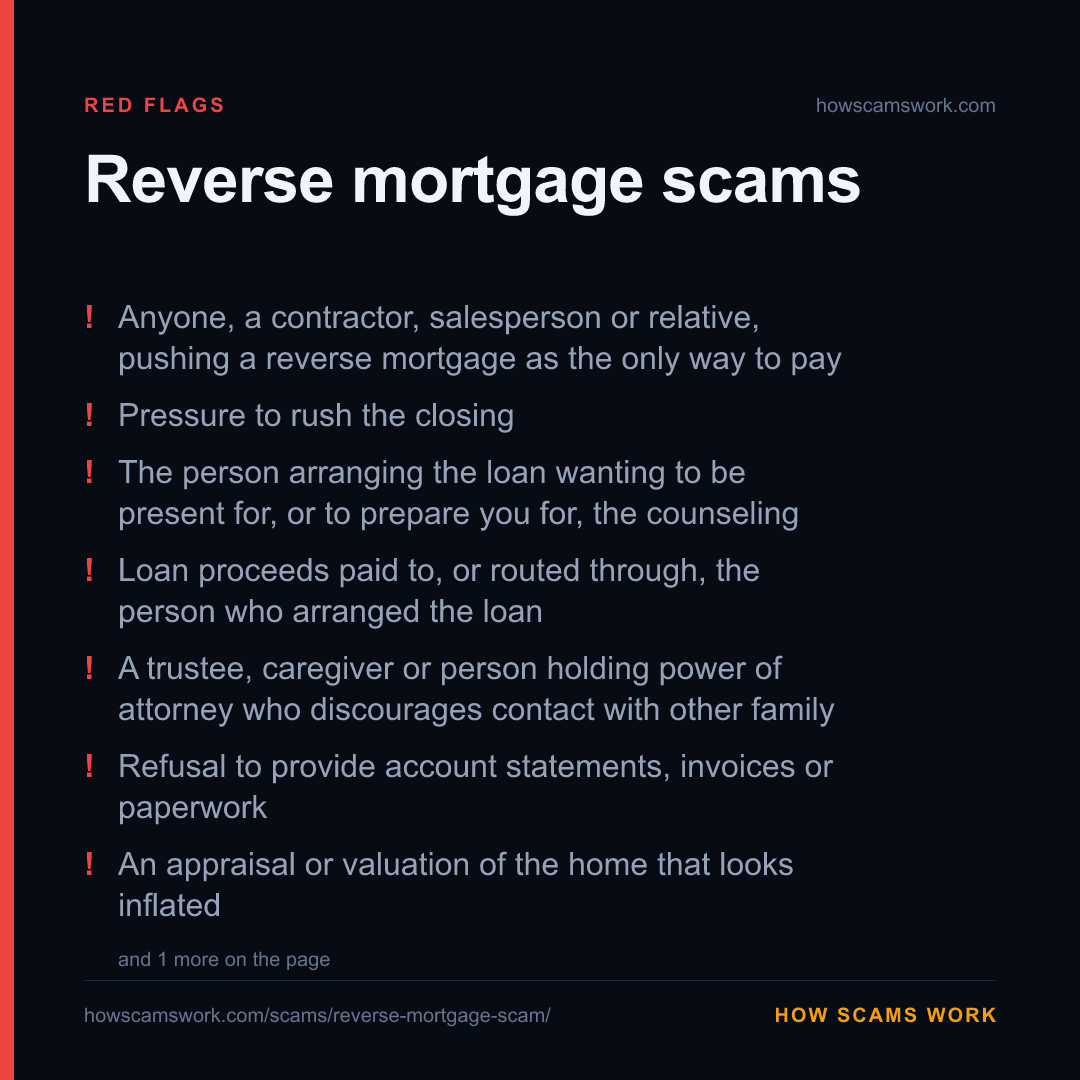
- Anyone, a contractor, salesperson or relative, pushing a reverse mortgage as the only way to pay for something. A genuine need for repairs or cash does not require this specific loan.
- Pressure to rush the closing or skip, minimize or script the required independent HUD counseling session.
- The person arranging the loan wanting to be present for, or to prepare you for, the counseling call. That session exists specifically so someone without a stake in the sale can ask hard questions.
- Loan proceeds paid to, or routed through, the person who arranged the loan rather than directly and entirely to the homeowner.
- A trustee, caregiver or person holding power of attorney who discourages contact with other family members while “handling” financial matters.
- Refusal to provide account statements, invoices or paperwork showing exactly where loan proceeds went.
- An appraisal or valuation of the home that looks inflated compared to recent sales of similar homes nearby.
- Sudden unexplained gaps in a trust or estate account that someone else manages on an older adult’s behalf.
If it’s happening to you
Stop before signing anything else, and if a reverse mortgage has already closed, request a full
accounting of where every dollar of the proceeds went.
- Contact an independent HUD-approved housing counselor yourself, not one suggested or scheduled by
whoever is arranging the loan. Find one through HUD at hud.gov or by calling the agency directly.
- Ask your reverse mortgage servicer for a complete payment and disbursement history. You are
entitled to see exactly how proceeds were paid out and to whom.
- If someone else manages your finances under a power of attorney or trust, ask a different family
member, an accountant, or an attorney you choose yourself to review recent account activity.
- Report suspected fraud to the FTC at ReportFraud.ftc.gov, to HUD’s Office of Inspector General
at hudoig.gov, and to the FBI’s Internet Crime Complaint Center at ic3.gov. See
where to report for other countries.
- Contact Adult Protective Services in your state if the person involved is a caregiver, relative or
fiduciary; this is how the Tacoma case in this page’s cases was first identified.
- Keep every document: the loan application, the appraisal, the counseling certificate, and any
repair contract or invoice. These records are what let investigators reconstruct a scheme years after
it started.
Where the money goes
Straight to the person who arranged the loan, with no offshore transfer and no laundering chain to
disguise, because a reverse mortgage disbursement is itself a large, legitimate check that a trusted
insider only has to redirect, not launder.
In the Florida case, loan proceeds moved directly from the lender into an account two of the loan
officers controlled. In the Chicago case, homeowners paid contractor invoices for repair work that was
billed but not substantively performed. In the Tacoma case, reverse mortgage proceeds went straight into
a trust account the attorney already controlled and was already transferring from into his own accounts,
on the same day, to cover personal credit card payments.
That directness is also why every one of these cases ended in a criminal wire fraud conviction rather
than a civil settlement: there is no corporate structure or offshore network to unwind, just a federally
insured loan and the person who diverted its proceeds.
By the numbers
No published dataset breaks this scheme out as its own category yet, so there is no chart to show.
The data page explains which agency categories exist and why some schemes are
invisible in official statistics.
Every factual claim above traces to one of these. Statistics are reported losses; see
methodology for what that does and does not measure.