Also called: unclaimed funds scam · unclaimed property fraud · heir finder scam · asset recovery fee scam · missing money scam
State treasuries hold billions of dollars in unclaimed wages, deposits and insurance payouts, free to search and claim through official government databases. This scam either charges an illegal fee to "locate" money anyone could find themselves, or forges a claimant's identity to steal the payout outright. A French national stole $1.8 million from California this way; a father and son stole $1.6 million from people who had actually hired them to help.
What it is
Every US state holds money it owes to someone: a final paycheque never collected, a security deposit,
an uncashed insurance payout, a dormant bank balance. States advertise this, run public awareness
events, and let anyone search for free, by name, on their own website or the national
MissingMoney.com. It is one of the most consumer-friendly things a government runs.
Two quite different crimes grow on top of that database, and they share almost nothing except the
asset.
The fee version is the more common one. A “finder” company, sometimes legitimate, sometimes not,
contacts people whose name matches a record, offers to do the paperwork for a cut, usually legal in
most states if the fee is disclosed and capped. Dishonestly run, the same business instead forges the
claim documents to redirect the entire payout to itself, or simply never discloses what percentage it
is keeping.
The identity-theft version skips the consumer relationship entirely. A fraudster obtains a
fabricated ID, sometimes in a dead person’s name, sometimes in a living stranger’s, has it notarized,
and files a claim against someone else’s property directly with the state. There is no victim to
persuade, because the real owner never knows a claim was filed until, or unless, they check.
A French national, Gabriel Adrien Lobe Diop, ran the second version against California’s Controller’s
office and got away with $1.8 million before his arrest. A father and son running a real
Sacramento-area finder business, Rodco & Associates, ran the first version against their own paying
clients and are accused of stealing $1.6 million.
How it actually works
A free database, and a name that matches
State controllers and treasurers publish unclaimed property by name, searchable by anyone, at no cost.
Billions of dollars sit there, correctly, waiting for an owner who has not yet looked.
The pitch
A letter, a cold call, or a classified ad tells someone they are owed money the sender has already
“located,” and offers to handle the paperwork for a fee or a cut of the recovery.
Where it could have stopped
Every state’s own site, and the free, NAUPA-endorsed MissingMoney.com, lets anyone search and claim directly. The moment a fee, a percentage, or a sense of urgency enters the conversation is the moment to go to the official site yourself instead.
A signed authorisation, redirecting payment
The claimant signs a locate agreement that, among other things, lets the state send the payout to the
finder’s own address rather than the claimant’s. This step is legitimate when disclosed; it is the
exact mechanism a dishonest finder forges or exploits when it is not.
Or, with no real client at all, a borrowed identity
Rather than recruiting a claimant, a fraudster files directly. Gabriel Lobe Diop used counterfeit
driver’s licences from several states and mail-forwarding addresses to pose as the real property
owners himself, needing no one’s cooperation and no one’s knowledge.
Paperwork a notary cannot see through
A notary stamp confirms someone presented identification and appeared in person, not that the
identification is genuine. Marilyn Cook obtained a real Tennessee state ID in a fabricated name to
have her false claims notarized, then added a forged Department of Justice letter for good measure.
The state pays, or catches it first
Diop’s false claims succeeded for years, netting $1.8 million of the roughly $9 million he attempted,
spent on luxury goods, property and electronics, before investigators caught up. Cook’s 128 false
claims, worth $398,537, were flagged as fraudulent and the state paid out nothing.
Discovery, usually from the state’s own side
None of the three documented cases on this page were discovered by the person whose name or money was
actually at stake. Each was caught by the unclaimed-property division’s own fraud controls or a
federal investigation, not by a victim noticing anything wrong.
Prosecution, years after the paperwork was filed
Diop’s decade of attempted fraud produced a sentence in 2024. Cook’s 2014 filings were not sentenced
until 2021. Rodco & Associates was charged in 2010 for a scheme that ran from 2007; what follows that
charge is less visible than the theft itself.
Why it works
The underlying money is completely real. Nobody has to invent a fortune or a dead relative; the
property genuinely exists, genuinely has the claimant’s name on it, and genuinely sits in a government
account. That removes the single biggest tell of most advance-fee fraud: a prize or inheritance that
never existed.
Most people do not know the search is free. A letter that already states a specific dollar figure,
in your name, feels like inside information rather than a public record lookup anyone could run.
A locate agreement is a real, legal instrument. Dozens of honest businesses operate exactly this
way, charging a disclosed, capped percentage. That legitimacy is the camouflage a dishonest operator
hides inside.
Verification was built for paperwork, not identity. A state’s claim process checks that a form is
complete, signed and notarized. It was not built to detect a counterfeit ID good enough to pass a
notary, which is a lower bar than passing a bank or a passport office.
And the real owner is the last to know. In the identity-theft version there is no call, no letter,
no contact at all. The only way to notice is to check a database you were never told to check.
Where it comes from
Domestic, civil and criminal both, and aimed at the exact same public records in every documented
case: a state Controller’s or Treasurer’s unclaimed-property division.
The fee-skimming side is a real industry with a real bad-actor minority. Most “finder” or
“heir location” businesses disclose their fee and operate within state caps, several of which limit
finder fees to a fixed percentage. State attorneys general have sued or settled with operators in
Indiana, West Virginia, Ohio and Pennsylvania over undisclosed fees, fabricated urgency, or simply
keeping funds a client was never told about, alongside the criminal Rodco & Associates case, where the
allegation goes further still: forged paperwork and fictitious mailing addresses rather than a merely
excessive fee.
The identity-theft side needs no consumer contact and no state-specific business licence.
Gabriel Lobe Diop ran his scheme as a one-man operation against a single state’s division, filing under
other people’s names using fabricated identification obtained across several states. Marilyn Cook’s
case shows the same mechanism attempted against federal property, the U.S. Marshals’ own unclaimed
funds, using a fictitious notarized identity and a forged Department of Justice letterhead.
Enforcement is a mix of state civil action and federal criminal prosecution, and the dollar
figures recovered rarely match what was taken or attempted. The California Attorney General’s office
pursued Rodco & Associates civilly and criminally at once; the Eastern District of California
prosecuted both the Diop and Cook cases as federal mail fraud, because the postal system carried the
forged claims.
Real cases
2024 US Sentenced $1.8m
Gabriel Adrien Lobe Diop, 35, a French national, was sentenced on June 10, 2024, to 10 years in federal prison after posing as the rightful owners of property held by California's State Controller's Office Unclaimed Property Division. Using post office boxes, mail-forwarding addresses, counterfeit notary stamps and fake driver's licences from several states, Diop submitted fraudulent applications claiming other people's unclaimed property. He attempted to steal at least $9 million between January 2019 and his arrest, and succeeded in stealing $1.8 million, which he spent on luxury goods, property and electronics. He was convicted on nine counts of mail fraud and one count of aggravated identity theft, and ordered to pay $1.8 million in restitution.
Read the case file ·
1 source
2021 US Sentenced $0
Marilyn Cook, 58, of Alcoa, Tennessee, who also used the names Marilyn Powell and Marilyn Sunset, was sentenced on August 26, 2021, to two years and five months in prison for filing false claims with California's State Controller's Office Unclaimed Property Division. In August and September 2014, using the alias Marilyn Sunset, Cook filed claims for 128 properties totalling $398,537, properties belonging to the United States Marshals Service and others, using a Tennessee state identification card obtained in the fictitious name to have the claim forms notarized, and a forged Department of Justice letter purporting to authorise her to collect on the Marshals' behalf. The Unclaimed Property Division identified every claim as fraudulent and did not disperse any property to Cook.
Read the case file ·
1 source
2010 US Charged (allegation, not conviction) $1.7m
Thomas Rodine, 56, of Carmichael, California, and his son Dustin Rodine, 28, of Citrus Heights, operated Rodco & Associates, a real asset and heir-location business that located people with assets sitting in the California State Controller's unclaimed property fund. From 2007 to 2009, the California Attorney General alleges, the pair forged documents to reroute their own clients' recovered funds to a network of post office boxes they controlled, and separately forged claim documents to collect money that was never disclosed to the clients who had hired them. Each was charged with three counts of embezzlement and one count of submitting fraudulent claims to the state Controller.
Read the case file ·
1 source
Red flags
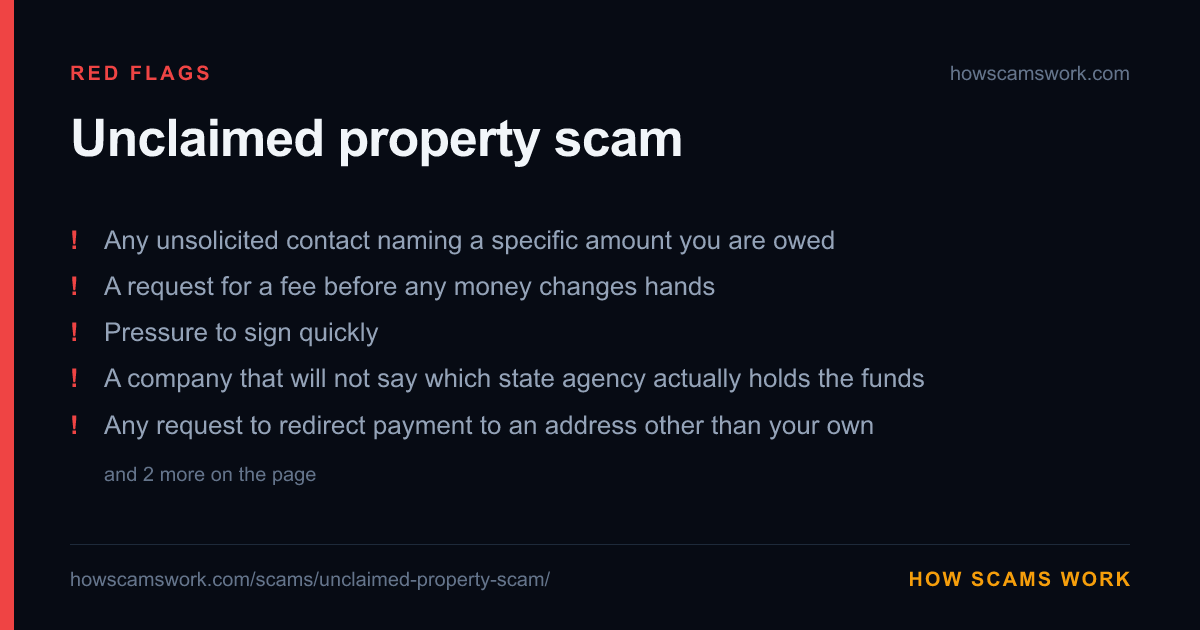
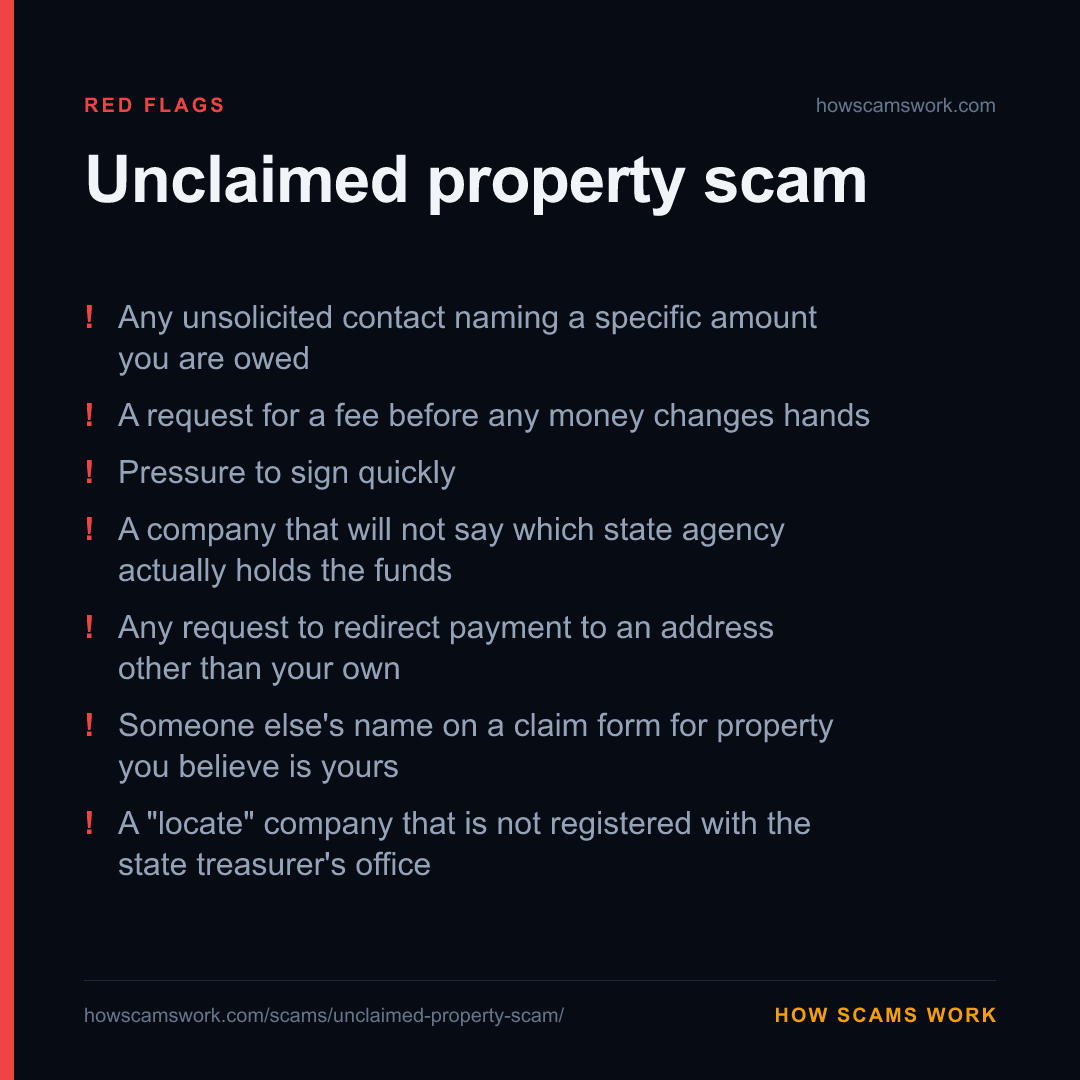
- Any unsolicited contact naming a specific amount you are owed. A real search is something you run yourself, for free.
- A request for a fee before any money changes hands, rather than a disclosed, capped percentage taken from the recovery itself.
- Pressure to sign quickly, “before someone else claims it” is not how an uncontested government record works.
- A company that will not say which state agency actually holds the funds.
- Any request to redirect payment to an address other than your own that you do not fully understand and have not independently verified.
- Someone else’s name on a claim form for property you believe is yours.
- A “locate” company that is not registered with the state treasurer’s office, where that registration is required.
If it’s happening to you
Before paying anyone, or signing anything.
- Search for yourself, for free, at your state treasurer’s or controller’s own site, or at
MissingMoney.com. If the money is there, you can usually claim it directly without any company’s
help.
- Never pay an upfront fee. A legitimate finder’s fee is a disclosed percentage deducted from the
recovery itself, not a payment demanded before anything is recovered.
- Confirm the payment address on any claim is yours, by contacting the state division directly on
a number you looked up yourself, not one given to you by the company that contacted you.
If you suspect your identity was used to file a false claim in your name.
- Contact the relevant state’s unclaimed-property division directly and ask whether any claim has
been filed or paid against property in your name.
- File an identity theft report with the FTC at IdentityTheft.gov, which creates a recovery plan
and an official affidavit.
- Report it to your state attorney general’s consumer protection office and, in the US, to the
FBI’s Internet Crime Complaint Center at ic3.gov. See where to report for
other countries.
- Check periodically, not just once. None of the documented victims on this page could have
prevented the original filing; the only real defence is catching it before the state pays out, or
soon after.
Where the money goes
There is no long laundering chain in any of the three documented cases here, which is itself
notable: the state’s own payout, a cheque or a direct deposit, goes straight to an address or account
the operator controls.
Rodco & Associates routed redirected payouts to a network of post office boxes. Gabriel Lobe Diop
received state payments through mail-forwarding addresses and spent the proceeds directly on luxury
goods, property and electronics, converting government funds into untraceable personal assets almost
immediately rather than running them through accounts designed to obscure the source.
That speed and simplicity is part of why these cases are built on postal and mail fraud statutes rather
than money laundering charges: the government’s own payment system does the work a launderer would
otherwise have to do, delivering a single clean payment to an address that was never verified as
belonging to the real owner.
By the numbers
No published dataset breaks this scheme out as its own category yet, so there is no chart to show.
The data page explains which agency categories exist and why some schemes are
invisible in official statistics.
Every factual claim above traces to one of these. Statistics are reported losses; see
methodology for what that does and does not measure.