Also called: fake vacation rental listing · holiday rental fraud · vacation home scam · Airbnb scam · double-booking scam · short-term rental fraud
Vacation rental scams take a deposit for a stay the seller cannot provide: a listing for a house they do not control, a spoofed copy of a real booking page, or a real property double-booked to the highest bidder. A Romanian toolkit behind fake rental ads admitted at least 14,000 victims; a two-cousin double-booking scheme was put at $1.5 million.
What it is
A vacation rental scam takes money for a stay the seller cannot or will not deliver. It comes in three forms
in the cases documented here. In the first, a listing is simply false: a house that is under
construction, owned by someone else, or invented, advertised on an ordinary rental website. In the second,
a real listing is copied: a victim who answers an ad on a legitimate rental site is redirected to a
spoofed website that imitates it, and pays there. In the third, the host is real but the booking is not:
the same property is sold several times and the guests who bid least are cancelled. The FTC describes
the first two directly, saying scammers “hijack real rental listings and advertise them as their own” or
make up listings for places that are not really for rent or do not exist.
The money is taken months before the trip, so the fraud usually surfaces only at a cancellation deadline or
when the guest stands at the door. That timing, more than any technical trick, is what makes it work.
How it actually works
A listing appears for a home the seller does not control
The advertisement sits on a mainstream rental website or classified site. In the Finger Lakes case, a house
under significant construction and a second house owned by someone who had never given permission were both
advertised as available vacation rentals.
The listing is dressed to look ordinary
In Kentucky, a paid platform generated fake ads and spoofed websites that mimicked legitimate listing
pages. In the California case, fake host names and, in some cases, other people’s identities were used to
post listings and fabricated positive reviews.
The conversation or the payment moves somewhere else
Victims who answered ads on legitimate rental sites were redirected to the spoofed sites, where people
posing as owners or managers asked for payment by bank wire, gift card, cryptocurrency or similar methods.
Where it could have stopped
The FTC advises searching online for the rental’s address together with the owner’s name, checking that the property is also listed on the rental company’s own website, and never paying anyone who insists on a wire transfer, gift card, cryptocurrency or payment app. A request to leave the booking site’s own payment system, or a second listing of the same address under a different name, is the moment to walk away.
A convincing invoice or a reassuring promise arrives
Users of the Kentucky platform sent invoices generated through it. In the New York case the customer was
told the deposit would be held in an escrow account, which did not exist.
The payment is collected and the operator is told
The Kentucky platform notified its users when a victim submitted payment, and many victims were encouraged
to pay in cryptocurrency. In the New York case, deposits were taken by wire transfer or online card
payment.
The trip draws near and the excuses begin
In the California case, overbooked guests were told of a plumbing problem or some other unforeseen issue and
then cancelled, talked into cancelling, or moved to a different property. The FTC describes the
hijacked-listing version as guests arriving to find other people booked into the same property.
Refunds are refused and the listing returns under a new name
Henry T. Dean III refused refunds even to customers who spotted the problem in advance. The California pair
deleted negatively reviewed listings and re-listed them with new identifiers, and used fake host accounts to
keep listing after one platform banned them in 2015.
Why it works
The money moves long before the evidence does. A stay is paid for weeks or months ahead, so by the time
a guest learns the house is not available, the deposit has been spent and the cancellation window has often
closed.
The setting is trusted. The New York listings ran on rental websites including Homeaway.com, the
California listings on Airbnb and Vrbo, and in the Kentucky case the pages imitated legitimate listing
sites. People are not suspicious of an
interface they have used before.
Scarcity and price push people to move fast. The FTC lists pressure to decide quickly and premium
properties offered at unusually low prices among the signs of a scam, and a popular holiday area with few
homes available gives that pressure something to push against.
Reviews can be manufactured. The California pair posted fabricated positive reviews through fake host
accounts, and posted bogus negative reviews about guests who complained. A good rating is not proof of an
honest host.
Specialisation lowers the bar for entry. The Kentucky platform supplied the ads, the lookalike websites,
the invoices and the payment alerts, so a user needed only to attract victims. That is how one service came
to admit at least 14,000 victims over 99 months.
Where it comes from
The cases on this page are US prosecutions, but the people behind them differ. The two California and New
York defendants operated domestically, one through a business with nearly 100 properties and one with two
advertised houses. The Kentucky case involves a Romanian national who ran a software service from January
2016 to September 2023, with Romanian police assisting the US Secret Service. A co-defendant was described as
pending extradition when the sentence was announced.
Enforcement is slow and mostly concerns operators, not individual listings. The Kentucky indictment was
returned in September 2023 and the sentence announced in July 2026; the California charges came in
December 2023 and January 2024 and the first sentence in August 2026. The Finger Lakes scheme ran from September 2014 to October
2016 and was sentenced in December 2018. A guest who loses a deposit this week is unlikely to see it come
back through a prosecution.
Real cases
2026 US · RO Sentenced
Liviu Mihai Dumitru, a 44-year-old Romanian national, created and ran a software platform from January 2016 to September 2023 that fraudsters paid to use. It generated fake ads, built spoofed websites that mimicked legitimate listing pages, produced convincing invoices, notified users when a victim paid, and helped create cryptocurrency addresses. Users posted ads on eBay, Craigslist and Airbnb for cars or vacation rentals that did not exist. Dumitru admitted operating the platform for 99 months and conceded that at least 14,000 people were victimized through it. He was sentenced on July 8, 2026 to 48 months in prison for conspiracy to commit money laundering by U.S. District Judge Karen Caldwell in Lexington, Kentucky. The U.S. Secret Service investigated with the Romanian National Police.
Read the case file ·
2 sources
2026 US Sentenced $1.5m
Shray Goel of Calabasas, California and his cousin Shaunik Raheja of Denver ran a short-term rental business, operating under names including Abbot Pacific LLC and Jet Set Work LLC, that listed the same property several times at different prices on Airbnb and Vrbo, kept the highest bidder, and then cancelled or moved everyone else with last-minute excuses such as a plumbing problem. A January 2024 superseding indictment alleged the scheme brought in more than $8.5 million across more than 10,000 reservations at nearly 100 properties in 10 states. In April 2026 Goel pleaded guilty to one count of wire fraud and Raheja to one count of obstruction of justice for lying to investigators. On August 14, 2026 Goel was sentenced to one year and one day in federal prison and a $15,000 fine; press coverage of the sentencing put the scheme at $1.5 million. Raheja's sentencing was set for September 11, 2026.
Read the case file ·
4 sources
2018 US Sentenced $137,272
Henry T. Dean III, 58, of Beaver Dams, New York, advertised vacation homes in the Finger Lakes region on FingerLakesGuesthouses.com, Homeaway.com and VacationRentalsByOwner.com between September 2014 and October 2016. One advertised house was under significant construction and not available to rent; the other was owned by a person who never gave Dean permission to rent or advertise it. Dean told customers their deposits would be held in an escrow account that did not exist, later cancelled many reservations and refused refunds, including to customers who spotted the problem in advance and tried to cancel. Losses to more than 20 victims totaled approximately $137,272.46. Convicted of wire fraud, he was sentenced on December 4, 2018 to 36 months in prison and ordered to pay $120,000 in restitution. The FBI investigated.
Read the case file ·
2 sources
Red flags
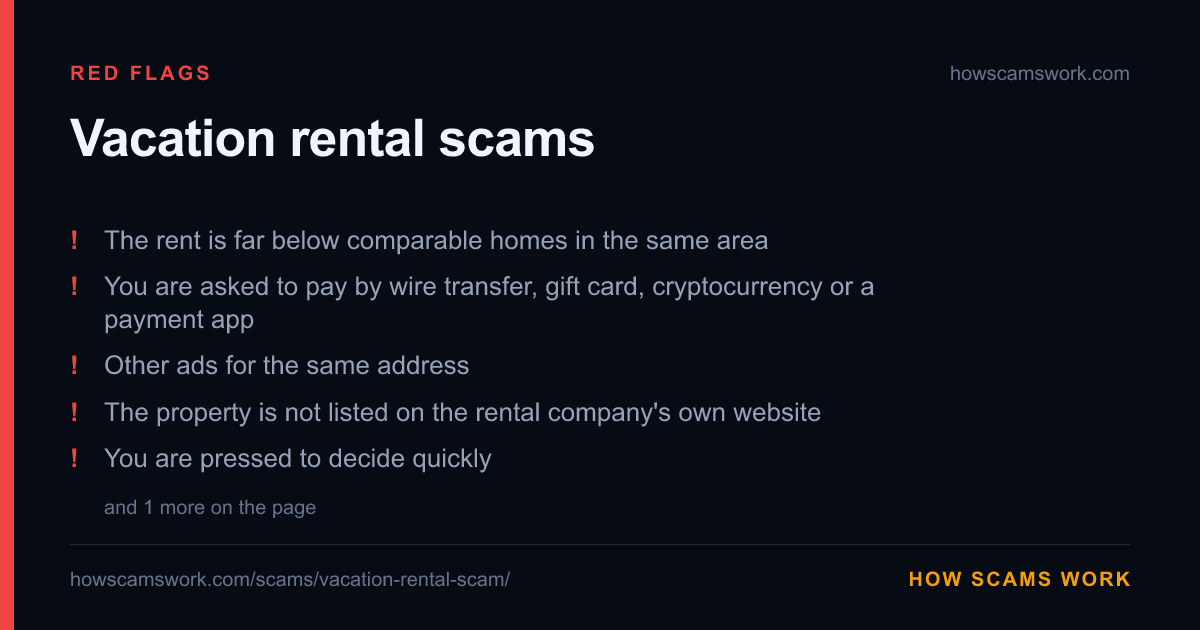
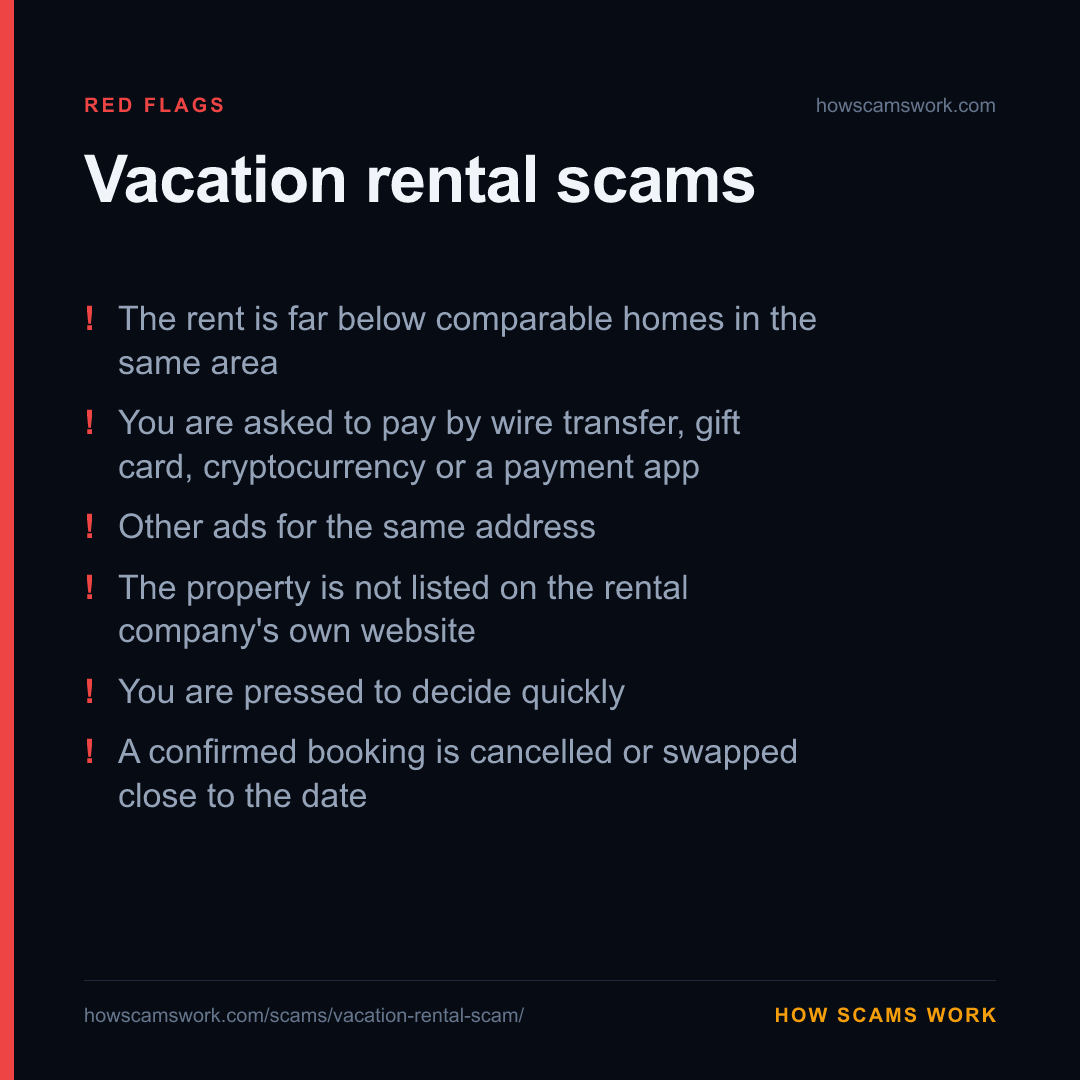
- The rent is far below comparable homes in the same area, or a premium property is offered cheaply, which the FTC lists as a sign of a scam.
- You are asked to pay by wire transfer, gift card, cryptocurrency or a payment app, or to move off the booking site’s own payment system.
- Other ads for the same address appear under a different owner or rental company name.
- The property is not listed on the rental company’s own website, or you were redirected from one site to another to pay.
- You are pressed to decide quickly, or told a deposit is “fully refundable” and held in an escrow you cannot see.
- A confirmed booking is cancelled or swapped close to the date, particularly with an excuse about repairs or plumbing, and the host has done it before according to other reviews.
If it’s happening to you
If you have paid for a rental you now doubt, act before the trip date and keep everything in writing.
- Contact the company you paid through straight away. The FTC says a credit card gives the best
protection; wire transfers, gift cards and cryptocurrency are almost impossible to recover once sent.
- Report the listing to the platform it appeared on, and keep every message, invoice, listing page and
payment confirmation.
- Check the address independently. Search for the address and the owner’s name, and call the rental
company or resort named in the listing.
- Report it to the FTC at ReportFraud.ftc.gov and to your state attorney general, as the FTC advises. In
the Kentucky case the US Secret Service asked victims to submit details through the Justice
Department’s case page.
- If you were the guest who was cancelled or moved at the last minute, keep the original booking
confirmation and the host’s stated reason, since a pattern across several guests is what prosecutors
relied on in the California case.
- Book a replacement through a payment method you can dispute, and do not send further money to the
first seller for a “re-booking.”
Where the money goes
In the cases on this page the money moved through ordinary channels, with one notable exception.
Straight to the seller’s accounts. In the New York case the deposits arrived by wire transfer or online
card payment, and the Justice Department put the losses of more than 20 victims at approximately
$137,272.46. In the California case, the payouts came from the booking platforms themselves, which the
indictment alleged exceeded $7 million from Airbnb and $1.5 million from Vrbo.
Through cryptocurrency addresses. In the Kentucky case many victims were encouraged to pay in
cryptocurrency, and for a period the platform helped create cryptocurrency addresses managed through
Coinbase accounts registered under false identities. Dumitru was sentenced for conspiracy to commit money
laundering.
How the loss range was derived. The typical-loss range shown for this scheme runs from $137,272, the
New York case’s total reported losses, to $1.5 million, the California case’s figure at sentencing. Only
those two cases give a dollar figure, so it is an estimate from a small sample; the Kentucky case admits at
least 14,000 victims but states no total. The first year shown, 2014, is when the earliest case here began.
Restitution is partial and slow. Henry T. Dean III was ordered to pay $120,000 against $137,272.46 of
reported losses, and the restitution hearing for the California case had not been scheduled when the first
sentence was reported.
By the numbers
No published dataset breaks this scheme out as its own category yet, so there is no chart to show.
The data page explains which agency categories exist and why some schemes are
invisible in official statistics.
Every factual claim above traces to one of these. Statistics are reported losses; see
methodology for what that does and does not measure.
Common questions
Is a double-booked Airbnb or Vrbo stay really a scam, or just bad hosting?
Most double bookings are honest mistakes. The case on this page was different because prosecutors said the pair listed the same property several times at different prices on purpose, kept the highest bidder, and invented excuses such as a plumbing problem for everyone else. Goel pleaded guilty to wire fraud. The test is whether the host is unlucky or is deliberately selling the same night more than once; a pattern of last-minute cancellations is the signal.
How can a fake listing look so convincing?
In the Kentucky case, the platform sold to fraudsters generated spoofed websites that mimicked legitimate listing pages, and produced convincing invoices and payment notifications, so the victim saw something that looked like an ordinary booking. In the New York case, the listings were placed on rental websites including Homeaway.com and described real addresses. A professional-looking page proves nothing about who controls the house.
What does the FTC say to check before paying?
The FTC advises searching online for the rental's address together with the owner's or rental company's name, and treating other ads for the same address under a different name as a sign of a scam. It also says to check whether the property appears on the rental company's own website, and not to pay anyone who says the only way is a wire transfer, gift card, cryptocurrency or payment app.
Why is payment method such a big deal?
Because once money has left by wire transfer, gift card or cryptocurrency, the FTC says it is almost impossible to get back. The FTC recommends paying by credit card, which gives the best protections. In the Kentucky case, many victims were encouraged to pay in cryptocurrency, which is the opposite of the payment route that can be reversed.
Does the booking platform refund me if the host turns out to be fake?
This page does not make a general promise, because policies differ by platform and by situation, and the cases here did not examine them. What the record shows is that Airbnb and Vrbo cooperated with the prosecution of the double-booking scheme. Read the platform's own protection terms before booking, keep every message inside the platform, and report a problem to the platform immediately.
How is this different from the rental scams already covered on this site?
The rental and real estate page covers long-term housing: deposits for apartments and houses that are not for rent, and fraud inside home purchases. This page covers short stays booked by the night or the week, where the money is collected months before the trip and the fraud usually surfaces only at the cancellation deadline or on arrival.