Also called: vending route scam · candy machine business scam · vending business opportunity fraud · bizopp vending scam
A vending machine business opportunity scam sells people candy, snack or video-rental machines with false promises of profit and prime locations, then places the machines where they earn little or nothing. A Long Island company took in about $60 million this way between 2005 and 2010, and all 22 people charged in the case were convicted.
What it is
A vending machine business opportunity scam sells a business, not a product. The seller advertises a small
business of your own: bulk candy machines, snack and soda machines, video-rental machines. It promises
profits, a route of good locations and support. The buyer pays thousands of dollars, receives machines, and finds
that the locations are poor or never materialize, that the profit figures were invented, or that the
“references” were working for the seller.
Selling vending machines is legal. What the Justice Department and the FTC pursued in the cases on this page
was the lying: about earnings, about locations, about other customers and, in one case, about a cancellation
right.
How it actually works
An ad for a business of your own
Vendstar advertised nationwide in newspapers and on the Internet. The FTC said the Miami “Sweet Tooth Sam”
ads promised “500% Profits” or “$4000 per month.”
A salesperson who says he runs routes himself
During telemarketing calls, the Justice Department said, Vendstar’s sales representatives falsely claimed to
operate their own profitable vending machine businesses. The Justice Department also said they misrepresented
what earlier customers were earning and how quickly buyers would recover their investment.
Profits and locations are promised
In the Las Vegas Success Vending Group case the Justice Department said salespeople gave baseless profit
projections and falsely claimed excellent machine locations were available in the buyer’s area. In the
Westbrook case the FTC alleged the profit projections and earnings claims had no reasonable basis in fact.
The references are not what they seem
Buyers who ask for the names of other owners are handed numbers to call. The Justice Department said the
Success “references” either did not own machines or had received them free from the company, and the FTC
alleged that the Sweet Tooth Sam sellers used “shill” references who posed as ordinary consumers.
Where it could have stopped
A buyer who finds the owners themselves, rather than calling the seller’s list, will hear a different story. The FTC advises asking current owners whether their experience matches the seller’s disclosure document, and reading that document at least seven days before signing or paying.
The buyer pays
The Justice Department said the typical Vendstar customer paid about $10,000. The Miami Sweet Tooth Sam
packages cost about $14,000 to $30,000, and the video-rental machines in the Florida case cost $28,000 to
$37,500 each.
The machines go where they go
The locating companies recommended by Vendstar, the Justice Department said, had no special expertise and placed
machines wherever they could as quickly as they could, often in businesses that had not agreed to host
them and that soon demanded removal. In the Westbrook case the FTC alleged buyers were told they could cancel
if machines were not delivered within 30 days, but that cancellation requests were not honored even when
machines never arrived.
Complaints are managed, then enforcement arrives
The Justice Department said Vendstar’s technical support manager’s primary job was to suppress the large number
of complaints, and that the locating companies regularly changed their names to stay ahead of them. The
prosecutions came after the companies had closed: Vendstar closed in July 2010, and its president was
sentenced in November 2016.
Why it works
The business sounds simple and the numbers sound checkable. A machine, a route and a profit per
sale feels like arithmetic. What a buyer cannot see is how many earlier buyers actually made the stated income,
which is what the FTC’s earnings claim statement is meant to answer: it must give the dates the earnings were
achieved and how many people achieved them.
Social proof is faked. Buyers are told to call references. In two of the cases here the references were
not independent owners. The FTC page on bogus business opportunities lists references limited to a few
hand-picked “insiders,” and fake online testimonials, among its red flags.
The price is large for one person. The amounts documented here run from about $10,000 to $37,500 per
buyer, and the Justice Department’s statements about Vendstar spoke of everyday Americans’ retirement accounts
and life savings.
The paperwork can seem to protect the seller. In the Vendstar appeal, the defendant argued that customers had
signed contracts disclaiming reliance on what salespeople said. The Second Circuit rejected the argument,
holding that fraudsters may not escape liability by having victims sign such disclaimers.
Enforcement is slow and recovery is partial. The Success Vending Group conduct ran about 2003 to 2005 and the
sentences came in 2008. In the video-rental case two settlements carried $19.2 million judgments, but nearly
all was suspended for inability to pay and the FTC reported more than $3 million to be refunded.
Where it comes from
A US scheme. The FTC has run coordinated sweeps against bogus business opportunities, including the 2002
sweep it called Operation (or Project) Busted Opportunity, which involved the Justice Department and 17 state
agencies, and the 2005 “Project Biz Opp Flop.” Vending machines appear in cases from both.
Scale ranges widely. Success Vending Group reached 673 people and about $7.4 million; Vendstar’s trial
evidence put the cost to consumers at $60 million over five years. The video-rental and Westbrook cases
gave no total buyer losses.
The product varies; the pitch does not. The documented machines run from 25-cent candy and snack and
soda to medical supplies and video rentals, and each came with a promise of profit and locations.
Cases are not recent. The most recent case documented here was sentenced in 2017, and this page does
not claim anything about the current volume of vending machine scams.
Real cases
2016 US Sentenced $60.0m
Multivend LLC, doing business as Vendstar, of Deer Park, New York, sold bulk candy vending machine business opportunities nationwide until it closed in July 2010. The Justice Department said trial evidence showed the scheme cost consumers $60 million from 2005 to 2010 and that the typical customer paid about $10,000. All 22 people charged were convicted. In early November 2016 the company's president and chief executive, Edward "Ned" Weaver, was sentenced to 60 months and its technical support manager to 54 months, after a six-week jury trial the previous year. The Second Circuit affirmed Weaver's conviction and sentence in June 2017.
Read the case file ·
4 sources
2011 US Settled
American Entertainment Distributors, Inc. and related companies sold video rental vending machines as a business opportunity. The FTC said buyers were told to expect $60,000 to $80,000 a year, or to earn back their investment in 6 to 14 months, and paid $28,000 to $37,500 each. The case was paused for three years while the Justice Department pursued criminal charges. By a February 17, 2011 announcement, the FTC reported settlements and judgments against ten defendants, a court-appointed receiver and surrendered assets, and more than $3 million to be refunded to investors.
Read the case file ·
1 source
2009 US Sanctioned
The FTC sued Westbrook Marketing Associates, LLC, three affiliated companies and three individuals in the Eastern District of New York in 2002, as part of "Project Busted Opportunity." The business opportunities were vending machines that dispensed medical supplies or soda and snacks. In October 2008 the court granted summary judgment against one individual and the companies, entering a litigated judgment of $4,059,235. On December 17, 2008 the court entered a $250,000 settlement with a second individual, and the FTC dismissed the case against the third. The FTC announced the results on January 26, 2009.
Read the case file ·
1 source
2008 US Sentenced $7.4m
Success Vending Group, Inc. ran a telemarketing sales room in Las Vegas from about January 2004 to February 2005, selling candy vending machine business opportunities that grew out of an earlier company, National Vending Consultants. The Justice Department said 673 people across the country lost about $7.4 million. The FTC sued in May 2005, and a court entered a final judgment in May 2006. Three salesmen who pleaded guilty to conspiracy to commit mail and wire fraud were sentenced to 20, 27 and 33 months. The owner died before his scheduled sentencing.
Read the case file ·
3 sources
Red flags
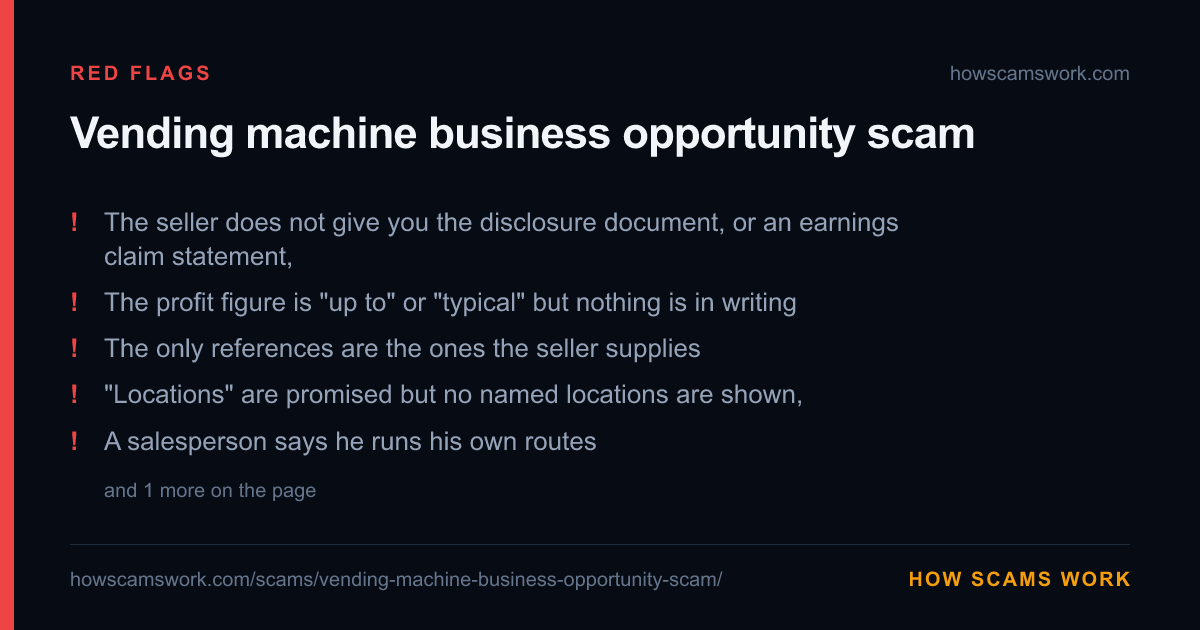
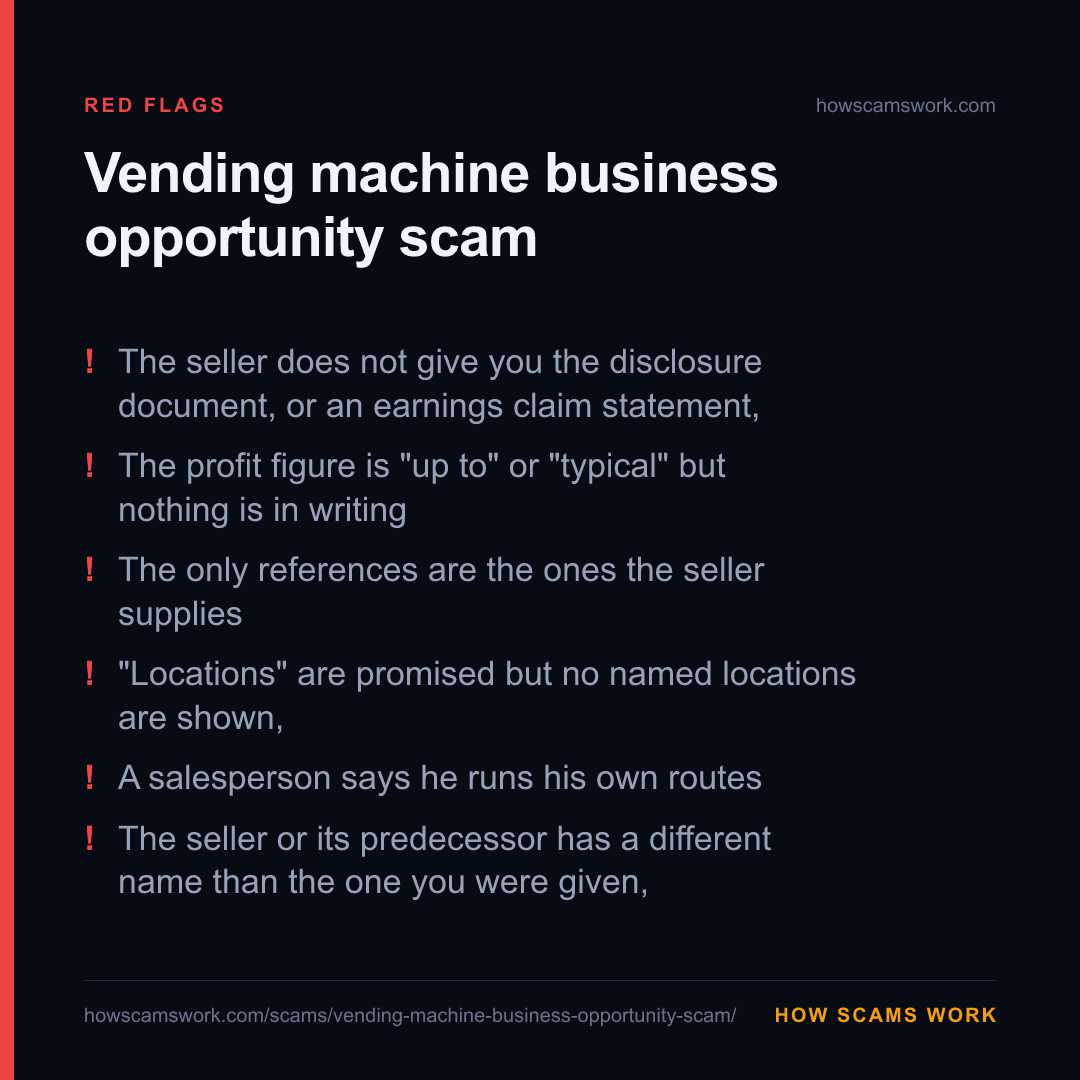
- The seller does not give you the disclosure document, or an earnings claim statement, at least seven days before you sign or pay. The FTC’s Business Opportunity Rule requires them.
- The profit figure is “up to” or “typical” but nothing is in writing.
- The only references are the ones the seller supplies. In Las Vegas, those references did not own machines or had received them free.
- “Locations” are promised but no named locations are shown, and the seller says a locating company will find them.
- A salesperson says he runs his own routes. At Vendstar, the Justice Department said, that claim was false.
- The seller or its predecessor has a different name than the one you were given, or the company changed names recently.
If it’s happening to you
- Before you pay, ask for the seller’s disclosure document and any earnings claim statement. Read them at
least seven days before you sign or pay anything. Walk away if the seller will not provide the required
information.
- Find the owners yourself. Do not call the seller’s reference list. The FTC advises contacting current
owners you choose and asking whether their experience matches what you were told.
- Ask a lawyer, accountant or business adviser to review the contract and the disclosure document.
- If you have already paid, keep the ad, the contract, the receipts, emails and the names of everyone you
spoke to, and report to your state attorney general, your local or state consumer protection agency,
the Better Business Bureau, or the FTC at ftc.gov or 1-877-FTC-HELP (1-877-382-4357). See
where to report for other countries.
- Expect partial recovery at best. The cases here show refunds that were a fraction of the judgments.
Where the money goes
Buyers pay the seller. The sources do not trace where the money went inside the companies. In the video-rental
case the FTC said $470,000 forfeited by one defendant had been held by a shell corporation, and that the net assets of two
dissolved companies, more than $250,000, went to refunds.
Recovery comes through court orders years later: restitution in criminal cases (for example, $2,291,844 to 230
victims ordered against one Vendstar sales representative) and civil judgments, many suspended because
the defendants said they could not pay.
By the numbers
No published dataset breaks this scheme out as its own category yet, so there is no chart to show.
The data page explains which agency categories exist and why some schemes are
invisible in official statistics.
Every factual claim above traces to one of these. Statistics are reported losses; see
methodology for what that does and does not measure.
Common questions
Is selling vending machine businesses illegal?
No. Selling the machines, the candy and help with locations is a legitimate business. The cases here are about sellers who lied about what buyers would earn, how good the locations were or what earlier customers had made. The FTC's Business Opportunity Rule requires sellers to give buyers a short disclosure document and, if they state or imply earnings, an earnings claim statement, and bars contradicting those documents.
What is a 'locating company'?
A separate business that a vending seller recommends or contracts with to find places for the machines. In the Long Island Vendstar case the Justice Department said the recommended locating companies had no special skills, tools or expertise in finding locations and generally placed machines wherever they could as quickly as they could, often in businesses that had not agreed to host them.
How can I check a seller's references?
Do not rely on the numbers the seller gives you. In the Las Vegas Success Vending Group case the Justice Department said the 'references' buyers were sent to either did not own machines or had received them free from the company. The FTC advises you to contact current owners you find yourself and to ask whether their experience matches the seller's disclosure document.
How much did buyers pay in these cases?
About $10,000 was the typical price in the Vendstar case, according to the Justice Department. In the Miami 'Sweet Tooth Sam' case the FTC said the smallest package, 30 machines with candy, shipping and location fees, cost about $14,000 and larger plans up to $30,000. In the video-rental vending case buyers paid $28,000 to $37,500 each.
Do sellers go to prison, or is it just fines?
Both happen, depending on whether the Justice Department brings a criminal case. The Vendstar president was sentenced to 60 months and 22 people were convicted. Most FTC civil cases here ended in orders banning claims or business, and judgments that were often suspended because the defendants said they could not pay.