Also called: qualified intermediary fraud · like-kind exchange fraud · 1031 accommodator fraud · exchange facilitator fraud · section 1031 exchange scam
1031 exchange fraud happens when a qualified intermediary, the company a property seller is legally required to hand sale proceeds to during a tax-deferred exchange, spends or loses that money instead of holding it untouched for up to 180 days. Federal cases have run from $13.7 million to $126 million, because almost no state licenses, bonds or audits these companies.
What it is
Section 1031 of the tax code lets someone who sells investment or business real estate defer the capital
gains tax, as long as they reinvest the proceeds in similar property within strict deadlines, usually
45 days to identify a replacement and 180 days to close on it. To qualify, the seller is not
allowed to touch the sale proceeds at all. The money has to pass through a qualified intermediary, a
company whose entire job is to hold it, untouched, until the replacement purchase closes.
1031 exchange fraud is what happens when that company does not hold the money. Almost no US state
licenses, bonds, audits or otherwise supervises qualified intermediaries, so a seller who wires six or
seven figures into one is relying entirely on the company’s own word. The documented federal cases on
this page run from $13.7 million lost by 91 clients of a single Oregon firm to $126 million
misappropriated by a Virginia operator who bought his way into six companies’ worth of client trust funds.
How it actually works
The deadline that forces trust
A seller who wants to defer the tax cannot keep the sale proceeds in their own account even briefly. The
law requires the money to go to a qualified intermediary, which then has up to 180 days to release it for
a replacement property purchase.
A company almost nobody has to vet
A federal tax watchdog found that qualified intermediaries are not licensed, bonded, audited or held to
any federal conduct standard. A seller typically takes a referral from a real estate agent, closing
attorney or accountant and wires money to a company they have never otherwise dealt with.
Where it could have stopped
A small number of states require a qualified intermediary to carry a fidelity bond, hold funds in a segregated qualified escrow or trust account at an independent institution, or register with a regulator. Most states require none of this. Every case documented on this page could have been caught earlier, or made impossible, by a bonding and segregation requirement the seller’s own state did not have.
The sale closes and the money leaves the seller’s control
Proceeds are wired directly to the intermediary’s account, not the seller’s. From this moment, the seller
has no further say over where the money sits or what it is used for; the exchange agreement, not a bank
account the seller can check, is the only thing standing between the money and the intermediary’s own
discretion.
Trust money becomes the owner’s money
In the cases on this page, trust funds were moved into entities the intermediary’s own owners controlled,
used to buy unrelated businesses, or spent directly on personal expenses, while clients were told, falsely,
that their money remained safely held.
New clients’ deposits cover the shortfall
An intermediary that has already spent earlier clients’ money has only one way to keep functioning: keep
taking in new clients’ deposits and use part of that incoming money to meet earlier obligations as they
come due, a structure that only works for as long as new money keeps arriving faster than deadlines do.
Reassurance when anyone asks
When clients or branch staff raise concerns, the response documented in more than one case on this page
was a direct false statement: that all client funds remained safely deposited or held in secure short-term
instruments, at the exact moment that was not true.
The deadline arrives and the money is gone
A seller who reaches day 180 and tries to close on a replacement property discovers the intermediary
cannot fund it. By this point the exchange deadline itself has often already passed, so the seller can
lose both the money and the tax deferral in the same event.
Collapse, bankruptcy and restitution years later
The company folds, often into Chapter 11 bankruptcy, as a falling real estate market or a regulator’s
questions make the shortfall impossible to keep covering. Criminal restitution and forfeiture orders,
when they come, typically arrive years after the deadline the client actually needed the money for.
Why it works
The law itself creates the exposure. A seller who wants the tax deferral has no legal alternative to
handing the money to a third party; there is no way to defer the gain while also keeping the funds in an
account only the seller controls.
Almost nobody checks the company’s health. The Treasury Inspector General for Tax Administration found
the IRS has no authority over qualified intermediaries at all, even though it recorded about $101.3
billion in deferred gains from roughly 429,000 like-kind exchanges in the year it audited the
program. No federal agency licenses, audits or insures the companies entrusted with that money.
A referral substitutes for diligence. Clients in every documented case on this page took their choice
of intermediary from a real estate agent, closing attorney or accountant’s recommendation, rather than
independently checking the company’s financial condition, which in most states there is no public record
to check in the first place.
Professional credentials can mask the risk. A certified public accountant and a practicing attorney
were among the owners sentenced in this page’s Oregon case. A client who would never wire money to an
unknown stranger may see little reason to question a company whose principals hold exactly the credentials
that are supposed to signal trustworthiness.
New deposits can disguise an existing shortfall. Once an intermediary has diverted earlier clients’
money, it has a strong incentive to keep recruiting new clients, whose incoming deposits can mask the
hole for months or years, exactly as new-client inflows did in more than one documented case here.
Where it comes from
A domestic US scheme, built on a tax provision that exists only in the US code, and prosecuted exclusively
through federal criminal fraud and money laundering statutes rather than any specialized financial
regulator.
Scale runs from a single-state firm to a multi-state network. Oregon’s Summit Accommodators operated
from one headquarters with affiliate offices in seven states; Virginia’s 1031 Tax Group was built by buying
six already-existing intermediary companies in different markets to reach a larger pool of client money at
once.
The owners are often licensed professionals, not outsiders. A certified public accountant, an
in-house attorney, and company founders with long-standing local reputations appear among the defendants
on this page, not anonymous operators running from offshore.
Enforcement is criminal, not civil, in every documented case here. Unlike some scams this site covers,
every case on this page ended in federal wire fraud, mail fraud or money laundering charges, not a
regulatory settlement, because the conduct amounts to the straightforward criminal misappropriation of
money the defendant was holding only in trust.
Recovery, when it happens, is slow and partial. Bankruptcy trustees and criminal restitution orders are
the only recovery paths documented here, and both typically take years and recover a fraction of what was
lost; a bankruptcy trustee’s own civil judgment against one Oregon defendant, for example, sought to claw
back only $7.5 million against a documented $44 million in misused funds.
Real cases
2013 US Sentenced $13.7m
Mark Neuman, a certified public accountant, and his partners Timothy Larkin and Lane Lyons ran Summit Accommodators, Inc. of Bend, Oregon, a qualified intermediary for Section 1031 real estate exchanges with affiliate offices across seven states. A federal jury in Portland convicted the three on July 5, 2013 of conspiracy to commit mail fraud and conspiracy to commit money laundering, after prosecutors showed they routed client trust money through an entity they controlled into more than 100 real estate projects in which they held personal interests. US District Judge Anna J. Brown sentenced Neuman to 78 months and Larkin and Lyons to 54 months each in mid-December 2013. A fourth owner, Brian Stevens, had pleaded guilty earlier and was sentenced in May 2012 to 48 months after agreeing to testify against the others.
Read the case file ·
3 sources
2011 US Sentenced $20.9m
Ezri Namvar ran Namco Financial Exchange Corp. (NFE), which held itself out as a qualified intermediary for Section 1031 real estate exchanges, in Los Angeles. A federal jury convicted him in May 2011 of four counts of wire fraud after prosecutors showed he and an associate used about $21 million of four clients' exchange proceeds, out of roughly $25 million they had wired to NFE in 2008, to pay the debts and operating expenses of a separate company he controlled, Namco Capital Group, Inc. US District Judge Percy Anderson sentenced Namvar on October 11, 2011 to seven years in federal prison and ordered $20,930,648 in restitution. His co-defendant, Hamid Tabatabai, was sentenced to 21 months.
Read the case file ·
1 source
2009 US Sentenced $97.4m
Donald McGhan, 75, bought the Nevada qualified intermediary company Southwest Exchange, Inc. around June 28, 2004, when it held about $109 million of client exchange money in trust. Within two weeks he moved more than $40 million of that trust money to his own affiliated entities, booked as loans, to help buy Eurosilicone, a French breast implant manufacturer, and continued soliciting new clients even after he knew the company could not meet its obligations. He pleaded guilty on June 8, 2009 to four counts of wire fraud and was sentenced on September 14, 2009 by US District Judge Philip M. Pro to 10 years in federal prison and ordered to pay $97,449,631.49 in restitution to 134 victims.
Read the case file ·
2 sources
2009 US Sentenced $126.0m
Edward H. Okun bought six existing qualified intermediary companies between August 2005 and April 2007 and rolled them into The 1031 Tax Group LLP (1031TG). A federal jury in Richmond, Virginia convicted him on March 19, 2009 of conspiracy to commit mail and wire fraud, wire fraud, conspiracy to commit money laundering, money laundering, bulk cash smuggling and perjury. U.S. District Judge Robert E. Payne sentenced him on August 4, 2009 to 100 years in federal prison. Prosecutors said he misappropriated about $126 million that clients believed was being held, untouched, for their Section 1031 tax-deferred real estate exchanges.
Read the case file ·
3 sources
Red flags
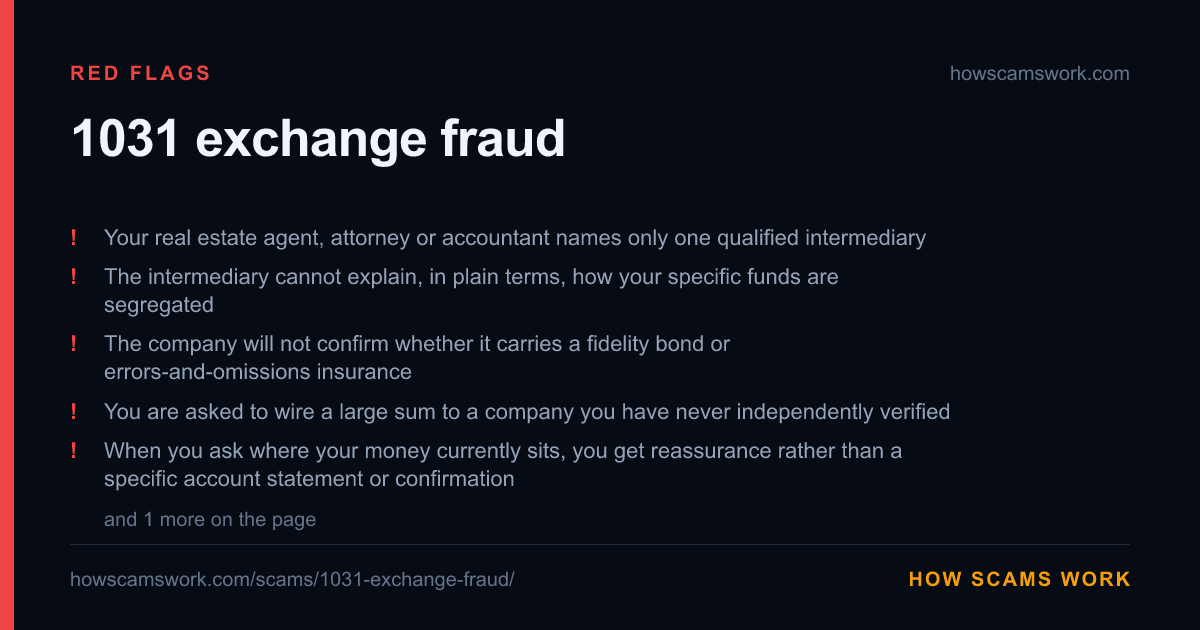
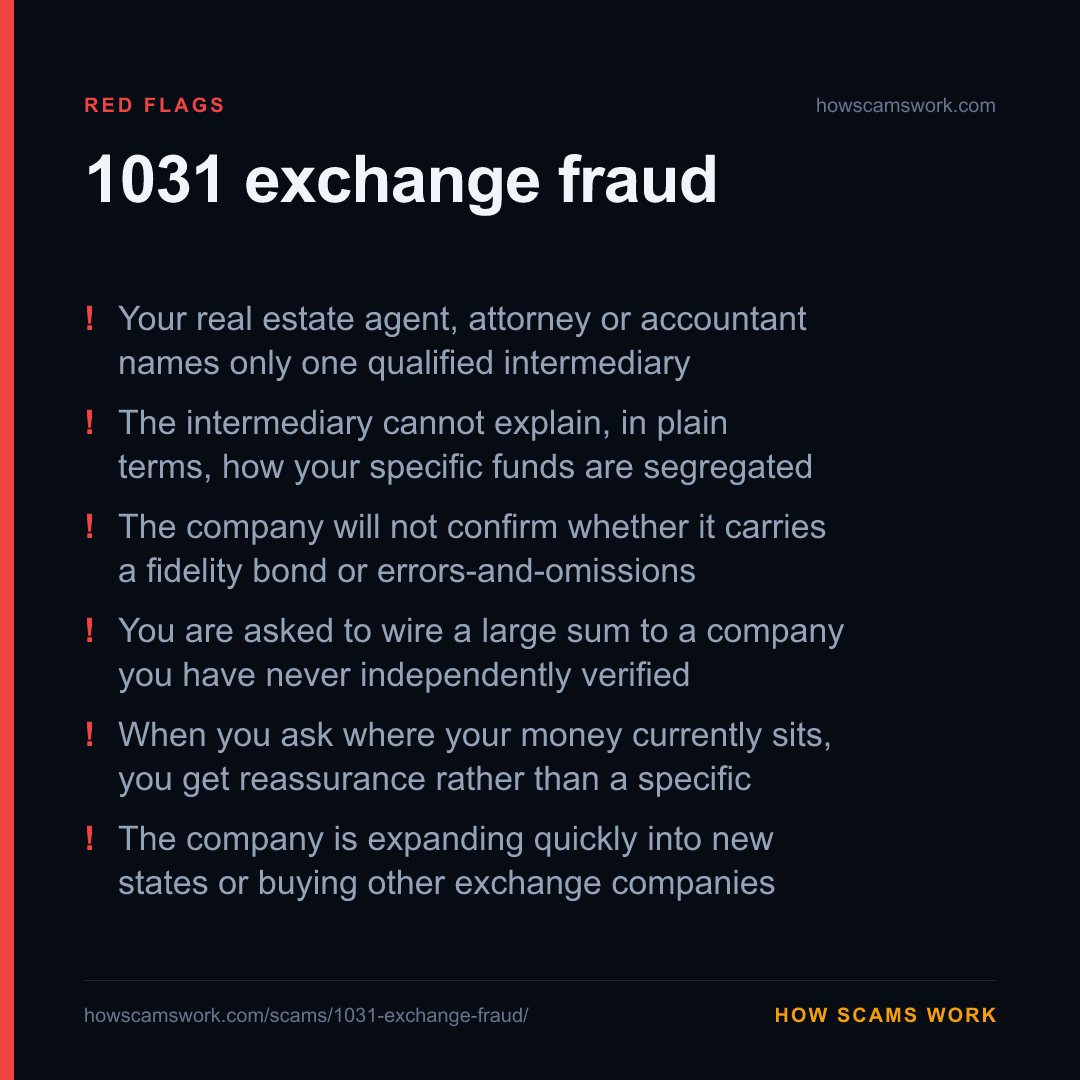
- Your real estate agent, attorney or accountant names only one qualified intermediary, with no mention of comparing options or checking its financial standing.
- The intermediary cannot explain, in plain terms, how your specific funds are segregated from its other clients’ money and from its own operating accounts.
- The company will not confirm whether it carries a fidelity bond or errors-and-omissions insurance, or claims your state does not require one, as most states do not.
- You are asked to wire a large sum to a company you have never independently verified, based solely on a referral.
- When you ask where your money currently sits, you get reassurance rather than a specific account statement or confirmation.
- The company is expanding quickly into new states or buying other exchange companies, which can mean access to a larger trust pool rather than a stronger business.
If it’s happening to you
- Contact the intermediary in writing immediately and demand written confirmation of your specific
funds’ location and availability. A vague or delayed response is itself a warning sign.
- Contact a real estate or tax attorney without delay if your 45-day identification or 180-day
closing deadline is approaching and the intermediary cannot confirm your funds are available; there may
be narrow IRS relief for exchanges that fail specifically because of a qualified intermediary’s default,
but it does not restore the lost money itself.
- Check for a bankruptcy filing by the intermediary or its parent company; if one exists, you likely
need to file a claim as a creditor promptly rather than wait for the company to resolve things informally.
- Report it. File a complaint with the FBI’s Internet Crime Complaint Center at ic3.gov and with
your state’s securities or financial regulator, if it has one. See where to report
for other countries.
- Gather every document showing the money was supposed to be held in trust: the exchange agreement,
wire confirmations, and any written statements the company made about how your funds were segregated.
These are exactly what prosecutors relied on in the cases documented here.
- If you are choosing an intermediary for a future exchange, ask specifically about bonding,
insurance, how long the company has operated, and whether your funds will sit in a qualified escrow or
trust account at an independent bank, not merely in the intermediary’s own name.
Where the money goes
In every documented case on this page, the money did not leave the country and did not pass through an
elaborate offshore network. It moved from the client’s sale into the intermediary’s own trust account,
and from there into real estate ventures, other businesses, or personal spending the intermediary’s owners
directly controlled: commercial real estate purchases and a Bahamas yacht in Virginia, a French breast
implant manufacturer in Nevada, more than 100 local real estate projects in Oregon, and a separate
company’s unpaid debts in California.
What comes back, when anything does, comes back slowly and partially: criminal restitution orders, a
bankruptcy trustee’s recoveries, or a civil judgment pursued years after the original deadline. None of
the documented cases on this page describe clients being made whole.
By the numbers
No published dataset breaks this scheme out as its own category yet, so there is no chart to show.
The data page explains which agency categories exist and why some schemes are
invisible in official statistics.
Every factual claim above traces to one of these. Statistics are reported losses; see
methodology for what that does and does not measure.
Common questions
Is a 1031 exchange itself a scam?
No. Section 1031 of the tax code is a legitimate, long-standing provision letting an owner defer capital gains tax on investment or business real estate by reinvesting the proceeds in similar property within strict deadlines. The fraud on this page is not the tax rule; it is the company the law requires you to hand your money to while you wait out those deadlines.
How is this different from the real estate closing wire fraud this site already covers?
In closing wire fraud, a criminal outside the deal spoofs or hijacks an email to trick you into sending money to an account the criminal controls, impersonating someone you already trust. In 1031 exchange fraud, there is no impersonation: the qualified intermediary is the party you were legally required to trust, and the person who takes the money is the one you knowingly, lawfully wired it to.
Do I have to use whichever qualified intermediary my agent or title company suggests?
No. You can choose your own qualified intermediary, and every case documented on this page involves a company a client, or a client's advisor, selected and trusted without independently checking it. Ask how the company segregates client funds, whether it carries a fidelity bond or errors-and-omissions insurance, and how long it has operated, before wiring a cent.
Does the IRS regulate or guarantee these companies?
No. A 2008 audit by the Treasury Inspector General for Tax Administration found that the IRS has no authority over qualified intermediaries at all: they are not licensed, bonded or subject to any federal standard for training, competency or conduct, even though the IRS recorded about $101.3 billion in deferred gains from roughly 429,000 like-kind exchanges in the year TIGTA studied. The IRS agreed and said it would add warnings about the risk to its taxpayer guidance; it still has no authority to supervise the companies themselves.
Why would a CPA or an attorney be involved in something like this?
Running or vouching for a qualified intermediary does not require a special license beyond whatever a state happens to impose, which in most states is none. Two of the four defendants in this page's Oregon case were a certified public accountant and the company's own in-house attorney, credentials a client might reasonably treat as reassurance rather than as something to independently verify.
How much money is typically involved?
The documented cases on this page range from $13.7 million realized loss to 91 clients up to roughly $126 million taken from a much larger, multi-state client base, because the exposure scales with however much trust money an intermediary happens to be holding when its owner decides to spend it.