Also called: viatical settlement fraud · bonded life settlement fraud · life insurance investment fraud · death benefit investment fraud
Life settlement fraud sells investors an interest in someone else's life insurance policy, to be paid when the insured dies, as a safe, guaranteed investment. In the cases here the premiums were not paid, the life expectancies were fraudulently low, or the money was spent on the promoters. Losses ranged from $7 million to over $800 million.
Key facts
Category
Investment
First documented
2001
Typical loss
$7000k–$800000k USD, per victim
Main channels
insurance agents and advisers selling investments, marketing companies and sales networks, fractional interests in life insurance policies, bonds and escrow accounts offered as protection, commissions paid to sellers
Who is targeted
Investors, many of them elderly, who put retirement savings into what was sold as a safe, fixed-return product; Investors who bought through insurance agents and advisers; Investors in the United States and Canada, in the A&O case
Documented origins
United States
Main targets
United States
Case files
3 documented cases
Last reviewed
2026-10-28
The stages of the scheme, in order, with the point where it can still be stopped.
What it is
A life settlement is described by prosecutors as a transaction in which an investor buys an interest in a
terminally ill or elderly person’s life insurance policy death benefit for a lump-sum cash payment. The
investor is paid when the insured dies, and profits if the benefit is greater than the price paid. Life settlement
fraud sells that investment on false promises of safety and a guaranteed return. In the cases here the money
was spent by the promoters, premiums were not paid, or life expectancies were set fraudulently low.
How it actually works
The product
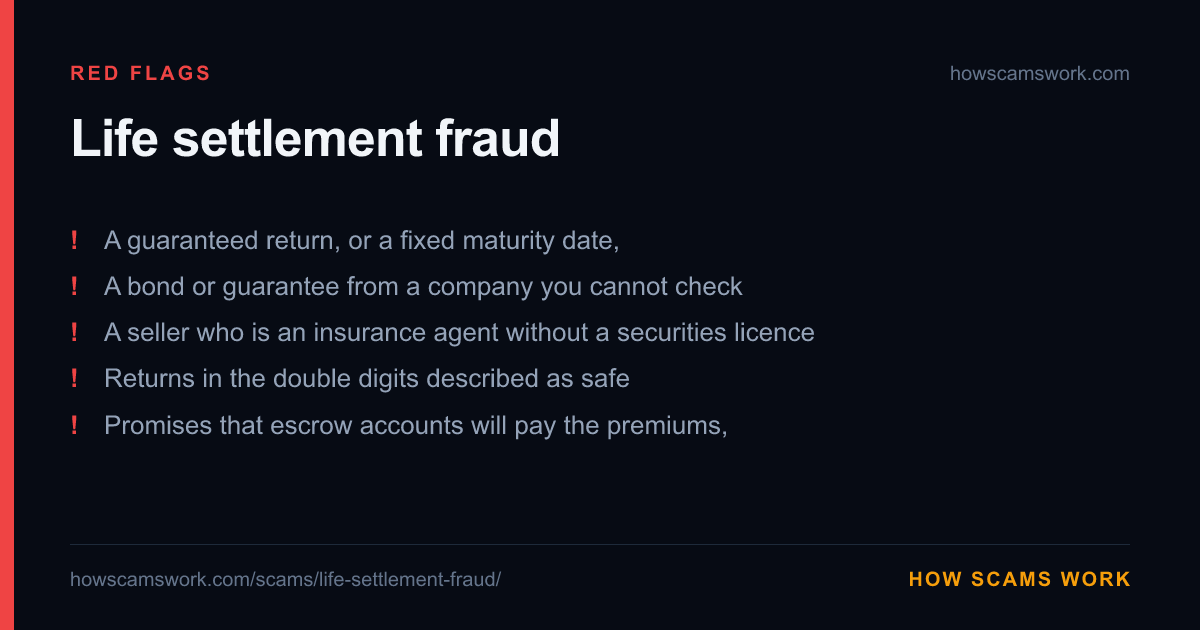
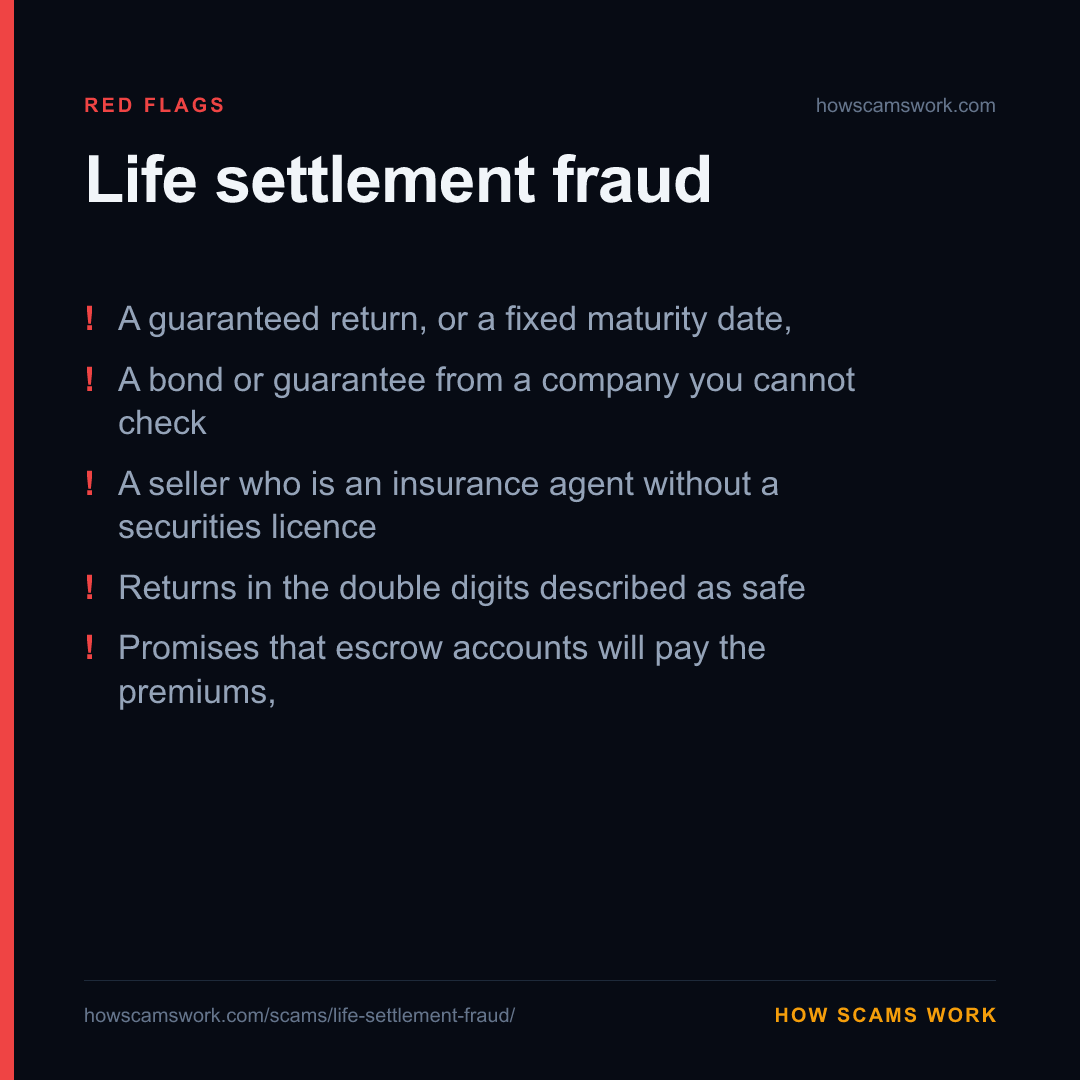
Investors are offered whole or fractional interests in life insurance policies. In the A&O case they were
described as bonded life settlements, fixed-maturity investments of four to seven years with a guaranteed
minimum compounded annual return of 10% to 12%. In the ABC Viaticals complaint the SEC alleged returns of 27%
to 150%.
The assurances
Sellers offer protection. The SEC alleged that ABC told investors an independent escrow agent controlled the
funds, that enough money to pay premiums for the insured’s life expectancy was segregated in a separate
escrow account, and that financial guarantee bonds fixed the date and amount of the return. Mutual Benefits
promised to escrow enough money for anticipated premiums.
The sales channel
The investments are sold by agents, advisers and marketing networks. MBC directed an international network of
sales agents and marketing directors. A&O paid a marketing company and independent insurance agents who were
not securities licensed a 10% commission on each purchase. In Massachusetts, the seller was an insurance adviser.
The shortfall
The product depends on premiums being paid until death. Prosecutors said MBC assigned fraudulently low life
expectancies, so premium reserves were insufficient, and it used premium funds from recently sold policies to
pay premiums on older policies that had not matured. The Massachusetts adviser let policies lapse by not
paying premiums.
Where it could have stopped
The SEC wrote in 2011 that without a bond a life settlement investment is open-ended, because the pay-out date depends on the date of death. A guarantee of a fixed date and return therefore depends on who stands behind it. The SEC alleged that one bond issuer misrepresented whether its financial statements had been audited and had no reinsurance coverage.
The cover-up
When regulators looked, the cases describe a cover story. Law enforcement said the A&O men set up a phony series of sales of the firm in 2007 and created sham companies, and the general counsel hired an actor who pretended to do due diligence, according to the ABA Journal.
The collapse and prosecution
A&O went into bankruptcy in September 2009 after failing to pay premiums on its policies. Sentences
documented here run from more than eight years to 60 years.
Why it works
The pitch is safety. The U.S. Attorney said in the A&O case that “the safety, security and no-risk nature of
the investment was critical to the sales pitch.” The product combined a guaranteed return with
words such as bond, escrow and reinsurance.
The sellers were in insurance. The Massachusetts defendant was an insurance adviser, and A&O’s sellers
were independent insurance agents.
Death is not on a schedule. The investor is paid when the insured dies and premiums are owed in the meantime;
the longer the insured lives, the more premium payments must be made, according to the U.S. Attorney’s Office.
Where it comes from
Entirely domestic in the documented cases, though A&O’s investors stretched across the United States and
Canada and the SEC alleged ABC raised money from investors worldwide.
The earliest conduct here. The Massachusetts scheme ran from 2001, and the SEC alleged ABC Viaticals raised
money from at least June 2001. The cases were prosecuted between 2007 and 2013.
Older cases. The sources are from 2007 to 2013 and the SEC releases are from 2007 and 2011. This page does not describe recent enforcement because none was
found in the sources read.
Joseph Gennaco, a 68-year-old insurance adviser from Winthrop, Massachusetts, pleaded guilty in February to 27 counts of mail and wire fraud for defrauding 40 people out of $7 million. The Associated Press reported in August 2013 that he was sentenced to more than eight years in federal prison and three years of probation and ordered to pay full restitution. The scheme ran from 2001 until 2011.
A&O Resource Management Ltd. of Houston, Texas sold whole and fractional interests in "bonded life settlements" to some 800 investors, most of them elderly, raising about $100 million. In July 2011 five people who pleaded guilty were sentenced to terms ranging from 188 to 36 months. The two others, Christian Allmendinger and Adley H. Abdulwahab, were found guilty at trial and were sentenced in September 2011 to 45 and 60 years.
Peter Lombardi, the former president and sole shareholder of Mutual Benefits Corp. (MBC), a South Florida viatical firm, was sentenced on January 19, 2007 to 240 months in prison, followed by three years of supervised release. He had pleaded guilty on October 23, 2006 to securities fraud in a viatical and life settlement scheme in which, the U.S. Attorney's Office said, 28,000 investors lost over $800 million.
Keep all papers, including the agreement, the escrow statements and the bond, as they may be needed in a court case.
Where the money goes
Domestic in the cases here.
Investor money goes to the promoter or the seller. In the A&O case, the U.S. Attorney’s Office said it was spent on
multi-million dollar homes, high-end cars and diamonds, and the sellers were paid a 10% commission. In the
Massachusetts case, prosecutors said the adviser diverted money for personal use. In the MBC case, the U.S.
Attorney’s release says new sales paid premiums on older policies.
No published dataset breaks this scheme out as its own category yet, so there is no chart to show.
The data page explains which agency categories exist and why some schemes are
invisible in official statistics.
Sources
Every factual claim above traces to one of these. Statistics are reported losses; see
methodology for what that does and does not measure.
Former viatical firm executive sentenced to twenty years for role in securities fraud scheme.
U.S. Attorney's Office, Southern District of Florida. Accessed 2026-10-28. Supports: The Mutual Benefits Corp. case: the sentence, the 28,000 investors and $800 million, how a viatical or life settlement works, the escrow promise, the low life expectancies and the Ponzi characterization.
Life settlements scammers get longer jail sentences than Enron's Skilling.
InvestmentNews. Accessed 2026-10-28. Supports: The A&O bonded life settlement product and its guaranteed return, the investors and amount raised, the commissions, the regulators' concerns, the 2007 phony sales, the 2009 bankruptcy and the 45-year and 60-year sentences.
Winthrop man sentenced to 8 years on fraud charges.
Boston 25 News, from the Associated Press. Accessed 2026-10-28. Supports: The Gennaco case: the 40 people, $7 million, 27 counts, the sentence, the diversion of funds, the lapsed policies and the 2001 to 2011 period.
SEC Charges Offshore Company with Massive Life Settlement Bonding Fraud.
U.S. Securities and Exchange Commission. Accessed 2026-10-28. Supports: How a life settlement bond fixes the maturity date and the SEC's 2011 allegations about Provident Capital Indemnity's bonds, audits and reinsurance.
Common questions
What is a life settlement, as prosecutors describe it?
The U.S. Attorney's Office for the Southern District of Florida described a viatical or life settlement as a transaction in which an investor buys an interest in a terminally ill or elderly person's life insurance policy death benefit for a lump-sum cash payment. The investor profits if the benefit is greater than the price paid when the insured dies. The longer the insured lives, the more premium payments must be made to keep the policy from lapsing and becoming worthless.
Why does the date of death matter so much?
Because the investor is paid when the insured dies, and until then premiums are owed. The SEC wrote in 2011 that without a bond a life settlement investment is illiquid and open-ended, because the pay-out date and return depend on the date of the insured's death. That is why some sellers offered bonds or guarantees giving a fixed maturity date, as A&O did.
Were the bonds and guarantees real protection?
Not in the cases the SEC described. The SEC alleged in 2011 that an offshore company, Provident Capital Indemnity, issued about 197 bonds backing life settlement offerings with a face value of more than $670 million while misrepresenting whether its financial statements had been audited, and it alleged the company had no reinsurance coverage. These are allegations in a civil complaint, and the SEC release does not give the outcome.
Were the sellers always strangers?
No. The Massachusetts defendant was an insurance adviser who told 40 people their money would be invested in life settlements. In the A&O case, a marketing company and independent insurance agents who were not licensed to sell securities sold the investments, for a 10% commission.
How do I report a suspected life settlement fraud?
The sources here do not give a hotline. See <a href="/report/">where to report</a> for agencies, and contact your state securities regulator and the SEC.
Where the money goes after it leaves, and where it becomes hard to recover.
Share the red flags
A card made from this page's red flags, for anyone you think might be targeted. Send it to a parent, a neighbour or a group chat.
Reporting is what produces the enforcement data on this page. Find the right agency and phone
number for your country on the report page. If money moved in the last
few hours, call your bank first.
Before you continue to How Scams Work
We use browser storage to remember this choice, and nothing else is needed to read the site. If you choose
Accept all, we also let Google Analytics set cookies (_ga, _ga_*) to count
visits and see which pages are read.
Accept required gives you the whole site with no analytics cookies. There is no advertising
here and no other tracking. You can change your choice at any time from "Cookie choices" in the footer.