Also called: fake carbon credit investment · carbon offset scam · VER investment fraud · voluntary carbon market fraud · green investment boiler room
Carbon credit fraud takes two forms. In the first, boiler rooms cold-call mostly older people and sell voluntary carbon credits as safe, high-return investments, though prosecutors and police said they were fake, overpriced or unsellable. In the second, a developer is accused of manipulating data to obtain more credits than it earned.
Key facts
Category
Investment
First documented
2007
Typical loss
$9000k–$16000k USD, per victim
Main channels
cold calls from call centers and boiler rooms, contract notes and investment certificates sent by email, bogus price analyses and brochures, wires to accounts in the names of corporate entities, carbon credit registries and project data
Who is targeted
Elderly, retired or older homeowners who are cold-called, in the UK cases; Investors who are told the credits are environmentally friendly and carry no risk; Investors in a carbon credit developer and buyers who rely on registry-issued credits, in the alleged developer fraud
Documented origins
United Kingdom, United States
Main targets
United Kingdom, United States
Case files
4 documented cases
Last reviewed
2026-10-28
The stages of the scheme, in order, with the point where it can still be stopped.
What it is
Carbon credits and offsets are bought by companies and individuals to offset emissions. Carbon credit fraud
exploits that. In the form that has produced most of the sentences, boiler rooms cold-called mostly older
people and sold voluntary carbon credits as safe, high-return investments. In a second form, charged in
2024, a developer is accused of manipulating project data so that a registry issued it more credits than it had
earned.
How it actually works
The call
A call center cold-calls people. In the UK cases the targets were older: brokers sought homeowners aged 50 and
over in affluent postcodes, and the U.S. case describes victims who were primarily elderly or retired. Brokers,
according to Financial Planning Today, often used fake names.
The pitch
The callers promise a safe, profitable, environmentally friendly investment. In the New York case, callers
claimed the investments would help address the climate crisis, and victims were falsely promised that they could be
easily sold, carried no risk and would yield a significant short-term return. In the Harman Royce case projected
profits of 6% to 100% over four months to 10 years were described.
The price
The credits are sold at prices far above what they trade for. Harman Royce victims paid £5.26 to £6.50 per
credit, when an independent consultant’s evidence was that the real trading price was between 25p and 30p.
In the Seakens and Ryan case police said mark-ups were over 1000%.
Where it could have stopped
In the Harman Royce case, an independent consultant said that voluntary emission reduction credits have no secondary market. A promise of a profit on something that cannot be resold needs someone to explain who buys it. In the Seakens and Ryan case, Financial Planning Today reported that some victims were offered an “exit strategy” only if they bought more credits.
The paperwork
Victims receive documents. Harman Royce sent contract notes and a bogus “carbon market analysis” spreadsheet; the
New York defendants emailed purchase contracts and investment certificates. The Seakens and Ryan case used
the accounts of a regulated company, which police said gave potential investors reassurance that their money
was with a safe third party.
The money
Payments go to accounts in the names of corporate entities. The New York victims wired funds to US accounts in the
names of entities controlled by a co-conspirator, and the proceeds were laundered through overseas accounts in
Cyprus, Switzerland and the UK in the names of shell companies. Harman Royce’s money bought staff wages, an Aston
Martin and a watch.
The prosecution
In the cases here, a British Columbia regulator froze a $1 million wire in 2010, and Essex Police referred the
Harman Royce case to the City of London Police. Sentences documented run from two years and three months to eight years.
In October 2024 a different kind of case, the alleged manipulation of cookstove data, was charged in New York.
Why it works
It sounds responsible. The New York callers appealed to victims by claiming that the investments were
environmentally friendly and would help address the climate crisis.
There was no way to resell. According to evidence in the Harman Royce case, VER credits had no secondary market,
so a buyer had no one to sell to.
The pressure to buy more. The New York release describes victims persuaded to make further investments under
the false pretense that they could not sell until they bought more, and the Seakens and Ryan case describes
“recovery room” sales.
The unregulated label. REDD-Monitor wrote in 2013 that the UK financial regulator played no role in a case
because voluntary carbon credits are not regulated. That is the blog’s comment on the UK position at the time and
this page has not verified how it stands today.
Where it comes from
The victims in the boiler room cases were in the UK, and the sources do not locate every call center. In the New York case, proceeds were sent through US accounts. The 2024 developer case is in New York and involved projects in
sub-Saharan Africa, Asia and Central America, according to Holland & Knight.
The earliest case here. The Macdonald and Downes scam ran from January 2007 to December 2010, and the UK
police called their 2013 sentences the first for a carbon credit fraud, as reported by REDD-Monitor.
A new kind. Holland & Knight described the October 2024 federal actions as the first cases arising from fraud
in the voluntary carbon market.
On 2 October 2024 the U.S. Attorney's Office for the Southern District of New York announced criminal charges against Ken Newcombe, former CEO of carbon credit developer C-Quest Capital, and Tridip Goswami, former head of its carbon and sustainability accounting team. The charges are allegations, and they are presumed innocent unless and until proven guilty. The former chief operating officer, Jason Steele, pleaded guilty and is cooperating, according to REDD-Monitor.
Christopher Wright and Steven Hooper, citizens of the United Kingdom, were sentenced on June 30, 2022 in the Southern District of New York to 52 and 42 months in prison for an over $16 million international telemarketing scheme. Call centers cold-called victims in the UK, who were primarily elderly or retired. From about 2011 to 2015 they were sold "carbon credits" that, the U.S. Attorney's Office said, were fake.
Sami Raja, 32, of Grays, Essex, was sentenced to eight years at Southwark Crown Court in January 2019 for his part in a £2.4 million carbon credit fraud. With four others he mis-sold carbon credits through two companies, Harman Royce Ltd and Kendrick Zale Ltd, between January 2012 and August 2013. Four others were sentenced in September 2018.
On 18 April 2013 at Kingston Crown Court, Ian David Macdonald was sentenced to eight years and David John Downes to four and a half years for a carbon credit boiler room that defrauded UK "investors" of a total of $9 million, according to the blog REDD-Monitor. It reported that these were the first prison sentences for such a scheme. The scam ran from January 2007 to December 2010.
Keep every document, including contract notes and certificates.
Where the money goes
Cross-border in the cases here.
Victims in the UK wired money to accounts in the US in the names of corporate entities; the Macdonald and
Downes money went to Canadian and US accounts, and a $1 million wire to a Swiss company was blocked. The New York
release says the proceeds were laundered through overseas accounts in Cyprus, Switzerland and the UK in
the names of shell companies. The Seakens and Ryan case used the accounts of a regulated company for what police
described as money laundering on a vast scale. Harman Royce’s money went on salaries and luxuries.
No published dataset breaks this scheme out as its own category yet, so there is no chart to show.
The data page explains which agency categories exist and why some schemes are
invisible in official statistics.
Sources
Every factual claim above traces to one of these. Statistics are reported losses; see
methodology for what that does and does not measure.
Operators of over $16 million international boiler room fraud sentenced to years in prison.
Internal Revenue Service, Criminal Investigation. Accessed 2026-10-28. Supports: The Wright and Hooper case: the sentences, the call centers, the DirectView stock, the fake carbon credits, the shell company accounts, the losses and the definition of carbon credits and offsets.
Fraudster gets 8 year sentence for role in £2.4m carbon credit con.
Financial Planning Today. Accessed 2026-10-28. Supports: The Raja case: the two companies, the targeting of homeowners over 50, the prices charged against the real price, the lack of a secondary market, the spreadsheet, the Kendrick Zale sales and the search warrant.
£2m carbon credit fraudsters convicted after BBC probe.
Financial Planning Today. Accessed 2026-10-28. Supports: The convictions of Seakens and Ryan, the mark-ups of over 1000%, the lack of a market for the credits, the recovery room sales and the use of a regulated company's accounts.
What is a carbon credit, as prosecutors describe it?
The U.S. Attorney's Office for the Southern District of New York wrote that carbon credits, issued as part of governmental and voluntary regulatory regimes, are permits representing the right to emit a certain number of tons of carbon dioxide into the atmosphere, and that carbon offsets, tied to particular emissions-reducing projects, represent a reduction in carbon dioxide emissions and can be bought by individuals and companies to offset their carbon footprints.
Why couldn't victims sell the credits?
In the Harman Royce case, evidence from an independent consultant was that voluntary emission reduction (VER) carbon credits have no secondary market, so the promised profits were false. In the Seakens and Ryan case, police said there was no market for investors to sell and no realistic likelihood of one. In the Wright and Hooper case, victims who tried to sell found they could not.
Is all carbon credit trading fraudulent?
No, and this page does not say so. The cases here are fraud convictions or charges about specific sellers and a specific developer. The Holland & Knight alert on the 2024 federal actions describes the voluntary carbon market as one in which companies voluntarily buy offsets to meet their emissions goals.
What happened in the 2024 C-Quest case?
Two former executives were charged in October 2024 with fraud, and a third, the former chief operating officer, pleaded guilty and is cooperating, according to REDD-Monitor. The charges are allegations and the sources read here do not report a verdict. The company avoided criminal charges after self-disclosing, according to Holland & Knight.
How do I report a suspected carbon credit investment scam?
The sources on this page do not give a US hotline. See <a href="/report/">where to report</a> for agencies. In the UK, REDD-Monitor's 2013 post, quoting the City of London Police, directed people who believed they were victims to Action Fraud at 0300 123 2040; that number was current in 2013 and should be checked.
Where the money goes after it leaves, and where it becomes hard to recover.
Share the red flags
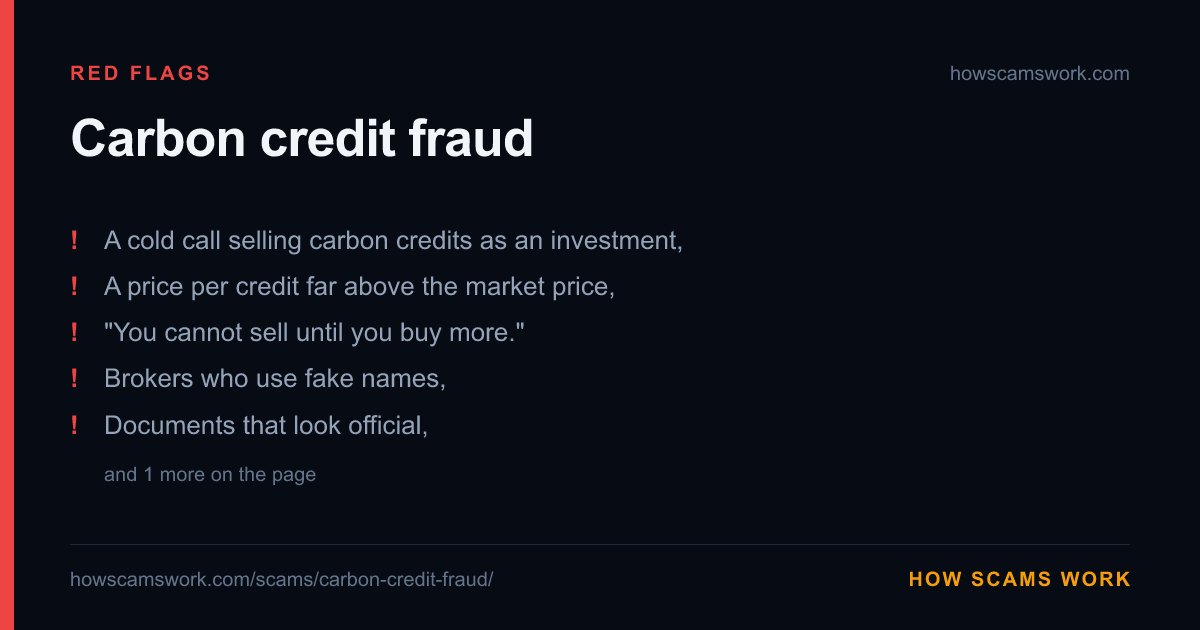
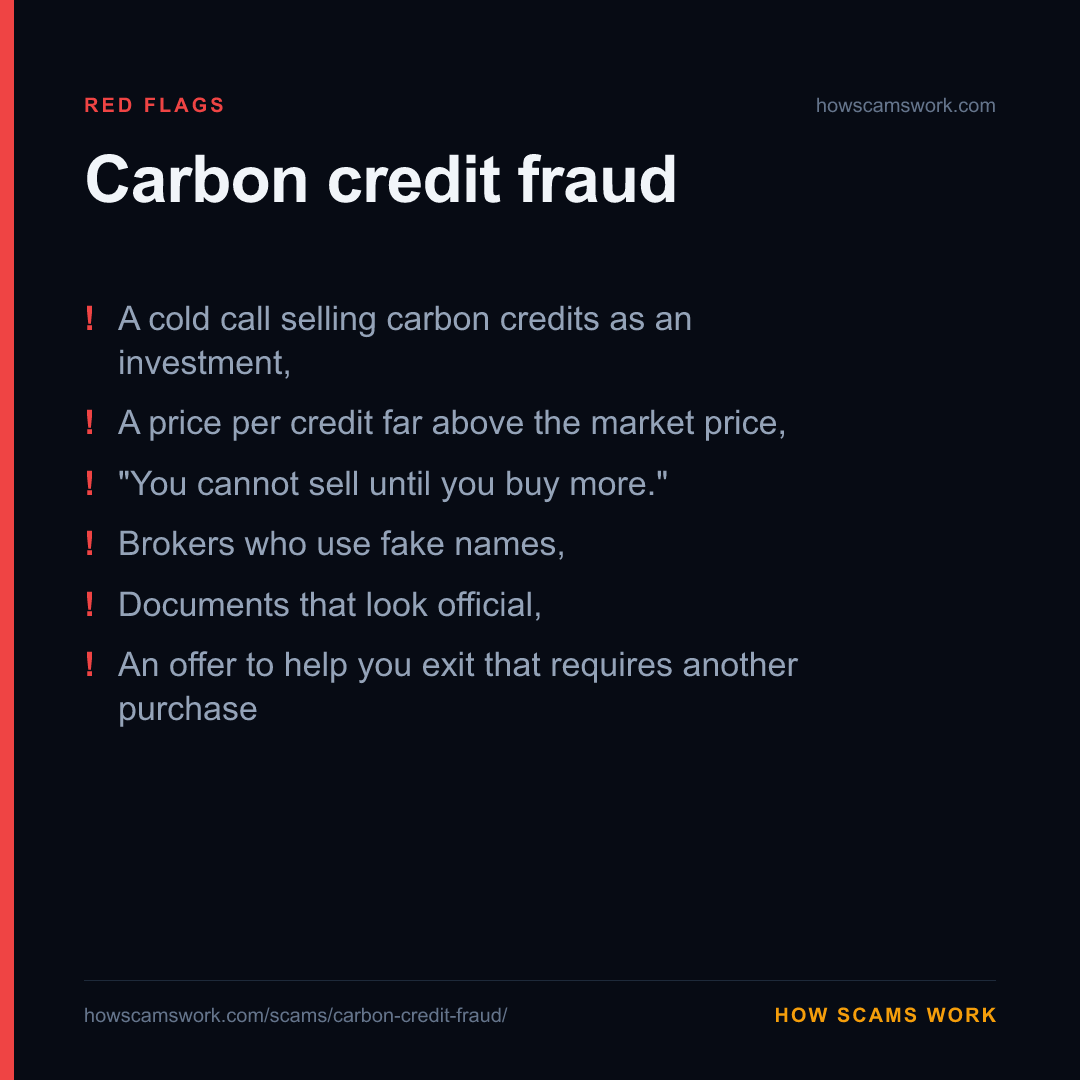
A card made from this page's red flags, for anyone you think might be targeted. Send it to a parent, a neighbour or a group chat.
Reporting is what produces the enforcement data on this page. Find the right agency and phone
number for your country on the report page. If money moved in the last
few hours, call your bank first.
Before you continue to How Scams Work
We use browser storage to remember this choice, and nothing else is needed to read the site. If you choose
Accept all, we also let Google Analytics set cookies (_ga, _ga_*) to count
visits and see which pages are read.
Accept required gives you the whole site with no analytics cookies. There is no advertising
here and no other tracking. You can change your choice at any time from "Cookie choices" in the footer.