Also called: oil and gas drilling program fraud · oil well investment scam · working interest fraud · private oil and gas offering fraud · gas well boiler room
Oil and gas investment fraud sells interests in wells or drilling programs by claiming that oil has been struck or drilling is imminent. In the cases here wells had not been acquired, drillers were not hired and production was overstated thirty-fold. Investors put in from $5.7 million to $15.8 million in the cases with a stated total, and sentences ran from 63 months to 18 years.
Key facts
Category
Investment
First documented
1995
Typical loss
$5700k–$99708k USD, per victim
Main channels
cold calls from boiler rooms, mailed brochures with geological reports, private placement memoranda, joint venture and drilling programs, salesmen, some of whom are not registered
Who is targeted
Investors who respond to cold calls, mailed brochures or sales presentations about drilling programs; Investors in many states, such as Kentucky, Arizona, California and New Jersey in the Target Oil and Gas case; Investors who cannot check the geology, the drilling or the books themselves, and rely on what the promoter tells them
Documented origins
United States
Main targets
United States
Case files
4 documented cases
Last reviewed
2026-10-28
The stages of the scheme, in order, with the point where it can still be stopped.
What it is
Oil and gas investment fraud sells investors interests in a well or a drilling program on claims that are false:
that wells have been acquired, that drilling is about to begin, that earlier wells hit oil or gas, or that the money
will go into the ground. The four sentenced cases here involved a California boiler room, a Dallas promoter, a
Kentucky company and a Texas family firm. They differ in size, but in each the company told investors one thing
and did another with the money.
How it actually works
The pitch
Investors are reached by cold call, brochure or presentation. Baiocchi’s telemarketers in Newport Beach and
Montreal cold-called people around the country; Barber’s associates cold-called for two of his projects; Target
mailed brochures and then followed up by phone. The SEC alert says common pitches refer to recent news such as
high oil or gas prices.
The prospect
The pitch describes a well that is producing or about to. Barber claimed one project produced more than 450
barrels a day when it produced under 15. Baiocchi’s callers said gas wells were already acquired and producing
when none had been acquired. Target’s brochures contained geological reports saying a geologist had assessed
proposed sites, and its salesmen said past wells had hit oil or gas. Aspen’s salesmen touted earlier wells
without disclosing vendor liens and investor litigation.
The offering
Investors are sold interests in a program, such as Barber’s Arrowhead, Sierra and Sidnee projects or
Aspen’s Rancho Blanco programs. Barber’s sales literature said proceeds would be held in escrow until 80% of the
offering was raised. Aspen’s salesmen told investors they could recoup their cash within three years, with
production revenues lasting up to 20 years.
The money
The money does not go where the pitch said. Barber withdrew investor money from escrow almost immediately.
Baiocchi kept 60 percent of what investors initially sent, and over $2.9 million of $5.7 million went to accounts
he controlled. Aspen’s funds were transferred almost immediately to its corporate accounts. Target returned about
$1.19 million of $15.8 million.
Where it could have stopped
The SEC alert says the promoter often does not tell investors that he owns the drilling company, or plans to hire a driller at far less than what investors were told, pocketing the difference, and that he makes money even if the well comes up dry. It suggests asking what the funds will be used for, in writing, and who is being paid.
The silence
Investors get little information. Aspen’s investors received no reports on the use and status of their funds and
their attempts to audit were thwarted. Several states issued a cease and desist order against Target, and the
Smith brothers concealed it from potential investors.
The prosecution
The cases ended in sentences from 63 months to 18 years, with restitution orders from $3.8 million to
$99,707,758 and forfeitures that included real estate, boats, luxury vehicles and an original Picasso.
Why it works
Investors cannot check. The SEC alert says that analysing an oil and gas investment may involve highly
technical matters such as geological findings and new drilling technologies, and that the only information an
investor has may come from the promoter.
The story is attractive. The SEC alert says that because the industry is often in the news, some people have
used the appeal of “striking it rich” with a gushing well as the basis for fraudulent schemes.
The programs are private. The SEC alert says private securities offerings carry unique risks, are generally
limited by law to certain institutional and high net worth investors, and typically have less liquidity.
Sales fees and the promoter’s pay may not be disclosed. The SEC alleged in the Petroleum Unlimited case
that only $534,000 of the $2.9 million raised was used for drilling, with sales fees of 49% and 74% of the investments
not mentioned. This is an allegation in the alert and the outcome was not read for this page.
Where it comes from
Entirely domestic in the documented cases, though Baiocchi’s telemarketers worked from Montreal as well as
California and Aspen’s programs were sold to investors “throughout the U.S. and elsewhere”.
The earliest conduct here. Baiocchi’s scheme ran from 1995 to 1997 and was sentenced in 2005.
A rising caseload. The SEC alert says its cases went from few in 2005 and 2006 to more than 20 a year, and that
state regulators saw a similar rise.
Older cases. The sentences here are from 2005, 2010 and 2011 and the alert from 2013. No later sentences were
read for this page, so it does not describe more recent enforcement.
Three family members who were principals of Aspen Exploration, Inc., the managing partner of oil and gas well programs sold to investors throughout the U.S. and elsewhere, were sentenced by U.S. District Judge Jorge A. Solis in July 2011. Gregory Rand got 18 years, William Nicholas Rand 14 years and William Anthony Rand five and a half years. The defendants were ordered to pay $99,707,758 in restitution and to forfeit property including an original Picasso.
Between 2003 and 2008, officials and employees of Target Oil and Gas of Albany, Kentucky lured about $15.8 million from investors in Kentucky, Arizona, California, New Jersey and other states through false statements about the company's drilling programs, returning only about $1.19 million in royalty payments. WAVE reported in July 2011 that five people were sentenced in U.S. District Court in Lexington on June 27 to 30, the company's president, Michael Smith, to 10 years and forfeiture of $3.2 million.
Tommy Eugene Barber, 33, of Dallas, who pleaded guilty in December 2009 to two counts of securities fraud, was sentenced on October 13, 2010 to 120 months in prison and ordered to pay $13,243,073 in restitution. From May 2006 to November 2007 he and associates sold investments in three oil and gas drilling projects, Arrowhead, Sierra and Sidnee, through T-Bar Resources, LLC, and he received about $13.5 million from more than 300 investors.
Alan Brian Baiocchi, 47, of Newport Beach, California, president and operator of the telemarketing boiler room Intro Technology Services (ITS), was sentenced on November 21, 2005 to 63 months in prison and $3.8 million in restitution. From 1995 to 1997 his telemarketers in Newport Beach and Montreal cold-called people soliciting investments in oil and gas wells in Oklahoma, and more than 200 victims invested more than $5.7 million.
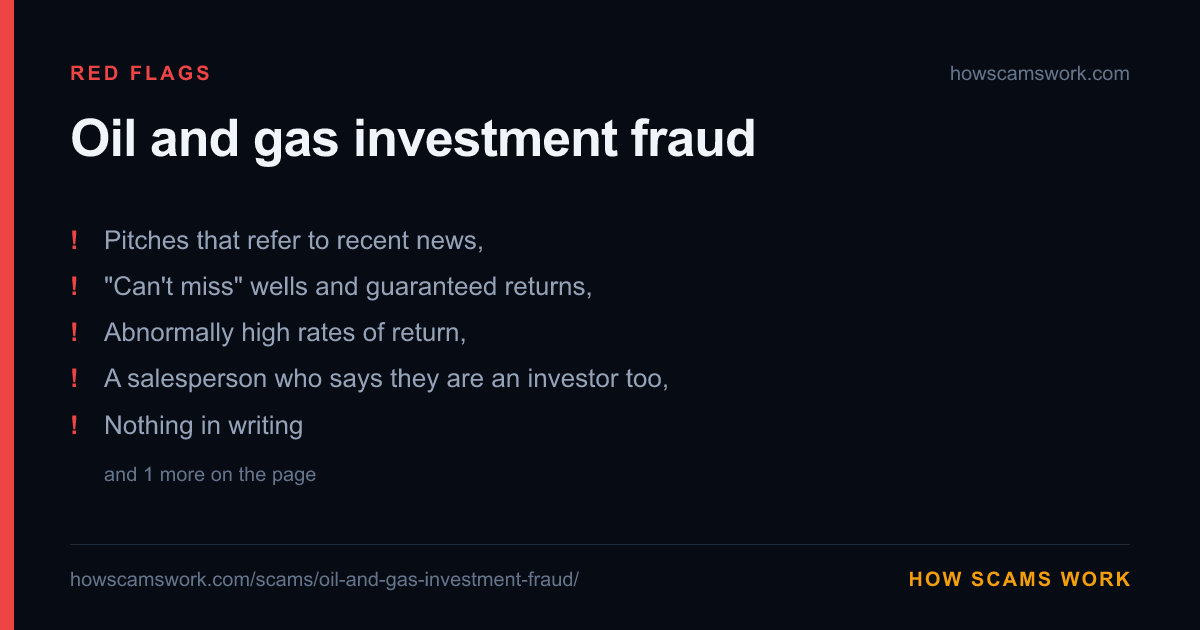
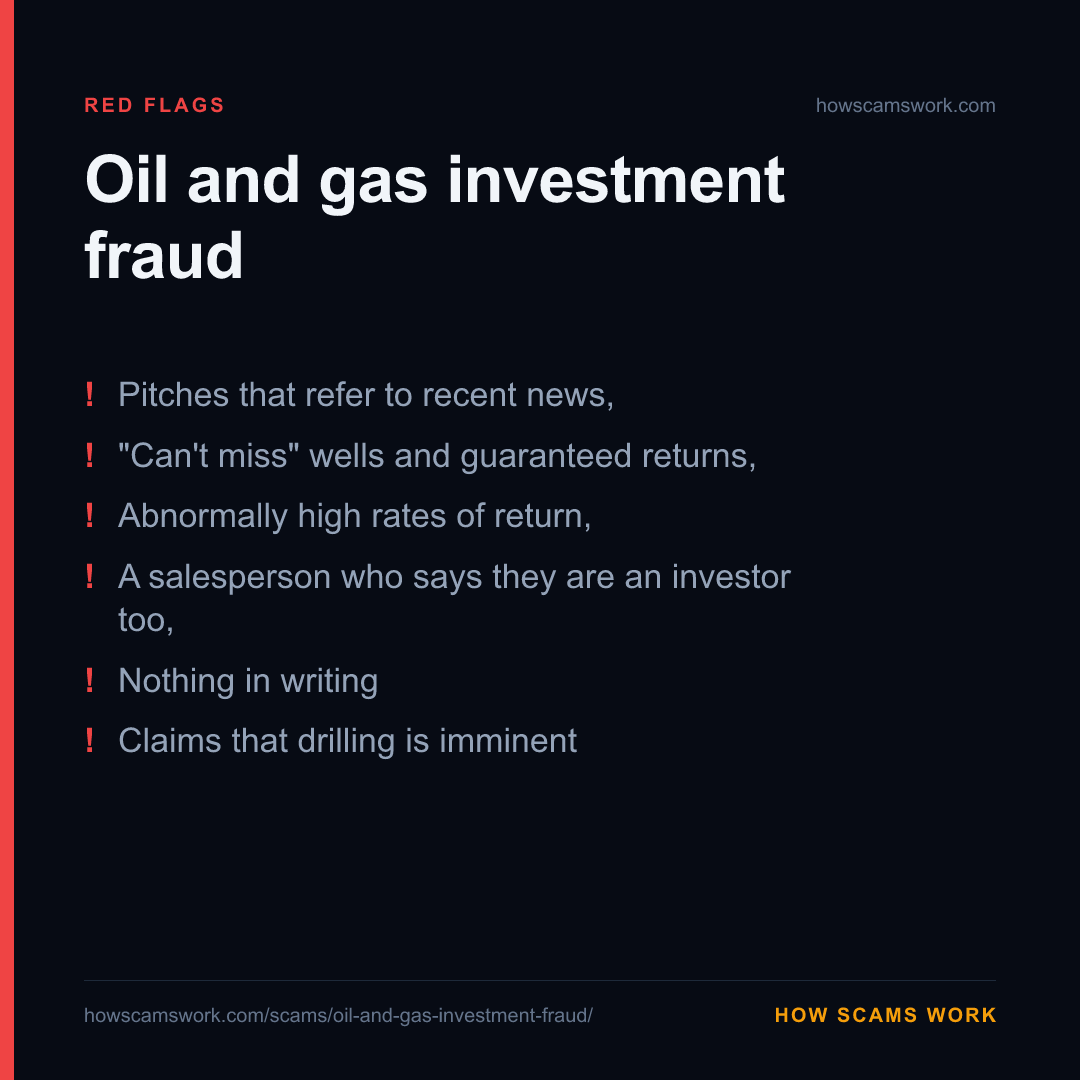
Pitches that refer to recent news, such as high oil or gas prices.
“Can’t miss” wells and guaranteed returns, including claims that major oil and gas companies are drilling nearby.
Abnormally high rates of return, unsolicited materials, or pressure to decide because the offer is “limited” or “once-in-a-lifetime”.
A salesperson who says they are an investor too, or asks you to sign that securities laws do not apply.
Nothing in writing about how the money will be used.
Claims that drilling is imminent when no driller has been hired.
If it’s happening to you
If you are asked to invest in a well or a drilling program:
Find out who is asking. The SEC alert suggests checking whether the seller is registered with FINRA’s BrokerCheck, the SEC’s adviser site or your state securities regulator.
Ask for the use of proceeds in writing, including sales fees and what the promoter and employees are paid.
Ask for the broker’s due diligence report if a registered broker recommends it.
Be wary of pressure and promises of low risk for high returns.
Investor money goes to the company’s accounts and is moved out. Barber withdrew escrowed funds almost
immediately. Baiocchi kept 60 percent. Target’s company returned about $1.19 million of $15.8 million. Aspen’s
funds were diverted for the defendants’ benefit and to costs of earlier wells, and the forfeited property included
real estate, boats, luxury vehicles, an original Picasso, jade, jewelry and wine.
No published dataset breaks this scheme out as its own category yet, so there is no chart to show.
The data page explains which agency categories exist and why some schemes are
invisible in official statistics.
Sources
Every factual claim above traces to one of these. Statistics are reported losses; see
methodology for what that does and does not measure.
Dallas man sentenced to 10 years in federal prison for running oil and gas scheme.
U.S. Attorney's Office, Northern District of Texas. Accessed 2026-10-28. Supports: The Barber case: the three projects, the $13.5 million from more than 300 investors, the cold calls, the 450 versus 15 barrels a day, the missing driller, the escrow withdrawals, the plea, sentence and restitution.
Five sentenced in Target Oil and Gas investment fraud scheme.
WAVE 3 News. Accessed 2026-10-28. Supports: The Target Oil and Gas case: the $15.8 million and $1.19 million, the brochures and geological reports, the coached salesmen, the cease and desist order and the five sentences.
They Said They Were Selling Interests in Oil Wells. Instead, They Were Buying Picassos..
Dallas Observer, reproducing the U.S. Attorney's Office for the Northern District of Texas recap. Accessed 2026-10-28. Supports: The Aspen Exploration case: the sentences, the $99,707,758 restitution, the forfeited property, the transfers to Aspen's accounts, the lack of reports and the claims about earlier wells.
Investor Alert: Private Oil and Gas Offerings.
U.S. Securities and Exchange Commission, Office of Investor Education and Advocacy. Accessed 2026-10-28. Supports: The growth in SEC cases, the points on registration and due diligence, the themes of undisclosed use of proceeds and overstated prospects, the SEC's allegations in Wellco, Petroleum Unlimited, Provident Royalties and Rose, and the list of common red flags.
Common questions
How common is oil and gas investment fraud?
In a May 2013 investor alert the SEC's Office of Investor Education and Advocacy wrote that the number of SEC cases involving private offerings for oil and gas ventures went from few in 2005 and 2006 to an average of more than 20 per year since, and that state securities regulators had seen a similar increase over the previous five years.
Does it help if the seller is registered?
Only somewhat. The SEC alert says that working with a registered individual is not a guarantee that the offering is sound, and that a registered broker recommending a private offering must independently review it rather than rely on the promoter. It also notes that the individuals selling the offerings in two of the cases it describes were not registered.
How does a promoter make money if the well comes up dry?
According to the SEC alert, the promoter often does not say that he owns the drilling company, or plans to hire a driller at far less than what investors were told the drilling would cost, pocketing the difference. The alert also describes undisclosed sales fees to brokers and compensation to the promoter and employees.
Are the SEC cases in the alert proven?
The alert describes what the SEC alleged in those cases and does not give outcomes in the text read for this page, so this page treats them as allegations. The four cases on this page ended in convictions and sentences.
How do I report an oil and gas investment I suspect is fraud?
The sources on this page do not give a hotline. See <a href="/report/">where to report</a> for agencies, and contact your state securities regulator and the SEC. The SEC alert suggests checking whether the seller is registered through FINRA's BrokerCheck, the SEC's Investment Adviser Public Disclosure site or your state securities regulator.
Where the money goes after it leaves, and where it becomes hard to recover.
Share the red flags
A card made from this page's red flags, for anyone you think might be targeted. Send it to a parent, a neighbour or a group chat.
Reporting is what produces the enforcement data on this page. Find the right agency and phone
number for your country on the report page. If money moved in the last
few hours, call your bank first.
Before you continue to How Scams Work
We use browser storage to remember this choice, and nothing else is needed to read the site. If you choose
Accept all, we also let Google Analytics set cookies (_ga, _ga_*) to count
visits and see which pages are read.
Accept required gives you the whole site with no analytics cookies. There is no advertising
here and no other tracking. You can change your choice at any time from "Cookie choices" in the footer.