Also called: guardianship fraud · conservatorship fraud · professional guardian embezzlement · ward exploitation · elder guardianship theft
Professional guardianship fraud is theft by a court-appointed guardian or conservator, often a company managing dozens or hundreds of wards at once, who drains the bank accounts, pensions, and veterans' or Social Security benefits of people a judge has already found unable to manage their own affairs. One Albuquerque firm stole $11 million from nearly 1,000 clients over a decade before anyone outside the company reported it.
What it is
A court finds that a person, usually elderly, living with dementia, or disabled, cannot manage their own
money or affairs, and appoints a guardian or conservator to do it for them. That appointment is a real
legal safeguard for people who genuinely need one. It is also, in every case documented on this page, the
exact mechanism the fraud used: once appointed, a guardian has legal control of the ward’s bank accounts,
pensions, real estate and federal benefits, and the ward, by the court’s own finding, cannot independently
check on it. The worst documented cases here were not lone family members; they were professional
guardianship companies serving dozens, and in one case nearly 1,000, wards at once.
How it actually works
The appointment
A petition asks a probate or family court to find someone incapacitated and appoint a guardian or
conservator. In the most severe documented case here, Nevada law before 2017 let a licensed guardian seek
a temporary appointment ex parte, without notifying the proposed ward’s own spouse, children or parents,
based on one physician’s or physician assistant’s signature.
Full control, one company for hundreds of wards
Once appointed, the guardian gains legal authority over the ward’s bank accounts, benefits, pensions and
property. April Parks typically served 50 to 100 wards at a time through A Private Professional Guardian
LLC; Ayudando Guardians, Inc. managed representative-payee and guardianship accounts for close to 1,000
clients, many of them disabled veterans, through one company.
One set of books for many wards
The guardian commingles each ward’s money with the company’s own operating account and with other wards’
funds, and covers a client’s depleted account with another client’s money rather than report the shortfall.
Where it could have stopped
Guardians generally must file an annual accounting with the appointing court. The US Government Accountability Office found in 2016 that most courts require these reports without specifying any actual review of them, and that the national scale of guardian abuse cannot even be measured because almost no state tracks it. An accountant working for Ayudando Guardians recognized the firm as a “family ATM” roughly five years before anyone reported it to the FBI, and did not alert authorities.
Diversion
Money moves into the operator’s own spending: Caribbean cruises, luxury vehicles, upscale homes and
sporting-event tickets in the Ayudando case; vacations, clothing, vehicles and lavish parties, including a
wedding-vow renewal for nearly 200 guests, in the Pennsylvania case.
Laundering it through a company that looks legitimate
In the Pennsylvania case, Gloria Byars wrote checks drawn on wards’ own accounts to companies she
controlled, or to shell companies her brother and a co-conspirator opened in Virginia posing as medical
services providers, which deposited the checks, withdrew the money as cash, and sent most of it back to
her.
Covering it on paper
To satisfy a benefits agency or pass a review, operators in the documented cases here submitted fabricated
statements: Ayudando mailed the Department of Veterans Affairs statements claiming ten client accounts held
$1,906,908 when the real balance was $72,281.
Discovery, usually from inside the company or from the family, not the court
Ayudando’s scheme surfaced after employees who noticed irregularities went to the FBI. The Pennsylvania
scheme came to light through the Delaware County District Attorney’s office after a probate judge ordered
Gloria Byars to repay one family and removed her from 31 other guardianships. April Parks’s case ended only
after a years-long effort by isolated wards and their families, not the court that appointed her.
Enforcement, after most of the money is already gone
Federal and state investigators build cases from bank records, benefit-agency statements and victim
interviews, a process that took years in every case here. Sentences can be severe, 47 years for Ayudando’s
founder, 16 to 40 years for April Parks, but restitution recovers only a fraction of what was stolen, and
in the Ayudando case it arrived in part through a 2025 insurance-litigation settlement, eight years after
the firm’s offices were closed.
Why it works
The same court order that protects a ward also isolates them. A judge’s finding that someone cannot
manage their own affairs is precisely what prevents that person from independently checking whether their
guardian is managing those affairs honestly.
Court oversight exists on paper more than in practice. The Government Accountability Office’s own 2016
review found most courts require periodic guardian reports without specifying any review of them, and that
no reliable national data on guardian abuse exists at all.
A professional guardian’s caseload defeats individual attention. A company managing 50, 100, or nearly
1,000 wards at once can commingle funds and shuffle shortfalls between accounts in ways a single relative
managing one person’s money cannot.
People closest to the fraud sometimes know and say nothing. Ayudando’s own accountant recognized the
“family ATM” pattern years before the FBI was told, after signing an agreement with the firm’s attorney.
Isolation does the rest. Victims in the Nevada case described being kept from spouses and family for
months after a guardian’s appointment, removing the people most likely to ask where the money went.
Where it comes from
Entirely domestic: guardianship and conservatorship are state court processes with no equivalent structure
documented outside the United States on this page.
Regulators have flagged the pattern for years without being able to measure it. The Government
Accountability Office’s November 2016 report, GAO-17-33, found that the number of guardians, the number of
people under guardianship, and the number of abuse cases are not reliably tracked in any state, and
identified unusually high guardian fees and excessive vehicle or dining expenses as warning signs.
New Mexico’s case ran the longest and took the most money. Ayudando Guardians operated from November
2006 to July 2017, nearly 11 years, before a sealed indictment and a US Marshals takeover of its offices.
Nevada’s case changed state law. The legislature overhauled the state’s adult guardianship statute in
2017 specifically in response to the April Parks case, now requiring notice to family before a temporary
appointment and a court-appointed attorney for the proposed ward.
Pennsylvania prosecutors called their case one of the first of its kind. The Delaware County District
Attorney’s office described the Byars and Rembert prosecution as one of the first dedicated guardianship
fraud cases it had brought, even though Pennsylvania required no background check for guardians at the
time of Byars’s own appointments, despite her 14 prior criminal convictions.
Real cases
2024 US Sentenced $1.0m
Gloria Byars of Aldan, Pennsylvania, worked first as an office manager for a Delaware County guardianship company before running her own, eventually serving as court-appointed guardian for more than 100 incapacitated wards across six counties at once. From 2012 to 2018, Byars wrote unauthorized checks drawn on wards' bank accounts, pensions and retirement accounts to companies she controlled or to shell companies her brother Carlton Rembert and a third conspirator, Alesha Mitchell, opened in Virginia under names posing as medical services providers. Rembert and Mitchell deposited the checks, withdrew more than $500,000 in cash, and sent most of it back to Byars, who spent it on vacations, vehicles, clothing and parties. Byars also stole over $756,000 from a retired federal employee's Thrift Savings Plan and several gold Krugerrand coins from a blind, nonverbal ward's safe deposit box. Byars pleaded guilty on the eve of trial in 2023 to conspiracy, wire fraud, money laundering and tax fraud but died on August 9, 2024, before her own sentencing. Rembert was convicted at a jury trial in November 2023 and sentenced in October 2024 to 66 months in prison and $534,335 in restitution.
Read the case file ·
4 sources
2021 US Sentenced $11.0m
Susan Harris and Sharon Moore co-founded Ayudando Alpha, Inc., doing business as Ayudando Guardians, Inc., in Albuquerque, New Mexico, in November 2006. The nonprofit served as representative payee, VA fiduciary, and court-appointed guardian or conservator for close to 1,400 clients, many of them disabled veterans. From November 2006 to July 2017, Harris, her husband William Harris, Moore, and company officer Craig Young used client trust accounts to pay for cruises, luxury vehicles, upscale homes and personal credit card bills, covering depleted client accounts with other clients' money and mailing the Department of Veterans Affairs fabricated statements overstating account balances. A federal grand jury returned a sealed 28-count indictment on July 11, 2017, and the US Marshals Service took control of the company's operations that summer after employees alerted the FBI. Susan and William Harris pleaded guilty, then fled New Mexico in March 2020 rather than appear for sentencing; US Marshals captured them weeks later in Shawnee, Oklahoma, living under assumed names. Moore was sentenced to 240 months; Young to 71 months; and, after their capture, William Harris to 15 years and Susan Harris to 47 years. A 2025 settlement with the company's insurer and asset forfeiture recovered nearly $5 million toward restitution for 969 identified victims.
Read the case file ·
5 sources
2019 US Sentenced $559,205
April Parks owned A Private Professional Guardian LLC in Boulder City, Nevada, and was one of the region's most active private professional guardians, typically serving as court-appointed guardian for 50 to 100 elderly or mentally incapacitated wards at a time. Before a 2017 overhaul of Nevada's guardianship law, a licensed guardian could seek a temporary appointment ex parte, without notifying the proposed ward's own spouse, children or parents, based on one physician's or physician assistant's signature. Prosecutors say Parks used that gap, with a physician's assistant who signed reports declaring clients incompetent, to gain control of wards' finances, move some into assisted living facilities, isolate them from family for months at a time, and drain their bank accounts and property. Parks and co-defendants Mark Simmons and Gary Neal Taylor pleaded guilty in November 2018 to elder exploitation, theft and perjury charges across two separate Clark County cases. On January 4, 2019, Judge Tierra Jones sentenced Parks to 16 to 40 years in prison, Simmons to 7 to 18 years, and Taylor to 2 to 5 years, with over $500,000 in combined restitution ordered. The case prompted Nevada's legislature to overhaul its adult guardianship law later that year.
Read the case file ·
3 sources
Red flags
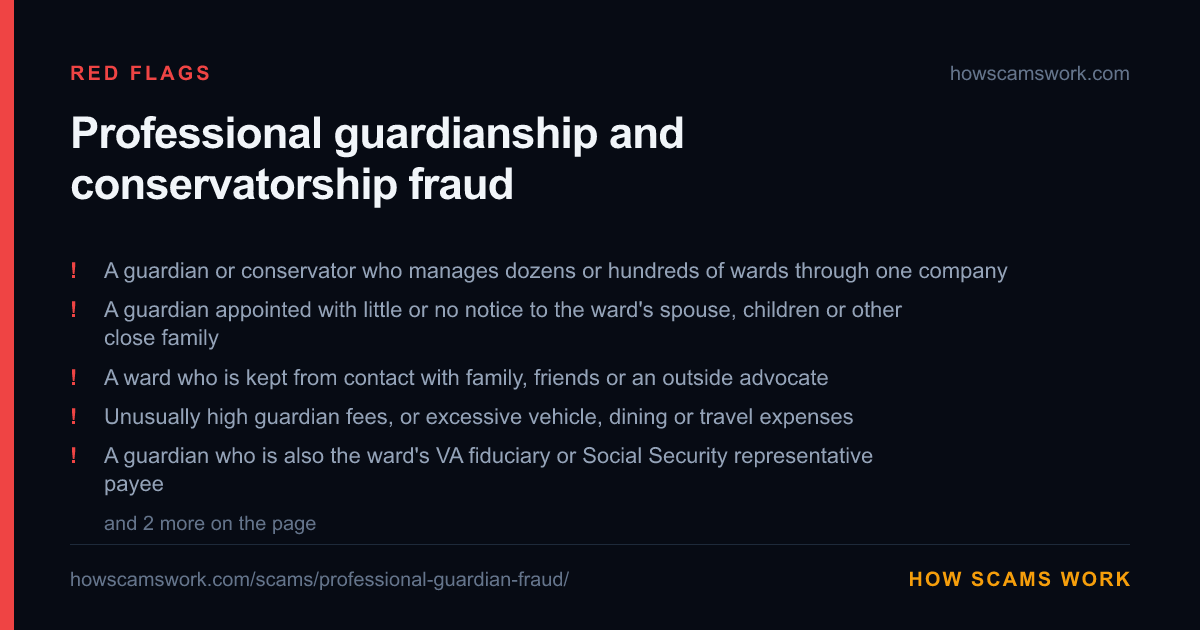
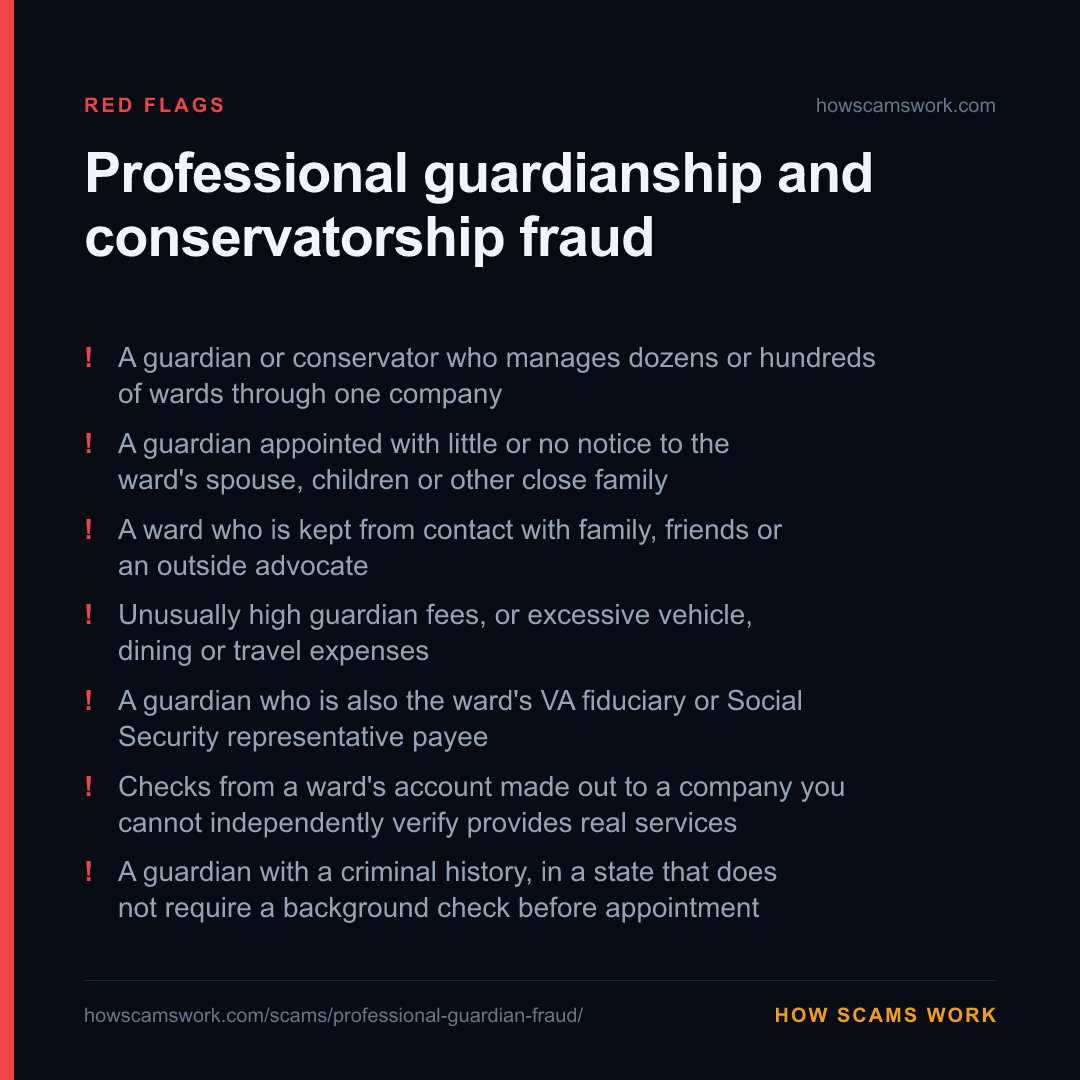
- A guardian or conservator who manages dozens or hundreds of wards through one company, with no family member reviewing individual accounts.
- A guardian appointed with little or no notice to the ward’s spouse, children or other close family.
- A ward who is kept from contact with family, friends or an outside advocate after a guardian’s appointment.
- Unusually high guardian fees, or excessive vehicle, dining or travel expenses charged against a ward’s account, a red flag the GAO itself names.
- A guardian who is also the ward’s VA fiduciary or Social Security representative payee, combining control of every income source in one appointment.
- Checks from a ward’s account made out to a company you cannot independently verify provides real services.
- A guardian with a criminal history, in a state that does not require a background check before appointment.
If it’s happening to you
If you suspect a guardian or conservator is misusing a ward’s money:
- Contact the court that appointed the guardian directly. Ask how to review the guardian’s required
annual accounting and how to petition for the guardian’s removal.
- If a VA or Social Security benefit is involved, report it to that agency’s inspector general. The
Social Security Administration’s Office of the Inspector General and the VA’s Office of Inspector
General both investigate fiduciary and representative-payee misuse.
- Ask for records directly. A guardian is required to account for what they spend; a guardian who
refuses, or whose answers do not match bank or benefit statements, is itself worth escalating.
- If you are being kept from contact with a family member under guardianship, document it and raise
it with the appointing court and, if the ward is elderly or disabled, your state’s Adult Protective
Services agency.
- Report what you’ve found. See where to report for agencies in other countries.
Where the money goes
Entirely domestic, moving from a federal benefit payment or a ward’s own trust account into accounts the
guardian personally controls, then out through either direct spending or a company built to look like a
real vendor.
Benefit payments and other funds the court places under the guardian’s control arrive in client accounts
the guardianship company manages for many wards at once. From there, the operator in the documented cases
here commingled the money with the company’s own operating account, sometimes covering one ward’s
shortfall with another ward’s funds rather than report it. What’s left moves either directly into personal
spending, real estate and vehicles, or through a shell company set up to look like a medical or service
provider, which converts the stolen checks into cash before sending most of it back to the person who
stole it.
By the numbers
No published dataset breaks this scheme out as its own category yet, so there is no chart to show.
The data page explains which agency categories exist and why some schemes are
invisible in official statistics.
Every factual claim above traces to one of these. Statistics are reported losses; see
methodology for what that does and does not measure.
Common questions
Isn't a court-appointed guardian supervised by a judge?
In theory, yes: guardians generally must file an annual accounting with the court. In practice, the US Government Accountability Office found in a 2016 report that the national extent of elder abuse by guardians is unknown because almost no state tracks it, and that state and local courts, which have primary responsibility over the guardianship process, often require periodic reports from guardians without specifying any court review of them. Every documented case on this page ran for years before anyone outside the guardian's own company raised an alarm.
How is this different from the power-of-attorney-abuse page on this site?
That page's cases are individual relationships: a single caregiver, relative or guardian stealing from one or two people they personally knew, as with Linda Laird, convicted of stealing from her own grandmother. This page covers a professional guardianship business appointed by a court to serve as fiduciary for dozens or hundreds of unrelated wards at once, where the probate court's own appointment and oversight process, not a signature the victim chose to give someone, is the mechanism that fails.
How is this different from the representative-payee-fraud page on this site?
A representative payee controls only a beneficiary's Social Security or VA payments. A guardian or conservator controls the ward's entire estate: bank accounts, pensions, real estate and medical decisions. Several of the documented cases on this page involved a guardian who was also the representative payee or VA fiduciary for the same wards, combining both roles.
Can a family member get a guardian removed once a court has appointed one?
It is difficult, and several documented cases here show why. Nevada's guardianship law before 2017 let a licensed guardian seek a temporary appointment without notifying the ward's own spouse, children or parents. After the April Parks case, the state's legislature now requires a temporary guardianship petition to be served on the proposed ward's family and, where relevant, a facility caring for them or a federal benefits agency, and the court must appoint the ward their own attorney. Where a family member suspects misuse, the Consumer Financial Protection Bureau says to contact the court that made the appointment.
What should I do if I suspect a professional guardian is stealing from a ward?
Contact the court that appointed the guardian directly and ask about its process for reviewing a guardian's annual accounting. If a federal benefit such as Social Security or VA compensation is involved, report it to the Social Security Administration's Office of the Inspector General or the VA's Office of Inspector General. See <a href="/report/">where to report</a> for other agencies and countries.