Also called: Social Security representative payee theft · rep payee fraud · stealing a beneficiary's Social Security · benefit fiduciary theft · misuse of benefits by a payee
Representative payee fraud is when a person or organization Social Security appoints to manage a beneficiary's payments uses the money for themselves. Payees range from parents to guardians to landlords. A Washington guardian took from 21 clients on 240 occasions; a Washington, D.C. rooming house operator took more than $400,000 and was sentenced to 32 months.
What it is
When a Social Security or SSI beneficiary cannot manage their own payments, the Social Security Administration
can appoint a representative payee to receive and manage them. That person or organization is then the only
one who sees the money. Representative payee fraud is when the payee uses it for themselves. The documented
cases cover a rooming house operator, a professional guardian, a social worker, and parents who kept a child’s
benefits after the child left their custody.
How it actually works
The appointment
Social Security appoints a payee for a beneficiary who is incapable of managing payments. It generally looks
for family or friends and, failing that, a qualified organization. In the Washington tribal case, the payee
applied by telephone.
The duty
A representative payee has a duty to use the benefits solely on behalf of the beneficiary, according to the
Justice Department’s release in the Washington, D.C. case. Social Security says all payees must keep records
of how the money is spent or saved.
Where it could have stopped
In the Washington tribal case, the misuse came to light when a supervisor went with the social worker to Social Security to ask what had happened to a child’s funds, and Social Security reported who the payee was. In the Massachusetts case, the mother had been told when she applied that she must notify Social Security if her child left her custody.
The diversion
The payee spends the money on themselves. In the documented cases the money went to the payee’s own bills,
into an account the payee controlled, or out through checks to the payee, to the payee’s company or to cash,
and ATM withdrawals.
The unreported change
Several cases turn on a change the payee did not report. In the Massachusetts case, a mother lost custody of her
child in May 2016 and did not notify Social Security. In the New York case, the child was removed from the
payee’s custody in September 2018 and she never reported it.
The false paperwork
When Social Security asked, payees in the documented cases gave false answers: in Massachusetts, two
fraudulent forms in June 2022 claiming the child still lived with her and that she spent all the benefits on
the child’s care, and in New York a lie that the child was still in her custody. In the Washington, D.C. case,
the payee told agents she had paid a beneficiary back when she had not.
Targets who will not notice
In the Washington guardian case, the release says the guardian targeted clients with significant income or
resources so that the theft was less likely to be detected.
Discovery and sentence
Social Security’s Office of the Inspector General investigates, usually with the US Attorney’s office. The
sentences in the cases documented here range from five months to 32 months in prison, with restitution to the
Social Security Administration, and in the tribal case a permanent bar on serving as a payee.
Why it works
The payee is the only one who sees the money. The payee receives the benefits on the beneficiary’s behalf, so
the beneficiary, who by definition cannot manage payments, usually has no other view of them.
Some payees file no annual report. Social Security says it no longer requires parents or legal guardians
of a minor who live with the child, parents of a disabled adult who live with them, and spouses to complete the
annual report, though all payees must keep records.
The payee may be the person closest to the beneficiary. The documented cases include parents, a landlord, a
professional guardian and a social worker.
Changes in circumstances need to be reported by the payee. In two of the cases here a child left the
payee’s custody and the payee did not report it for years.
A professional position gives access. The guardian in the Washington case had access to clients’ bank
accounts to pay rent and bills, and used it to write checks to himself.
Where it comes from
Entirely domestic: the Representative Payment Program is Social Security’s, so every documented case here is a
US case.
Cases span the country. The documented cases are from Washington, D.C., Washington State, Massachusetts and
New York, and the Social Security Administration’s Office of the Inspector General publishes similar releases
from many states.
It can last for years. The rooming house scheme ran from at least March 2009 to February 2020. The
Massachusetts mother received her child’s benefits for six years. The Washington guardian took from client
accounts over about seven years, beginning in 2010.
Real cases
2026 US Sentenced $17,638
Akeatha Diane Akintola, 48, formerly of Bellevue, Washington, a social worker for the Snoqualmie Tribe, pleaded guilty to theft of public funds and was ordered into custody on June 17, 2026 to serve five months in prison for stealing $17,638 in Social Security survivor benefits meant for a disabled minor who was a ward of the Tribe. The Tribe prohibits its social workers from becoming a representative payee for any child under its care. She applied by telephone in September 2023, had the benefits deposited into an account she controlled and spent them on herself. She failed to appear at the original May 22, 2026 hearing after leaving the United States. She is barred from becoming a representative payee for anyone in the future.
Read the case file ·
1 source
2023 US Sentenced $523,696
Rosemary Ogbenna, 46, of the District of Columbia, was sentenced on February 28, 2023 to 32 months in prison for a scheme to steal more than $400,000 in Social Security and Veterans Affairs benefits intended for the care of elderly, mentally ill, disabled and veteran tenants of her rooming house business. Between at least March 19, 2009 and February 23, 2020 she became the representative payee of some tenants' Social Security benefits and used a portion for herself, and gained control of some tenants' monthly VA benefits and used a portion of those too. She pleaded guilty to mail fraud and false statements in June 2022 and was ordered to pay restitution of $523,696 and forfeit the same amount.
Read the case file ·
1 source
2020 US Sentenced $256,336
Wayne Jerome Houston, 61, of Port Ludlow, Washington, who owned and operated Cross Point Services LLC, a guardianship business for disabled and vulnerable adults, was sentenced on October 14, 2020 to one year and a day in prison and $256,336 in restitution for Social Security representative payee fraud. Over about seven years he took money from the accounts of 21 clients, using his access to write checks to himself, to his company or to cash, and to make ATM withdrawals, on 240 occasions. Social Security benefits were paid into accounts for at least 13 of the clients, for whom he was the representative payee.
Read the case file ·
1 source
Red flags
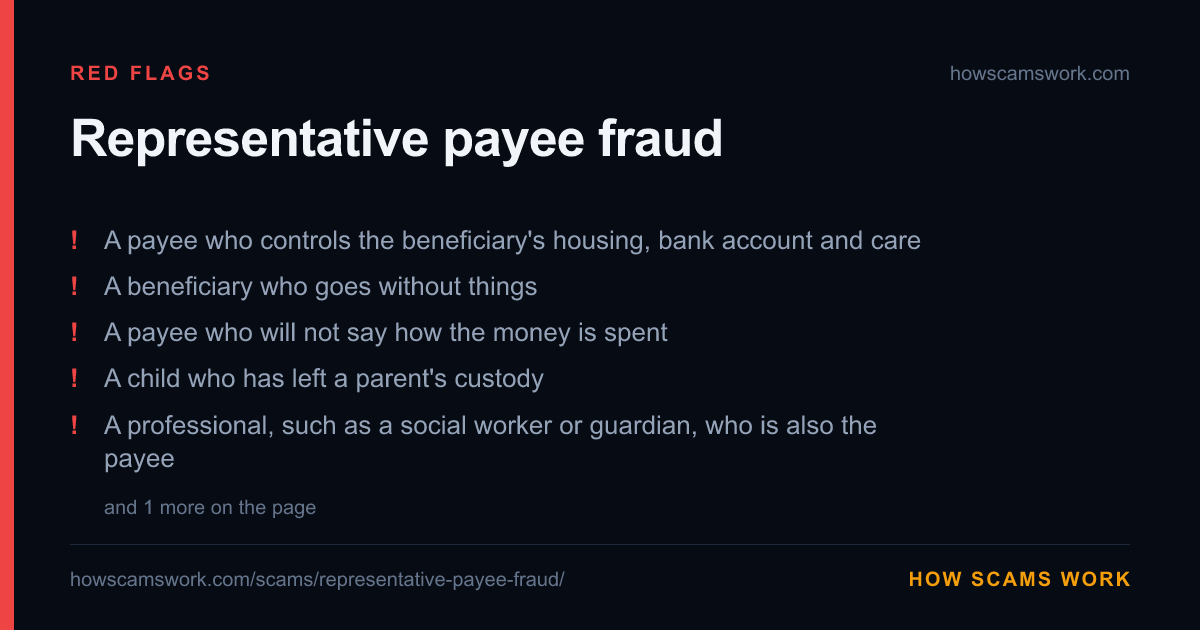
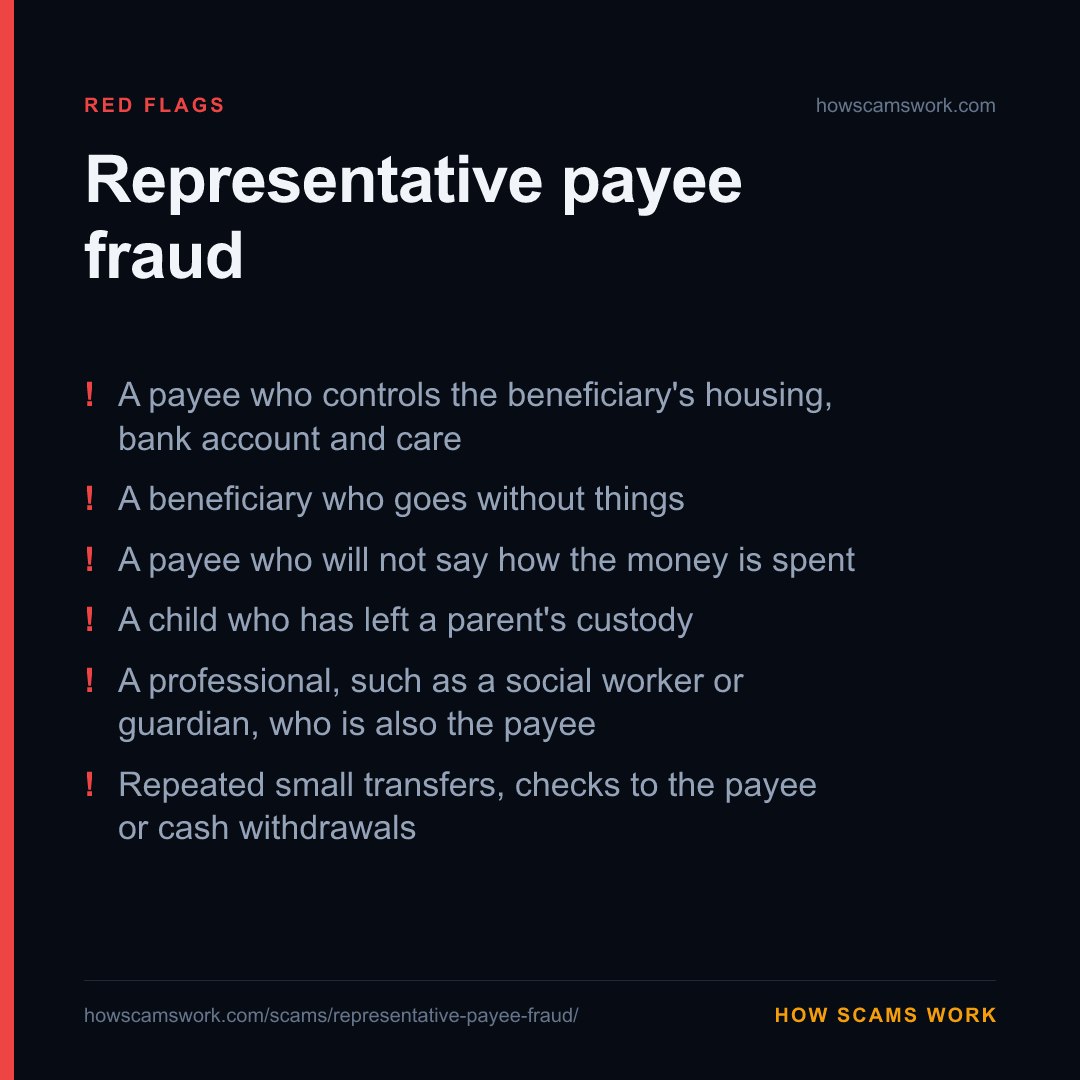
- A payee who controls the beneficiary’s housing, bank account and care, with no one else watching the money.
- A beneficiary who goes without things the benefit should cover, such as rent, bills or personal items.
- A payee who will not say how the money is spent, although all payees must keep records and show them if Social Security asks.
- A child who has left a parent’s custody while the parent still receives the child’s benefits.
- A professional, such as a social worker or guardian, who is also the payee for someone in their care.
- Repeated small transfers, checks to the payee or cash withdrawals from a beneficiary’s account.
If it’s happening to you
If you think someone is misusing another person’s benefits:
- Find out who the payee is. In the Washington tribal case, a call to Social Security is what established it.
- Contact Social Security about your concern at 1-800-772-1213 (TTY 1-800-325-0778).
- Ask the payee how the money is being spent. All payees must keep records and make them available if
Social Security asks.
- If a child has left your custody, tell Social Security. The Massachusetts mother was told when she
applied that she must notify it, and she did not.
- Report suspected misuse. See where to report for agencies and for countries
outside the United States.
Where the money goes
Entirely domestic, from the Social Security Administration into an account the payee controls, then out in
small, repeated amounts.
The benefit is paid into an account the payee controls. In the documented cases it left that account in the
payee’s own bills, ATM withdrawals, checks to the payee or the payee’s company, and a purchase at a retailer.
Restitution is owed to the Social Security Administration: $523,696 in the Washington, D.C. case, $256,336 in the
Washington guardian case, $86,994 in Massachusetts and $17,638 in the tribal case, plus forfeiture in the
largest.
By the numbers
No published dataset breaks this scheme out as its own category yet, so there is no chart to show.
The data page explains which agency categories exist and why some schemes are
invisible in official statistics.
Every factual claim above traces to one of these. Statistics are reported losses; see
methodology for what that does and does not measure.
Common questions
What is a representative payee?
According to the Social Security Administration, its Representative Payment Program provides benefit payment management for beneficiaries who are incapable of managing their Social Security or Supplemental Security Income payments. Social Security appoints a suitable payee to manage the payments on the beneficiary's behalf. Generally it looks for family or friends, and when they cannot serve it looks for qualified organizations.
What must a payee do with the money?
The Justice Department's release in the Washington, D.C. case states that a representative payee has a duty to use Social Security benefits solely on behalf of the beneficiary. The Social Security Administration says all payees are responsible for keeping records of how the payments are spent or saved and for making them available for review if it asks.
Do all payees have to file a report?
No. The Social Security Administration says that, following a change in the law, it no longer requires some payees to complete the annual Representative Payee Report, including parents or legal guardians of a minor child who primarily live in the same household, parents of a disabled adult who live in the same household, and spouses. All payees must still keep records and make them available if asked. Social Security may also select any payee for an educational visit and payee review.
What if the beneficiary leaves the payee's custody?
The Massachusetts case on this page involved a mother who, according to the release, was told when she applied that she must notify Social Security if her child left her custody. She did not report losing custody, and the release says she kept receiving the child's benefits for six years. In the New York case on this page, a woman failed to report that her child had been removed from her custody and stole over $25,000.
How is this different from power of attorney abuse?
A power of attorney is a legal document the person signs, and the abuse is of that authority over their assets. A representative payee is appointed by the Social Security Administration and controls only Social Security or SSI payments. The two can overlap: the Washington guardian in this page's cases was both a court-appointed guardian and the payee for at least 13 clients.
What should I do if I think a payee is misusing someone's benefits?
Social Security's payee page lists 1-800-772-1213 (TTY 1-800-325-0778) for concerns about someone's benefits. In the Washington tribal case, the misuse came to light when a supervisor went with the payee to Social Security to ask what had happened to a child's funds. See <a href="/report/">where to report</a>.