Child nutrition program fraud claims federal reimbursement for meals that were never served. In Minnesota's Feeding Our Future case, a sponsor recruited over 250 sites that claimed to feed thousands of children a day. Investigators found some sites were parking lots. Prosecutors put the loss at $242 million, and the founder was sentenced to 500 months.
Key facts
Category
Other
First documented
2020
Typical loss
$7300k–$242000k USD, per victim
Main channels
nonprofit sponsors that sign agreements with a state agency, food sites registered under a sponsor, monthly meal count claims, attendance rosters and invoices, kickbacks and bribes paid to sponsor personnel
Who is targeted
The federal Child Nutrition Programs, which pay for meals served to eligible children, and the taxpayers who fund them; Children in low-income areas who are meant to receive the meals the program pays for; Legitimate sponsors and sites, which face tighter checks and delayed payments after a fraud is found; State agencies that administer the programs and are responsible for monitoring the sponsors
Documented origins
United States
Main targets
United States
Case files
3 documented cases
Last reviewed
2026-10-27
The stages of the scheme, in order, with the point where it can still be stopped.
What it is
The federal Child Nutrition Programs pay organizations to feed children: the Child and Adult Care Food
Program, the Summer Food Service Program and others. A sponsor signs an agreement with a state agency, sites
operate under the sponsor, and the sites submit monthly meal counts that the state sends on for reimbursement.
Child nutrition program fraud is claiming that money for meals that were not served. The cases here involve
sites that claimed to feed thousands of children a day, supported by invented rosters and meal counts.
How it actually works
The sponsor
A nonprofit becomes a sponsor, which signs a program agreement with the state agency and takes responsibility
for the sites under it. In the Minnesota case the sponsor, Feeding Our Future, recruited people to open over 250
child nutrition sites.
The site
A site is registered. Many were, in the words of the IRS Criminal Investigation release, nothing more than
parking lots or vacant commercial spaces, and others were small businesses. One site at a deli claimed to be
serving 2,000 to 3,000 children a day within three weeks of its application.
The paper
The defendants created meal counts, invoices and rosters of children. In the Farah case few of the names on
the rosters matched real students in the local districts. In the Ahmed case, prosecutors said the spreadsheet
that produced the rosters contained a formula that inserted a random age between seven and 17.
The claim
The sponsor submits the claims to the state, which sends the meal counts to the federal government. According to
Sahan Journal, the government reimburses one month after the food is served.
Where it could have stopped
The Minnesota Reformer reported that the state education department had stopped payments to meal sites and asked for more documentation, and that payments resumed after Feeding Our Future sued. Federal rules require sponsors to keep attendance records, meal counts and food receipts, and the state agency to monitor, with some meals observed.
The kickback
Prosecutors said the sponsor disbursed the money in exchange for $18 million in kickbacks. In the Farah case, prosecutors described a pay-to-play system of bribes and kickbacks to personnel at Feeding Our Future and Partners in Nutrition, and in the Ahmed case more than $49,000 in bribes and kickbacks to a sponsor employee.
The cash-out
The proceeds are spent. The IRS Criminal Investigation release lists five luxury vehicles, about $4.2 million of
real estate in the Twin Cities and Kentucky and real estate in Kenya for one defendant, and the Ahmed case
describes a transfer to a shell company, the purchase of a former bar and restaurant location and a 2022 Mini
Cooper.
The prosecution
Search warrants were executed in January 2022. The sentences documented here were announced between August 2025
and 2026, and by the date of the Bock sentencing the investigation had led to over 70 indictments and 66
convictions.
Why it works
The program pays on counts, one month later. Sites submit meal counts to the state each month, the state
sends them on, and the reimbursement follows a month after the meals are said to have been served, according to
Sahan Journal.
Oversight was reported as weak before the fraud. Sahan Journal reported in 2022 that the Government
Accountability Office had been raising concerns about lax oversight of the $23.6 billion Child Nutrition Programs
since at least 2018, and that a temporary loosening of program requirements during the pandemic made oversight
even less vigilant.
Rapid claims. In the cases here, sites claimed to be serving thousands of children a day
almost immediately after opening, and the sponsor had more than 250 sites.
A sponsor stands between the sites and the state. The state agency signs agreements with sponsors, and
sponsors collect the sites’ records. Prosecutors said Bock personally submitted every site application and
signed every reimbursement claim.
Where it comes from
Entirely domestic: the programs are US Department of Agriculture programs administered by state agencies, and
the documented cases are from Minnesota.
The early days of the pandemic. The IRS Criminal Investigation release says Farah enrolled Empire Cuisine in
the program in April 2020, during the early days of the COVID-19 pandemic.
Scale. The Minnesota Reformer reported that prosecutors said the overall scheme ran upward of $246 million,
limited to the $242 million defrauded after April 2020 from the Department of Agriculture, which funded the
pandemic relief. The IRS Criminal Investigation release gives it as a $300 million scheme.
Abdihakim Ali Ahmed, 41, of Minneapolis, owner of Gurley Deli in Maplewood, Minnesota, was sentenced to 54 months in prison and ordered to pay more than $2.2 million in restitution for his part in the Feeding Our Future scheme. He pleaded guilty in March 2025 to wire fraud and money laundering. Prosecutors found that through a site at his deli he claimed to serve 2,000 to 3,000 children a day, claiming more than 1.6 million meals between September 2020 and 2021, and that he and co-conspirators charged a total of $7.3 million in fraudulent claims through Feeding Our Future.
Aimee Bock, 45, the founder and executive director of the Minnesota nonprofit Feeding Our Future, was sentenced on May 21, 2026 to 500 months, more than 41 years, in federal prison. A federal jury found her guilty in 2025 on all seven counts, including wire fraud, conspiracy and federal programs bribery. Feeding Our Future recruited people to open over 250 child nutrition sites eligible for federal money, and the sites fraudulently claimed to be serving meals to thousands of children a day almost immediately. Prosecutors said Feeding Our Future disbursed the money in exchange for $18 million in kickbacks. The judge held Bock responsible for the full $242 million in losses.
Abdiaziz Shafii Farah, 36, co-owner of Empire Cuisine & Market, was sentenced on August 6, 2025 to 28 years in federal prison followed by three years of supervised release and ordered to pay restitution of $47,920,514. A jury convicted him in June 2024 after a seven-week trial. He enrolled Empire Cuisine in the Federal Child Nutrition Program in April 2020, opened a number of fraudulent sites, and with co-defendants stole more than $47 million in program funds by claiming to serve 18 million meals at more than 30 sites. Many sites served no meals and were parking lots or vacant commercial spaces. He personally took more than $8 million in 18 months.
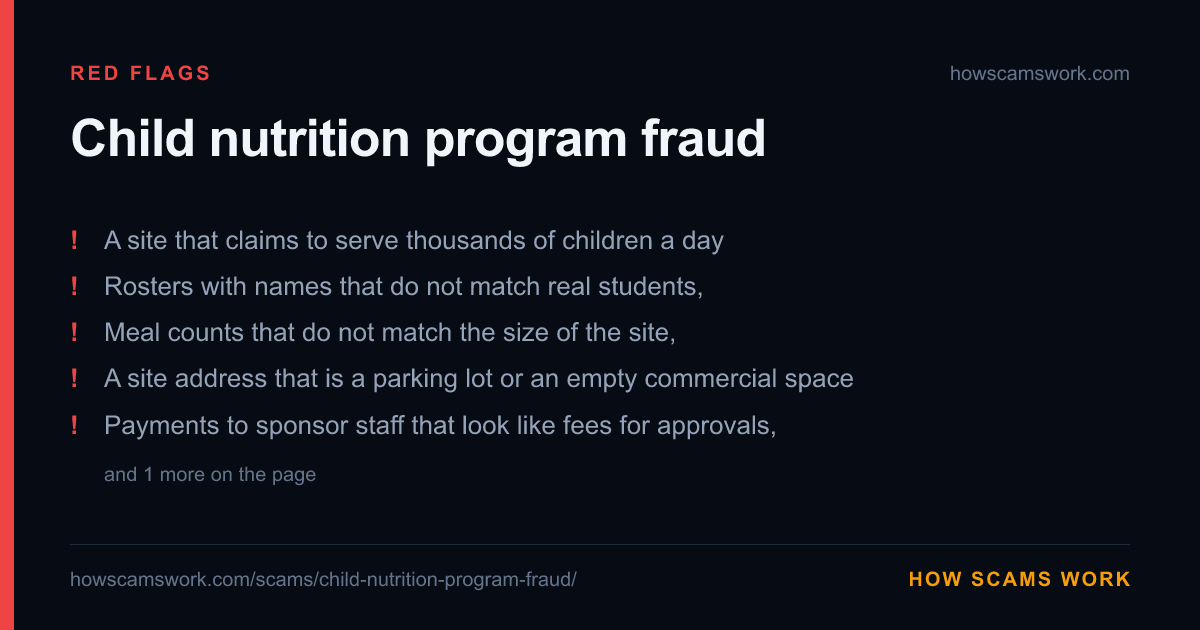
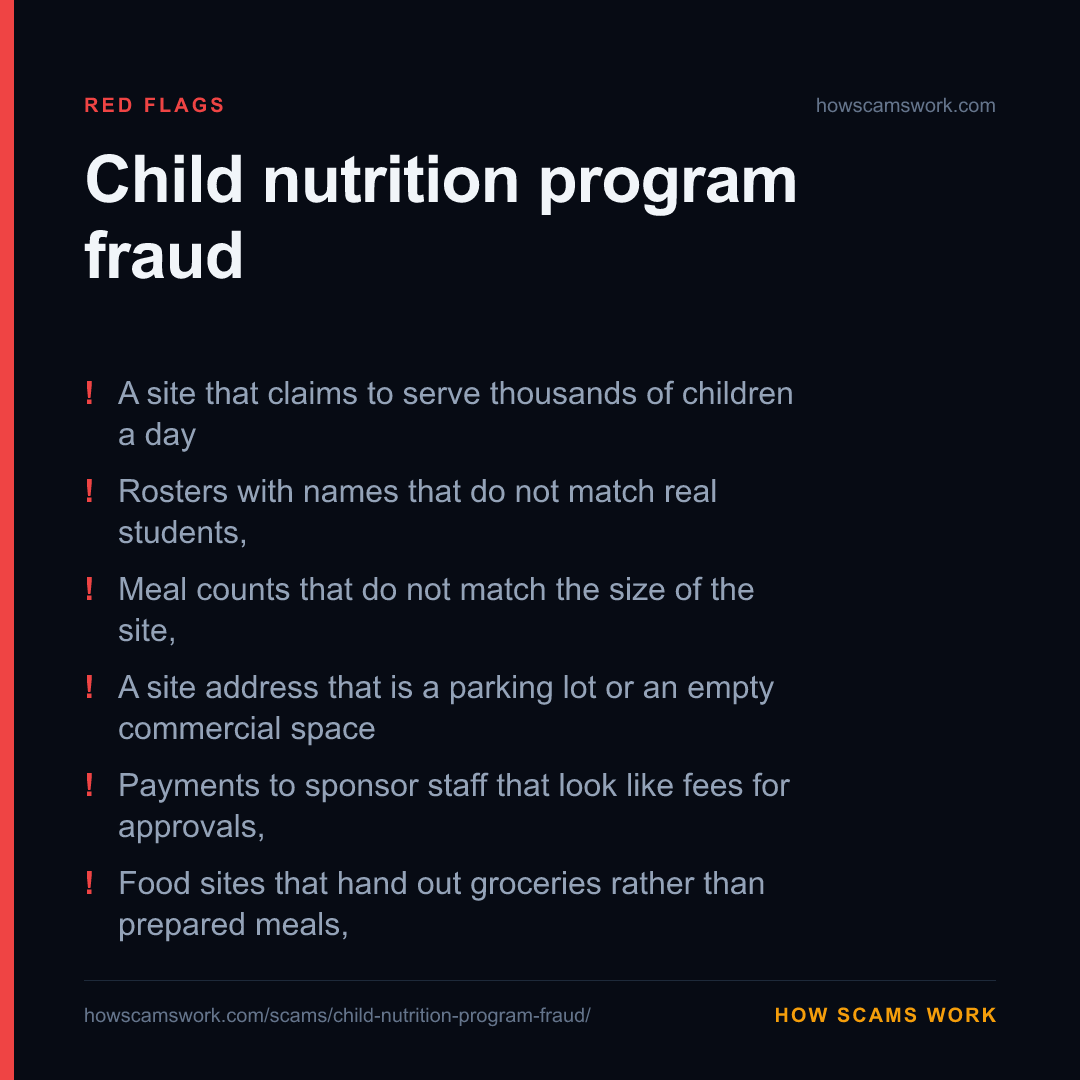
A site that claims to serve thousands of children a day within days or weeks of opening.
Rosters with names that do not match real students, or obviously fake names, or ages that look generated.
Meal counts that do not match the size of the site, such as a deli serving thousands of children a day, seven days a week.
A site address that is a parking lot or an empty commercial space.
Payments to sponsor staff that look like fees for approvals, described in the cases as pay-to-play.
Food sites that hand out groceries rather than prepared meals, which the Sahan Journal explainer says should not be eligible.
If it’s happening to you
If you run a legitimate site, or you are a parent or neighbour who sees something wrong:
If you are a sponsor or site, keep the records the rules require: attendance records, meal counts and food
receipts, for at least three years, according to the Sahan Journal explainer.
Look at what a site actually does. A child nutrition site is meant to serve prepared, ready-to-eat meals to
children, and the Sahan Journal explainer says groceries do not qualify.
Ask your state agency that administers the program about a site you doubt, and about a sponsor’s
agreement.
Do not pay or take payments for approvals. The cases describe kickbacks and bribes to sponsor staff as
crimes.
Where the money goes
Entirely domestic at the start, with some of it sent abroad in the Farah case.
Federal reimbursement goes to the state agency and out to the sponsor, which disburses it to sites. In the
Feeding Our Future case, prosecutors said the sponsor disbursed the money in exchange for $18 million in
kickbacks. From the sites,
the cases describe luxury vehicles, real estate in Minnesota, Kentucky and Kenya, a shell company and a
restaurant property, and in the Farah case more than $8 million to one defendant personally in 18 months. The IRS Criminal Investigation release says some of the money sent overseas is beyond the reach of American law enforcement.
No published dataset breaks this scheme out as its own category yet, so there is no chart to show.
The data page explains which agency categories exist and why some schemes are
invisible in official statistics.
Sources
Every factual claim above traces to one of these. Statistics are reported losses; see
methodology for what that does and does not measure.
Feeding Our Future 'mastermind' sentenced to over 41 years in prison.
KAXE, by Alyssa Chen of the Minnesota Reformer. Accessed 2026-10-27. Supports: Aimee Bock's role, the more than 250 sites, the claims to the state, the $18 million in kickbacks, the $246 million and $242 million figures, the prosecutors' filing, the 500-month sentence, the defense arguments, the state's stopped payments and the 70 indictments and 66 convictions.
In landmark sentence, Feeding Our Future scheme leader sentenced to 28 years in prison.
Internal Revenue Service, Criminal Investigation. Accessed 2026-10-27. Supports: Abdiaziz Farah's more than 30 sites and 18 million meals, the sites that were parking lots or vacant spaces, the fake rosters and names, the bribes and kickbacks, his spending, the juror bribery attempt and the 28-year sentence with $47,920,514 restitution.
Former deli owner sentenced for role in Feeding our Future fraud.
FOX 9. Accessed 2026-10-27. Supports: Abdihakim Ahmed's deli site, the 2,000 to 3,000 children a day, the 1.6 million meals, the rosters with random ages, the $7.3 million in claims and his 54-month sentence.
Feeding Our Future and federal child nutrition programs: an explainer.
Sahan Journal. Accessed 2026-10-27. Supports: How the Child and Adult Care Food Program and the Summer Food Service Program work, the reimbursement rates and delay, the sponsor and site structure, the monitoring requirements, the Government Accountability Office's concerns and the comment on profits.
Common questions
How do the federal child nutrition programs pay?
According to a 2022 explainer by Sahan Journal, the government reimburses organizations that feed children one month after the food has been served. Sites submit the number of meals served each month to the state agency, which sends the meal counts to the federal government for reimbursement. The federal government sets the rates, and the Sahan Journal reported figures of up to $1.97 for a breakfast, $3.92 for a lunch and $1 for a snack under the Child and Adult Care Food Program, which may have changed since.
Could real meals at these rates make anyone rich?
Probably not. A Government Accountability Office official told Sahan Journal in 2022 that it is hard to believe there is much room for the kinds of profits described in the search warrants, given food prices and low reimbursement rates. The cases here describe money that went to luxury vehicles, real estate and shell companies.
Who checks that the meals were served?
Sahan Journal reported that federal regulations require sponsor organizations to collect attendance records, meal counts and food records, including receipts of food purchases, and that the state agency is required to conduct periodic monitoring, with some meals observed, once in a while. In the Feeding Our Future case the state education department had stopped payments to meal sites and asked for more documentation, and, according to the Minnesota Reformer, payments resumed after Feeding Our Future sued.
Are the people convicted in these cases the only ones involved?
No. By the date of Aimee Bock's sentencing in May 2026 the federal investigation had led to over 70 indictments and 66 convictions, according to the Minnesota Reformer. This page describes three of the cases.
How do I report suspected fraud in a child nutrition program?
The Sahan Journal explainer and the court records on this page do not give a reporting number. See <a href="/report/">where to report</a> for agencies, and contact the state agency that administers the program.
Where the money goes after it leaves, and where it becomes hard to recover.
Share the red flags
A card made from this page's red flags, for anyone you think might be targeted. Send it to a parent, a neighbour or a group chat.
Reporting is what produces the enforcement data on this page. Find the right agency and phone
number for your country on the report page. If money moved in the last
few hours, call your bank first.
Before you continue to How Scams Work
We use browser storage to remember this choice, and nothing else is needed to read the site. If you choose
Accept all, we also let Google Analytics set cookies (_ga, _ga_*) to count
visits and see which pages are read.
Accept required gives you the whole site with no analytics cookies. There is no advertising
here and no other tracking. You can change your choice at any time from "Cookie choices" in the footer.