SNAP benefits trafficking

Also called: food stamp fraud · SNAP trafficking · EBT trafficking · food stamp trafficking · SNAP cash-out scheme

SNAP benefits trafficking is when a retailer swipes a recipient's EBT card for cash, typically at a steep discount, rather than for food, then collects full reimbursement from the US Department of Agriculture as if groceries were sold. A Boston store owner trafficked nearly $7 million before his 2026 sentencing; two other store owners' schemes totaled $5.2 million and $885,000.

Key facts

Category
Business & payments
First documented
2002
Typical loss
$885k–$7000k USD, per victim
Main channels
small retail stores and bodegas authorized to accept SNAP, corner stores with an EBT terminal but minimal food inventory, point-of-sale cash exchanges, usually confirmed by an undercover buy, family-run grocery businesses
Who is targeted
SNAP recipients who trade benefits for cash at a loss, commonly getting back only fifty to seventy cents on the dollar of their own monthly food budget; Small, independently owned corner stores and bodegas authorized to accept SNAP, whose owners profit by swiping benefit cards for groceries that are never sold; The Supplemental Nutrition Assistance Program itself, which reimburses the retailer's bank account in full on the strength of an EBT swipe it does not verify against any actual food sale; Family members and employees of a trafficking store, drawn into the scheme as co-conspirators who personally work the register during the cash-for-benefits exchange
Documented origins
United States
Main targets
United States
Case files
3 documented cases
Last reviewed
2026-10-14
Anatomy of SNAP benefits traffickingAnatomy of SNAP benefits trafficking. A small store's register moves more cash than its shelves could ever sell in food. 1. A small store gets authorized: Any retailer stocking a minimum amount of staple food can apply for USDA authorization to accept SNAP, a paperwork check rather than an ongoing audit. 2. The swipe for cash: A recipient hands over their EBT card and PIN. The clerk rings up a fabricated or inflated total, swipes it, and hands back a cut in cash, commonly fifty to seventy cents on the dollar. 3. The transaction pattern tells on itself: A store that size cannot plausibly generate this redemption volume from real food sales; USDA's own transaction-data monitoring is built to flag exactly this kind of anomaly. 4. Selling what SNAP was never meant to buy: Some operators also swap SNAP for liquor, let customers buy ineligible items at inflated prices, or resell donated humanitarian food never authorized for retail sale. 5. Laundering the cash: Proceeds move into secondary or relatives' accounts, with cash withdrawals kept just under the $10,000 threshold that would otherwise trigger a bank's reporting rule. 6. The undercover buy: A federal agent posing as a SNAP recipient completes the cash-for-benefits exchange in person, turning a data pattern into a transaction a prosecutor can charge. 7. Enforcement, months to years later: USDA's Office of Inspector General, often with the FBI or IRS Criminal Investigation, builds the case from the store's own transaction records plus the undercover buys. The diagram marks stage 2 as the point where the scheme can still be stopped: Exchanging SNAP benefits for cash is a federal crime under 7 U.S.C. § 2024(b) the moment it happens, at any dollar amount, before the store does anything else with the money. A conviction carries mandatory permanent disqualification from SNAP.Anatomy of SNAP benefits traffickingA small store's register moves more cash than its shelves could ever sell in food.1A small store getsauthorizedAny retailer stocking aminimum amount of staplefood can apply for USDAauthorization to acceptSNAP, a paperwork checkrather than an ongoingaudit.One-time approval2The swipe for cashA recipient hands overtheir EBT card and PIN. Theclerk rings up a fabricatedor inflated total, swipesit, and hands back a cut incash, commonly fifty toseventy cents on thedollar.Seconds, at the register3The transactionpattern tells onitselfA store that size cannotplausibly generate thisredemption volume from realfood sales; USDA's owntransaction-data monitoringis built to flag exactlythis kind of anomaly.Visible within months4Selling what SNAP wasnever meant to buySome operators also swapSNAP for liquor, letcustomers buy ineligibleitems at inflated prices,or resell donatedhumanitarian food neverauthorized for retail sale.Ongoing5Laundering the cashProceeds move intosecondary or relatives'accounts, with cashwithdrawals kept just underthe $10,000 threshold thatwould otherwise trigger abank's reporting rule.Weeks to months6The undercover buyA federal agent posing as aSNAP recipient completesthe cash-for-benefitsexchange in person, turninga data pattern into atransaction a prosecutorcan charge.One or more visits7Enforcement, monthsto years laterUSDA's Office of InspectorGeneral, often with the FBIor IRS CriminalInvestigation, builds thecase from the store's owntransaction records plusthe undercover buys.Under a year to several yearsWhere it can still be stopped: stage 2Exchanging SNAP benefits for cash is a federal crime under 7 U.S.C. § 2024(b) the moment it happens, at any dollar amount, before the store does anything elsewith the money. A conviction carries mandatory permanent disqualification from SNAP.Stages drawn from three documented cases: a $7 million Boston scheme (Antonio Bonheur, 2026), a $5.2 million Bessemer, Alabama scheme (Hasan Ahmed, 2016), and an $885,000 Newark, New Jersey scheme (the Venegas family, 2019), plus USDA's own trafficking definition and 7 U.S.C. § 2024.howscamswork.com
The stages of the scheme, in order, with the point where it can still be stopped.

What it is

A small, USDA-authorized store swipes a SNAP recipient’s EBT card for an amount that has nothing to do with what the recipient is actually buying, then hands back a cut of that amount in cash. The store rings the transaction up as a grocery sale, the government’s Supplemental Nutrition Assistance Program reimburses the store the full face value within a day or two, and no food changes hands for most of it. This is trafficking, a federal crime the moment a SNAP benefit is exchanged for cash at any amount, and it is the single most common way SNAP’s roughly $1.27 billion a year in estimated trafficked benefits leaves the program: not through hacking or forged paperwork, but through an ordinary-looking cash register.

How it actually works

  1. A small store gets authorized

    Any retailer that stocks a minimum amount of staple food can apply for USDA authorization to accept SNAP. Approval is largely a paperwork check against stocking and eligibility criteria, not an ongoing audit of what a store actually sells once it is approved.

  2. The swipe for cash

    A recipient hands over their EBT card and PIN. The clerk, often the owner personally, rings up a fabricated or inflated “grocery” total, swipes the card for the full amount, and hands back a cut in cash, commonly fifty to seventy cents on the dollar.

    Where it could have stopped

    Exchanging SNAP benefits for cash is a federal crime under 7 U.S.C. § 2024(b) at the moment it happens, independent of the dollar amount and of whatever the store does with the money next. A retailer convicted of this faces mandatory permanent disqualification from the program on top of any prison sentence.

  3. The transaction pattern tells on itself

    A 150-square-foot store with one register and minimal food stock does not plausibly generate $100,000 to $500,000 a month in SNAP redemptions, more than a full-service supermarket nearby redeems, or have more than 70% of its transactions over $95 while carrying almost no fresh food. Patterns like these, documented in the cases on this page, are exactly what USDA’s own transaction-data monitoring is built to flag.

  4. Selling what SNAP was never meant to buy

    Some operators go further: swapping SNAP for liquor, letting customers buy ineligible items at inflated prices, or, in the largest case on this page, reselling donated humanitarian food meant for hungry children overseas rather than SNAP customers at all.

  5. Laundering the cash

    Proceeds get moved into secondary accounts, sometimes opened in a relative’s name, and cash withdrawals get kept just under the $10,000 threshold that would otherwise trigger a bank’s currency transaction report, a pattern documented in the largest single-operator case here once a bank teller flagged the reporting rule to the owner directly.

  6. The undercover buy

    A federal or state agent, posing as a SNAP recipient, completes the cash-for-benefits exchange in person, sometimes dozens of times over the course of an investigation, turning a suspicious data pattern into a transaction a prosecutor can actually charge.

  7. Enforcement, months to years after the pattern first appears

    USDA’s Office of Inspector General, often working with the FBI or IRS Criminal Investigation, builds the case from the store’s own EBT transaction records plus the undercover buys. In the cases documented here, that process took anywhere from under a year to several years to reach a guilty plea and sentence.

Why it works

The payment mechanism cannot see what is in the shopping bag. An EBT terminal checks a recipient’s balance and authorizes a dollar amount; it has no way of confirming the register actually rang up food, only that an amount within the recipient’s balance was approved.

A government reimbursement, not a government inspector, pays the store. USDA deposits the full value of every approved SNAP transaction directly into the retailer’s own bank account, typically within a day or two, with no inspector verifying any individual swipe against an actual sale before the money moves.

Cash now beats full value later for a recipient who needs it. Trading $100 in SNAP for $60 in cash is a real loss, but it still beats having no cash at all for rent, a utility bill, or anything else SNAP cannot be used to pay for, which is why the trade persists even though the arithmetic is obviously against the recipient.

A single small storefront is easier to run than it is to watch. A 150-square-foot store with one register, run personally by its owner, can process a transaction volume that would be unremarkable at a supermarket and glaringly anomalous for a store its size, a pattern that becomes visible only once someone compares it against similarly sized businesses.

And the paperwork that would catch it arrives on a delay. Currency transaction reports, tax returns and bank account reviews all surface months or years after the fact, time the operators in the documented cases here used to keep trafficking going, structure withdrawals, and move proceeds into other names, long after the pattern in the underlying data had already started to show.

Where it comes from

Entirely domestic: SNAP is a US federal program, so every documented case on this page is a US case.

The mechanism dates to the national rollout of electronic benefits. Food stamps moved from paper coupons to EBT cards nationwide under an October 2002 federal deadline; swiping a card for cash instead of food has been the dominant form of SNAP trafficking ever since.

Every documented case here runs through a single authorized retailer, not a network spanning states or outside recruiters. Scale ranges from a father-and-daughter-run deli in Newark exchanging $885,000 over seven years to a single Boston storefront trafficking nearly $7 million in three years, which shows this does not take a large operation, just one SNAP-authorized cash register and a willingness to use it.

USDA’s own estimate puts annual trafficking at roughly $1.27 billion, about 1.6% of all benefits redeemed in its most recent published study, covering fiscal years 2015 through 2017. The Government Accountability Office reviewed the methodology behind that kind of estimate in 2018 and found USDA has never independently verified the core assumption it rests on, putting the true range anywhere from $960 million to $4.7 billion a year.

Enforcement runs through USDA’s Office of Inspector General, frequently alongside the FBI or IRS Criminal Investigation, and a conviction carries mandatory permanent disqualification from SNAP participation in addition to whatever criminal sentence follows.

Real cases

A 150-square-foot Boston store trafficked nearly $7 million in SNAP benefits

2026 US Sentenced $7.0m

Antonio Bonheur, 74, owned Jesula Variety Store, a 150-square-foot shop in Boston's Mattapan neighborhood, where he personally worked the register exchanging SNAP benefits for cash. His monthly SNAP redemptions, ranging from $100,000 to $500,000, far outpaced a full-service supermarket in the same area. He also sold liquor for SNAP and resold donated humanitarian food meant for hungry children overseas. Arrested alongside co-defendant Saul Alisme in December 2025, Bonheur pleaded guilty in March 2026 to food stamp fraud and wire fraud, forfeited nearly $400,000 in seized proceeds, and was sentenced in July 2026 to two years in federal prison and $1 million in restitution.

Read the case file · 3 sources

A father and daughter traffic $885,000 through a Newark deli

2019 US Sentenced $885,000

Maria Teresa Venegas, listed owner of Jenny's Deli in Newark, New Jersey, and her father Manuel Venegas, an employee there, exchanged more than $885,000 in SNAP benefits for cash between 2011 and 2018. An undercover agent completed roughly 20 cash-for-benefits purchases at the store before charges were filed. Maria Teresa pleaded guilty and was sentenced in February 2019 to two years in prison; Manuel pleaded guilty and was sentenced the following month to 18 months in prison, two years of supervised release, and $573,199 in restitution.

Read the case file · 1 source

A Bessemer grocer forfeits $5.2 million over food stamp fraud and laundering

2016 US Sentenced $5.2m

Hasan F. Ahmed, owner of Associated Discount Foods in Bessemer, Alabama, swapped food stamps for cash below face value and let customers buy ineligible items at inflated prices, acquiring an estimated $5,243,866.49 in SNAP benefits unlawfully between July 2011 and June 2014. He laundered the proceeds through a relative's bank account and structured dozens of cash withdrawals to avoid a $10,000 reporting threshold, while underreporting his income on his tax return. Ahmed pleaded guilty in March 2016 to food stamp fraud, tax evasion, structuring and four counts of money laundering, and was sentenced in June 2016 to three years and ten months in prison and ordered to forfeit $5.2 million.

Read the case file · 2 sources

Red flags

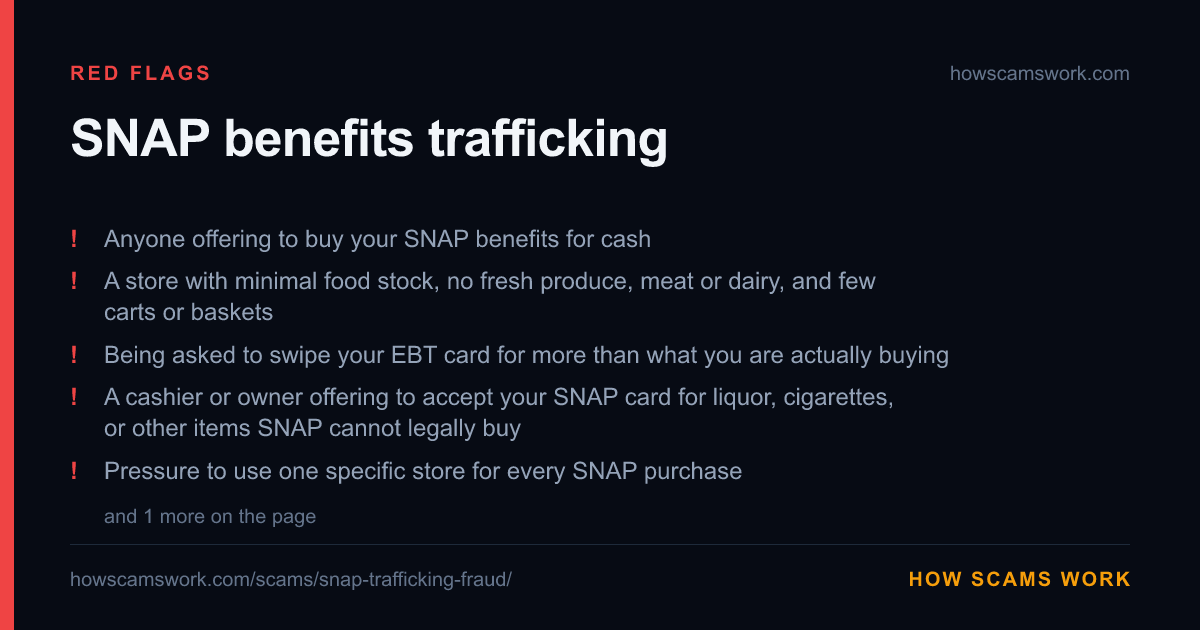
  • Anyone offering to buy your SNAP benefits for cash, in person, by flyer, or online. It is illegal for both sides and strips real value from a food budget calculated for exactly what it provides.
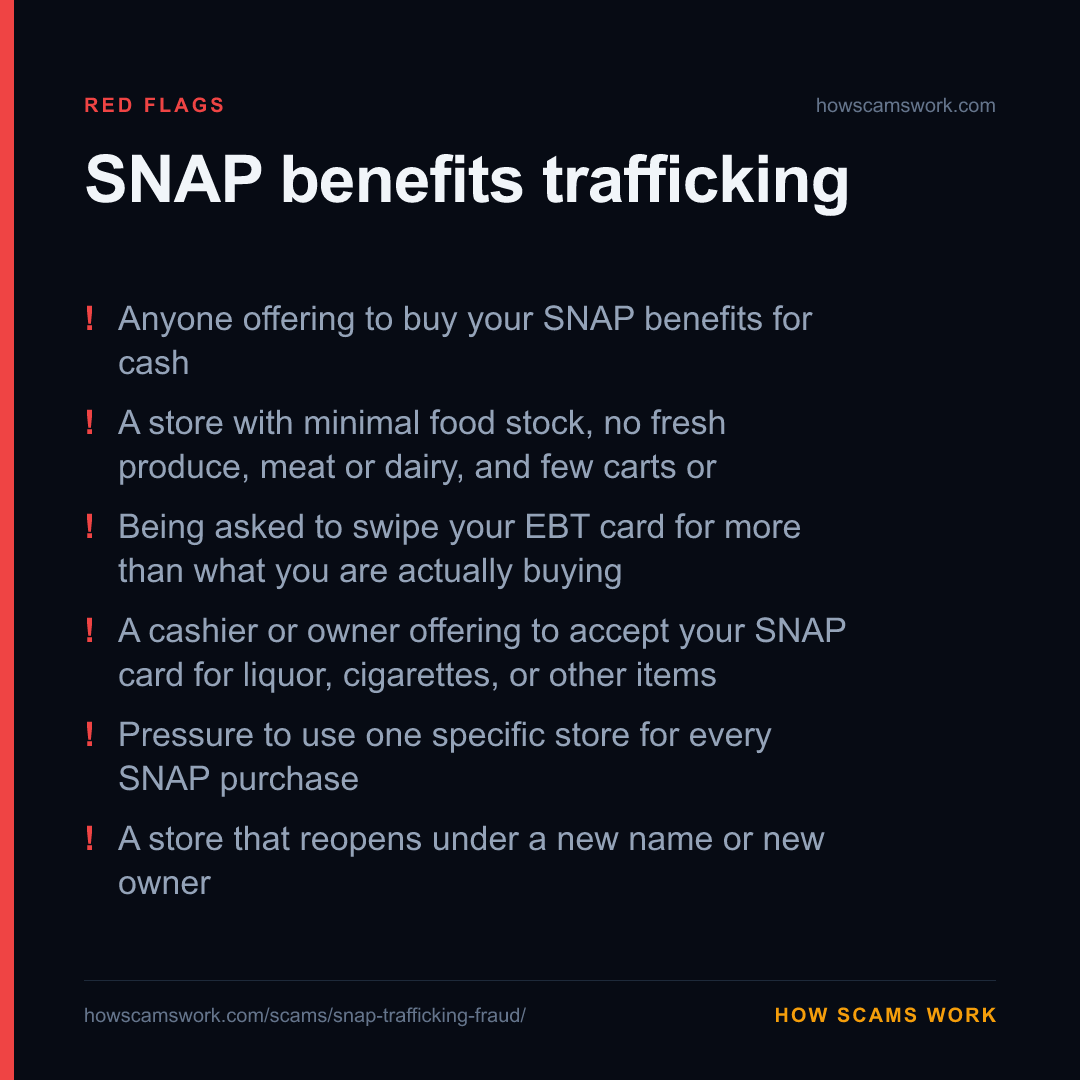
  • A store with minimal food stock, no fresh produce, meat or dairy, and few carts or baskets, despite doing heavy SNAP business.
  • Being asked to swipe your EBT card for more than what you are actually buying, with the difference handed back in cash.
  • A cashier or owner offering to accept your SNAP card for liquor, cigarettes, or other items SNAP cannot legally buy.
  • Pressure to use one specific store for every SNAP purchase, especially paired with a cash-back offer.
  • A store that reopens under a new name or new owner shortly after losing its SNAP authorization.

If it’s happening to you

Stop the exchange and do not repeat it, even once more, while you decide what to do next.

  1. Do not trade your SNAP benefits for cash. Trafficking is a federal crime for the recipient as well as the retailer, and can mean losing your own SNAP eligibility on top of whatever cash you received.
  2. If a store has offered you this, you can still report it. USDA’s hotline takes anonymous tips, and the documented cases on this page were built against the retailers running these schemes, not against individual recipients who came forward.
  3. Report it to USDA’s Office of Inspector General hotline at 1-800-424-9121 or online at usda.gov/oig/hotline, or to your state SNAP agency’s own fraud line. See where to report for benefit programs in other countries.
  4. If you run a legitimate small store serving SNAP customers, keep clean records of your actual food inventory and purchase mix. What triggers an investigation is a transaction pattern that does not match what a store your size could plausibly sell, not high SNAP volume by itself.
  5. If your store’s SNAP authorization is ever suspended or under review, that administrative process is separate from any criminal case; respond to USDA’s requests promptly and keep your own records in order rather than ignoring the notice.

Where the money goes

Entirely domestic, moving from a federal reimbursement account into a small retailer’s own bank account, then split and, in the larger cases, laundered.

USDA deposits the full face value of every approved SNAP transaction directly into the authorized store’s bank account, usually within a day or two, the most traceable step in the chain since it comes from a federal program with its own records. From there, the store’s owner hands a share back to the recipient in cash, commonly fifty to seventy cents on the dollar, and keeps the rest. In the largest single-operator case on this page, the remainder moved through a relative’s bank account and a string of cash withdrawals kept just under the $10,000 threshold that would otherwise trigger a currency transaction report, until forfeiture, restitution and a prison sentence took a share of it back.

The other half of this story

Our sibling site Clean on Paper explains why a cash-heavy corner store is one of the oldest ways to move money a bank would otherwise ask about, the same structural blind spot that let the largest case on this page run for three years out of a single 150-square-foot storefront.

By the numbers

No published dataset breaks this scheme out as its own category yet, so there is no chart to show. The data page explains which agency categories exist and why some schemes are invisible in official statistics.

Sources

Every factual claim above traces to one of these. Statistics are reported losses; see methodology for what that does and does not measure.
  1. Store Owner Admits to Multi-Million-Dollar SNAP Fraud Scheme. US Attorney's Office, District of Massachusetts. Accessed 2026-10-14. Supports: Antonio Bonheur's guilty plea, the nearly $7 million trafficked, the $400,000 forfeiture, the 150-square-foot Jesula Variety Store, the monthly redemption figures compared to a full-service supermarket, the transaction-size pattern, the four undercover buys, the resold liquor and donated MannaPack meals, and his own fraudulently obtained SNAP card.
  2. Two Massachusetts Men Charged with Large-Scale SNAP Benefits Trafficking. US Attorney's Office, District of Massachusetts. Accessed 2026-10-14. Supports: The December 2025 charges against Antonio Bonheur and co-defendant Saul Alisme, the two stores involved, and the allegation that both exchanged SNAP benefits for cash on recorded undercover visits.
  3. Bessemer Grocer Pleads Guilty to $5 million Food Stamp Fraud, Tax Evasion, Money Laundering and Currency Structuring. US Attorney's Office, Northern District of Alabama. Accessed 2026-10-14. Supports: Hasan Ahmed's guilty plea, the Associated Discount Foods store, the rising SNAP redemption figures, the exchange of food stamps for cash below face value, and the sale of ineligible items at inflated prices.
  4. Bessemer Grocer Sentenced to Nearly 4 Years in Prison. US Attorney's Office, Northern District of Alabama. Accessed 2026-10-14. Supports: Ahmed's sentence and $5.2 million forfeiture, the $5,243,866.49 fraud total, the tax evasion figures, the structured currency withdrawals used to avoid the $10,000 reporting threshold, and the official quotes about the SNAP program being misused.
  5. Essex County, New Jersey, Man Sentenced to 18 Months in Prison for his Role in a Food Stamps Fraud Scheme. US Attorney's Office, District of New Jersey. Accessed 2026-10-14. Supports: Manuel and Maria Teresa Venegas's roles at Jenny's Deli, the $885,000 exchanged for cash between 2011 and 2018, the roughly 20 undercover purchases, Manuel's 18-month sentence and $573,199 restitution, and Maria Teresa's earlier two-year sentence.
  6. 7 U.S. Code § 2024 - Violations and enforcement. Cornell Law School, Legal Information Institute. Accessed 2026-10-14. Supports: The felony and misdemeanor thresholds for unlawfully using, transferring, acquiring or possessing SNAP benefits contrary to federal regulations, the dollar-value tiers, and the up to 18-month additional SNAP suspension a court may impose on top of a criminal sentence.
  7. Do Not Traffick SNAP Benefits. US Department of Agriculture, Food and Nutrition Service. Accessed 2026-10-14. Supports: The plain-language definition of trafficking as giving customers cash for SNAP benefits or buying store inventory bought with SNAP, the examples given, and the mandatory permanent disqualification penalty for a retailer.
  8. The Extent of Trafficking in SNAP: 2015-2017. US Department of Agriculture, Food and Nutrition Service. Accessed 2026-10-14. Supports: The 1.6 percent trafficking rate and approximately $1.27 billion annualized trafficking estimate for FY2015 to FY2017, the 12.7 percent store violation rate, and the comparison showing both rates increased since the FY2012 to FY2014 study.
  9. Supplemental Nutrition Assistance Program: Actions Needed to Better Measure and Address Retailer Trafficking (GAO-19-167). US Government Accountability Office. Accessed 2026-10-14. Supports: GAO's finding that FNS has never evaluated the accuracy of the assumption behind its trafficking estimate, and GAO's own wider range of $960 million to $4.7 billion in annual trafficking.

Common questions

If a SNAP recipient agrees to the cash trade, is it still a crime?

Yes, for both sides. Federal law makes it a crime to use, transfer or possess SNAP benefits contrary to the program's rules, which covers a recipient who knowingly sells their own benefits for cash as well as the retailer who buys them. In practice, prosecutors in the documented cases on this page have pursued the retailers, not the recipients, but a recipient's own benefits can still be suspended if their state agency finds out.

How does USDA catch a cash exchange that happens inside a store, with no outside witness?

The transaction data gives it away first. A store's SNAP redemption volume, average transaction size, and the mix of large versus small purchases are compared against similarly sized, similarly located stores; a 150-square-foot variety store redeeming more than a full-service supermarket, as in the largest case on this page, is the kind of anomaly that triggers a closer look. Investigators then send an undercover agent to complete the cash-for-benefits exchange in person, which is what turns a suspicious pattern into a provable transaction.

Is this the same as someone cloning or skimming my EBT card?

No. This site's card-skimming page covers a hidden device copying your card's data without your knowledge, so someone else can drain your account. SNAP trafficking is a transaction a recipient takes part in on purpose, trading their own benefits for cash at a store willing to make the exchange. The harm is different too: skimming steals the entire balance from you; trafficking has you giving up a share of your own benefit's value voluntarily, usually because you need cash SNAP cannot provide.

What happens to a store after a trafficking conviction?

Permanent disqualification from SNAP is mandatory for the store, on top of whatever criminal sentence the owner receives. Every documented case on this page also ended in forfeiture of the illegally obtained proceeds, or a restitution order, or both, running from $573,199 in the smallest case here to $5.2 million in the largest.

I run a small grocery store in a neighborhood with a lot of SNAP customers. Could I get investigated just for that?

High SNAP volume by itself is not what triggers scrutiny; a transaction pattern that does not match what a store your size could plausibly sell is. A legitimate store with a normal mix of small and large purchases, and food inventory to match its redemptions, looks nothing like the anomalies described in the documented cases here.

Where the SNAP reimbursement actually goesWhere the SNAP reimbursement actually goes. The government pays the store in full before anyone checks whether the sale was real. Where the SNAP reimbursement actually goesThe government pays the store in full before anyone checks whether the sale was real.USDA, paying the fullvalue of everyapproved swipeUSDA deposits the fullSNAP redemption amountinto the store's bankaccount, usuallywithin a day or two,without confirming anygroceries were soldThe SNAP-authorizedstore, recording theswipe as a grocerysaleThe owner withdrawsand moves theproceeds, in onedocumented casestructuring 38 cashwithdrawals just under$10,000 to dodge thebank's reporting ruleThe store's owner, whosplits and moves thecashA cut goes back to therecipient as cash,usually fifty toseventy cents on thedollar; the ownerkeeps the rest, untilforfeiture,restitution or prisontake a share backCash to the recipient,personal spending, andwhat forfeiture takesbackReversibilityA recall is realistically possible only at the first hop, and only in the first hours. After the money is converted it becomes an investigation, not a refund.Why a cash-heavy corner store is one of the oldest ways to move money a bank would otherwise ask about: Clean on Paper, our sibling sitehttps://cleanonpaper.com/techniques/cash-intensive-businesses/All three documented cases on this page moved proceeds through ordinary US bank accounts; the largest, a Bessemer, Alabama scheme, also moved money into a relative's account and structured cash withdrawals before a $5.2 million forfeiture order.howscamswork.com
Where the money goes after it leaves, and where it becomes hard to recover.

Report it

Reporting is what produces the enforcement data on this page. Find the right agency and phone number for your country on the report page. If money moved in the last few hours, call your bank first.