Also called: stop foreclosure bankruptcy scam · sham bankruptcy filing · pump fake bankruptcy · bankruptcy mill fraud · foreclosure delay bankruptcy scheme
Bankruptcy petition preparer fraud is charging homeowners facing foreclosure to file bankruptcy papers that only delay the sale, while hiding the preparer's role, giving legal advice or using other people's bankruptcy cases. An Ohio man was sentenced to 120 months in a scheme that defrauded at least 780 homeowners.
What it is
A person who is not a lawyer is allowed, under federal law, to type up bankruptcy forms for a fee. They are not allowed to give legal advice, and they must put their name and details on every document they prepare. A bankruptcy
filing also pauses a foreclosure by law, which is what makes it a tempting product to sell to someone about to lose their home.
This scheme sells that pause. The preparer charges a fee to “stop the foreclosure,” files or arranges a bankruptcy
that delays the sale for a time, and either hides their role, poses as a lawyer, or, in one case, files in the names
of strangers. The homeowner may still lose the house and the fee.
The victims are mostly the homeowners. In the Gladle case they also include debtors whose bankruptcy cases were used without their
knowledge, and lenders forced to stop their sales.
How it actually works
A homeowner in foreclosure is found
In Ohio, the U.S. Attorney’s Office said affiliates used online databases and court records to find homeowners who had
recently received a foreclosure notice, and the defendants mailed more than 56,000 postcards. In Maryland, a client of
the preparer delivered flyers. In Oregon, the couple found the preparers through a website after being referred.
A promise to stop the sale
The Ohio postcards promised to “stop foreclosure” or “stop the sheriff sale” for a fixed fee. In the Gladle case
the Justice Department said the promise was a delay of up to six months for about $750 a month. In Maryland the preparer
assured a woman he could stop an auction for $500.
The preparer’s role is hidden
The Ohio petitions were skeletal and failed to disclose the defendants as preparers, so they looked like the
homeowners’ own work. In Oregon, the court found the preparer concealed his identity, typed “no” on the question about
paid help, and wrote to the trustee under a real attorney’s name.
Where it could have stopped
The Bankruptcy Code requires a preparer to sign each document and print their name and address on it, and to give the debtor a written notice before taking fees. A preparer who does this cannot easily pose as a lawyer or hide behind a homeowner’s signature.
A bankruptcy is filed
In Ohio the defendants persuaded homeowners to file chapter 13 cases. In the Gladle case the preparer instead
had homeowners deed a fractional interest in their home to debtors already in bankruptcy, whose names he found in public records, and sent
those debtors’ petitions to the lenders. In Maryland the preparer kept filing after a court had enjoined him.
The automatic stay pauses the sale
The Justice Department said bankruptcy filings give rise to automatic stays, so lenders who received the petitions had to cancel foreclosure sales
and could not collect until the bankruptcy court gave permission.
The delay ends and the home is lost
In Ohio the relief lasted only until the court dismissed the case. The U.S. Attorney’s Office said victims lost
thousands of dollars and often their homes. In Maryland, the woman’s home was sold at auction the same day her papers
were refused.
Enforcement arrives, slowly
The Maryland injunction was issued in November 2007 and the preparer was sentenced in March 2010. The Texas defendant’s scheme ran from October 2007 to
October 2011 and ended in a May 2012 sentence. The Ohio scheme ran from 2013 to 2018, with a verdict in November 2022
and a sentence in October 2023.
Why it works
Foreclosure is urgent. A sale date forces a quick decision. The Maryland woman pawned family jewelry to find $500 before an auction two days away.
The filing really does pause the sale. The automatic stay is real, which is why the pitch is credible and why the scheme can repeat. In the Gladle case, the Justice Department said he repeated the step with a new bankruptcy each time a lender won relief.
The preparer can look like a lawyer. The Oregon court found the couple thought the preparer was a licensed attorney because of his knowledge and his use of words such as “associates” and “partners.” He had been disbarred in California in 2015.
Most “pro se” filers are not alone. A court report quoted by the federal courts in 2012 cited a 2003 U.S. Trustee Program study that only 3 percent of debtors filing were truly pro se, and said the court had reason to believe about half of preparers fail to disclose their involvement. These are dated, local statements.
Barred preparers can be replaced. A chief bankruptcy judge in Wisconsin described a network in which a barred preparer was replaced by a relative, who was then also barred and replaced by another. That is one judge’s account, not a measured rate.
Where it comes from
A US scheme, because the preparer rules are in the US Bankruptcy Code. The Oregon court wrote that Congress enacted
restrictions on non-attorney preparers in 1994 to curtail fraud and the unauthorized practice of law. The cases here
are in Ohio, Oregon, Texas, California and Maryland.
Official counts exist, but they are old. The federal courts reported in 2012 that the U.S. Trustee Program filed 2,529
formal actions against preparers in fiscal years 2005 to 2011 with a 98.5 percent success rate, and 504 actions in fiscal
year 2011, with more than $1.9 million in fines and about $419,000 in fees recovered. This page found no newer count.
Scale ranges widely. The Oregon case involved one couple and $3,995 in fees. The Maryland preparer took approximately $58,850
in fees. The Texas defendant admitted more than $1.6 million in fees from 1,100 homeowners. The Ohio scheme defrauded at least 780.
Most cases here are older. Two of the four concern conduct ending before 2012. This page does not claim to measure current volume.
Real cases
2024 US Sanctioned $3,995
In a default decision on March 29, 2024, the U.S. Bankruptcy Court for the District of Oregon found that a non-attorney preparer and his company violated the Bankruptcy Code in a chapter 13 case for a couple facing foreclosure. The court found the preparer concealed his identity, gave legal advice, led the couple to believe he was a licensed attorney and used a different person's name in emails to the trustee. It ordered $22,500 in fines, $7,990 in damages and forfeiture of $3,995 in fees, and permanently enjoined the preparer in Oregon. The defendants did not appear.
Read the case file ·
1 source
2023 US Sentenced
From 2013 through 2018, the U.S. Attorney's Office said, defendants mailed more than 56,000 postcards promising to stop foreclosure, collected fees from homeowners, and persuaded them to file chapter 13 bankruptcies that delayed the foreclosure only until the court dismissed the case. The petitions were skeletal and did not name the defendants as preparers. A Hamilton, Ohio man was convicted by a jury in November 2022 and sentenced on October 5, 2023 to 120 months.
Read the case file ·
1 source
2012 US Sentenced $1.6m
Frederic Alan Gladle admitted that from October 2007 to October 2011 he netted more than $1.6 million in fees from about 1,100 distressed homeowners by promising to delay foreclosures. He found the names of people already in bankruptcy in public records, had homeowners sign deeds giving a fractional interest in their homes to those debtors, who did not know, and sent the lenders the debtors' bankruptcy petitions and the deeds. On May 3, 2012 he was sentenced to 61 months.
Read the case file ·
2 sources
2010 US Sentenced $58,850
Jerry Thomas of Bowie, Maryland was ordered by a bankruptcy court in November 2007 to stop acting as a bankruptcy petition preparer. He kept going: in 2008 he prepared petitions for homeowners facing foreclosure and, avoiding the courthouse, had clients and a paid helper file them. The U.S. Attorney's Office said he filed about 15 more cases and took approximately $58,850 in fees. He was sentenced on March 2, 2010 to two years for contempt of court.
Read the case file ·
1 source
Red flags
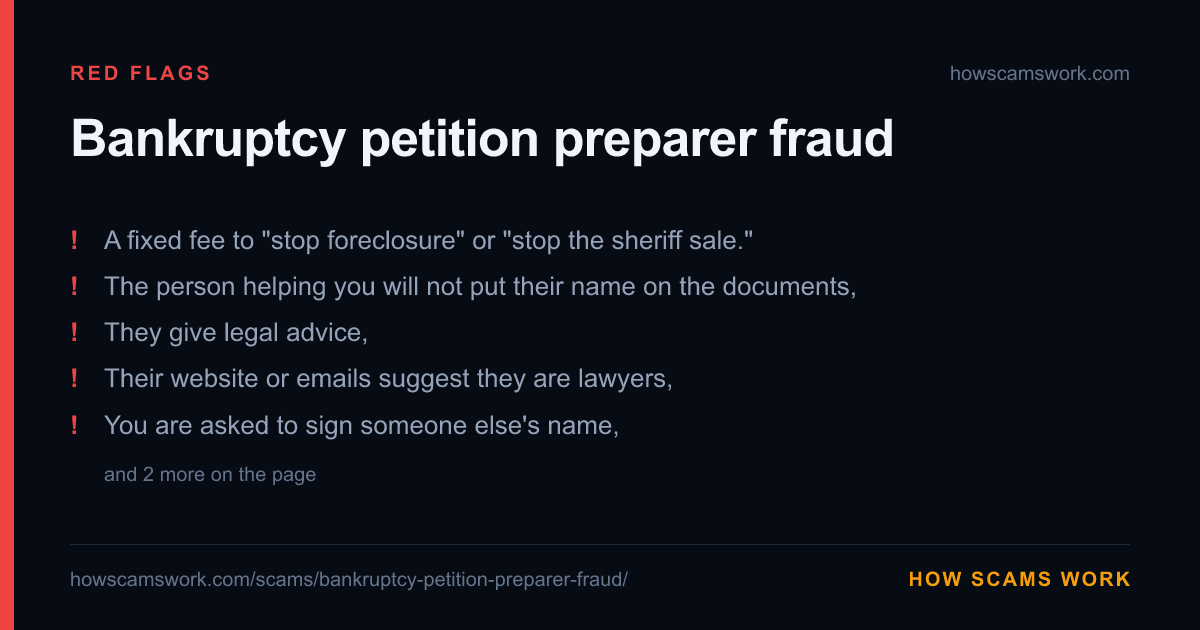
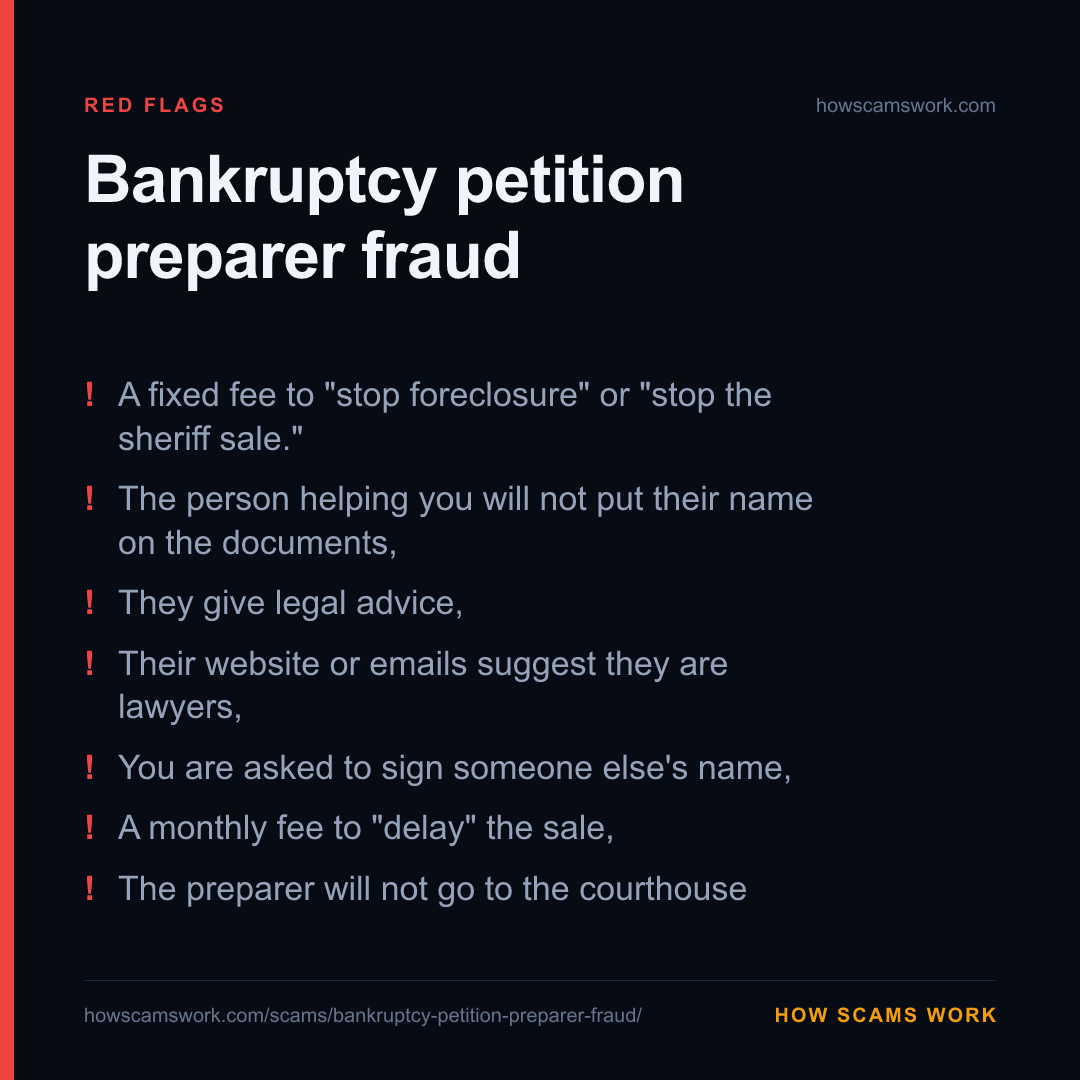
- A fixed fee to “stop foreclosure” or “stop the sheriff sale.” The Ohio postcards said both.
- The person helping you will not put their name on the documents, or tells you not to mention their help to the court.
- They give legal advice, such as which chapter to file or whether bankruptcy will erase your debts. The Oregon court found the preparer did.
- Their website or emails suggest they are lawyers, with words such as “legal services,” “associates” or “partners.”
- You are asked to sign someone else’s name, or to deed part of your home to a stranger.
- A monthly fee to “delay” the sale, as in the Gladle case, where it was about $750 a month.
- The preparer will not go to the courthouse. The Maryland preparer waited outside.
If it’s happening to you
- Before paying, ask the person whether they are an attorney, and check any lawyer’s name with your state bar. The
Oregon preparer was not a licensed attorney, and the attorney whose name appeared on his emails said he had no connection to him.
- Ask for the written notice a preparer must give you before taking fees, and make sure the preparer’s name and
address appear on every document you sign. The Oregon court found these missing.
- Do not sign another person’s name or deed part of your home to anyone because a preparer says it will delay a sale.
- If you already paid, keep every receipt, message and paper, and ask in writing for a refund. The Oregon court ordered
fees forfeited and damages paid to the couple.
- Report it to the clerk of the bankruptcy court and the U.S. Trustee for your region, which supervises bankruptcy
cases, and to the FBI or the FTC. If a bankruptcy was filed in your name without your knowledge, tell the court clerk.
See where to report for other countries.
Where the money goes
The documented money is mostly the fee. The Oregon preparers were paid, or received through a referrer, $3,995.
The Maryland preparer paid a client $40 for each petition filed on his behalf. The Texas defendant’s fees came to more than $1.6 million
and his prepaid, reloadable debit cards were forfeited.
Recovery is partial. The Texas defendant was ordered to pay $214,258.60 in restitution and to forfeit $84,010, and the
Justice Department noted the order does not show he can pay. The Oregon fines of $22,500 go to the U.S. Trustee Fund and the
$7,990 in damages and $3,995 in fees go to the couple. The sources do not say how much of any of these has been collected.
By the numbers
No published dataset breaks this scheme out as its own category yet, so there is no chart to show.
The data page explains which agency categories exist and why some schemes are
invisible in official statistics.
Every factual claim above traces to one of these. Statistics are reported losses; see
methodology for what that does and does not measure.