Also called: fake birth mother scam · private adoption scam · sham adoption scheme · adoption intermediary fraud · double-matching adoption fraud
Adoption fraud is a fake or double-matched "birth mother," or an unlicensed facilitator, charging hopeful adoptive parents for a placement that was never real. A Michigan woman took in $2.1 million inventing and double-matching birth mothers before a 10-year sentence; a Missouri day care operator tried to secretly place a client's own infant with a second family instead.
What it is
A person, or sometimes an entire unlicensed “agency,” promises a hopeful family a baby to adopt. The
birth mother is real but has already been promised to someone else. Or she is real but never intended to
place her child. Or she does not exist at all, a name, a photo borrowed from someone else’s social media,
a voice on the phone reading a script. Either way, the family is asked to pay: for her “living expenses,”
for legal fees, for a service that was never going to end in a baby.
This is not a story about agencies failing to deliver on a hard, uncertain process. Private adoption is
genuinely uncertain, and a birth parent lawfully changing her mind is not fraud. The scheme on this page
is different: a match that was invented, or sold twice, specifically to collect money from people who
were never going to receive a child in exchange for it.
A Michigan woman took in $2.1 million this way before a 10-year sentence. A Missouri day care
operator tried to physically hand a client’s own infant to a second family. A Houston woman faked a
pregnancy with twins twice in two years, at the same agency, for two different sets of victims.
How it actually works
The match
A “birth mother,” real, borrowed, or invented, is introduced to a hopeful family: through an unlicensed
online “adoption agency,” a Facebook post, or, in one documented case, a day care provider the family
already trusted with their own children.
The emotional build
Calls and texts escalate the relationship: morning sickness updates, an ultrasound photo, a due date,
a name already picked out, a nursery already prepared. One Michigan family was told the birth mother
had been “shot and killed” and her baby had died, a story invented because the birth mother never
existed.
The payment, sent directly
Once the match feels real, money is requested for “living expenses,” legal fees, or care of the child,
paid directly to the birth mother or facilitator rather than held in a licensed, bonded agency’s trust
account. One Michigan couple paid $33,000 to be matched with a woman who was never pregnant.
Where it could have stopped
A licensed adoption agency or attorney holds adoptive-family payments in a trust or escrow account and independently verifies the pregnancy, rather than letting a family send money straight to a stranger they have only spoken to by phone. Paying directly, before any licensed third party has confirmed the pregnancy is real and unclaimed by anyone else, is the point most of these schemes depend on.
Double-matching, or no pregnancy at all
The same real pregnancy is sold to more than one family at once, each paying, each believing they are
the only match. Or the pregnancy itself is fabricated from the start, supported by a borrowed photo or a
forged doctor’s note.
The excuse, then the silence
A miscarriage story. A due date that quietly slips. Then fewer calls, then none. In the Missouri case,
the facilitator instead tried to move the child across state lines before anyone could ask questions.
Discovery, almost always by the family itself
An adoptive mother finds the “birth mother’s” real Facebook profile, full of photos of a baby who was
never placed. Another family posts about the same woman. A biological mother is contacted directly and
says she never agreed to anything.
Investigation, often slow
Law enforcement, the FBI for interstate wire fraud, a county consumer-fraud unit for a state theft
charge, builds a case from bank records, phone logs, and the fabricated documents themselves, such as
the fake attorney email one Missouri operator sent to cover her story.
Sentencing that varies enormously
The same underlying deception is charged very differently depending on jurisdiction and amount: a
federal wire-fraud operator who ran the scheme for years drew 10 years; a day care operator who nearly
handed over a child drew six years without parole on a comparatively small dollar amount; a single state
theft charge drew two years.
Why it works
The need is emotionally overwhelming, not just financial. Families pursuing adoption have often
already survived infertility, miscarriage, or a previous match falling through lawfully. Someone offering
exactly what they want, now, is answered with hope rather than suspicion.
A pregnancy is hard for a stranger to verify. A signed note from a doctor is easy to produce, easy to
forge, or easy to borrow from an earlier, real pregnancy. One agency director has said plainly that she
does not require an in-office pregnancy test, because she wants to treat prospective birth mothers as
adults rather than interrogate them, a reasonable policy for a legitimate agency that is also exactly the
gap this fraud exploits.
Paying directly feels like helping, not like a red flag. “Living expenses” for a pregnant woman reads
as compassion, not as the unsecured, unverified wire transfer it actually is once there is no licensed
third party holding the money or confirming the pregnancy.
Trust is sometimes already established before the fraud starts. The Missouri case did not begin with
a stranger; it began with a day care provider the family had already trusted with their actual children
for months.
And discovery depends entirely on a chance encounter. Every documented case on this page was
uncovered by the adoptive family itself, usually by finding the “birth mother’s” real social media
account, not by any agency, bank, or regulator catching it first.
Where it comes from
Overwhelmingly domestic, individual rather than organized, and often repeated.
This is not typically an organized ring. Every case documented on this page is one person, or a small
number of co-defendants, operating alone or under a single invented or unlicensed “agency” name, not a
cartel or an offshore call center.
The same person, or the same vulnerable agency, is often targeted more than once. One Houston agency
was defrauded by two different women using the same false-pregnancy method within about three years of
each other.
Regulators are separately worried about the legitimate end of the industry. The FTC warned 31
for-profit “adoption intermediaries,” unlicensed businesses that charge a substantial fee to match
families with birth parents, that their advertising may illegally suggest they are licensed, child-placing
agencies. That is a deceptive-marketing concern about the industry’s edges, not proof that intermediaries
generally commit the outright theft described in the cases below, but it shows how little verification
separates a legitimate-looking service from a fraudulent one.
Enforcement is a mix of federal wire fraud and state theft charges, producing wildly different
sentences for comparable conduct: a federal case against a years-long, six-figure operator can draw a
decade in prison, while a single state theft charge against someone who defrauded one family draws a
fraction of that.
Real cases
2020 US Sentenced $2.1m
Tara Lynn Lee of New Haven, Michigan ran an unlicensed operation called Always Hope Pregnancy and Education Center from 2014 to 2018, inventing fictional birth mothers, double-matching real ones to more than one adoptive family at once, and collecting payment regardless. Federal prosecutors say she took in $2.1 million. She was sentenced in February 2020 to 10 years in federal prison. A co-defendant, Enhelica Wiggins, who posed on the phone as a pregnant woman and supplied Lee with unverified "referrals," was separately sentenced to 21 months.
Read the case file ·
4 sources
2019 US Sentenced $20,000
Jessica Felder, 35 or 36, told a Houston-area adoption agency and an adoptive family she was pregnant with twin boys, then kept collecting "living expenses" payments for months after she had miscarried without telling anyone. She pleaded guilty to aggregate theft of almost $20,000 from two adoption agencies and prospective parents, and in August 2019 a Harris County court sentenced her to two years in state prison, the maximum available under her plea.
Read the case file ·
2 sources
2019 US Sentenced $1,500
Lasonya Faye Poindexter, a 31-year-old day care operator in Joplin, Missouri, used her access to a client's two children to try to arrange the adoption of their five-month-old daughter by a different family in Arkansas, fabricating a story that the infant's mother wanted a closed adoption because the child was the product of rape. The infant's actual parents never consented and were unaware. Poindexter pleaded guilty to wire fraud and was sentenced in February 2019 to six years in federal prison without parole.
Read the case file ·
2 sources
2011 US Sentenced $55,000
Angela Wilkerson, a 32-year-old from Tecumseh, Oklahoma, took money from families in several states by promising to place her child for adoption with them. She pleaded guilty to child trafficking and was sentenced in October 2011 to five years in prison, followed by ten years of probation, and ordered to pay more than $55,000 in restitution to her victims.
Read the case file ·
2 sources
Red flags
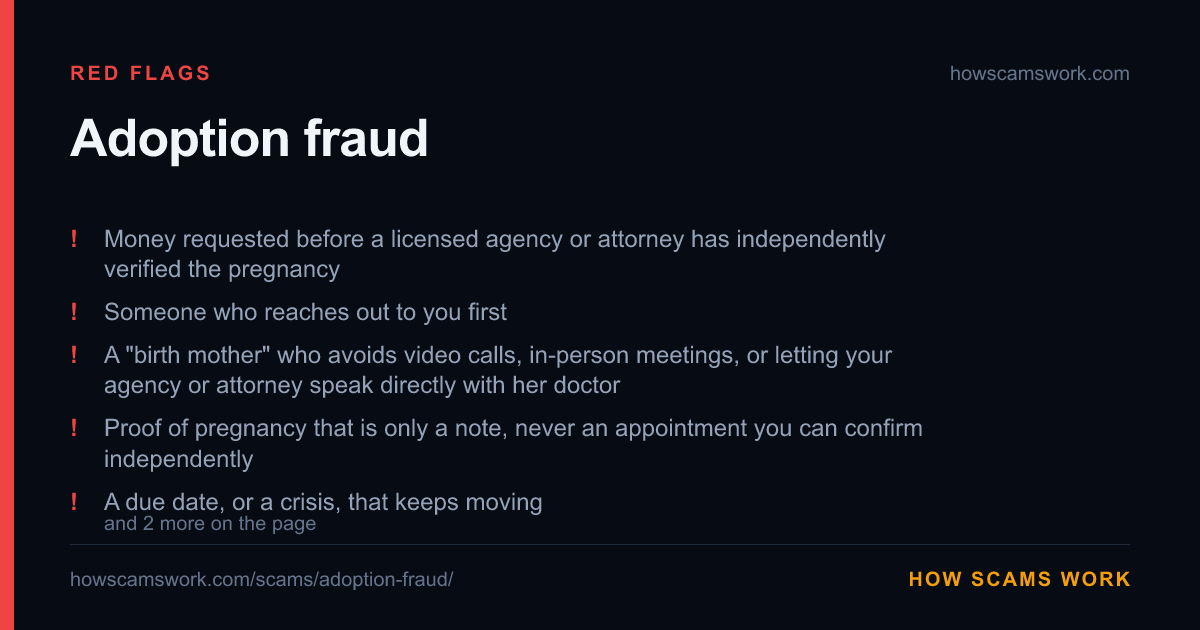
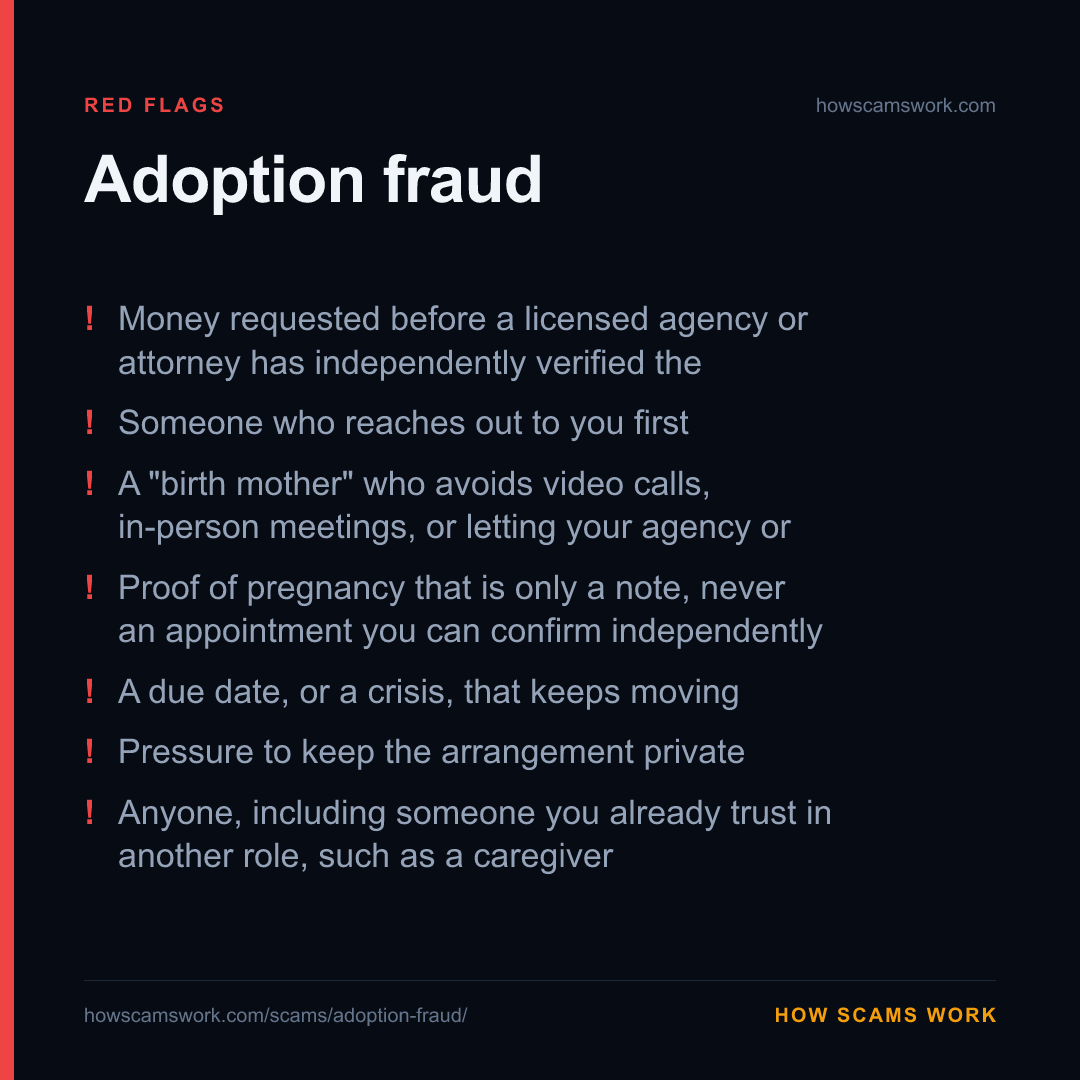
- Money requested before a licensed agency or attorney has independently verified the pregnancy, especially if it is to be paid directly to the “birth mother” rather than held in trust.
- Someone who reaches out to you first, rather than you contacting a licensed agency or attorney yourself. Reputable agencies generally do not cold-contact prospective adoptive families.
- A “birth mother” who avoids video calls, in-person meetings, or letting your agency or attorney speak directly with her doctor.
- Proof of pregnancy that is only a note, never an appointment you can confirm independently or a provider who will not answer a direct call.
- A due date, or a crisis, that keeps moving, each time asking for more money or more patience.
- Pressure to keep the arrangement private, from your own family, from other professionals, or from the agency itself.
- Anyone, including someone you already trust in another role, such as a caregiver, offering to arrange a private adoption outside the state’s own legal process.
If it’s happening to you
Stop sending money immediately. Do not wire, transfer, or hand over cash for any further “expenses”
until the pregnancy and the match have been independently confirmed by a licensed professional you chose
yourself.
- Contact a licensed adoption attorney or agency in your state directly, rather than through
whoever introduced you to the match. They can confirm in writing whether a pregnancy, a provider, or
an agency actually exists and is licensed.
- Search for the “birth mother’s” real identity online, including reverse-searching any photo she
has sent you. Every documented case on this page was uncovered this way, by the family, not by any
institution.
- Report it. File with the FBI’s Internet Crime Complaint Center at ic3.gov for any contact made
online or across state lines, and with your state attorney general’s consumer protection office. See
where to report for other countries.
- If money has already been sent, keep every record: bank transfers, texts, emails, and any document
you were given, including anything that turns out to be forged, such as a fake attorney’s letter. These
become the evidence a restitution order depends on.
- If you suspect a licensed-looking agency or intermediary itself is the problem, not just one
individual birth mother, you can also file a complaint with the FTC at ReportFraud.ftc.gov, the
same channel that led to the agency’s 2024 warning letters to adoption intermediaries.
- Do not expect full restitution even after a conviction. Courts in documented cases on this page
have ordered restitution as low as $1,500, far below what some families actually lost.
Where the money goes
Directly into the facilitator’s own accounts and immediate personal spending, not into any laundering
chain or overseas network.
Every documented case on this page shows money moving the same simple way: from the adoptive family’s
own bank account or cash, straight to the individual running the scheme, with no licensed agency, escrow
account, or third party in between to catch it. There is nothing to launder because the money was never
disguised as anything other than what it claimed to be, adoption expenses, it just never reached an
adoption.
Spending tends to be immediate and personal, not reinvested in the scheme. Federal prosecutors say
one Michigan operator spent $372,892.63 of the $2.1 million she took on luxury goods, including $44,065.03
at Louis Vuitton, $42,705.91 at David Yurman and $34,899.44 at Saks Fifth Avenue, while a Missouri day
care operator’s scheme involved almost no money at all because the family she targeted refused to pay
before the adoption was finalized.
Restitution, when ordered, recovers only a fraction of what was taken, and years after the fact: a
Missouri court ordered $1,500 against a scheme that nearly resulted in a child being handed over without
her parents’ knowledge, while a Michigan court’s $1,005,398.78 recommendation came against $2.1 million
actually taken.
By the numbers
No published dataset breaks this scheme out as its own category yet, so there is no chart to show.
The data page explains which agency categories exist and why some schemes are
invisible in official statistics.
Every factual claim above traces to one of these. Statistics are reported losses; see
methodology for what that does and does not measure.