Also called: GoFundMe fraud · fake fundraiser scam · crowdfunding scam · Kickstarter scam · fake crowdfunding campaign
A crowdfunding scam collects money through a fabricated personal crisis on a site like GoFundMe, or a product pitched on Kickstarter or Indiegogo that never ships. Payments move directly from donor or backer to organiser, with no verification step. Four documented US cases raised between $105,513 and over $800,000 each before the stories or the products were exposed as false.
What it is
A crowdfunding scam collects money directly from the public, through a donation-based site like
GoFundMe or a reward-based site like Kickstarter or Indiegogo, for something that is not true. It comes
in two forms.
The first is a fabricated personal crisis: an illness that was never diagnosed, a death that never
happened, a hardship invented for sympathy. This is distinct from the charity scams covered elsewhere on
this site, where the appeal is for a cause, a disaster or an organisation. Here, the person asking is
also the person claiming to be in trouble, often soliciting their own friends, family and followers
rather than strangers, and no charity, no disaster and no third-party beneficiary is involved at all.
The second is a fabricated product: a campaign that promises backers a physical reward, a gadget, a
device, in exchange for money paid up front, then never delivers it. The FTC pursued exactly this
against the creator of iBackPack, who raised more than $800,000 across four campaigns on Indiegogo
and Kickstarter and, the agency alleged, spent most of it on himself rather than the product.
Both forms share the same structural weakness: a card payment reaches the organiser’s own bank account
within days, with no charity registration, no escrow and no verification standing between the appeal and
the money.
How it actually works
The appeal
A fabricated personal crisis, or a product pitch with a prototype video and a specific shipping date,
posted to a crowdfunding page with photographs and a story built to be shared.
No one checks the claim
The platform does not verify what the campaign says. The FTC’s own consumer guidance states it
plainly: some dishonest people can take your money and produce nothing, no product, no project and
no reward.
Where it could have stopped
Checking the organiser’s own history, earlier campaigns and how they turned out, before paying, is the one verification step that exists. Nothing in a crowdfunding site’s signup or payment flow requires or even prompts a donor or backer to take it.
Money moves directly and instantly
A card payment or bank transfer reaches the organiser’s own account within days, through the
platform’s payment processor, with no charity registration, no escrow and no delivery guarantee in
between.
Spent before anyone can check
In the GoFundMe case on this page, the trio’s $400,000 was gone within about a month, spent on an
RV, a BMW and casino trips. In the iBackPack case, the FTC alleged the money went largely to personal
expenses and more marketing rather than the product.
The lie surfaces through behaviour, not paperwork
A lawsuit from someone who was supposed to receive the money, a missed shipping deadline repeated
for years, or a threat made against a complaining backer, not a background check, is usually what
finally exposes it.
Enforcement splits into two tracks
A fabricated personal crisis is prosecuted as wire fraud or bank fraud, a crime against the donors
who were deceived. A fabricated product is pursued by the FTC as a deceptive and unfair trade
practice, because a backer is legally a buyer expecting a product, not simply a donor.
A fraction back, years later, if at all
Restitution in the criminal cases here matched close to the amount proven taken, $105,513 and
$79,629 in two of them. In the civil case, the nearly $800,000 judgment was suspended entirely
because the operator could not pay.
Why it works
The need, or the product, sounds completely ordinary. Real people get sick, lose homes and bury
relatives, and real inventors successfully fund real products this way. A fabricated version of either
does not have to clear a high bar of plausibility; it only has to look like the thousands of genuine
campaigns next to it.
Closeness is a strength, not a safeguard. Both fake-illness cases here ran for years against the
organiser’s own personal network, people who had every ordinary reason to trust someone they actually
knew, rather than strangers who might have asked harder questions.
The platforms are built for speed, not verification. Payment processing exists to move money from
donor to organiser as fast and as easily as possible. A verification step that slowed every one of
millions of legitimate campaigns down would defeat the product’s entire purpose, which is also why the
FTC’s own advice puts the burden of checking on the person deciding whether to give.
A viral story recruits its own audience. Local news coverage, shares and comments from people who
have already given function as social proof for the next donor, the same mechanism that makes a
legitimate appeal spread, with no way for a new donor to tell the difference.
And a product pitch borrows credibility from products that were real. Kickstarter and Indiegogo have
funded genuinely successful devices, so a professional-looking video and a concrete shipping date read
as ordinary ambition rather than a warning sign.
Where it comes from
Every documented case on this page is domestic: US organisers, raising money from a US audience, through
US-based platforms.
There is no offshore network and no stolen-identity step. The organiser uses their own name, their
own photograph and, in the personal-crisis cases, their own real medical appointments and forged medical
paperwork to back the story. The fraud is in what is claimed, not in who is claiming it.
Scale ranges from a single viral campaign to years of ongoing solicitation. The GoFundMe case here
ran for about a month before the money was gone; Amanda Riley’s fabricated cancer claim ran for seven
years, 2012 to 2019, before an investigation caught it.
Enforcement runs through both criminal and civil channels, depending on what was faked. The three
personal-crisis cases here were prosecuted criminally, for wire fraud or bank fraud. The one
fabricated-product case was a civil FTC action under the FTC Act, because a backer who is promised a
product and never receives one is legally a defrauded buyer, not a misled donor.
Real cases
2022 US Sentenced $400,000
In late 2017, Mark D'Amico, Katelyn McClure and Johnny Bobbitt Jr. invented a story that Bobbitt, a homeless man, gave McClure his last $20 so she could buy gas after running out on Interstate 95 near Philadelphia. The "Paying It Forward" GoFundMe campaign raised more than $400,000 from over 14,000 donors in about a month, almost all of it spent by McClure and D'Amico on an RV, a BMW and casino trips before Bobbitt sued them for his promised share and the fabrication came to light. All three pleaded guilty to state and federal charges; D'Amico was sentenced in April 2022 to 27 months in federal prison.
Read the case file ·
3 sources
2022 US Sentenced $105,513
Amanda Christine Riley, formerly of San Jose, California, falsely claimed from 2012 to 2019 to have Hodgkin's lymphoma, shaving her head, forging medical records and physicians' letters, and persuading family members to back the story to collect $105,513 from 349 donors through blog and social media appeals for treatment she never needed. Charged by criminal complaint in July 2020, she pleaded guilty to one count of wire fraud in October 2021 and was sentenced in May 2022 to 60 months in federal prison plus $105,513 restitution.
Read the case file ·
1 source
2020 US Settled $800,000
Douglas Monahan, operating as iBackPack of Texas, LLC, raised more than $800,000 from consumers through four crowdfunding campaigns on Indiegogo and Kickstarter between 2015 and 2016 for a high-tech backpack with built-in batteries, a Bluetooth speaker and related accessories. The FTC alleged he missed the delivery deadline, never delivered the products, and spent most of the money on personal expenses and further marketing. The FTC filed suit in May 2019; a May 2020 settlement permanently banned Monahan from crowdfunding and entered a nearly $800,000 judgment, suspended because he could not pay.
Read the case file ·
3 sources
2017 US Sentenced $264,163
Jennifer Flynn Cataldo, a 37-year-old former special education teacher in Alabama, falsely portrayed herself as having terminal cancer from 2014 to May 2017, collecting $264,163 in checks, cash and online donations, including through two GoFundMe pages, from friends, family and the public. She pleaded guilty to one count of wire fraud and one count of bank fraud, and was sentenced in November 2017 to 25 months in federal prison and ordered to pay $79,629 in restitution.
Read the case file ·
2 sources
Red flags
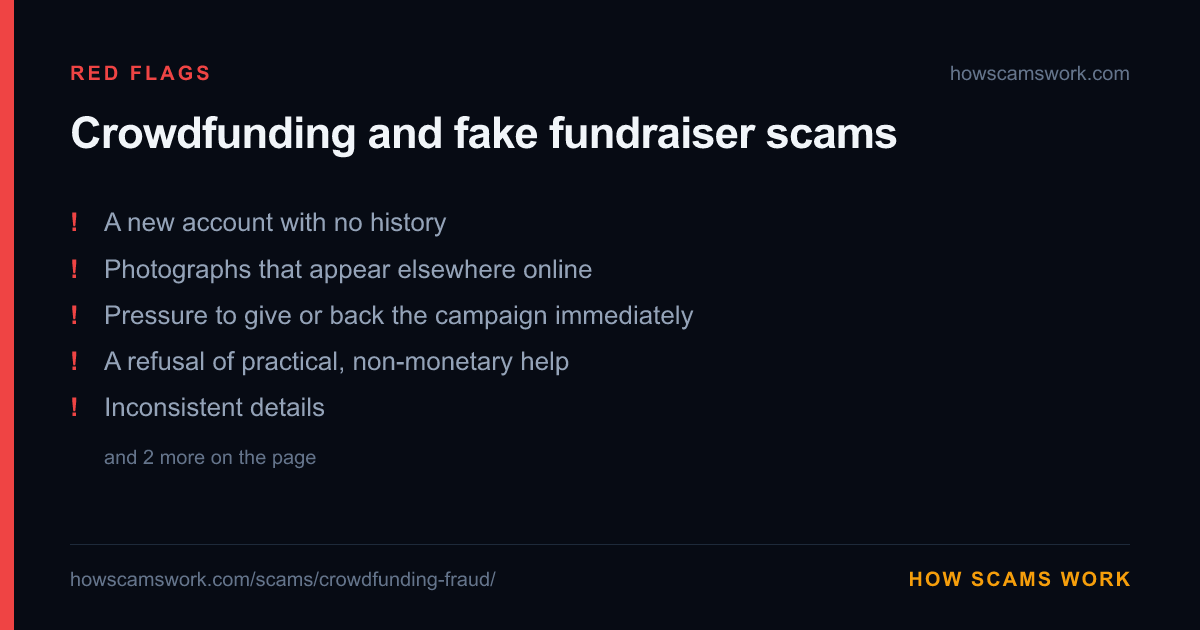
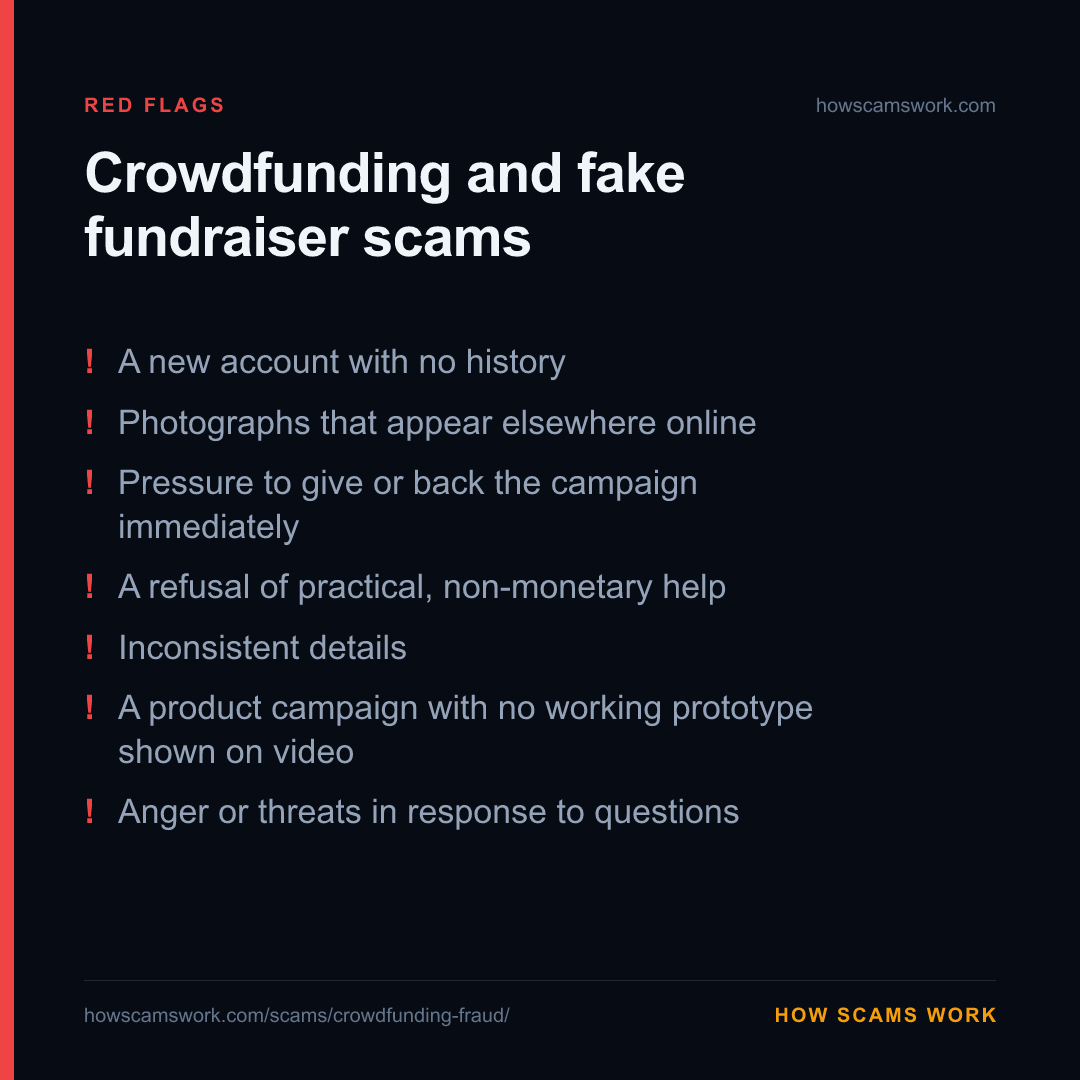
- A new account with no history running a single, high-stakes campaign with no other activity before or since.
- Photographs that appear elsewhere online attached to a different name or a different story, found with a simple reverse-image search.
- Pressure to give or back the campaign immediately, before a deadline the organiser controls and can always extend.
- A refusal of practical, non-monetary help, meals, rides, visits, in favour of cash only.
- Inconsistent details between the campaign page, social media posts and what the organiser says directly, about dates, diagnoses or progress.
- A product campaign with no working prototype shown on video, only renders or stock photography, and a creator with earlier campaigns that also missed their promises.
- Anger or threats in response to questions, rather than documentation, when a backer or donor asks where the money or the product actually is.
If it’s happening to you
Stop giving further, and keep every record you have: the campaign page, your payment confirmation,
and any messages with the organiser.
- If you donated on GoFundMe, you can file a Giving Guarantee claim within one year of your
donation if the campaign misused the money or its stated purpose was false. GoFundMe investigates and
decides the outcome, including any refund, at its own discretion; it excludes donations to your own
fundraiser and anything given outside the platform.
- If you backed a Kickstarter or Indiegogo project, know that neither platform guarantees a refund
for a late or undelivered product; you accepted that risk under the platform’s own terms. A dispute
with your card issuer is usually the more realistic path.
- Dispute the charge with your card issuer if you paid by card and are still inside the chargeback
window, often your fastest route to getting money back regardless of what the platform itself decides.
- Report it to the FTC at ReportFraud.ftc.gov, and to local police if you believe a crime was
committed, since the GoFundMe Giving Guarantee requires a police report from an intended beneficiary
who never received funds. See where to report for other countries.
- If you are the person a fundraiser named as the beneficiary and never received the money, file
both a platform claim and a police report; the guarantee specifically covers this situation.
- Before giving to any future campaign, spend five minutes checking the organiser’s history, earlier
campaigns, and whether the photographs or story appear anywhere else under different details.
Where the money goes
Directly into the organiser’s own bank account, spent as ordinary personal money, with none of the
layering or mule networks this site’s other pages describe.
There is no laundering chain here because none is needed: the money arrives already placed, through a
legitimate card payment on a legitimate platform, into an account in the organiser’s own name. The $400,000
raised in the GoFundMe case here went to a recreational vehicle, a BMW and casino trips, ordinary
purchases rather than concealment. The money the FTC says Douglas Monahan collected went largely to
personal expenses and to marketing for raising more of the same.
That is also why recovery is so limited. There is no seized account, no frozen wallet and no shell
company to unwind, only whatever the organiser has left by the time a court orders restitution or a
settlement is reached, often years after the money was spent.
By the numbers
No published dataset breaks this scheme out as its own category yet, so there is no chart to show.
The data page explains which agency categories exist and why some schemes are
invisible in official statistics.
Every factual claim above traces to one of these. Statistics are reported losses; see
methodology for what that does and does not measure.
Common questions
Isn't this the same thing as the charity scams on this site?
No. A charity scam solicits money for a cause, a disaster, a group of veterans, a sick child who is not the fundraiser, through an organisation that is either sham or badly run. A crowdfunding scam, in the sense used here, is an individual fundraising for a crisis they claim is happening to them personally, or a company raising money for a product it never delivers. No charity registration, no disaster, and often no gap at all between the person asking and the person claiming to need help.
Can I get my donation back?
On GoFundMe, its Giving Guarantee lets a donor file a claim within one year of giving if the campaign misused the money or the stated purpose was false; GoFundMe investigates and decides the outcome, including any refund, at its sole discretion, and excludes donations to your own fundraiser and anything given outside the platform. Kickstarter and Indiegogo offer far less: backers are treated as having funded a project at their own risk, and neither platform guarantees a refund simply because a product is late or never ships.
The person is someone I actually know. Doesn't that make it safer?
It can make it more effective, not safer. Two of the cases on this page involved women who maintained a fabricated cancer diagnosis for years, convincing family, friends, coworkers and blog readers who had every reason to trust them personally. A close relationship supplies exactly the social proof a stranger's appeal lacks.
A Kickstarter project missed its shipping date. Is that automatically fraud?
No. Most delayed crowdfunded products are genuine projects that ran into real manufacturing, supply or funding problems, and a late or even cancelled product is not on its own evidence of a crime. The FTC's test, in its case against iBackPack, was not the missed deadline; it was what happened to the money: evidence that most of it went to personal spending and further marketing rather than toward building the product at all.
Why doesn't the platform just verify the story or the product before releasing the money?
Because verification does not scale to the volume these platforms are built for, and they say so plainly. The FTC's own consumer alert states it bluntly: some dishonest people can take your money and produce nothing, no product, no project and no reward. Checking the creator's own history and reviews before paying is the one verification step available, and nothing in the signup flow requires or even prompts a donor to take it.
What's the single best protection before I give or back a campaign?
Research the person or company running it before you pay, not after. Look for a track record: earlier campaigns, how they turned out, whether photos appear elsewhere online under a different story, and whether the organiser will answer specific questions about delivery or use of funds. A campaign that cannot survive that five minutes of checking is not worth the thirty seconds it takes to donate.