Also called: annuity churning · annuity switching scam · unnecessary annuity replacement · annuity twisting
Annuity switching, or churning, is when an insurance agent persuades an existing client, often a retiree, to surrender one annuity and buy another, triggering surrender charges of thousands of dollars and a new multi-year lock-up period, mainly to generate a fresh sales commission. Regulators have revoked agents' licenses and ordered insurers to refund surrender fees in multiple US states.
What it is
An insurance agent you already trust, often someone who has reviewed your account every year for a
decade, tells you a different annuity would serve you better than the one you already own. You sign the
paperwork. What you are not always told clearly: surrendering your current annuity early triggers a
surrender charge, sometimes thousands of dollars, and the new annuity starts its own multi-year
surrender period from zero.
This is not always a scam. A tax-free “1035 exchange” between annuities is a real, legal tool, and
sometimes a genuinely better product exists. What state insurance law bans is an “unnecessary
replacement”: swapping a senior’s annuity for a new one that a reasonable person would not expect to
provide a substantial financial benefit once the surrender charge and new fees are counted. Regulators
call the repeated version of this churning, and in every documented case on this page, the agent
collected a new sales commission on the replacement while the client absorbed the surrender charge.
How it actually works
The approach
An existing client relationship, built over annual “account review” visits, or a new one started through
a direct-mail postcard offering a free elder-law or tax-law review, or a free-meal retirement seminar. A
2007 joint SEC, NASAA and FINRA examination found that financial firms were increasingly targeting
exactly this audience through “free lunch” sales seminars.
Undermining confidence in the policy already owned
The agent reviews the client’s existing annuity and finds something wrong with it: a lowered
participation rate, a competitor “going broke,” poor recent performance. In California’s case against
agent Alan Cerf, one client’s prior agent was described to a hearing judge as having already
“unnecessarily switched” his products once before Cerf arrived.
The “better vehicle” pitch
A new annuity is recommended, often without a side-by-side comparison of the two products’ fees, bonus
structures or surrender terms. Wisconsin regulators found one agent’s annuity and life insurance
recommendation to a retired client was made “without reasonable grounds” given her age, her low risk
tolerance and her limited financial sophistication.
Signing before the disclosures are explained
Where it could have stopped
State insurance codes require an agent recommending an annuity replacement to a senior to have a reasonable basis for believing it provides a substantial financial benefit, and most require the replacement paperwork itself to disclose any surrender charge. Pennsylvania’s insurance commissioner said two agents convinced clients the new annuities would simply pay higher interest, and when the insurers themselves sent letters questioning the changes, the agents told clients to ignore them, defeating the one external check in the system before it could work.
The surrender charge and a new clock
The old insurer deducts a surrender charge, sometimes a fixed percentage of the account that declines
over several years, before releasing the remaining funds to fund the new annuity. The new annuity then
starts its own multi-year surrender period from day one, so the client cannot access that money again
without a fresh penalty for years longer than if nothing had changed.
The commission
The agent is paid a new commission on the new annuity’s premium, calculated as a percentage of money that,
in California’s case against Cerf, had often already paid the same agent a commission once or twice
before on the same client’s prior annuities.
Enforcement, years later, and rarely criminal
A complaint from a client, a relative, or an insurer’s own suitability review eventually reaches a state
insurance department. Every documented case on this page ended in a civil or administrative sanction, a
license revocation, a financial penalty, an insurer ordered to refund surrender fees, rather than a
criminal charge.
Why it works
The agent is already trusted, often for years. An annual review visit, sometimes built as much around
personal rapport as around the account itself, establishes exactly the credibility a later replacement
recommendation draws on.
The loss is deferred and easy to miss. A surrender charge is deducted from an account statement a
client may not scrutinise line by line, and the real cost, a multi-year lock-up reset plus lost benefits,
only becomes obvious if the client needs that money again before the new surrender period ends.
“A better vehicle” sounds like expertise, not a sales pitch. Comparing two insurance products’ fee
structures, bonus terms and surrender schedules requires exactly the specialised knowledge most clients
came to the agent for in the first place, which makes the agent’s own recommendation hard to independently
check.
The one external safeguard can be talked around. An insurer’s own letter questioning a replacement
exists specifically to catch this pattern. Pennsylvania’s case shows that safeguard only works if the
client acts on it, and an agent who sold the replacement has an obvious reason to tell the client not to.
And the paper trail looks completely legitimate. Every signature is real, every disclosure form exists
somewhere in the file, and the only thing wrong is a judgment call, whether the replacement was
“unnecessary”, that takes a regulator’s hearing to establish after the fact.
Where it comes from
Entirely domestic, and carried out by licensed professionals already embedded in their clients’
financial lives, not anonymous callers or offshore operators.
Every documented case here is a US-licensed insurance agent, not an unlicensed operator. Alan Cerf
held a California life-only and accident-and-health agent license dating back to the 1970s; Donald and
Nicole Gilberg and Richard Freeland were each separately licensed in their own states before regulators
revoked those licenses.
Enforcement runs through state insurance departments, not federal agencies. Insurance is regulated
state by state in the US, so every sanction documented here came from a state insurance commissioner, not
the FTC, CFPB or SEC. A closely related pattern can instead draw in a state securities regulator when the
seller is a registered investment adviser representative rather than only a licensed insurance agent:
Illinois’s Secretary of State revoked two advisers’ registrations in 2011 over a nearly identical pattern
of liquidating elderly clients’ annuities, finding $122,630 in surrender charges across just 12 investors
who had collectively paid the advisers $426,281 in commissions in under four months.
It is overwhelmingly civil or administrative, not criminal. None of the three cases on this page
produced a criminal charge; each ended in a license revocation and a financial penalty paid to the state
or, in Pennsylvania’s case, restitution the department negotiated directly with the insurers involved.
And it can continue for years before anyone catches it. Alan Cerf had already been disciplined once,
in 2003, for similar conduct, and went on recommending unnecessary replacements for another decade before
a second hearing revoked his license entirely.
Real cases
2021 US Sanctioned
Wisconsin's Office of the Commissioner of Insurance announced in October 2021 that it had revoked former agent Richard Freeland's insurance license for five years and ordered him to pay $27,206.16, after an administrative law judge found he sold a retired consumer an annuity and life insurance policy that were unsuitable given her age, her low risk tolerance and her limited financial means.
Read the case file ·
1 source
2019 US Sanctioned
California's Insurance Commissioner revoked agent Alan Lucien Cerf's license in a decision effective in early 2019, after an administrative law judge found he had recommended nine "unnecessary" annuity replacements to elderly clients between 2007 and 2013, in violation of a state law written specifically to protect seniors from exactly this. Cerf was ordered to pay $49,683.15, calculated as the commission he personally collected on each violation, and had already been the subject of a 2003 stipulated order over similar conduct.
Read the case file ·
1 source
2019 US Sanctioned
Pennsylvania's Insurance Department announced in August 2019 that it had revoked the licenses of Pittsburgh-area agents Donald L. and Nicole P. Gilberg, a husband-and-wife team, after an investigation found they convinced clients to replace existing annuities with new ones, earning more than $136,000 in commissions while telling clients to ignore insurer letters questioning the changes. The department separately reached an agreement with the two insurers involved to refund a combined $117,559 in surrender fees to 25 Pennsylvania consumers.
Read the case file ·
1 source
Red flags
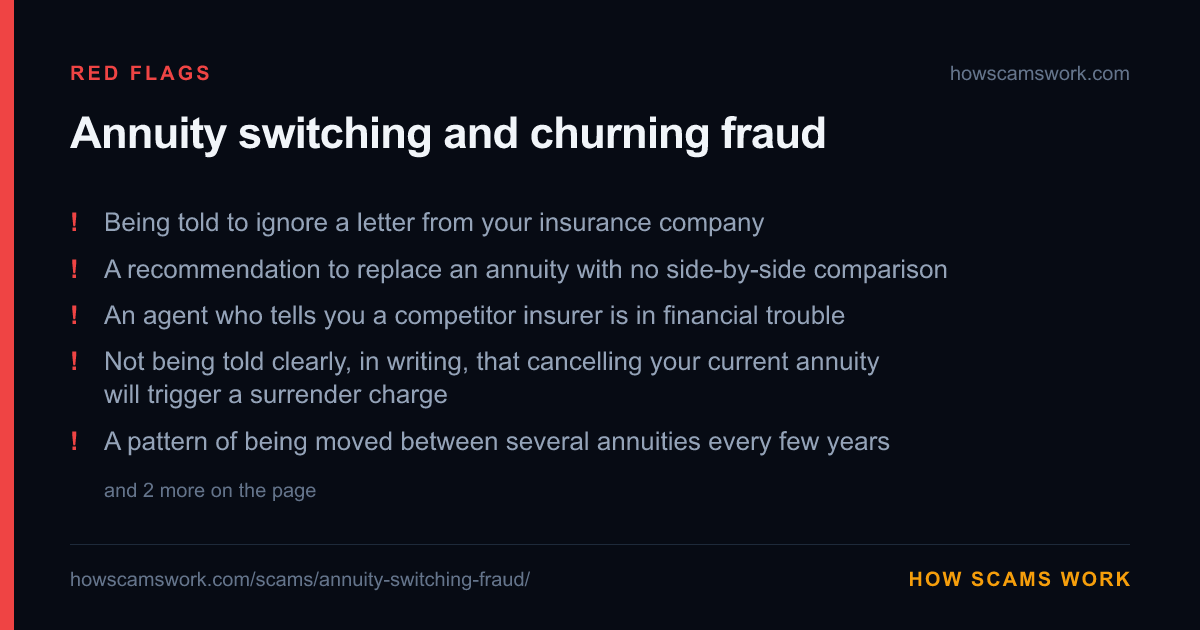
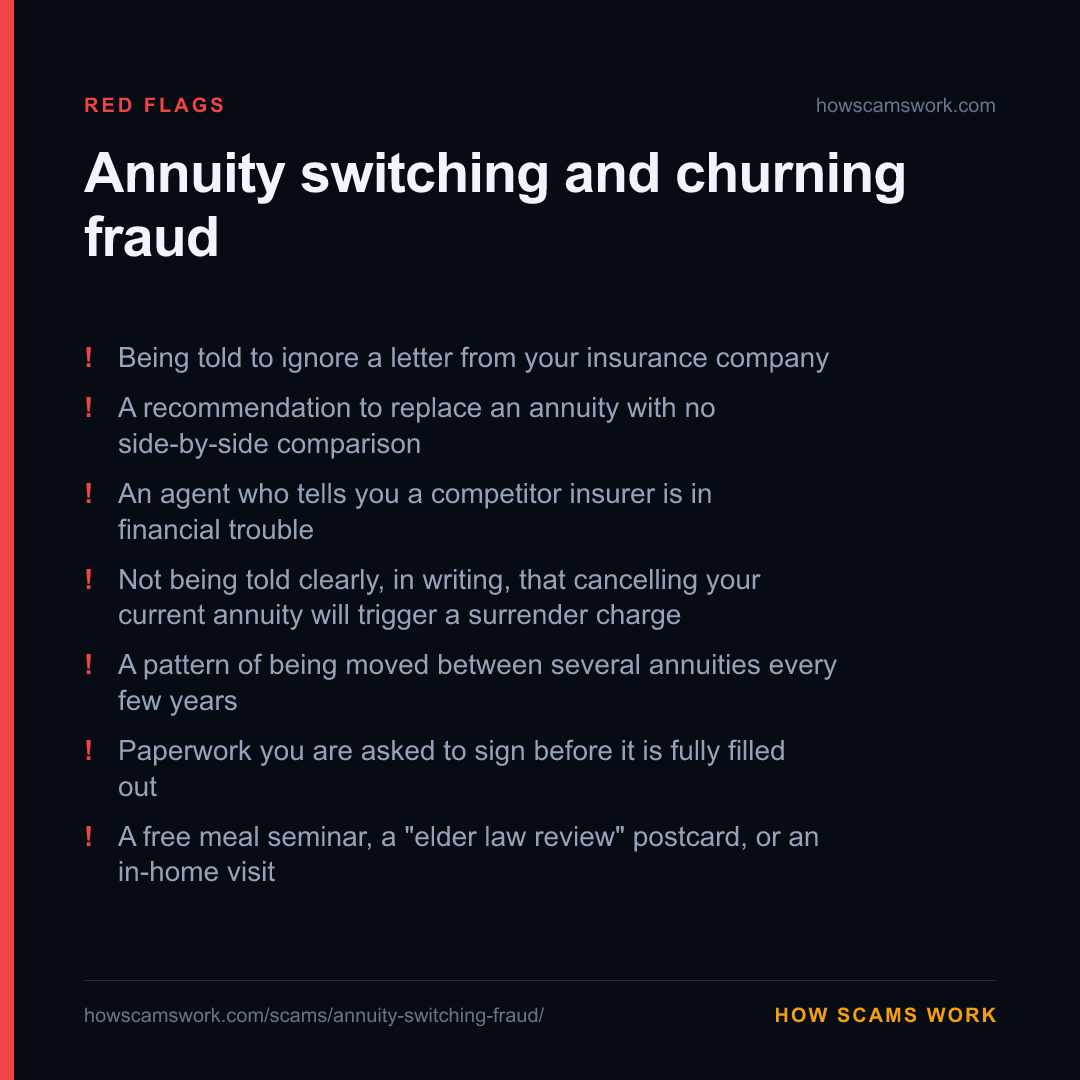
- Being told to ignore a letter from your insurance company questioning a recent annuity replacement. That letter exists specifically to protect you.
- A recommendation to replace an annuity with no side-by-side comparison of the surrender charge, the new surrender period, and any lost benefits against the stated upside.
- An agent who tells you a competitor insurer is in financial trouble, or that your current annuity has a problem, without showing you the documentation behind that claim.
- Not being told clearly, in writing, that cancelling your current annuity will trigger a surrender charge, or being told the new product’s interest rate without being shown the full cost of switching to get it.
- A pattern of being moved between several annuities every few years by the same agent, each move paying that agent a new commission.
- Paperwork you are asked to sign before it is fully filled out, or that you sign without an explanation of the 30-day free-look period.
- A free meal seminar, a “elder law review” postcard, or an in-home visit as the way the relationship with a new agent began.
If it’s happening to you
If you are still inside your new annuity’s free-look period, usually 30 days, you can typically return
it for a full refund. Check your contract’s cover page for the exact window and instructions.
- Ask your current or former insurer directly for the surrender charge and benefit comparison between
your old and new annuities, rather than relying on the agent’s own summary of the trade.
- Do not ignore a letter from your insurance company asking why you want to replace or surrender a
policy. Answer it yourself, honestly, even if your agent tells you it is not necessary.
- Get a second opinion from an agent, fee-only financial planner or attorney with no relationship to
the one who sold you the replacement, before signing anything further.
- Report it to your state insurance department. Several of the cases on this page began with exactly
that kind of complaint, and state departments can investigate, sanction an agent, and in some cases
order an insurer to refund surrender fees.
- Report it to the FTC at ReportFraud.ftc.gov and, if you believe a federally registered
investment adviser was involved rather than only an insurance agent, the SEC at sec.gov/tcr. See
where to report for other countries.
- If an older family member has been visited repeatedly by the same insurance agent, ask to see the
actual surrender charge and commission disclosures on any recent replacement, not just the sales
brochure.
Where the money goes
Mostly into the agent’s own commission, with the client’s loss landing as a surrender charge paid to the
insurer being left, not to any third party hiding the money.
There is no laundering chain in any case on this page. The surrendered annuity’s account value, minus
whatever surrender charge the original insurer deducts, becomes the premium for the new annuity, and the
new insurer pays the agent a commission out of that premium. In California’s case against agent Alan
Cerf, a single replacement transaction for one client generated $10,939.76 in commission while that same
client incurred $12,327 in surrender charges on the same transaction; regulators calculated his total
administrative penalty, $49,683.15 across nine such transactions, as equal to the commission he had
personally collected on each one. Pennsylvania’s case is similar in scale: two agents collected more than
$136,000 in commissions while their clients lost enough in surrender charges that insurers later agreed to
refund $117,559 of it.
No federal complaint dataset currently breaks annuity switching out as its own tracked category, so this
page’s typical-loss estimate is drawn directly from the documented surrender-charge figures in its own
cases, from a single $3,146.38 surrender penalty in the California case’s smallest sustained transaction up
toward the low five figures a client can lose when churned more than once, rather than from any national
total.
By the numbers
No published dataset breaks this scheme out as its own category yet, so there is no chart to show.
The data page explains which agency categories exist and why some schemes are
invisible in official statistics.
Every factual claim above traces to one of these. Statistics are reported losses; see
methodology for what that does and does not measure.