Also called: structured settlement scam · settlement factoring fraud · annuity purchase scam · structured settlement transfer fraud · factoring company fraud
Structured settlement purchase fraud defeats the safeguards the law requires before someone sells a lawsuit settlement for cash now: independent professional advice and a judge's finding the sale serves the seller's best interest. Operators have faked that advice for kickbacks, forged the judge's signature outright, or simply stolen the money meant to buy the annuity.
What it is
A structured settlement pays a lawsuit settlement out over years, in scheduled checks, instead of as one
lump sum. Courts order this on purpose, often specifically to protect minors, people with
long-term injuries, or anyone a judge decides should not have unsupervised access to a large sum all
at once.
Federal law has let people sell that future payment stream for cash since 2002, but only through a
specific legal process: a court must issue a “qualified order” finding the sale is in the seller’s
best interest, and most states additionally require the seller to get independent professional
advice before that happens. Skip the process and the buyer owes the federal government a 40% excise
tax on the whole transaction.
This scheme is what happens when a company, or a lawyer working for one, defeats that process instead of
following it: faking the independent advice, forging the court’s approval outright, or simply stealing
money a court already ordered set aside to buy someone’s annuity in the first place.
How it actually works
The payment stream exists because a court ordered it
Someone wins a lawsuit, often a child poisoned by lead paint, a patient harmed by malpractice, or anyone
a defendant’s insurer agreed to pay over time. A court structures the payout as scheduled checks, in some
cases specifically because the recipient is a minor or needs long-term protection from a lump sum.
The law builds in two safeguards before anyone can buy it
A structured settlement is legally sellable, but federal and state law condition that sale on a judge’s
qualified order finding it serves the seller’s best interest, and, in many states, on the seller
first getting independent professional advice with no financial tie to the buyer.
The pitch for cash now
A company, often through direct mail, broadcast ads or a referral from someone already involved in the
settlement, offers a lump sum today in exchange for years of future payments, framed as a routine
business transaction rather than a legal process with a built-in protection for the seller.
Defeating the safeguard
Where it could have stopped
The independent advisor and the judge’s order exist specifically so someone with no stake in the deal checks it first. Maryland prosecutors say Access Funding paid an attorney directly to sign off as 94 victims’ “independent” advisor while he secretly took kickbacks tied to how many of his clients’ payment rights the company acquired, and made false statements to the court to get the transfer orders issued. A Florida lawyer skipped the court order altogether, forging at least seven judges’ signatures on 114 structured settlement orders rather than wait for them to be signed.
The lowball
Once the safeguard is gone, the price is whatever the buyer wants to pay. Access Funding’s victims, owed
payment rights with a present value of more than $21 million, received under $7 million combined, as
little as 8 cents on the dollar in some cases.
Or the money never reaches an annuity at all
In a different version of the same failure, the company is not buying someone’s existing payments, it
is hired, by a court or an insurer, to actually purchase the annuity for an injured child in the first
place. Joseph Gargan’s Virginia firm, trusted with nearly $16 million in federal settlement money for
exactly that purpose, kept close to $7 million of it for himself and manufactured fake annuity
contracts to make it look purchased.
Unwinding, years after the money moved
The fraud surfaces when a detail does not add up: a judge notices her own forged signature carries an
impossible date, an audit catches a missing annuity, or a scheme can no longer be covered from the next
deal’s proceeds. Restitution, where it is ordered, comes years after the settlement money was supposed to
reach the person it was meant to protect.
Why it works
The need for cash is real and the wait is long. Structured payments can run for decades; someone
facing a medical bill or an eviction today has little patience for a payment schedule written years
earlier.
The safeguard looks like paperwork, not protection. An “independent advisor” and a court order sound
like procedural steps a company can “handle,” not a check specifically designed to catch a bad deal
before it closes.
The victims are often the people the safeguard was built for. Minors, lead-poisoning victims and
people with long-term injuries are the exact population a court orders a structured settlement to
protect in the first place, which makes them the exact population a scheme defeating that protection
finds easiest to target.
A forged signature or a fake annuity contract looks exactly like the real thing. Nothing about either
document is visibly wrong until someone with no reason to doubt it happens to check: a judge’s own
calendar, an insurer’s audit, a beneficiary who finally asks where the annuity went.
And the company that bought it, or was supposed to buy it, controls what the seller sees next. The
person owed the money has no independent view into whether the court order was genuine, whether the
“advisor” was actually independent, or whether the annuity was ever purchased at all.
Where it comes from
Entirely domestic, and run through licensed, named businesses and professionals, not hidden offshore
operations.
Every documented case here is a US settlement, sold or administered by a US company or a licensed US
attorney. Access Funding operated openly out of Montgomery County, Maryland; Jose Camacho was a
practicing Miami lawyer; Joseph Gargan’s Pension Company was a known, trusted name in Arlington,
Virginia’s structured settlement industry.
Enforcement has run both tracks: civil and criminal. The CFPB pursued Access Funding and its
principals civilly, for a combined $85,000 in penalties and disgorgement plus permanent industry bans;
Maryland’s Attorney General separately charged three of the same people criminally, over the underlying
theft itself.
A company that loses a case does not always lose its market. Access Funding’s co-defendant in the
CFPB’s case, Reliance Funding, LLC, operated as a successor entity named in the same lawsuit, the same
pattern this site’s other pages document: a company sued under one name keeps operating, or reappears,
under another.
And the theft can run for years inside a business everyone already trusted. Gargan’s own letter to
the sentencing judge described “shifting money from one government settlement to the next” to cover an
earlier shortfall, a slow-motion pattern that ran from 2015 to 2019 inside a company specifically hired to
safeguard the money.
Real cases
2022 US Convicted
Maryland prosecutors say Raffi Boghosian, the chief operating officer of structured settlement factoring company Access Funding, and two lawyers, Charles Smith and Anuj Sud, defeated the independent-advice safeguard required before buying a structured settlement from 94 Baltimore residents, primarily lead-paint poisoning victims, between 2013 and 2015. Smith posed as every victim's required independent advisor while secretly taking kickbacks through Sud tied to how many deals closed, and the pair made false statements to the court to get the transfer orders approved. Access Funding paid under $7 million combined for payment rights the state says were worth more than $21 million, as little as 8 cents on the dollar in some cases. A Baltimore City jury convicted all three in November 2022 of Theft Scheme Over $100,000 and Conspiracy to Commit Theft Scheme Over $100,000.
Read the case file ·
3 sources
2020 US Sentenced $8.0m
Joseph Edward Gargan, CEO of The Pension Company in Arlington, Virginia, was hired by the federal government and by a New York hospital to purchase annuities for 13 children harmed by medical malpractice or the loss of a parent to medical negligence. Between 2015 and 2019, Gargan embezzled $6,925,000 of nearly $16 million the government provided for that purpose, plus a further $1,032,750 entrusted to him by St. John's Riverside Hospital for a severely disabled child's trust, a combined $7,957,750. He created false documents purporting to show annuities had been purchased when the money had instead been converted to his own use. Gargan pleaded guilty in June 2020 and was sentenced in September 2020 to 70 months in federal prison and $9,117,165 in restitution.
Read the case file ·
2 sources
2017 US Sentenced
Jose Manuel Camacho, a Miami lawyer with a high-volume structured settlement practice, was charged in February 2016 with forging the signatures of at least seven Broward County judges on 114 court orders approving structured settlement transfers, rather than waiting for the judges to sign off themselves. Florida law requires a judge to approve any structured settlement transfer. The forgeries were discovered after a judge noticed an order bearing her signature carried a date on which she had been out of town. Camacho was sentenced in August 2017 to 364 days in jail and 10 years of probation.
Read the case file ·
2 sources
Red flags
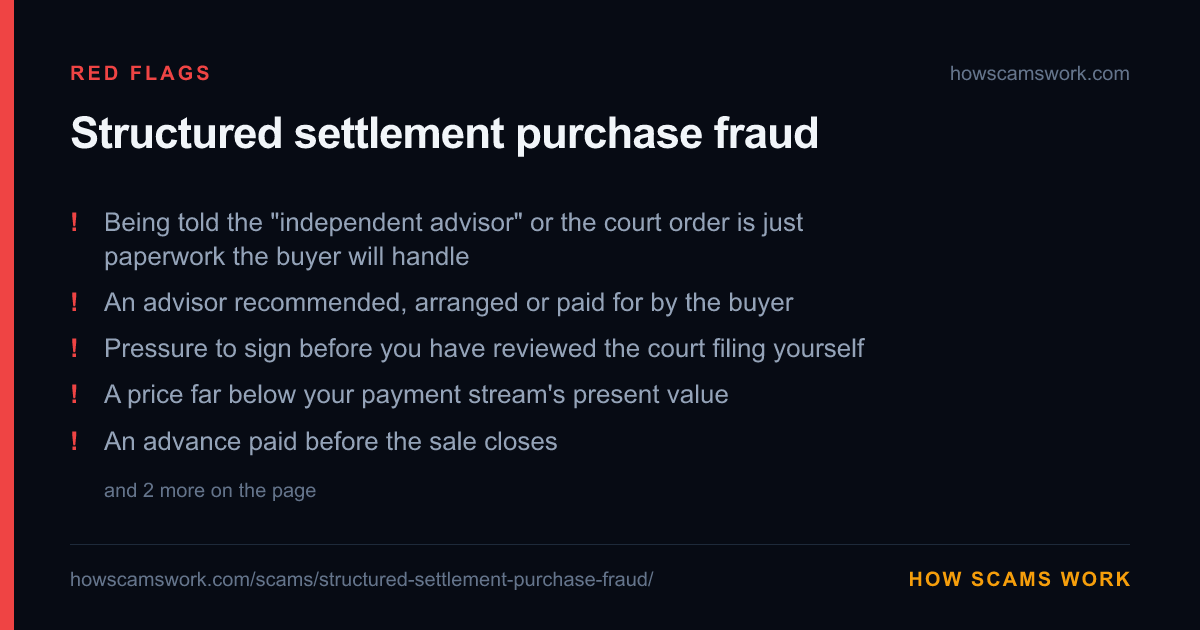
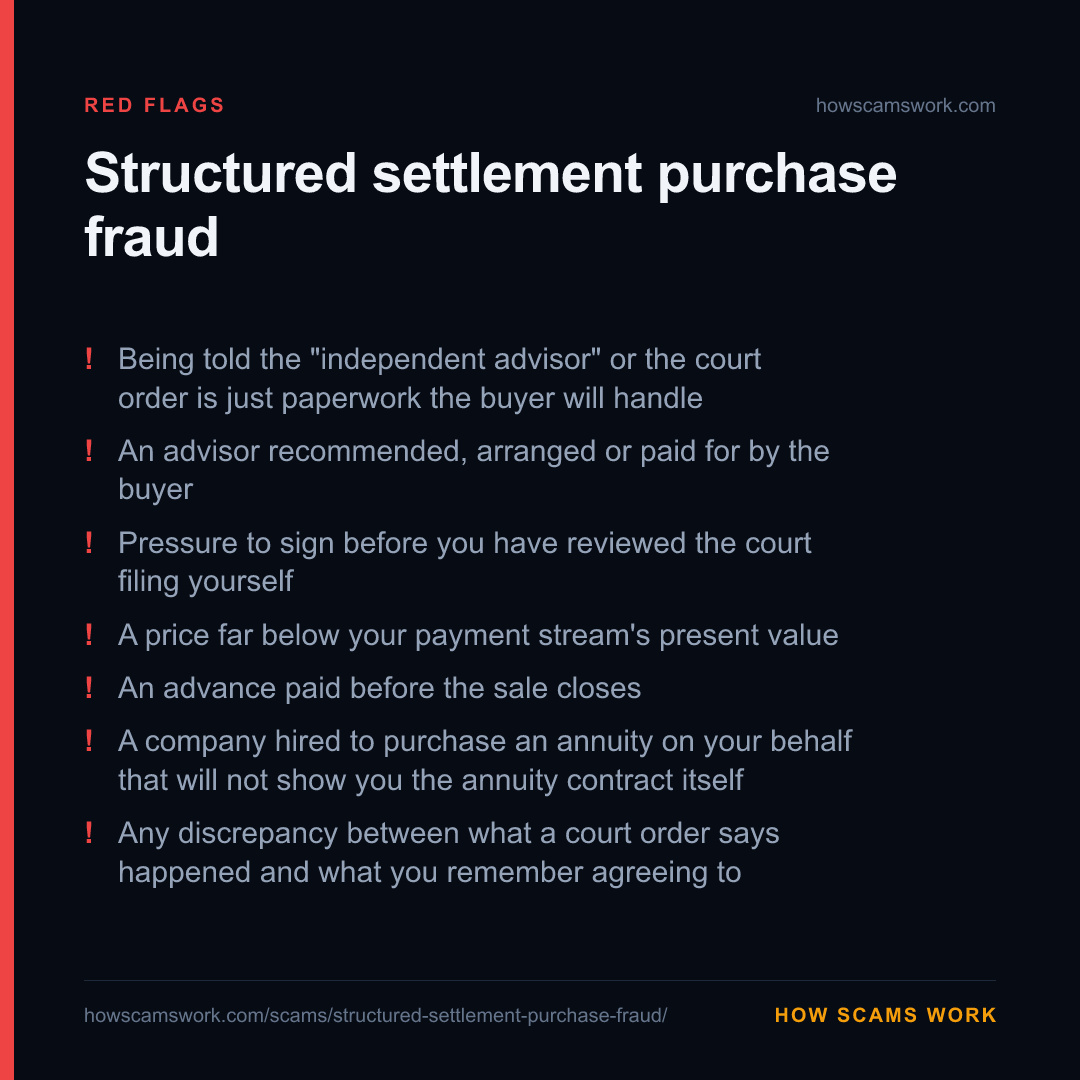
- Being told the “independent advisor” or the court order is just paperwork the buyer will handle. Both exist specifically to work for you, not the company buying your payments.
- An advisor recommended, arranged or paid for by the buyer. A genuine independent professional advisor has no financial relationship with the company on the other side of the deal.
- Pressure to sign before you have reviewed the court filing yourself. You are entitled to see, and should read, the actual petition and order a court is asked to approve.
- A price far below your payment stream’s present value, especially anything approaching single-digit cents on the dollar.
- An advance paid before the sale closes, then a claim that accepting it obligates you to complete the transaction even after you reconsider.
- A company hired to purchase an annuity on your behalf that will not show you the annuity contract itself, or produces one you cannot verify with the issuing insurer directly.
- Any discrepancy between what a court order says happened and what you remember agreeing to, including a signature or a hearing date you do not recognize.
If it’s happening to you
Do not sign anything, and do not cash an advance check, until you have reviewed the court filing
yourself with a lawyer who has no relationship with the buyer.
- Get your own lawyer, paid by you, not recommended or arranged by the purchasing company. This is
exactly the independent check the law requires, and it only works if it is genuinely independent.
- Ask to see the actual court petition before any hearing. You have a right to know what is being
asked of the judge in your name.
- Verify an annuity directly with the insurer that is supposed to have issued it, rather than relying
on a contract or statement the purchasing or administering company gave you.
- If you already sold your payment rights at a price that seems far below their value, contact your
state attorney general’s consumer protection division; several of these cases were only caught because
regulators, not the victims, noticed the pattern first.
- Report it to the FTC at ReportFraud.ftc.gov, the CFPB at consumerfinance.gov/complaint, and
your state attorney general. See where to report for other countries.
- If you are a parent or guardian of a child with a court-ordered settlement trust or annuity, ask the
court or the administering company for a current account statement or annuity contract, and verify it
with the insurer, rather than assuming it has been handled.
Where the money goes
Straight from the government, an insurer, or the seller’s own future payments, into the operator’s hands,
with the shortfall landing on exactly the person the structured settlement was meant to protect.
In the purchase version of this scheme, the money a defendant or its insurer already set aside to pay the
seller over time simply changes hands at a steep discount: Access Funding’s 94 Maryland victims, owed
payment rights worth over $21 million, received under $7 million combined. Averaging that shortfall
across the group works out to roughly $150,000 per person, the low end of this page’s typical loss
estimate, a rough figure since the $21 million and $7 million totals are themselves “over” and “under”
figures from the prosecutor’s own filing, not a precise accounting.
In the administration version, the money never leaves the operator’s control long enough to become an
annuity at all. Joseph Gargan’s company received close to $16 million from the federal government and a
New York hospital, specifically to buy annuities for 13 injured children; he embezzled $7,957,750 of it
for himself. Split across those 13 beneficiaries, that averages roughly $612,000 each, the high end of
this page’s loss estimate, covered for years with fabricated annuity paperwork until the scheme could no
longer be sustained.
Restitution, where a court orders it, arrives only after the fraud is caught, sometimes years after the
settlement money was supposed to reach the person it was meant to protect, and after the operator has
already spent much of it.
By the numbers
No published dataset breaks this scheme out as its own category yet, so there is no chart to show.
The data page explains which agency categories exist and why some schemes are
invisible in official statistics.
Every factual claim above traces to one of these. Statistics are reported losses; see
methodology for what that does and does not measure.