Also called: MCA fraud · predatory business lending · revenue-based financing scam · confession of judgment scam · small business loan sharking
Merchant cash advance fraud markets a business funding product as a "purchase" of future sales, a structure that skirts interest-rate caps, while collecting a fixed daily debit regardless of revenue. A signed confession of judgment lets the lender freeze the business's bank account without a hearing. New York's largest case forced $534 million in debt cancellation for over 19,000 small businesses.
What it is
A small business gets turned down for a bank loan, or just needs cash faster than a bank can move. A
broker or the lender itself offers a “merchant cash advance”, not a loan, they’ll stress, but a purchase
of a fixed slice of the business’s future sales, funded in a day or two. In exchange, the business agrees
to a fixed amount debited from its bank account every business day, and often signs a confession of
judgment: a document giving the lender the right to go straight to court and freeze the business’s
account if a payment is missed, without a hearing.
This is not a fringe corner of small-business finance. New York’s attorney general secured a
$1.065 billion judgment against a single network, Yellowstone Capital and its affiliates, that
canceled $534 million owed by more than 19,000 small businesses, at effective interest rates the
state alleges ran as high as 820% a year.
How it actually works
The pitch
A broker or lead generator cold-calls, texts or emails a business that has been turned down by a bank,
offering “same-day funding”, framed from the first sentence as a sale of future sales, not a loan.
The paperwork
The contract is structured as a purchase of a fixed amount of future receivables, which is exactly why it
escapes state interest-rate caps and federal Truth in Lending disclosures a loan would require.
Where it could have stopped
A merchant cash advance is legally a purchase, not a loan, which is the entire reason it isn’t covered by usury limits or truth-in-lending rules. The FTC’s case against Richmond Capital Group / RCG Advances alleged the company advertised “no personal guaranty of collateral” while its actual contracts required one anyway, the “purchase” framing doing the same disguising work one level up.
The confession of judgment
The business owner, often without an independent lawyer reviewing the contract, signs a confession of
judgment, pre-authorizing any future lawsuit over the debt without a hearing.
The daily debit
A fixed dollar amount is withdrawn from the business’s bank account every business day, regardless of how
much, or how little, the business actually sold that day. New York’s attorney general documented one
Manhattan bakery paying over $2,000 a day before it closed after nearly 30 years in business.
No reconciliation
Reputable providers promise a periodic “true-up” that lowers the daily debit when sales fall. The FTC’s
own staff perspective on small business financing warns that some providers simply don’t perform it, so
the fixed payment continues straight through a slow month.
Default, and an instant judgment
A missed payment can trigger the confession of judgment being filed, often, prosecutors allege, in a
court far from where the business operates, freezing the account before the owner has a chance to
contest anything.
A rigged appeal
New York’s attorney general alleges one online arbitration platform was secretly built with MCA
companies’ input to favor them: about 97% of roughly 3,000 arbitrations proceeded without the small
business appearing, and the platform ruled for the lender almost every time.
Collection escalates
The FTC’s case against Robert Giardina and RCG Advances alleged collectors threatened physical violence,
including, per the complaint, a threat to “break his jaw”, and made false reports to third parties to
pressure payment.
Why it works
The need is real and the timing is brutal. A business that can’t make payroll this week cannot wait
six weeks for a bank’s underwriting process, an MCA can fund in a day or two, which is precisely the
gap conventional lending doesn’t fill.
The “purchase, not a loan” framing is a genuine legal distinction, not just marketing. Because an MCA
buys future receivables rather than lending money, it sits outside the interest-rate caps and disclosure
rules that would otherwise force a lender to state the true annual cost, a structure regulators are now
arguing, in specific documented cases, was used to disguise what was functionally a loan.
A factor rate reads as cheaper than it is. “1.4 times the amount advanced” sounds like a fee, not an
interest rate, and providers are not required to translate it into the triple-digit APR the FTC’s own
staff perspective says it can amount to.
The confession of judgment removes the business’s only leverage in a dispute. Once signed, a missed
payment doesn’t lead to a negotiation; it can lead directly to a frozen account, before the business gets
a chance to explain a slow month, a late-paying customer, or a billing error.
And the enforcement mechanism can be rigged at every later stage, too. Even a dispute process meant to
be neutral can, prosecutors now allege in one case, be built by the industry it’s supposed to referee.
Where it comes from
Entirely domestic, running through New York’s courts more than any other single jurisdiction, because
that’s where MCA contracts are drafted to send the confession of judgment.
These are US finance companies operating openly, with names and offices, not an offshore operation.
Richmond Capital Group, doing business as RCG Advances, and Yellowstone Capital and its roughly two dozen
subsidiaries and aliases, are the two most heavily-litigated MCA networks to date, both New York-based,
both the subject of multiple separate federal and state actions.
Scale runs from a handful of brokers to a network canceling debt for tens of thousands of businesses.
Yellowstone’s settlement alone covered more than 19,000 small businesses nationwide; the FTC’s case
against RCG Advances and its principals produced over $2 million in initial redress before a further
$20.3 million judgment against one defendant who took the case to trial.
Enforcement is entirely civil in the documented cases here, mixing federal and state authority. The
FTC has pursued MCA operators under its general consumer-protection authority and the Telemarketing Sales
Rule; New York’s attorney general has used the state’s own lending and consumer-fraud statutes to secure
far larger judgments, including the industry’s largest to date.
And the fight has moved from the loan contract itself to how disputes over it get resolved. The most
recent documented case on this page targets not a lender but an arbitration platform, evidence that even
after regulators close off one enforcement mechanism, the industry’s next move is to build a new one.
Real cases
2026 US Ongoing
New York Attorney General Letitia James sued Rapid Ruling, an online arbitration platform, and its founders Zachary Meyer and Andrew Sachs, in June 2026, alleging the platform was marketed as a neutral, independent forum for resolving merchant cash advance disputes while secretly coordinated with MCA companies that helped draft its rules. The complaint alleges that in roughly 3,000 arbitrations run through the platform since its 2019 founding, 97% proceeded without the small business defendant appearing, and the platform ruled for the lender in nearly all of those cases. The lawsuit is ongoing and unresolved.
Read the case file ·
1 source
2025 US Settled $534.6m
New York Attorney General Letitia James sued Yellowstone Capital LLC and 25 affiliated companies in March 2024, alleging the network, operating since 2009 under dozens of aliases including Fundry, Green Capital Funding and High Speed Capital, disguised illegal loans as merchant cash advances, charging effective interest rates up to 820% a year, debiting fixed daily amounts regardless of revenue, and filing fraudulent confessions of judgment in New York courts. The case settled with a $1.065 billion judgment approved by the court in January 2025, canceling $534,552,724 owed by more than 1,100 New York businesses and over 18,000 nationwide.
Read the case file ·
3 sources
2024 US Sanctioned $20.3m
The FTC sued Richmond Capital Group (later RCG Advances, LLC) and its principals, including Robert Giardina and Jonathan Braun, alleging they misrepresented the terms of merchant cash advances, made unauthorized withdrawals from small businesses' bank accounts, used confessions of judgment to seize assets without consumers' knowledge, and threatened physical violence during collections. Giardina and other defendants settled in June 2022 for over $2.7 million in relief and a permanent industry ban. Braun litigated to trial; a federal court entered a $20.3 million judgment against him in February 2024 after the FTC's first-ever jury trial, along with a permanent ban from the merchant cash advance and debt collection industries.
Read the case file ·
3 sources
Red flags
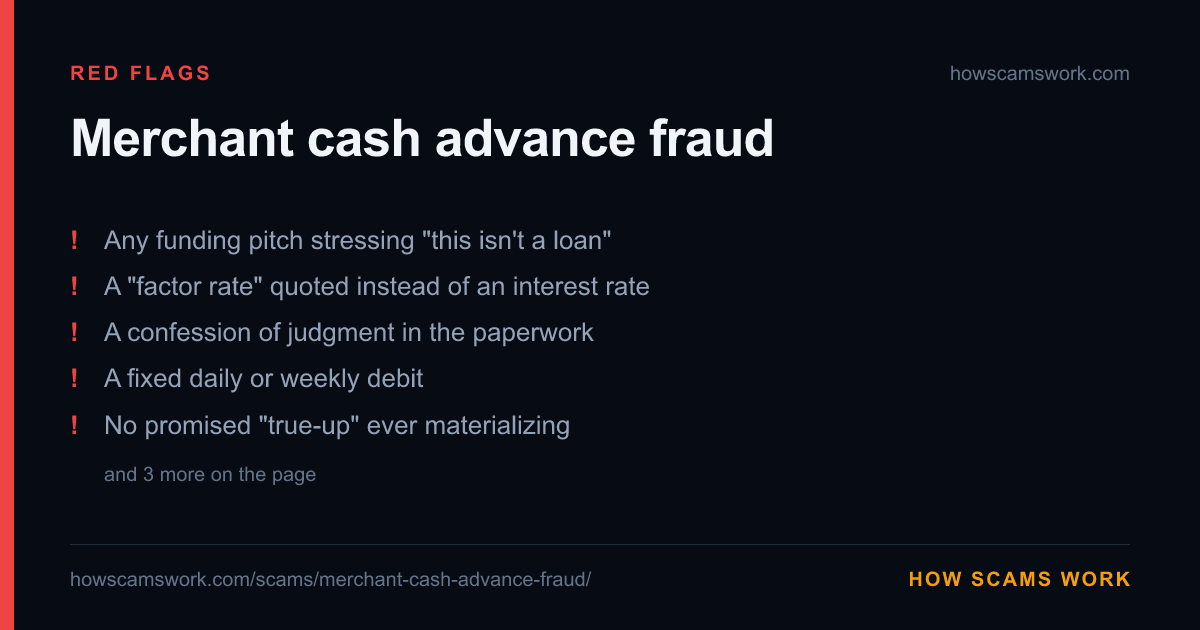
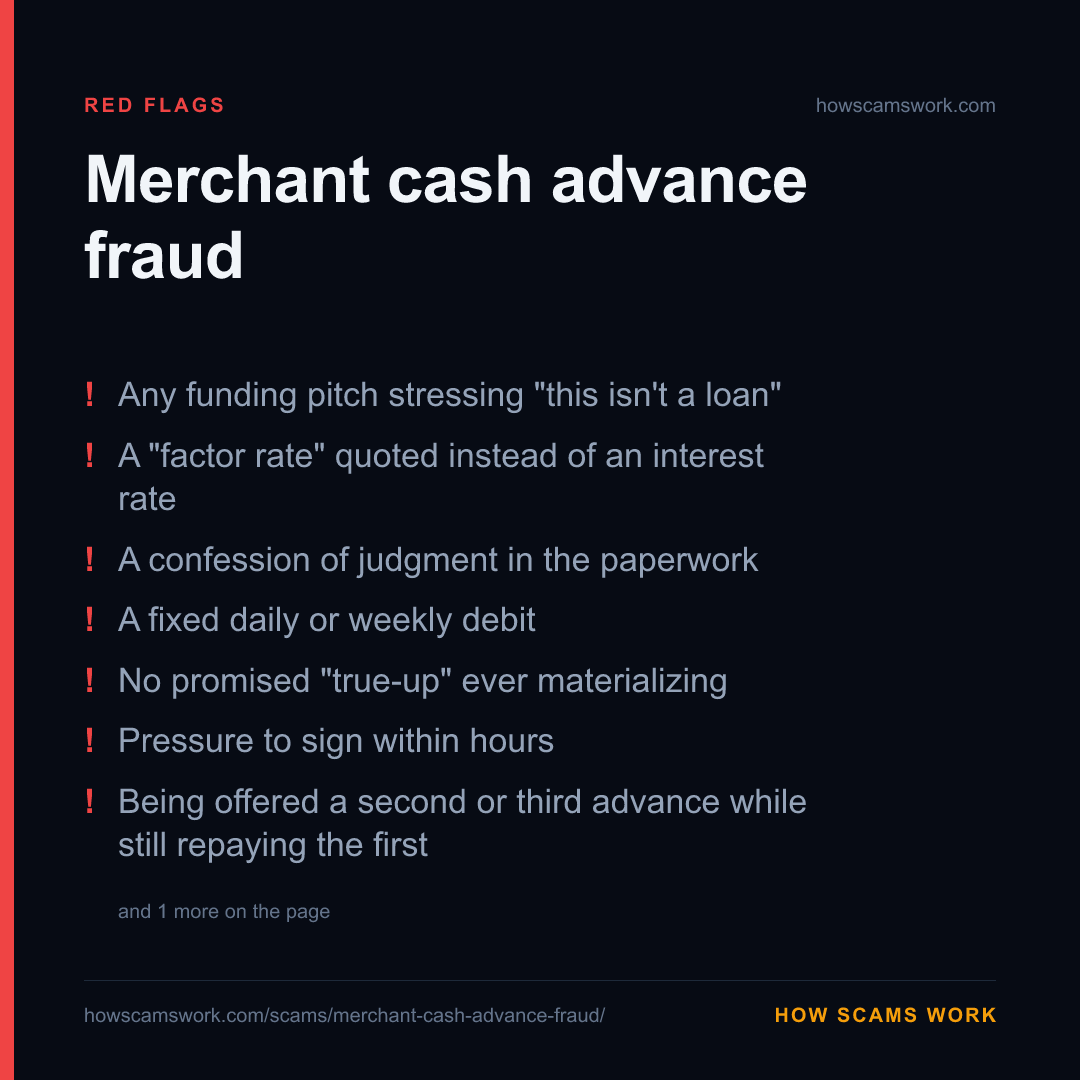
- Any funding pitch stressing “this isn’t a loan” as its first selling point, rather than explaining what it actually is.
- A “factor rate” quoted instead of an interest rate, with no one willing to convert it to an annual percentage.
- A confession of judgment in the paperwork, a clause letting the lender obtain a court judgment against you without a hearing.
- A fixed daily or weekly debit that doesn’t adjust with your actual sales, despite being marketed as revenue-based financing.
- No promised “true-up” ever materializing during a slow month, despite it being part of the pitch.
- Pressure to sign within hours (“funded by tomorrow”) on a contract you haven’t had a lawyer review.
- Being offered a second or third advance while still repaying the first, “stacking,” which multiplies the daily debit against the same revenue.
- An arbitration clause routing disputes to a platform you’ve never heard of, rather than your local court.
If it’s happening to you
- Do not sign a new advance to cover payments on an existing one. Stacking is how a single cash-flow
problem becomes several simultaneous daily debits.
- Get the complete contract and a plain accounting of what you’ve paid to date, including whether you
signed a confession of judgment and, if so, which court it names.
- Talk to a small-business or consumer attorney before a payment is missed, not after, many legal
aid organizations and small-business legal clinics handle exactly these cases, and options narrow
sharply once a confession of judgment is filed.
- If a judgment has already been entered against you, ask a lawyer immediately whether it can be
vacated, courts have set aside confessions of judgment in cases where the underlying MCA was found to
be a disguised loan.
- Report it to the FTC at ReportFraud.ftc.gov and, if you’re in New York, to the Attorney
General’s office, which has brought the largest actions in this area to date. See
where to report for other jurisdictions.
- Read any arbitration clause closely before a dispute arises, and ask who selects the arbitrator and
under what rules, a genuinely neutral process should be able to answer both questions plainly.
Where the money goes
Real money changes hands up front, the business does receive the advance, which is part of why this
scheme is harder to spot than one built purely on a stolen payment. The harm is in what comes back out,
and how it’s enforced.
The lender funds the advance directly to the business’s bank account, typically within one to two
business days. Repayment then flows the other way, in fixed daily or weekly debits from that same
account, continuing regardless of the business’s actual revenue, in New York’s largest documented case,
regulators found the total collected, converted to an annual rate, could reach 820% of the amount
advanced. Averaged across the more than 19,000 businesses covered by that one settlement, the debt
canceled came to roughly $28,000 per business, a broad average across advances of very different sizes,
not a single “typical” loss. When a business falls behind, the confession of judgment routes the dispute
straight into a court record rather than a negotiation, and, in the most recently filed case on this page,
potentially into an arbitration process regulators allege the industry itself helped design. There is no
offshore movement or laundering chain in any of the cases documented here: the advance, the debit and the
judgment all stay inside the same US banking and court system the business was already operating in.
By the numbers
No published dataset breaks this scheme out as its own category yet, so there is no chart to show.
The data page explains which agency categories exist and why some schemes are
invisible in official statistics.
Every factual claim above traces to one of these. Statistics are reported losses; see
methodology for what that does and does not measure.