Also called: counterfeit goods fraud · fake brand website scam · knockoff scam · trafficking in counterfeit goods · fake storefront scam
A counterfeit goods scam sells a fake version of a real brand through a convincing website or social media ad, using genuine product photos and a price just low enough to look like a deal. The item usually does arrive, just not the one paid for. US Customs and Border Protection seized nearly 33 million counterfeit items in fiscal year 2024 alone, worth over $5.4 billion had they been genuine.
What it is
A website or a social media post shows a real brand, at a real-looking discount, with photos lifted
straight from the manufacturer’s own catalogue. The checkout looks ordinary. The order confirmation
arrives. Then a package does too, eventually, and it is not what was advertised: a handbag, a pair of
sunglasses, a hair straightener or a phone case that resembles the real thing closely enough to fool
a glance, built from a license the seller never had.
This is not a non-delivery scam. The buyer is not left waiting for a product that never comes. Something
arrives, every time, which is exactly why the deception works for longer: there is a physical object in
hand, and a receipt, and for some categories that is where the problem starts rather than ends.
US Customs and Border Protection seized nearly 33 million counterfeit items in fiscal year 2024 alone,
items that would have carried a combined retail price over $5.4 billion had they been genuine.
How it actually works
The ad or listing
A social media ad, a sponsored search result or a standalone website displays a real brand’s own
product photography, often lifted directly from the manufacturer’s catalogue or a legitimate retailer’s
listing.
A price just low enough
The price sits meaningfully below the authorised retail price, low enough to look like a deal, rarely
so low that it reads as obviously fake. In one documented case, a Louis Vuitton handbag with a $1,690
suggested retail price sold for $110.
The order
Payment is taken through an ordinary-looking checkout, often by credit card, on a site that uses https
and gives no visual sign anything is wrong.
The source
The seller buys the goods cheaply and in bulk from an overseas manufacturer or distributor, then resells
them at a price still well under the genuine item’s retail cost, keeping the difference as profit.
Small packages, built to avoid scrutiny
Shipments move in small, low-value parcels rather than one large container.
Where it could have stopped
US Customs and Border Protection says 97% of its intellectual-property seizures in the cargo environment happen in shipments valued under the $800 “de minimis” threshold, the exact category that receives the least per-package scrutiny. The same low-value shipment rule built to speed ordinary small purchases through customs is the gap this scheme is built to fit inside.
What arrives
The item resembles the real product closely enough to pass a quick look, with the differences showing up
in stitching, labelling, materials or, in some categories, in ingredients or construction that make it a
genuine safety hazard rather than merely a lesser copy.
Enforcement, years later
Investigators build a case from seized shipments, financial records and often an undercover purchase. In
the documented cases on this page, the gap between the first shipment under investigation and a charge or
sentence ran from roughly a year to several years.
Why it works
The product photos are real, because they are stolen from somewhere real. A buyer checking that a
listing’s images match the brand’s own marketing is checking the one thing a counterfeit seller does not
need to fake.
A website that looks professional is mistaken for a website that is authorised. Https, a clean layout
and working buttons are table stakes for any hobbyist storefront tool, not evidence of a relationship with
the brand being sold.
The discount is calibrated, not careless. A price cut large enough to look like a deal but not so
large that it reads as fake sits in a narrow, deliberately chosen band, the sweet spot between “too good
to pass up” and “too good to be true.”
Something genuinely arrives. Unlike a pure non-delivery scam, the buyer holds a physical object, which
short-circuits the instinct to report anything at all unless the item is obviously, immediately wrong.
And the risk is split between buyer and public health. A buyer who gets a merely disappointing knockoff
has little incentive to pursue it; a buyer who gets a counterfeit phone charger, cosmetic or child’s toy
is bearing a safety risk that the seller, not the buyer, created.
Where it comes from
The goods overwhelmingly originate in China and Hong Kong. CBP’s FY2024 data puts the two together at
roughly 90% of everything seized by quantity, and China alone accounted for over $4.1 billion of the
year’s seized MSRP.
The storefronts selling to US buyers, in the documented cases on this page, are US-based operators,
not the overseas manufacturers themselves. Christine Parry ran Bugaboo Boutique from Nebraska on Facebook;
Kara Allen ran Keepin Up With Kara LLC from a Ferndale, Washington warehouse with its own dedicated
website; Stephen Voudouris Sr., Yung Chung and Jaimmy Chun ran Misikko.com, headquartered in Newtown
Square, Pennsylvania. Each bought the goods from overseas and resold them domestically.
Scale varies enormously, from a single Facebook seller to a dedicated e-commerce business. Allen’s
website advertised 467 distinct items at once; Misikko.com operated as a standing retail brand for high-end
hair appliances.
Enforcement runs through Homeland Security Investigations, Customs and Border Protection and the
National Intellectual Property Rights Coordination Center, a 23-agency task force, using the federal
trafficking-in-counterfeit-goods statute enacted in 1984.
Real cases
2025 US Sentenced $1,935
Christine L. Parry, 62, of Columbus, Nebraska, ran an online shop called Bugaboo Boutique on Facebook selling counterfeit Birkenstock, Ray-Ban, Chanel and Louis Vuitton items, among other goods, shipped from China and Taiwan. US Customs and Border Protection agents inspecting shipments at a FedEx facility in Anchorage, Alaska found the counterfeit goods and traced them to Parry. She was sentenced in January 2025 to time served, a $12,000 fine, and $1,935 in restitution to two victims.
Read the case file ·
1 source
2022 US Charged (allegation, not conviction)
A federal grand jury indicted Kara Suneva Allen, 42, of Ferndale, Washington, in 2022, alleging she ran Keepin Up With Kara LLC, a business selling counterfeit designer goods from a Ferndale warehouse and an associated website. Prosecutors said the site advertised 467 items under 16 brands including Louis Vuitton, Gucci and Chanel, and that an undercover agent bought a counterfeit Louis Vuitton handbag for $110 against a $1,690 authentic retail price.
Read the case file ·
1 source
2015 US Charged (allegation, not conviction) $150,346
Federal prosecutors charged Stephen Voudouris Sr. of Newtown Square, Pennsylvania, Yung Chung of West Chester, Pennsylvania, and Jaimmy Chun of Philadelphia with conspiracy, trafficking in counterfeit goods and wire fraud, alleging the three ran Misikko.com, an online retailer that sold counterfeit CHI, T3 and Babyliss-branded hair appliances imported cheaply from China and resold at near-authentic prices, while the site also allegedly claimed falsely that some purchases would benefit a breast cancer charity.
Read the case file ·
1 source
Red flags
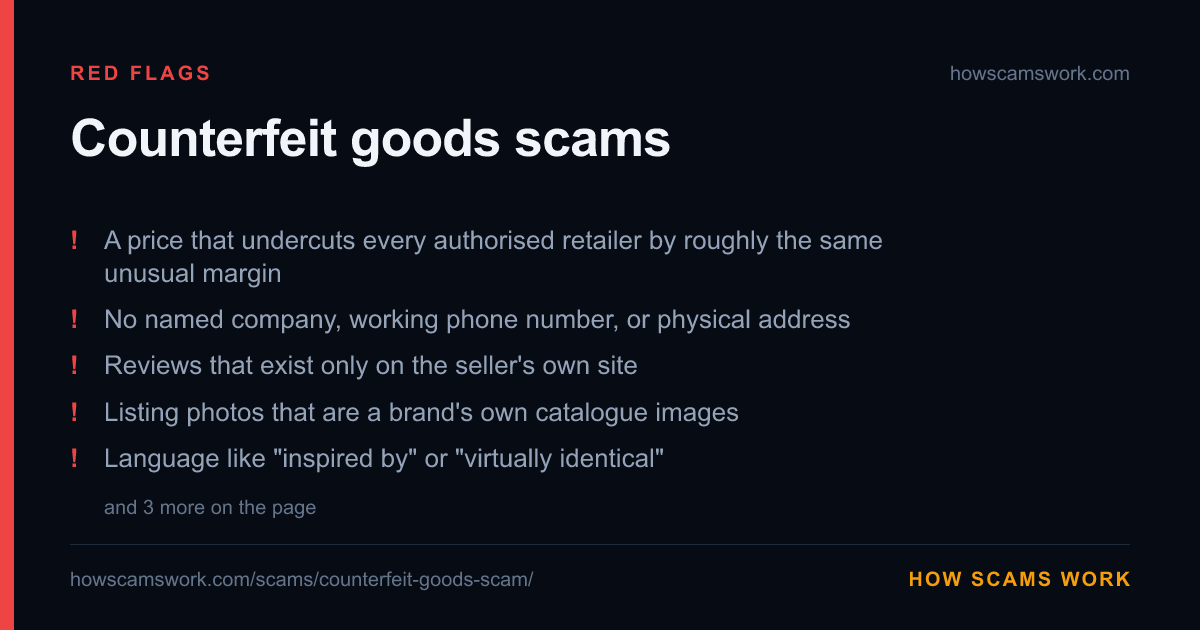
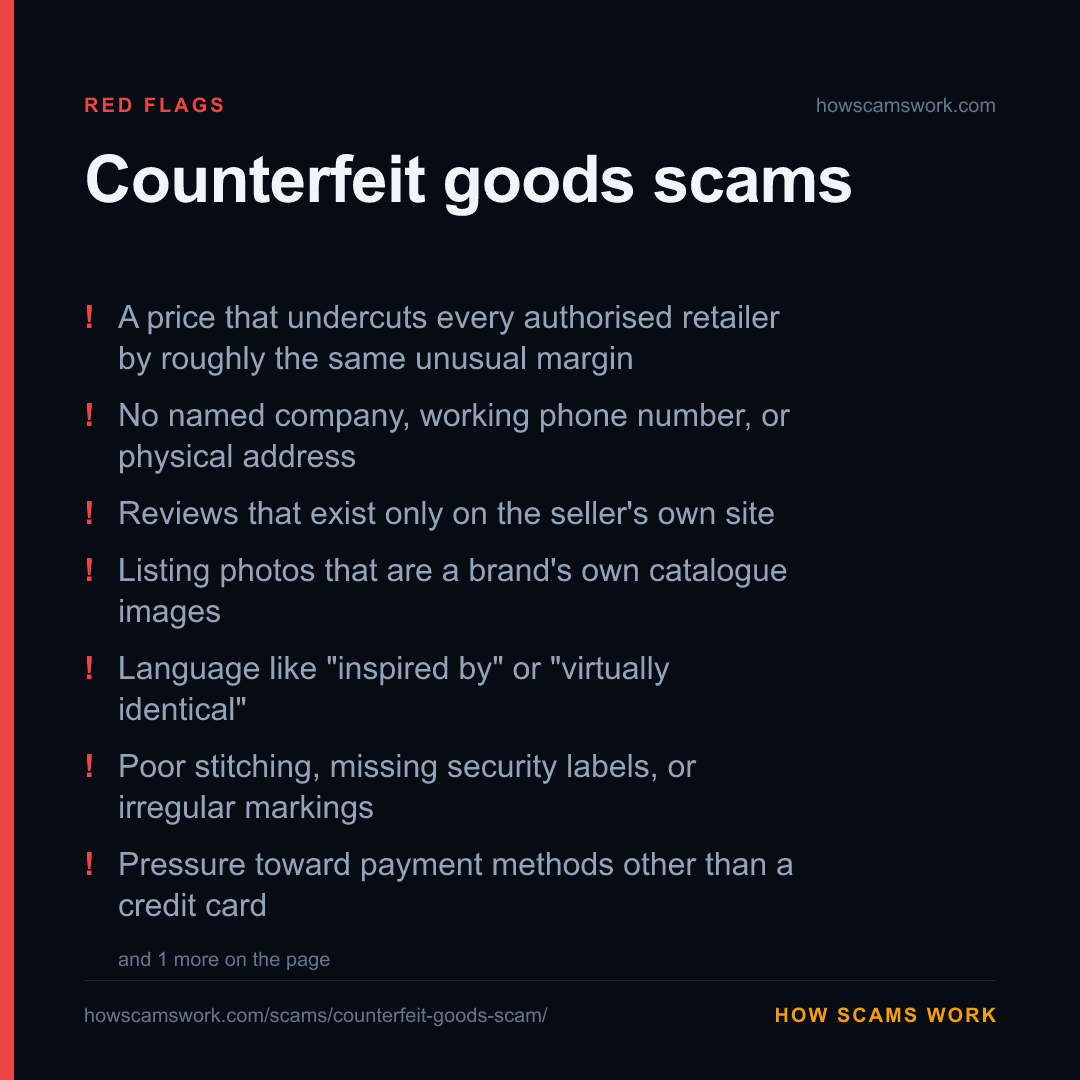
- A price that undercuts every authorised retailer by roughly the same unusual margin, not a one-off clearance discount.
- No named company, working phone number, or physical address behind the storefront.
- Reviews that exist only on the seller’s own site, rather than anywhere independent.
- Listing photos that are a brand’s own catalogue images rather than the seller’s own product photography.
- Language like “inspired by” or “virtually identical” describing a supposedly genuine branded item.
- Poor stitching, missing security labels, or irregular markings once an item arrives.
- Pressure toward payment methods other than a credit card, which removes your strongest route to a refund.
- A product category where a fake carries real risk: electronics, cosmetics, personal care items, safety equipment, and children’s products.
If it’s happening to you
- Dispute the charge with your card issuer if you paid by credit card. A chargeback puts the burden
on the seller to prove the sale was legitimate, and does not require the seller’s cooperation.
- Stop using the item immediately if it is electronic, a cosmetic, a personal-care product, or
anything meant to protect you physically, such as a helmet or car part. Treat it as a safety risk, not
just a disappointing purchase.
- Report it to CBP at eallegations.cbp.gov or 800-BE-ALERT, and to the National Intellectual Property
Rights Coordination Center at iprcenter.gov or 866-347-2423.
- Report the listing or seller to the platform it was sold through, social media site, marketplace or
search engine, so the specific listing can be taken down.
- File a report with the FTC at ReportFraud.ftc.gov. See where to report for
other countries.
- Keep the item, the packaging and your order confirmation. If the brand ever pursues the seller, or
if a product recall follows, you will need to show exactly what you received.
Where the money goes
A buyer’s payment splits in two, almost immediately. Most of it stays with the US-based storefront
operator as profit; a smaller share goes overseas, in bulk, to pay the manufacturer or distributor for
the goods themselves. Both documented domestic operators on this page ran their storefronts as ordinary
US businesses, a Facebook shop, a registered LLC, not as a hidden network, which is part of why they
were eventually traceable through shipping records and financial accounts rather than through any
cross-border money trail.
The interception point, when it happens, is the shipment itself rather than the money. CBP’s seizure
statistics describe goods stopped at the border before a sale is ever completed; the documented
prosecutions on this page instead followed a paper trail of shipping records, from Chinese and Hong Kong
suppliers to a US address, built after repeated shipments drew attention.
Recovery for buyers, when it happens at all, is small. The one case on this page that reached a
concluded sentence produced $1,935 in restitution, split between two buyers, against a $12,000 fine paid
to the government rather than to them.
By the numbers
No published dataset breaks this scheme out as its own category yet, so there is no chart to show.
The data page explains which agency categories exist and why some schemes are
invisible in official statistics.
Every factual claim above traces to one of these. Statistics are reported losses; see
methodology for what that does and does not measure.