Also called: free COVID test scam · COVID-19 Medicare testing fraud · respiratory panel bundling fraud · pandemic lab billing fraud · no-cost COVID test scam
COVID-19 test billing fraud uses a "free" COVID-19 test to collect a Medicare or insurance number, then bills for unrelated, far more expensive tests nobody ordered. One nationwide lab logged more than $500 million in claims before its chief operating officer pleaded guilty; a Maryland lab owner who targeted nursing homes was convicted in October 2026.
What it is
A website, a phone call, a TV ad or a table set up outside a pharmacy offers a COVID-19 test at no
cost. The test itself might be real. What the offer exists to collect is a Medicare number or private
insurance information, the one thing a laboratory needs to bill a claim. From there, the COVID-19 test
becomes the occasion for billing something else entirely: a respiratory pathogen panel, a drug test, or
another far more expensive test that a doctor never ordered and that a lab sometimes never ran at all.
The pandemic gave this fraud two advantages no earlier Medicare billing scheme had. Testing access
points, drive-through sites, mobile labs, specimen collection inside nursing homes, were everywhere and
treated as urgent, and federal payers relaxed their usual claims-review rules to get testing paid for
quickly. The HHS Office of Inspector General has been opening and resolving COVID-19 testing fraud cases
continuously since 2020, and new convictions and guilty pleas were still being announced in October 2026,
six years after the first lockdowns.
How it actually works
The offer
A website, phone call, TV ad or on-site table advertises a free or “no cost” COVID-19 test. Fast Lab
Technologies ran its version online, marketing the test as free to anyone who entered their insurance
information. Provista Health’s version ran inside nursing homes, collecting specimens from residents
during the facilities’ required pandemic testing routine.
The Medicare or insurance number
Getting the free test means handing over Medicare or insurance information, the one thing a lab needs
to bill a claim. Nursing home residents in the Britton-Harr case never saw a form or a bill; their
Medicare numbers were already on file with the facility that was billing them.
Where it could have stopped
The FTC and HHS Inspector General both warn against giving a Medicare number to anyone who calls, texts, advertises online or sets up a table offering a free test. Medicare does not call beneficiaries with testing offers, and nobody legitimate needs your Medicare number to give you one.
A second test riding on the first
The COVID-19 swab becomes the occasion for billing an unrelated, far more expensive test. Provista
Health billed a respiratory pathogen panel every time a COVID-19 specimen was collected from a nursing
home resident, regardless of whether a doctor ordered one or whether the panel was run at all.
An order, or a claim, with no basis
A doctor who never examined the patient signs the order, or no real order exists. Fast Lab’s medical
director is alleged to have ordered the majority of its tests without seeing the patients billed for
them, and prosecutors say the company submitted claims for payment before test kits had even shipped.
Billed before, or after, the service existed
Claims went out ahead of any service being performed, or kept going after the lab that supposedly ran
them had already closed. Provista Health kept billing for respiratory panels from its Arizona
laboratory for months after that facility’s equipment was gone and its employees were barred from
entering.
The payer pays, pandemic rules and all
Medicare, Medicaid, TRICARE and private insurers reimbursed testing claims quickly, under rules
relaxed specifically to speed pandemic-era access to COVID-19 testing. By the time a claim was
flagged, the money had generally already gone out.
Enforcement years later
The scheme periods documented here run from 2020 into 2022. The convictions and sentences came years
afterward: Taylor in 2023, Seyhun and Britton-Harr in 2026, and the HHS Inspector General’s own
enforcement log counted 192 separate COVID-19-related actions as of October 2026.
Why it works
The access point already felt official. Nursing homes were legally required to keep testing
residents, and drive-through sites were government-sanctioned. Handing over an insurance number in that
setting read as routine paperwork, not a risk.
“Free” removes the only check most people perform. Nobody haggles over the price of something that
costs nothing, so there is no total to question before handing over the one piece of information the
scheme actually needed.
The second test rides inside a legitimate one. Nobody is checking whether a COVID-19 swab turned
into a respiratory panel claim, and the person tested, especially a nursing home resident, often never
sees the line items a lab submits on their behalf.
Payers were told to move fast. Pandemic-era reimbursement rules prioritised speed over verification,
the same pay-and-chase dynamic documented across Medicare fraud generally, which gave operators months
to bill before a claim was flagged.
Some of the billed people could not have objected even if they had seen the bill. Prosecutors in the
Britton-Harr case said some of the respiratory panel claims were submitted for nursing home residents who
had already died.
Where it comes from
Entirely domestic: this fraud exploits Medicare, Medicaid, TRICARE and US private insurance, so every
documented case here is a US case.
Scale runs from a single small operator to a nationwide platform. Billy Joe Taylor ran two
Arkansas-based companies, Vitas Laboratories and Beach Tox. Fast Lab Technologies, by contrast, logged
more than $500 million in claims nationwide through one online operation.
Enforcement has run continuously since 2020, not in a single takedown. By October 2026, the HHS
Inspector General’s own enforcement log listed 192 separate COVID-19-related criminal and civil actions,
a number still growing six years after the first lockdowns, including new convictions and pleas announced
that same month.
Not every defendant in a documented scheme has reached the same point in court. Fast Lab’s chief
operating officer, Hasan Seyhun, pleaded guilty in September 2026. Its CEO and medical director, Cemhan
Biricik and Dr. Martin Perlin, were charged in July 2025 and, as of this page’s last review, had not been
reported convicted, sentenced or acquitted; the allegations against them are allegations, and both are
presumed innocent unless and until a court finds otherwise.
Real cases
2026 US Convicted $35.0m
Fast Lab Technologies, LLC marketed "no cost" COVID-19 tests online, collecting customers' insurance information and using it to bill government and private health insurers, including Medicare, Medicaid and TRICARE, for antigen tests, saliva sample collection and CR testing that were never performed as represented, in some instances before test kits had even shipped to the customer. Prosecutors say the scheme logged more than $500 million in claims nationwide and resulted in at least $35 million in illicit payments. Hasan "Lucas" Seyhun of Miami, Florida, the company's chief operating officer, pleaded guilty on September 23, 2026 to conspiracy to commit health care fraud and agreed to forfeit $4,313,153, the amount he personally received. Fast Lab's CEO, Cemhan "Jimmy" Biricik, and its medical director, Dr. Martin Perlin, were charged in July 2025 and had not been reported convicted, sentenced or acquitted as of this page's last review; the allegations against them are allegations only, and both are presumed innocent unless and until a court finds otherwise.
Read the case file ·
2 sources
2026 US Convicted $7.2m
Patrick Britton-Harr, 42, of Annapolis, Maryland, owned Provista Health, which offered COVID-19 testing to nursing homes nationwide beginning in 2020. Alongside each COVID-19 specimen collected from a resident, the company billed Medicare for a respiratory pathogen panel test that prosecutors say physicians did not order and that in many cases was never performed, supposedly run at Britton-Harr's Arizona laboratory, including for some residents who had already died. Billing continued even after the Arizona lab closed and its equipment was removed. Provista Health billed Medicare about $18.7 million for the respiratory panel tests over roughly six months, and Medicare paid out more than $7.2 million. A federal jury in the District of Maryland convicted Britton-Harr on October 19, 2026 of five counts of health care fraud and one count of transactional money laundering. No sentencing date had been set as of this page's last review.
Read the case file ·
3 sources
2023 US Sentenced $38.0m
Billy Joe Taylor of Lavaca, Arkansas controlled two diagnostic laboratory companies, Vitas Laboratories and Beach Tox, which submitted more than $134 million in false claims to Medicare for urine drug tests and respiratory illness tests, including COVID-19 testing, during the pandemic. Taylor and his co-conspirators obtained Medicare beneficiaries' medical and personal information and used it to submit claims for tests that were medically unnecessary, not ordered by medical providers, and not actually provided as represented. Medicare paid more than $38 million on the claims. Taylor pleaded guilty on October 27, 2022 to conspiracy to commit health care fraud and money laundering, and was sentenced on June 8, 2023 to 15 years in prison, three years of supervised release, and $29,835,825.99 in restitution.
Read the case file ·
2 sources
Red flags
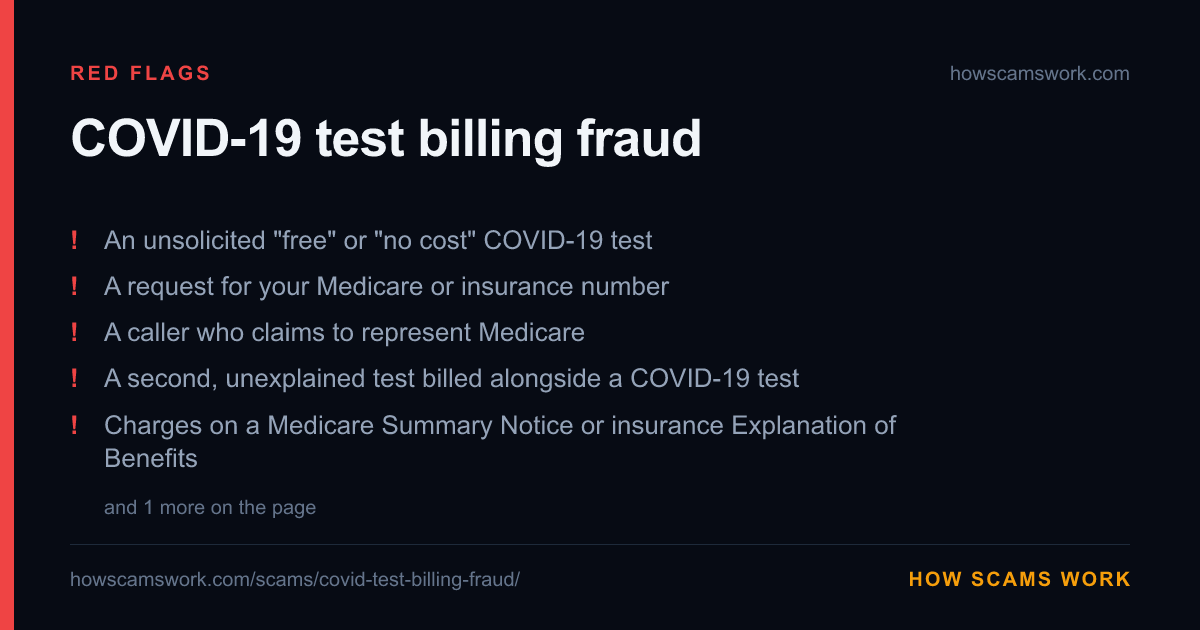
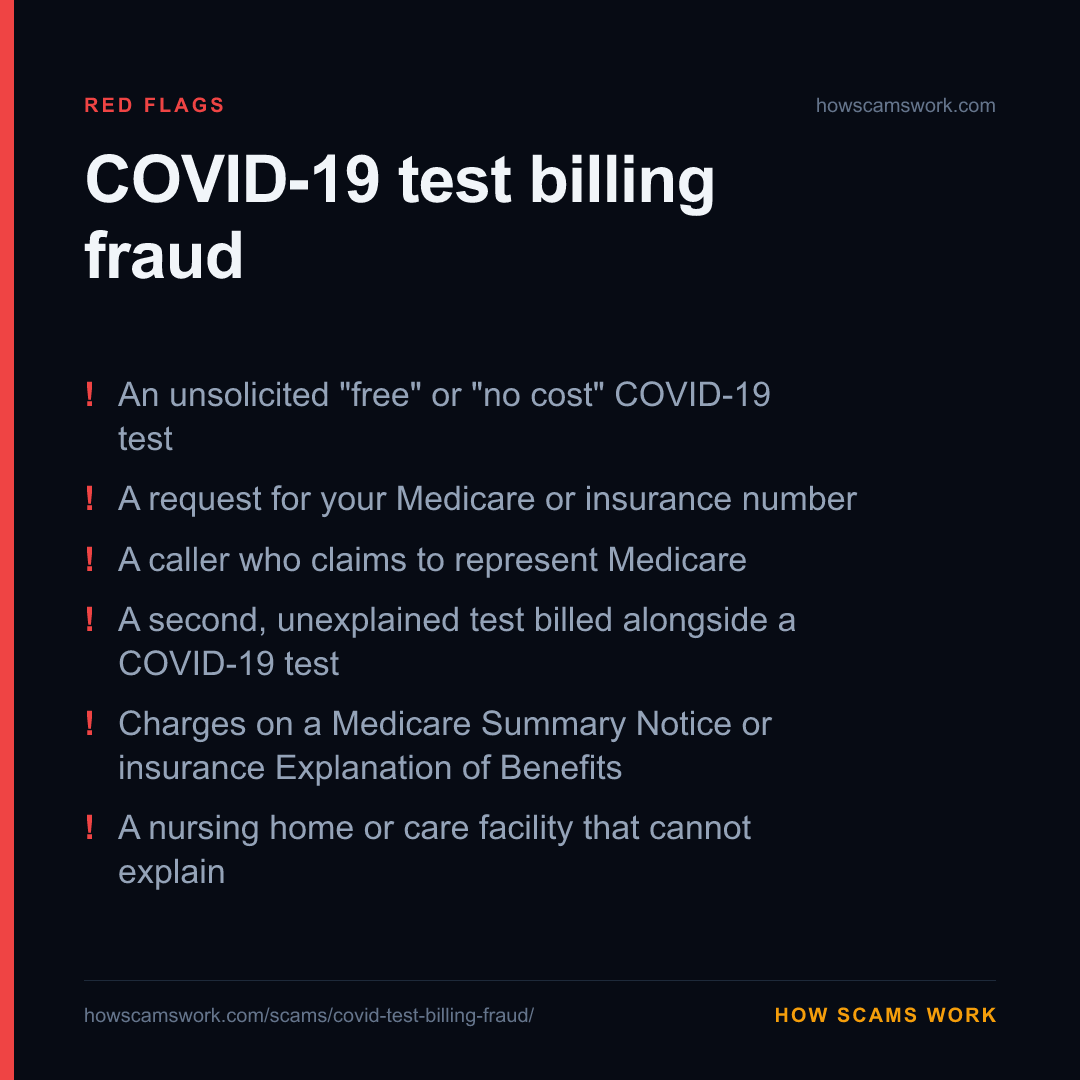
- An unsolicited “free” or “no cost” COVID-19 test advertised by phone, text, website or TV ad.
- A request for your Medicare or insurance number to receive a free test, rather than to receive care you asked for.
- A caller who claims to represent Medicare. Medicare does not call beneficiaries with testing offers.
- A second, unexplained test billed alongside a COVID-19 test, such as a respiratory panel nobody mentioned.
- Charges on a Medicare Summary Notice or insurance Explanation of Benefits for a lab or test you do not recognise.
- A nursing home or care facility that cannot explain exactly which tests were billed for a resident, or who ordered them.
If it’s happening to you
- Check your Medicare Summary Notice or insurance Explanation of Benefits for any lab or test you
do not recognise.
- Do not give your Medicare number to anyone who contacts you unexpectedly, whether by phone, text,
website or an in-person table, offering a free test.
- If a family member is in a nursing home or care facility, ask the facility directly which tests
were billed for them and whether a doctor ordered each one.
- Report suspected Medicare billing fraud to the HHS Inspector General hotline at 1-800-447-8477
(TTY 1-800-377-4950) or tips.hhs.gov.
- Report it to the FTC at ReportFraud.ftc.gov. See where to report for
agencies in other countries.
Where the money goes
Entirely domestic, from the payer straight into the testing company’s accounts, then out to its owners
and executives personally.
Medicare, Medicaid, TRICARE and private insurers pay the lab or testing company that submitted the
claim. From there, the documented cases show the money going directly to the people who ran the
operation rather than through any separate laundering chain. Seyhun agreed to forfeit $4,313,153, the
amount prosecutors say he personally received from the Fast Lab scheme. Britton-Harr spent Provista
Health’s proceeds on a $112,500 Porsche 911 and an Annapolis waterfront mansion with $25,000 monthly
mortgage payments. Taylor was ordered to pay $29,835,825.99 in restitution after receiving more than $38
million from Medicare through Vitas Laboratories and Beach Tox.
By the numbers
No published dataset breaks this scheme out as its own category yet, so there is no chart to show.
The data page explains which agency categories exist and why some schemes are
invisible in official statistics.
Every factual claim above traces to one of these. Statistics are reported losses; see
methodology for what that does and does not measure.
Common questions
Is it illegal for a lab to offer a free COVID-19 test?
No. Free testing was a deliberate, legitimate part of the pandemic response, and Medicare itself covered COVID-19 tests. The fraud is in what happens after someone accepts the offer: a Medicare or insurance number gets used to bill for a second, unrelated test, a respiratory pathogen panel in one documented case, that nobody ordered and that is far more expensive than the COVID-19 test itself.
How is this different from the genetic-testing-fraud page on this site?
The bait and the billing pattern are similar, a free sample in exchange for an insurance number, then a bill for an unrelated test, but the access point is different. Genetic testing fraud works through health fairs, telemarketers and mailed kits aimed at individual Medicare beneficiaries. The cases documented here used COVID-19 testing itself, including testing nursing homes were legally required to keep doing, as the entry point.
If a nursing home resident never saw a bill, were they really a victim?
The direct financial victim in every case on this page is the payer, Medicare, Medicaid, TRICARE or a private insurer, not the person tested. Prosecutors in the Britton-Harr case said some of the billed respiratory panel claims were submitted for residents who had already died, which is why this page describes the institutional payer, not the individual patient, as who the money was actually taken from.
Were the free test kits advertised online ever delivered?
Not always, and not necessarily before the claim was filed. In the Fast Lab Technologies case, prosecutors said the company submitted claims for payment before test kits had even been shipped to the people who ordered them.
What happened to the people charged but not yet convicted in these cases?
This page states plainly where a case has not reached a final outcome. Fast Lab's CEO and medical director were charged in July 2025 and, as of this page's last review, had not been reported convicted, sentenced or acquitted. A charge is an allegation, and both are presumed innocent unless and until a court finds otherwise.