Skin substitute and wound graft fraud

Also called: amniotic graft fraud · wound care fraud · skin substitute Medicare fraud · allograft billing fraud · wound graft kickback scheme

Skin substitute fraud bills Medicare for expensive wound grafts that were not medically necessary, often applied to elderly and hospice patients. Sales representatives with no medical training find patients, a distributor pays kickbacks for orders, and clinicians apply every graft. An Arizona couple submitted $1.2 billion in claims in about 19 months; Medicare and other insurers paid $615 million.

Key facts

Category
Business & payments
First documented
2022
Typical loss
$29000k–$614990k USD, per victim
Main channels
sales representatives contracted to find patients with wounds, hospice facilities and nursing settings, a graft distributor paying kickbacks for orders, mobile clinics and nurse practitioners who apply the grafts, invoices that did not reflect the kickback
Who is targeted
Elderly Medicare patients with wounds, including patients in hospice, who have grafts applied that they do not need; Patients whose wounds are infected, already healed, or unresponsive to treatment, who in the Arizona case were given grafts anyway; The Medicare program, TRICARE, CHAMPVA and private insurers, which pay the claims
Documented origins
United States
Main targets
United States
Case files
3 documented cases
Last reviewed
2026-10-19
Anatomy of a wound graft billing schemeAnatomy of a wound graft billing scheme. The product costs thousands per square inch. The order, not the wound, drives the bill. 1. The product: Skin substitutes cost thousands of dollars per square inch, according to the New York Times, and Medicare pays for them when they are medically necessary. 2. The sales representative: Representatives with no medical training find elderly patients with wounds, including hospice patients. In the Arizona case they were told to target hospice facilities. 3. The oversized order: Representatives are told to order grafts of 4x6 centimeters or larger even for much smaller wounds, and are paid more for doing so. 4. The application: Nurse practitioners are directed to apply every ordered graft. In the Arizona case that meant grafts on infected, healed and unresponsive wounds. 5. The copayment that is never collected: The Utah indictment alleges copayments, at times thousands of dollars, were routinely not pursued from patients. That is an allegation. 6. The bill and the kickback: The clinic bills Medicare, TRICARE, CHAMPVA and private insurers, and in Arizona the distributor paid over $279 million in kickbacks. In Nevada, charges allege invoices did not reflect a 40% kickback. 7. The money and the crackdown: Nearly $100 million was seized in Arizona and the couple were sentenced in October 2025. Medicare paid nearly $15 billion for skin substitutes in 2025, then cut rates. Utah and Nevada charges followed in 2026. The diagram marks stage 2 as the point where the scheme can still be stopped: Medicare billing is permissible only if the graft is medically necessary and basic wound care has been given for the previous 30 days, according to the Utah indictment. Ask the clinic what the product is, why it is needed and who ordered it.Anatomy of a wound graft billing schemeThe product costs thousands per square inch. The order, not the wound, drives the bill.1The productSkin substitutes costthousands of dollars persquare inch, according tothe New York Times, andMedicare pays for them whenthey are medicallynecessary.Ongoing2The salesrepresentativeRepresentatives with nomedical training findelderly patients withwounds, including hospicepatients. In the Arizonacase they were told totarget hospice facilities.Days3The oversized orderRepresentatives are told toorder grafts of 4x6centimeters or larger evenfor much smaller wounds,and are paid more for doingso.Per visit4The applicationNurse practitioners aredirected to apply everyordered graft. In theArizona case that meantgrafts on infected, healedand unresponsive wounds.Per visit5The copayment that isnever collectedThe Utah indictment allegescopayments, at timesthousands of dollars, wereroutinely not pursued frompatients. That is anallegation.Ongoing6The bill and thekickbackThe clinic bills Medicare,TRICARE, CHAMPVA andprivate insurers, and inArizona the distributorpaid over $279 million inkickbacks. In Nevada,charges allege invoices didnot reflect a 40% kickback.Monthly7The money and thecrackdownNearly $100 million wasseized in Arizona and thecouple were sentenced inOctober 2025. Medicare paidnearly $15 billion for skinsubstitutes in 2025, thencut rates. Utah and Nevadacharges followed in 2026.YearsWhere it can still be stopped: stage 2Medicare billing is permissible only if the graft is medically necessary and basic wound care has been given for the previous 30 days, according to the Utahindictment. Ask the clinic what the product is, why it is needed and who ordered it.Stages drawn from the Justice Department's account of the Arizona case (sentenced October 2025), the May 2026 Utah indictment and the August 2026 Nevada charges, which are allegations.howscamswork.com
The stages of the scheme, in order, with the point where it can still be stopped.

What it is

Skin substitutes are expensive wound coverings that Medicare pays for under conditions. The fraud described in these cases bills Medicare and other insurers for them when they were not medically necessary, and in the Arizona case, with an elaborate sales structure around them: representatives who found patients, a distributor that paid for orders, and clinicians who applied the grafts. The Justice Department described the Arizona patients as elderly and terminally ill, including hospice patients.

How it actually works

  1. The product

    Skin substitutes, which the New York Times describes as bandages manufactured from dehydrated placentas, cost thousands of dollars per square inch. Medicare pays for them when they are medically necessary.

  2. The sales representative

    Gehrke’s companies hired sales representatives with no medical training to find elderly patients with wounds, including hospice patients. According to the indictment as Courthouse News reported it, she told representatives to target hospice facilities because that was where the most money was.

    Where it could have stopped

    The Utah indictment says Medicare billing of a skin substitute is permissible only if it is medically necessary and basic wound care has been administered to the wound for the previous 30 days. A patient or relative can ask the clinic what the product is, why it is needed and who ordered it.

  3. The oversized order

    Representatives were told to order grafts of 4x6 centimeters or larger even for much smaller wounds, and were financially incentivized to do so, which the Justice Department says maximized reimbursement.

  4. The application

    Nurse practitioners were directed to apply every ordered graft and set aside their own medical judgment. The release says grafts were applied to infected wounds, wounds that had already healed and wounds that did not respond to treatment.

  5. The copayment that is never collected

    The Utah indictment alleges the defendants routinely did not pursue Medicare copayments from beneficiaries, which at times would have been thousands of dollars owed by a beneficiary. That is an allegation.

  6. The bill and the kickback

    The treating company bills Medicare, TRICARE, CHAMPVA and private insurers. In the Arizona case the distributor paid Gehrke’s companies more than $279 million in kickbacks. In the Nevada charges, the Justice Department alleges that the invoices sent to Medicare did not reflect a 40% kickback.

  7. The money and the crackdown

    In the Arizona case, nearly $100 million in assets were seized and the defendants were sentenced in October 2025. According to the New York Times, Medicare paid nearly $15 billion for skin substitutes in 2025, and the administration then sharply cut reimbursement rates. Charges against doctors in Utah and Nevada followed in 2026.

Why it works

The product costs thousands per square inch. The New York Times describes skin substitutes as costing thousands of dollars per square inch while not having been found to help most wounds heal better than regular bandages.

Size drives the bill. In the Arizona case, orders were sized 4x6 centimeters or larger even for smaller wounds, because larger grafts maximize reimbursement.

The patients described are elderly and often terminally ill. The Justice Department describes elderly and terminally ill patients, including hospice patients, and Gehrke told sales representatives to target hospice facilities, according to the indictment as reported.

The copayment can disappear. The Utah indictment alleges the copayments owed by patients were routinely not pursued.

Kickbacks can be hidden. In the Nevada charges the Justice Department alleges sham invoices that did not reflect a 40% kickback.

Where it comes from

Entirely domestic: Medicare’s payments for the products, and the companies that billed them.

The scale was visible in Medicare’s own data. According to figures the administration released and Fox 9 reported, skin substitute claims rose from $200 million in 2019 to $14.4 billion in 2025, a 7,100 percent increase. CMS said it identified 4,200 suspicious claims totalling $224 million through May.

Cases span Arizona, Utah and Nevada. The Arizona couple were sentenced in October 2025. The Utah and Nevada cases were charged in May and August 2026. Charges are allegations, the people charged are presumed innocent unless convicted, and this page does not say how the charged cases ended.

Real cases

Nevada doctor charged in $95 million skin substitute scheme with a hidden 40% kickback

2026 US Charged (allegation, not conviction) $95.0m

The Justice Department filed charges on August 4, 2026 against Dr. Stephen Dubin, a doctor in Nevada, alleging that he orchestrated a $95 million Medicare fraud scheme involving expensive and unnecessary wound coverings applied to elderly patients. According to the charges, he submitted sham invoices to Medicare that did not reflect a 40% kickback, and applied skin substitutes to patients who were not good candidates, including those with infected wounds and those not helped by prior treatments. The Justice Department said he used his Medicare earnings to finance a lavish lifestyle that included multimillion-dollar yachts. These are allegations. Dubin is presumed innocent unless a court finds otherwise.

Read the case file · 1 source

Utah podiatrist and two nurses charged over skin substitutes billed to Medicare

2026 US Charged (allegation, not conviction) $29.0m

A federal grand jury in St. George, Utah, returned an indictment on May 12, 2026 charging podiatrist Ryan Scott Ellsworth of Highland, nurse practitioner Emily Kelly of Washington, and nurse Drake Dell Broadbent of Santa Clara with health care fraud and wire fraud. The indictment alleges that from July 2021 through December 2025 they billed Medicare for skin substitutes for patients without qualifying wounds. Ellsworth billed $44 million and Medicare paid Summit over $19 million; Kelly billed $17 million and Medicare paid over $10 million. These are allegations. The defendants are presumed innocent unless a court finds otherwise.

Read the case file · 1 source

Arizona couple sentenced to about 15 and 14 years over $1.2 billion in wound-graft claims

2025 US Sentenced $615.0m

Alexandra Gehrke, 39, and her husband Jeffrey King, 46, both of Phoenix, Arizona, pleaded guilty to conspiracy to commit health care fraud and wire fraud over a scheme that submitted $1,212,005,778 in false claims for amniotic wound grafts between November 2022 and May 2024. Gehrke's companies hired sales representatives with no medical training to find elderly and hospice patients with wounds and order grafts from one distributor, which paid her companies more than $279 million in kickbacks. King's company supplied nurse practitioners who applied the grafts and billed Medicare and other insurers, which paid $614,990,420. Courthouse News reported that Gehrke was sentenced to 15 years and King to 14 years in October 2025, with restitution of more than $614 million and more than $605 million.

Read the case file · 3 sources

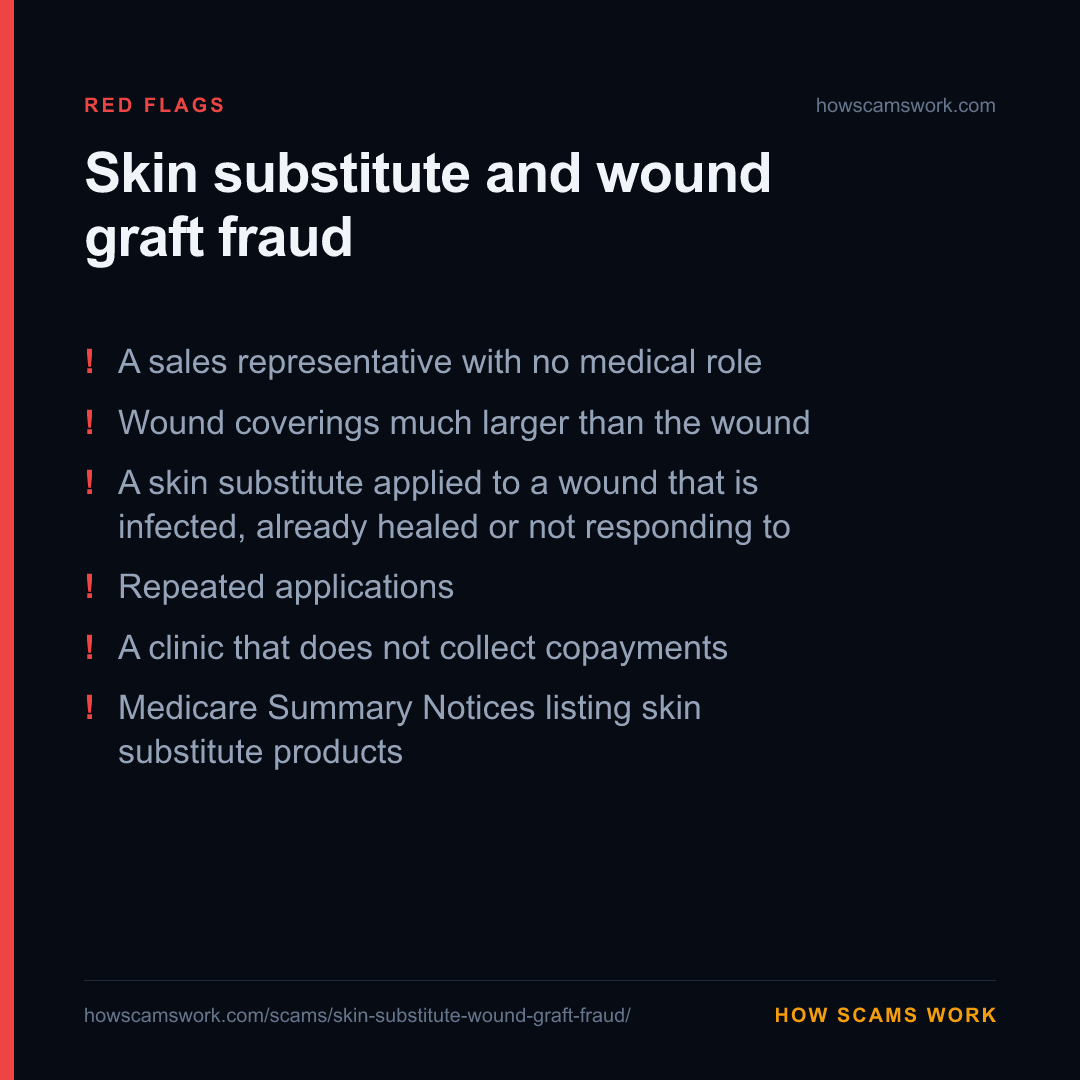
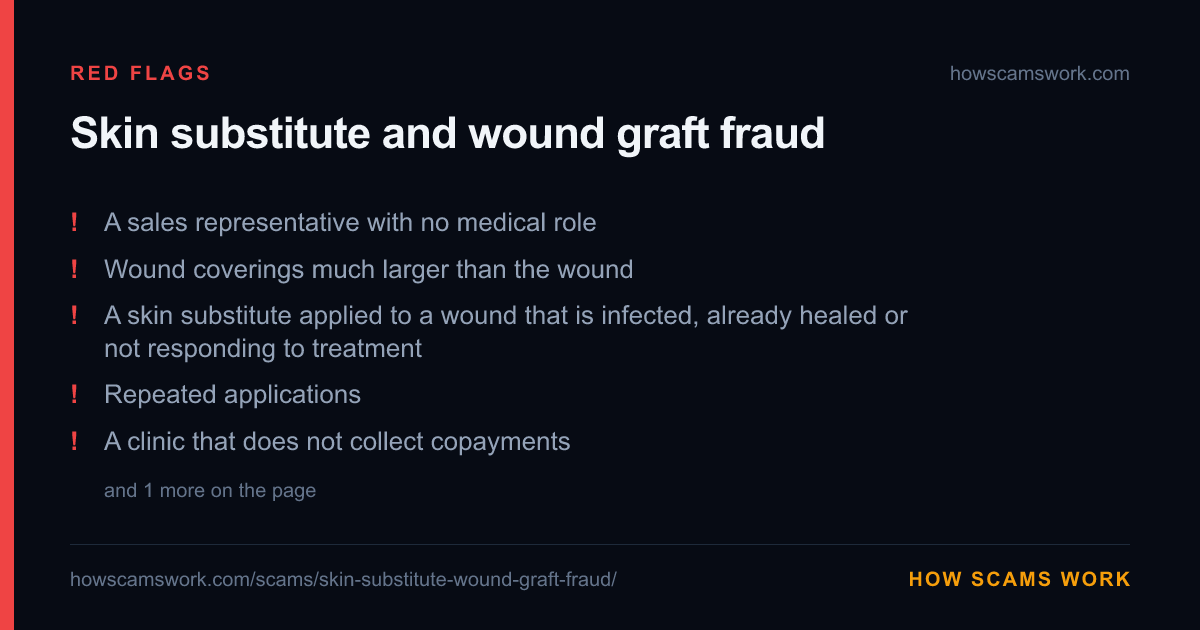
Red flags

  • A sales representative with no medical role who identifies patients with wounds, especially in hospice or nursing settings.
  • Wound coverings much larger than the wound.
  • A skin substitute applied to a wound that is infected, already healed or not responding to treatment.
  • Repeated applications where basic wound care has not been given for the previous 30 days.
  • A clinic that does not collect copayments for an expensive product.
  • Medicare Summary Notices listing skin substitute products that you or your relative do not remember being applied.

If it’s happening to you

If you or a relative has had a skin substitute applied, or you suspect a billing problem:

  1. Ask the clinic what the product was, why it was needed and who ordered it.
  2. Ask whether basic wound care was given first. The Utah indictment treats 30 days of it as a billing condition.
  3. Review the Medicare Summary Notice for skin substitute claims you do not recognise.
  4. Note whether copayments are collected. The Utah indictment alleges copayments were routinely not pursued.
  5. Report suspected fraud to the HHS Office of Inspector General. See where to report.

Where the money goes

Entirely domestic: from Medicare and other insurers to the billing company, then on to sales representatives and the defendants’ own spending.

In the Arizona case, the insurers paid $614,990,420 on $1.2 billion in claims. Gehrke’s companies received over $279 million in kickbacks from the distributor, and tens of millions of dollars went on to sales representatives. Nearly $100 million in assets were seized, including over $68 million in bank balances, four luxury vehicles, $22 million in life insurance annuities, and jewelry and precious metals. The Justice Department alleges that the Nevada doctor used his Medicare earnings to finance multimillion-dollar yachts.

The other half of this story

Our sibling site Clean on Paper explains why sham invoices and companies in other people’s names hide a kickback from the payer, the concealment the Nevada charges allege.

By the numbers

No published dataset breaks this scheme out as its own category yet, so there is no chart to show. The data page explains which agency categories exist and why some schemes are invisible in official statistics.

Sources

Every factual claim above traces to one of these. Statistics are reported losses; see methodology for what that does and does not measure.
  1. Arizona Couple Pleads Guilty to $1.2B Health Care Fraud. US Department of Justice, Office of Public Affairs. Accessed 2026-10-19. Supports: The Arizona couple's companies, the sales representatives and oversized graft orders, over $279 million in kickbacks, the November 2022 to May 2024 period, $1,212,005,778 claimed and $614,990,420 paid, the pleas and the seizures.
  2. Arizona Medicare fraudster gets 14 years. Courthouse News Service. Accessed 2026-10-19. Supports: The October 2025 sentences of 15 years and 14 years, the restitution, the instruction to target hospice facilities and the instruction to nurse practitioners to apply all grafts.
  3. Utah doctor and two nurses charged with health care fraud after submitting false claims to Medicare and receiving millions in payout. Internal Revenue Service, Criminal Investigation. Accessed 2026-10-19. Supports: The May 12, 2026 Utah indictment, the 30-day wound care rule, billing for patients without qualifying wounds, unpursued copayments, and the $44 million and $17 million billed and over $19 million and $10 million paid.
  4. Justice Dept. charges doctor in $95 million skin substitute fraud scheme. Las Vegas Sun, reprinting The New York Times (Sarah Kliff). Accessed 2026-10-19. Supports: The August 2026 charges against Dr. Stephen Dubin, the sham invoices and 40% kickback allegation, the description of skin substitutes, Medicare's nearly $15 billion in payments in 2025 and the cut in reimbursement rates.
  5. Update: Pair Sentenced in Wound Grafts Scheme. Senior Medicare Patrol Resource Center. Accessed 2026-10-19. Supports: The October 2025 sentences in the Arizona case and the description of the patients, many terminally ill and in hospice.
  6. Trump admin uncovers 7,100% surge in Medicare skin substitute claims, says fraud crackdown blocked millions. Fox 9. Accessed 2026-10-19. Supports: The administration's figures, as reported by Fox 9, on skin substitute claims rising from $200 million in 2019 to $14.4 billion in 2025, and on the claims CMS identified and denied.

Common questions

What is a skin substitute?

According to the New York Times reporting reprinted by the Las Vegas Sun, skin substitutes are bandages manufactured out of dehydrated placentas that cost thousands of dollars per square inch but have not been found to help most wounds heal any better than regular bandages. Some are billed to Medicare under the names amniotic grafts or allografts.

Is every skin substitute fraud?

No. The Utah indictment says Medicare billing of a skin substitute is permissible only if it is medically necessary and if basic wound care has been administered to the wound for the previous 30 days. The fraud alleged in these cases is billing for patients without qualifying wounds, or for grafts applied indiscriminately, or with kickbacks hidden from the payer.

Would a patient be asked to pay a copayment?

The Utah indictment alleges the defendants routinely did not pursue Medicare copayments from beneficiaries, which at times would have been thousands of dollars owed by a beneficiary. The indictment is an allegation.

How is this different from the hospice fraud page on this site?

Hospice fraud bills a flat daily hospice rate for patients certified as terminally ill. Wound graft fraud bills a product and a procedure. The two meet in the Arizona case, where the Justice Department says sales representatives were told to target hospice patients and facilities.

What should I do if I think a relative received grafts they did not need?

Ask the clinic what the graft was, why it was needed and who ordered it, and check the Medicare Summary Notice for the claims. Report suspected Medicare fraud to the HHS Office of Inspector General, which investigates these cases alongside the FBI. See <a href="/report/">where to report</a>.

Where the skin substitute payments actually goWhere the skin substitute payments actually go. Insurers pay the clinic's bill, and some of the money goes back out as kickbacks and spending. Where the skin substitute payments actually goInsurers pay the clinic's bill, and some of the money goes back out as kickbacks and spending.Medicare, TRICARE,CHAMPVA and privateinsurersIn the Arizona caseinsurers paid$614,990,420 on$1,212,005,778 inclaimsThe clinic or companythat applied andbilled the graftsA distributor paidGehrke's companiesover $279 million inkickbacks, and tens ofmillions of dollarswent on to salesrepresentativesThe owners and salesoperatorsNearly $100 millionwas seized, includingover $68 million inbank balances, fourluxury vehicles and$22 million inannuities; charges inNevada allege yachtsKickbacks torepresentatives,seized assets andyachtsReversibilityA recall is realistically possible only at the first hop, and only in the first hours. After the money is converted it becomes an investigation, not a refund.Why sham invoices and companies in other people's names hide a kickback from the payer: Clean on Paper, our sibling sitehttps://cleanonpaper.com/techniques/shell-companies/Arizona figures are from the Justice Department's January 2025 release on the pleas; the Nevada yacht allegation is from the August 2026 charges, which are allegations.howscamswork.com
Where the money goes after it leaves, and where it becomes hard to recover.

Report it

Reporting is what produces the enforcement data on this page. Find the right agency and phone number for your country on the report page. If money moved in the last few hours, call your bank first.