Hospice fraud

Also called: fake hospice scam · sham hospice fraud · hospice Medicare fraud · ineligible hospice enrollment · door knocker hospice scam

Hospice fraud enrolls Medicare patients who are not terminally ill, sometimes without their knowledge, then bills Medicare's flat daily hospice rate while the paperwork strips away the curative care Medicare would otherwise cover. Texas's Merida Group ran this at scale, over $150 million billed before its owner's 20-year sentence, while California cases show the same scheme run out of a single storefront.

Key facts

Category
Business & payments
First documented
2009
Typical loss
$3290k–$150000k USD, per victim
Main channels
door-to-door recruiters offering free housekeeping, meals or home health perks tied to one specific hospice, patient brokers and marketers paid a kickback per patient referred, physicians and medical directors paid to certify a six-month prognosis without independently examining the patient, concealed or 'straw' ownership used to keep billing after a prior Medicare exclusion
Who is targeted
Medicare beneficiaries, often elderly or with limited mental capacity, enrolled in hospice without being told, who find out only when a later claim for real medical care is denied; Nursing home, group home and low-income housing residents, recruited because they are easy to certify and unlikely to push back; Patients with long-term but not terminal conditions, including dementia and Alzheimer's, certified as having six months or less to live on a diagnosis supplied by hospice staff rather than reached independently; The Medicare program itself, which pays a flat daily hospice rate on the strength of a certification it does not verify before paying
Documented origins
United States
Main targets
United States
Case files
3 documented cases
Last reviewed
2026-10-13
Anatomy of a hospice fraud schemeAnatomy of a hospice fraud scheme. Medicare pays a flat daily rate for every patient enrolled, which is what makes enrollment itself the fraud. 1. The recruitment: A marketer, sometimes door to door, sometimes working inside a nursing home or housing project, offers free housekeeping, meals or home health visits, conditional on enrolling with one specific hospice. 2. The kickback: The hospice pays the marketer a flat fee or a share of future billings for every patient who ends up enrolled, whether or not that patient is terminally ill. 3. The false certification: A physician, sometimes the hospice's own paid medical director, certifies a terminal diagnosis and six-month prognosis, often adopting a diagnosis hospice staff supplied rather than one reached through an independent exam. 4. Billed by the day enrolled, not by the care given: Medicare pays the hospice a flat daily rate for every day a certified patient stays on its rolls, regardless of how much care, if any, is delivered that day. 5. Real care disappears: Once enrolled, a patient's other Medicare coverage for curative treatment, medication and equipment tied to the certified illness is switched off. Documented patients found out only when a later claim was denied. 6. Falsifying the paper trail: When Medicare requests documentation, operators in the documented cases directed staff to create or backdate patient charts rather than let a real, incomplete file be reviewed. 7. Enforcement, built from the claims themselves: HHS-OIG, the FBI and state health-fraud units build cases from billing data, survival-rate patterns and kickback payments traced through bank records, a process that took one to several years in the documented cases. The diagram marks stage 2 as the point where the scheme can still be stopped: Paying or accepting money for a patient referral is illegal under federal anti-kickback law on its own, before Medicare is ever billed a single dollar. Prosecutors in the documented cases charged the kickback payments as separate counts from the billing fraud itself.Anatomy of a hospice fraud schemeMedicare pays a flat daily rate for every patient enrolled, which is what makes enrollment itself the fraud.1The recruitmentA marketer, sometimes doorto door, sometimes workinginside a nursing home orhousing project, offersfree housekeeping, meals orhome health visits,conditional on enrollingwith one specific hospice.Days2The kickbackThe hospice pays themarketer a flat fee or ashare of future billingsfor every patient who endsup enrolled, whether or notthat patient is terminallyill.Ongoing3The falsecertificationA physician, sometimes thehospice's own paid medicaldirector, certifies aterminal diagnosis andsix-month prognosis, oftenadopting a diagnosishospice staff suppliedrather than one reachedthrough an independentexam.First visit4Billed by the dayenrolled, not by thecare givenMedicare pays the hospice aflat daily rate for everyday a certified patientstays on its rolls,regardless of how muchcare, if any, is deliveredthat day.Monthly5Real care disappearsOnce enrolled, a patient'sother Medicare coverage forcurative treatment,medication and equipmenttied to the certifiedillness is switched off.Documented patients foundout only when a later claimwas denied.Ongoing6Falsifying the papertrailWhen Medicare requestsdocumentation, operators inthe documented casesdirected staff to create orbackdate patient chartsrather than let a real,incomplete file bereviewed.On audit7Enforcement, builtfrom the claimsthemselvesHHS-OIG, the FBI and statehealth-fraud units buildcases from billing data,survival-rate patterns andkickback payments tracedthrough bank records, aprocess that took one toseveral years in thedocumented cases.YearsWhere it can still be stopped: stage 2Paying or accepting money for a patient referral is illegal under federal anti-kickback law on its own, before Medicare is ever billed a single dollar.Prosecutors in the documented cases charged the kickback payments as separate counts from the billing fraud itself.Stages drawn from three sentenced hospice fraud cases documented on this page (2023 to 2025, California and Texas) and the FBI Internet Crime Complaint Center's 2026 public service announcement on emerging hospice fraud.howscamswork.com
The stages of the scheme, in order, with the point where it can still be stopped.

What it is

A hospice operator enrolls a Medicare patient who is not actually dying, sometimes without the patient ever finding out, and bills Medicare’s hospice benefit anyway. Hospice is meant for people certified by a doctor as having a terminal illness with six months or less to live, who elect comfort care over an attempt to cure their illness. Medicare pays for it with a flat daily rate for every certified day a patient is on a hospice’s rolls, paid on the strength of the certification rather than on proof that any particular service was delivered that day. That payment structure, bill for enrollment rather than for care, is the entire scheme: recruit patients who qualify on paper, certify them, and collect the daily rate for as long as they stay enrolled, whether or not they need, want, or ever receive hospice care.

How it actually works

  1. The recruitment

    A marketer, sometimes knocking door to door, sometimes working inside a nursing home, group home or low-income housing project, offers a Medicare beneficiary free housekeeping, meals, transportation or home health visits, conditional on enrolling with one specific hospice.

  2. The kickback

    The hospice pays the marketer a flat fee or a share of future billings for every patient who ends up enrolled, whether or not that patient is terminally ill.

    Where it could have stopped

    Paying or accepting money for a patient referral is illegal under federal anti-kickback law on its own, before Medicare is ever billed a single dollar. In the cases on this page, prosecutors charged the kickback payments as separate counts from the billing fraud itself.

  3. The false certification

    A physician, sometimes the hospice’s own paid medical director, certifies that the patient has a terminal illness and a life expectancy of six months or less, often adopting a diagnosis supplied by hospice staff rather than one reached through an independent examination of the patient.

  4. Billed by the day enrolled, not by the care given

    Medicare pays the hospice a flat daily rate for every day a certified patient remains on its rolls, regardless of how much care, if any, is actually delivered that day, which is what makes enrolling patients, rather than treating them, the thing that generates revenue.

  5. Real care disappears

    Once enrolled in hospice, a patient’s other Medicare coverage for curative treatment, medication and equipment tied to the certified terminal illness is switched off. Patients in the documented cases here found out they had been enrolled only when they were later denied coverage for care they actually needed.

  6. Falsifying the paper trail

    When Medicare requests documentation to support a claim, operators in the cases here directed employees to create or backdate patient charts and recertification paperwork rather than let a real, incomplete file be reviewed.

  7. Enforcement, built from the claims themselves

    HHS Office of Inspector General investigators, the FBI and state health-fraud units build cases from the billing data itself: patient survival rates far below ordinary hospice norms, length-of-stay patterns, and kickback payments traced through bank records. In the cases documented here, that process took one to several years to reach a conviction and sentence.

Why it works

Medicare pays the daily rate on certification, not on proof of care. Like most large insurance programs, Medicare pays hospice claims in the first instance on the provider’s own certification, with detailed audits, if they happen at all, coming later, which is exactly the gap every case on this page exploited for months or years before being caught.

The targeted patients are the ones least able to catch it. People with dementia, limited mental capacity, or no family checking their Medicare statements are easy to certify and unlikely to object, a pattern federal prosecutors specifically alleged in the Merida Group case, where marketers enrolled patients from group homes, nursing homes and housing projects.

Enrollment itself can be hidden from the patient. Because hospice is a change in Medicare’s own billing status rather than a visible service, a patient can be enrolled, and billed for, without ever being told, and without noticing anything is wrong until a separate, unrelated Medicare claim for real care is denied.

A prior disqualification doesn’t have to be permanent. An operator already excluded from Medicare for a past fraud can buy or control a hospice through a relative’s or associate’s name, concealing their ownership on paperwork Medicare does not independently verify at the point of enrollment, exactly how California’s largest documented case here got back into the program.

The daily rate rewards keeping patients enrolled, not discharging them. Once a patient is on a hospice’s rolls, every additional day enrolled is additional revenue regardless of whether real care is delivered, which is why the documented cases describe operators fabricating charts to keep a patient’s file looking active rather than letting a weak file trigger a discharge.

Where it comes from

Entirely domestic: hospice fraud exploits Medicare’s own hospice benefit, which does not exist outside the United States in this form, so every documented case here is a US case.

California and Texas are the two states with the largest documented scandals. A 2022 California State Auditor report found Los Angeles County alone saw a 1,500% increase in hospice agencies over the preceding decade, with indicators of large-scale billing fraud and evidence that thieves used stolen medical personnel identities to obtain hospice licenses in the first place. California responded with a moratorium on new hospice licenses beginning in 2022, still in effect, while the state Attorney General has filed 119 hospice-related criminal cases since 2021, including an April 2026 case alleging $267 million in fraud across 21 defendants.

Texas produced the largest single scheme documented on this page. The Merida Group, a hospice and home health chain with dozens of locations across the state, ran its false-certification-and-kickback scheme from 2009 to 2018, billing Medicare more than $150 million before its owner, chief executive and medical director were convicted at trial and sentenced to 20, 15 and just over 4 years respectively.

Operators range from a single storefront to a multi-location chain. California’s documented cases here involve one or two hospices apiece, run by an individual owner working with a handful of paid marketers. Texas’s Merida Group shows the same fraud structure, kickbacks for referrals, false certifications, billing for days rather than care, scaled across dozens of locations and nearly ten thousand patients.

Real cases

Glendale hospice owner sentenced to 9 years over $10.6 million in fraudulent kickback-driven claims

2025 US Sentenced $8.3m

Nita Almuete Paddit Palma, excluded from Medicare over prior kickback convictions, bought Magnolia Gardens Hospice through her daughter and C@A Hospice through her husband in 2015, concealing her ownership. She paid marketers, including co-defendant Percy Dean Abrams, hundreds of thousands of dollars in illegal kickbacks for patient referrals, instructing them to tell prospective patients they did not need to be dying to go on hospice. Through the two companies, Palma caused the submission of approximately $10.6 million in fraudulent Medicare claims. A federal jury convicted her in December 2024 on 12 counts of health care fraud and 16 counts of paying illegal kickbacks; she was sentenced in August 2025 to 108 months in federal prison and ordered to pay $8,270,032 in restitution. Abrams was convicted on six counts of receiving illegal kickbacks and sentenced the same day to three years of probation, including two years of home confinement.

Read the case file · 1 source

Santa Paula physician sentenced for certifying patients as terminal who were not

2024 US Sentenced $3.3m

Dr. Victor Contreras, a Santa Paula, California physician, and co-defendant Juanita Antenor schemed from July 2016 to February 2019 to defraud Medicare through two Pasadena hospice companies Antenor controlled, Arcadia Hospice Provider Inc. and Saint Mariam Hospice Inc. Contreras falsely certified patients as terminally ill, typically adopting diagnoses hospice employees supplied rather than diagnoses he reached himself, despite not being the patients' primary care physician. The scheme submitted nearly $4 million in false claims, of which Medicare paid approximately $3,289,889. Contreras pleaded guilty to one count of health care fraud in July 2024 and was sentenced in December 2024 to 24 months in federal prison and ordered to pay $3,289,889 in restitution.

Read the case file · 1 source

Merida Group's owner, CEO and medical director sentenced over $150 million hospice fraud

2023 US Sentenced $150.0m

From 2009 to 2018, the Merida Group, a health care company operating dozens of hospice and other locations across Texas, submitted more than $150 million in false and fraudulent Medicare claims. Marketers enrolled patients with long-term incurable conditions such as Alzheimer's and dementia, and people with limited mental capacity living in group homes, nursing homes and housing projects, falsely telling some they had less than six months to live. Medical directors were paid, contingent on certifying unqualified patients for hospice; medical director Jesus Virlar-Cadena personally certified over $18 million of the scheme's claims in exchange for kickbacks that included luxury trips and nightclub bottle service. A federal jury convicted owner Rodney Mesquias, CEO Henry McInnis and medical director Francisco Pena in October 2019. Mesquias was sentenced to 20 years and ordered to pay $120 million in restitution; McInnis was sentenced to 15 years; Pena died in custody before sentencing. Virlar-Cadena, who pleaded guilty separately, was sentenced in September 2023 to 50 months and ordered to pay $9 million in restitution and $9 million in forfeiture.

Read the case file · 3 sources

Red flags

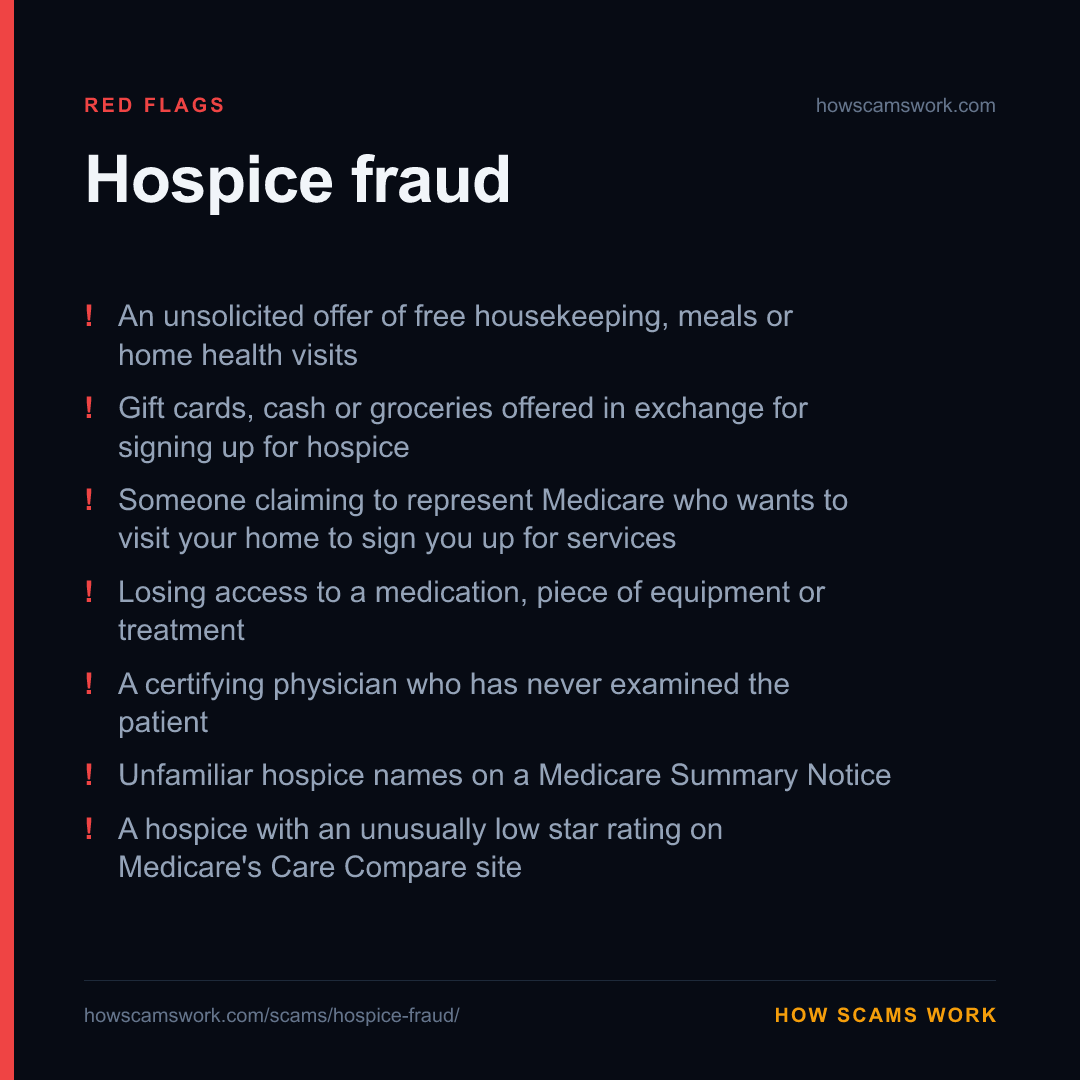
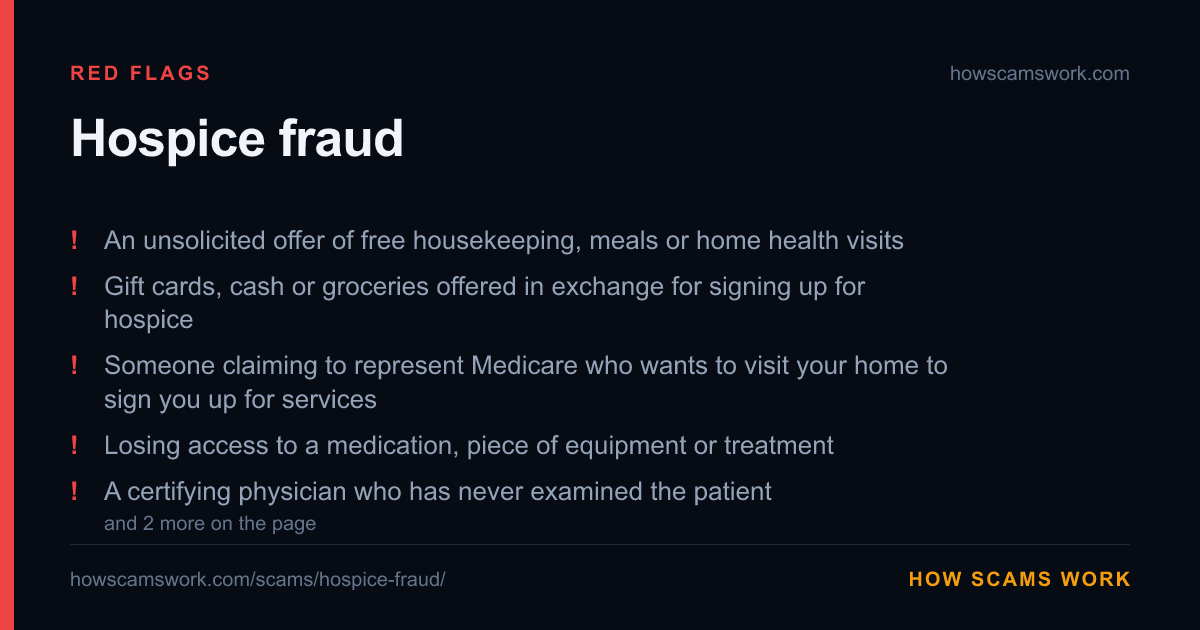
  • An unsolicited offer of free housekeeping, meals or home health visits in exchange for Medicare information or for enrolling with a specific hospice, by phone, text, email or a door-to-door visit.
  • Gift cards, cash or groceries offered in exchange for signing up for hospice.
  • Someone claiming to represent Medicare who wants to visit your home to sign you up for services, which Medicare itself never does.
  • Losing access to a medication, piece of equipment or treatment you were previously getting through Medicare, which can be a sign you were enrolled in hospice without realizing it.
  • A certifying physician who has never examined the patient, or who is not the patient’s own doctor.
  • Unfamiliar hospice names on a Medicare Summary Notice or explanation of benefits, for services never requested or received.
  • A hospice with an unusually low star rating on Medicare’s Care Compare site, or one that keeps reopening under a new name after losing its billing privileges.

If it’s happening to you

If you or a family member may have been signed up for hospice without needing it:

  1. Ask the hospice directly for the name of the certifying physician, and whether that physician has examined the patient; a legitimate hospice answers this without hesitation.
  2. Check whether coverage for an existing treatment, medication or piece of equipment has stopped. That is often the first sign a fraudulent enrollment happened, since electing hospice switches off Medicare’s coverage for curative care related to the certified terminal illness.
  3. Review recent Medicare Summary Notices or explanation of benefits statements for a hospice name you don’t recognize.
  4. Don’t agree to disenroll or sign anything on the spot if someone shows up in person; verify who they are and who they work for first.
  5. Report what you’ve found to 1-800-MEDICARE (1-800-633-4227), your local Senior Medicare Patrol, the FBI’s Internet Crime Complaint Center at ic3.gov, or the HHS Office of Inspector General at 1-800-HHS-TIPS (1-800-447-8477) or TIPS.HHS.GOV. See where to report for agencies in other countries.

Where the money goes

Entirely domestic, moving from Medicare’s Trust Fund into the hospice’s own operating accounts, then out again as kickbacks and personal spending.

Medicare pays its flat daily rate directly into the hospice company’s bank account, typically the smallest and most traceable step in the chain since it comes from a federal program with its own records. From there, the hospice’s owner or controlling operator pays kickbacks to the marketers and recruiters who supplied the patients, a cost the documented cases here describe as running up to roughly $1,000 a month per enrolled patient. What’s left moves into real estate, forfeited bank accounts and, in the Merida Group case, personal perks for the medical director who kept certifying unqualified patients, luxury trips and nightclub bottle service, paid in exchange for his signature.

The other half of this story

Our sibling site Clean on Paper explains why an operator already excluded from Medicare buys back in through a relative’s name rather than their own, the same concealed-ownership pattern that let California’s largest documented case here keep billing for years.

By the numbers

No published dataset breaks this scheme out as its own category yet, so there is no chart to show. The data page explains which agency categories exist and why some schemes are invisible in official statistics.

Sources

Every factual claim above traces to one of these. Statistics are reported losses; see methodology for what that does and does not measure.
  1. Glendale Woman Sentenced to 9 Years in Federal Prison for $10.6 Million Hospice Fraud Scheme Involving Kickbacks for Patients. US Attorney's Office, Central District of California. Accessed 2026-10-13. Supports: Nita Almuete Paddit Palma's sentence, the $10.6 million in fraudulent claims, the $8,270,032 restitution order, the concealed ownership of Magnolia Gardens Hospice and C@A Hospice, the kickback structure, the $6,000-a-month per-patient billing, and the fabricated patient charts.
  2. Santa Paula Doctor Sentenced to 2 Years in Federal Prison for Role in Hospice Fraud that Bilked Medicare Out of $3.2 Million. US Attorney's Office, Central District of California. Accessed 2026-10-13. Supports: Dr. Victor Contreras's sentence and restitution, the false terminal-illness certifications adopted from hospice-supplied diagnoses, the two Pasadena hospice companies, and the $3,917,946 in claims submitted.
  3. Hospice medical director sentenced for $150M hospice fraud scheme. US Attorney's Office, Southern District of Texas. Accessed 2026-10-13. Supports: The Merida Group's $150 million in fraudulent hospice claims, the 2009 to 2018 scheme period, Jesus Virlar-Cadena's sentence and restitution, the kickback-for-certification arrangement, the false six-month prognoses given to patients with Alzheimer's and dementia, the chaplain visits, and Mesquias's and McInnis's prior 20-year and 15-year sentences.
  4. Hospice fraudster sentenced to 20 years, must pay $120 million in restitution. AARP. Accessed 2026-10-13. Supports: Rodney Mesquias's 20-year sentence, the $120 million restitution order, the 2009 to 2018 scheme period, the $152.7 million in total billings across 47,210 claims for 9,339 Medicare patients, and Francisco Pena's death in custody.
  5. Merida CEO Sentenced to 15 Years for Hospice Fraud. Hospice News. Accessed 2026-10-13. Supports: Henry McInnis's role as Merida Health Group's chief executive, his 15-year sentence, the roughly $154 million scheme total, and his convictions for conspiracy to commit health care fraud and money laundering.
  6. Emerging Hospice Fraud Targeting Medicare Recipients. FBI Internet Crime Complaint Center (IC3). Accessed 2026-10-13. Supports: The door-to-door recruitment pattern offering free home services conditional on using a specific hospice, enrollment without the patient's knowledge, falsified diagnosis paperwork, enrollment-quota bonuses for recruiters, the red flags list, and the reporting guidance.
  7. Hospice fraud targets older adults. US Federal Trade Commission. Accessed 2026-10-13. Supports: The FTC's description of hospice scam recruitment by phone, text, email and door-to-door visit, the free-services-for-your-Medicare-number pattern, the fact that Medicare never comes to your home to sign you up, and the 1-800-MEDICARE and Senior Medicare Patrol reporting guidance.
  8. Why hospice fraud is so easy in California, and why the state can't stop it. CalMatters. Accessed 2026-10-13. Supports: The 2022 California State Auditor finding of a 1,500% increase in Los Angeles County hospice agencies over a decade, evidence that identity theft was used to obtain hospice licenses, the 2022 new-license moratorium, the Attorney General's April 2026 $267 million case against 21 suspects, and the 119 hospice-related criminal cases filed since 2021.

Common questions

Isn't this fraud against Medicare, not against a person?

It's both. Medicare is the party that pays the fraudulent claim, but the patient whose name and Medicare number it's billed under is used as the raw material of the fraud, and often loses real coverage because of it. Patients in the documented cases here found out they were enrolled only after being denied medical equipment, medication or treatment they actually needed, because electing hospice switches off Medicare's coverage for curative care related to the certified terminal illness.

How is this different from the ID-theft Medicare scams on this site?

The scams on this site's medicare-health-insurance page mostly use a stolen Medicare number once or twice, for a fake brace or a genetic test kit, and move on. Hospice fraud is a standing monthly claim: once a patient is certified and enrolled, the hospice collects Medicare's flat daily rate for as long as that patient stays on its rolls, which is what makes operators fight to keep patients enrolled rather than simply billing once and disappearing.

This looks a lot like the sober-living-fraud page on this site. What's the difference?

The underlying structure, a kickback for the referral, then a bill for care that's thin or fictional, is the same. The programs and the patients are not: sober-living-fraud describes Medicaid-funded addiction counseling billed against people in early recovery, while hospice fraud describes Medicare's end-of-life benefit billed against patients certified, correctly or not, as having six months or less to live.

I think a family member was signed up for hospice without needing it. What should I do?

Ask the hospice directly for the name of the certifying physician and whether that physician has ever examined the patient; a legitimate hospice can answer this without hesitation. Check whether your relative has lost access to a treatment, medication or piece of equipment they were previously getting through Medicare, a sign they may already be enrolled. Report what you've found to 1-800-MEDICARE, your local Senior Medicare Patrol, or the HHS Office of Inspector General at 1-800-HHS-TIPS (1-800-447-8477) or TIPS.HHS.GOV. See <a href="/report/">where to report</a> for agencies in other countries.

Where the Medicare hospice payment actually goesWhere the Medicare hospice payment actually goes. A flat daily rate, paid before anyone checks the certification, then split into kickbacks and personal spending. Where the Medicare hospice payment actually goesA flat daily rate, paid before anyone checks the certification, then split into kickbacks and personal spending.Medicare, paying adaily rate beforeverifying thediagnosisMedicare pays thedaily hospice rate onthe strength of thecertification, beforeverifying thediagnosis is realThe hospice company,sometimes with aconcealed ownerHospice revenue flowsto the operator whocontrols the company,sometimes through arelative's orassociate's name tohide ownershipThe operator, whocontrols the company'sbank accountsProceeds split betweenillegal kickbacks ofup to roughly $1,000 amonth per patient,real estate andforfeited accounts,and, in one documentedcase, a medicaldirector's luxurytrips and nightclubbottle serviceKickbacks torecruiters, realestate, forfeitedaccounts and personalperksReversibilityA recall is realistically possible only at the first hop, and only in the first hours. After the money is converted it becomes an investigation, not a refund.Why an operator already excluded from Medicare buys back in through a relative's name rather than their own: Clean on Paper, our sibling sitehttps://cleanonpaper.com/techniques/shell-companies/The Medicare payment and the kickback both move through ordinary US bank accounts in every documented case here; the largest, Texas's Merida Group, moved the proceeds into luxury vehicles, real estate and a medical director's personal perks before a $120 million restitution order.howscamswork.com
Where the money goes after it leaves, and where it becomes hard to recover.

Report it

Reporting is what produces the enforcement data on this page. Find the right agency and phone number for your country on the report page. If money moved in the last few hours, call your bank first.