Also called: sober home scam · patient brokering · body brokering · addiction treatment fraud · recovery house fraud
A sober living home recruits someone in addiction recovery with free rent, then refers them, for an illegal kickback, to a behavioral-health clinic that bills Medicaid for counseling that is shortened, duplicated, or never held. One Arizona clinic alone billed $69 million this way before its owner was sentenced to 14 years.
What it is
An operator sets up, or takes over, a sober living home, a group house for people in early recovery
from drug or alcohol addiction, and pairs it with, or refers its residents to, a behavioral health
clinic that bills Medicaid for “treatment.” The housing is often free or nearly free, which is the
point: it gets a resident’s Medicaid ID into the system. What follows is not one fraud but two stacked
on top of each other.
The first is patient brokering: paying or receiving money for referring a patient to a specific
provider, which is illegal under federal and state anti-kickback law regardless of what happens next.
The second is billing fraud: the clinic then submits Medicaid claims for counseling sessions,
intensive outpatient programs or other behavioral health services that are shortened, duplicated,
billed under the wrong code, or never actually provided. In Arizona, the country’s largest documented
version of this scandal, prosecutors say operators specifically targeted Native American patients
enrolled in the state’s American Indian Health Program, which reimburses at a higher rate and, according
to state regulators, involved fewer up-front eligibility checks than standard Medicaid.
How it actually works
The recruitment
A recruiter, sometimes affiliated with a sober home, sometimes a paid “patient broker” working for
a clinic, approaches someone struggling with addiction or homelessness, often far from their home
community, offering free transportation, housing and treatment.
Free housing, one condition attached
The sober home provides a bed, sometimes food and a modest cash allowance. In exchange, the resident’s
Medicaid ID is used to enroll them with a specific behavioral health clinic, not necessarily the one
best suited to their care.
The referral kickback
The clinic pays the sober home, or the individual recruiter, a fee for each person referred, a flat
rate, a percentage of billings, or both.
Where it could have stopped
Paying or accepting money for a patient referral is illegal under federal and Arizona anti-kickback law on its own, before a single dollar is billed for treatment. The HHS Office of Inspector General’s own consumer alert names this referral-for-cash pattern as the first warning sign of a fraudulent behavioral health provider.
Billing for treatment that’s thin or fictional
The clinic submits Medicaid claims for counseling, group therapy or intensive outpatient sessions.
Federal and state cases here allege claims for sessions that ran a fraction of their billed length,
were billed twice, or were never held, including, in one Arizona indictment, billing for clients who
were already deceased or incarcerated.
Little or no real recovery happening
Because the clinic’s incentive is billing volume rather than outcomes, residents in the documented cases
received counseling far short of what was billed, or none at all, leaving the underlying addiction
essentially unaddressed while the paperwork shows a full course of treatment.
The churn: evicted and re-brokered
When a facility’s Medicaid billing privileges are suspended, or the operator judges a resident no longer
“billable,” reporting on Arizona’s scandal describes people evicted with little notice, sometimes left
homeless, hundreds of miles from where they were recruited, and in some cases re-recruited into another
operator’s facility.
Enforcement, sometimes years later
State Medicaid Fraud Control Units, the Arizona Attorney General’s Health Care Fraud and Abuse Section,
the FBI, IRS-Criminal Investigation and HHS-OIG build cases from billing records, bank records and
witness cooperation, a process that in the cases here took one to three years from the fraudulent
billing to an indictment or sentencing.
Why it works
The housing offer solves a real, urgent problem. Someone in active addiction or newly out of
treatment, especially if homeless, has an immediate and legitimate need for shelter, which makes a
“free” bed easy to accept without scrutinizing what’s attached to it.
Medicaid pays claims before verifying that the billed treatment happened. Like most large insurance
programs, AHCCCS processes claims on the provider’s word in the first instance, with detailed audits
coming later if at all, which is exactly the gap the largest documented cases here exploited for
months or years before being caught.
The population targeted is the population least equipped to complain. People in early recovery,
homeless, or far from their home community and support network are less likely to know their rights,
less likely to be believed if they do report something wrong, and in several documented cases were
moved between facilities specifically to keep them dependent on the operator.
A benefit designed for a specific, vulnerable group became the target precisely because of that
design. Arizona’s American Indian Health Program pays behavioral health claims at a higher rate than
standard AHCCCS Medicaid, a policy meant to address a real access gap for Native American patients,
which several of the cases here allege operators exploited by recruiting Native American patients
specifically because of the higher reimbursement.
And the fraud is legally two crimes stacked together, which makes it hard to unwind from the outside.
A resident or family member who sees a sober home and a clinic working closely together has no easy way
to tell a lawful, coordinated referral relationship from an illegal kickback arrangement, the
difference is a financial transaction between the two businesses that nobody outside it can see.
Where it comes from
Entirely domestic, and concentrated, though not exclusively, in Arizona.
Arizona’s AHCCCS behavioral health scandal is the largest documented version of this fraud in the
United States. By May 2025, the state’s Attorney General had indicted more than 100 people, along
with several businesses and a church, in a scheme state officials estimate at roughly $2.8 billion in
fraudulent billing, with about $140 million recovered so far.
The same referral-kickback-and-overbilling structure has produced separate, unrelated prosecutions
elsewhere, including a series of addiction-treatment kickback cases in Orange County, California
brought by the Justice Department’s Health Care Fraud Unit, evidence that the underlying fraud pattern
is not unique to Arizona’s specific Medicaid program, even if Arizona’s scandal is the largest and most
thoroughly documented single-state version of it.
Operators range from single clinic owners to multi-state consulting operations. One Arizona case
involved a single nurse practitioner’s clinic; another, L & L Investments LLC, began operating
fraudulent sober living homes in Nevada before expanding into Arizona and later acting as a paid
consultant handling billing and administration for other operators’ facilities, what the Arizona
Attorney General described as “franchising” the fraud.
Money moves from the state Medicaid program into the operators’ businesses, and from there into real
estate, forfeited bank accounts, and in at least one case, overseas. Prosecutors allege Happy House
Behavioral Health LLC paid $5 million to a Phoenix-area church, Hope of Life International Church, which
later wired $2 million of it to an entity in Rwanda, a detail that remains an allegation, not a proven
fact, as that case has not yet gone to trial.
Real cases
2025 US Charged (allegation, not conviction) $60.0m
A state grand jury indicted 20 individuals, Happy House Behavioral Health LLC and Hope of Life International Church in May 2025, as part of Arizona's broader sober living home Medicaid fraud scandal. The indictment alleges Happy House was paid roughly $60 million by AHCCCS for behavioral health and addiction treatment services that were never provided or only partially completed, and for clients who were deceased or incarcerated, and that it paid $5 million of those proceeds to Hope of Life International Church, which then wired $2 million to an entity in Rwanda. These are allegations from a grand jury indictment; the defendants are presumed innocent unless and until convicted.
Read the case file ·
2 sources
2025 US Sentenced $6.5m
Kenneth Terrell Harrison, of College Park, Georgia, secretly owned Aurtism LLC, an outpatient behavioral health counseling business in Mesa, Arizona, after concealing his ownership interest when applying to become an AHCCCS provider in 2019 for fear his criminal history would get the application denied. Between January 2020 and October 2021, Aurtism billed AHCCCS $6,538,485.09 for counseling services never provided to enrollees, many of them members of the American Indian Health Plan. Harrison was sentenced in September 2025 to 52 months in federal prison and ordered to pay full restitution.
Read the case file ·
1 source
2025 US Sentenced $30.2m
L & L Investments, LLC operated fraudulent sober living homes, first in Nevada and then expanding into Arizona, and submitted false billing claims to AHCCCS, Arizona's Medicaid program. The company later acted as a paid consultant handling billing and administrative functions for other operators, which Arizona Attorney General Kris Mayes described as effectively "franchising" the fraud to other bad actors. Following a 2021 indictment brought jointly by the Arizona Attorney General's Health Care Fraud and Abuse Section, HHS-OIG and the AHCCCS Inspector General, a jury convicted the company in May 2024 of conspiracy, illegal control of an enterprise, theft, and fraudulent schemes and artifices. It was sentenced in August 2024 to seven years of probation, and a restitution order of $30,236,207.52 plus a $4 million fine was entered in May 2025.
Read the case file ·
1 source
2025 US Sentenced $54.9m
Rita Ntusa Anagho, a 54-year-old licensed nurse practitioner from San Tan Valley, Arizona, owned and operated Tusa Integrated Clinic, LLC, which fraudulently billed Arizona's Medicaid program (AHCCCS) more than $69 million for addiction treatment services between May 2022 and March 2023, of which AHCCCS paid approximately $54.9 million. Anagho and her co-conspirators specifically targeted Native American patients enrolled in Arizona's American Indian Health Program, which reimburses at a higher rate, and paid illegal kickbacks to sober home operators for patient referrals. She pleaded guilty in May 2025 to conspiracy to commit wire fraud and health care fraud and was sentenced in September 2026 to 14 years in federal prison.
Read the case file ·
2 sources
Red flags
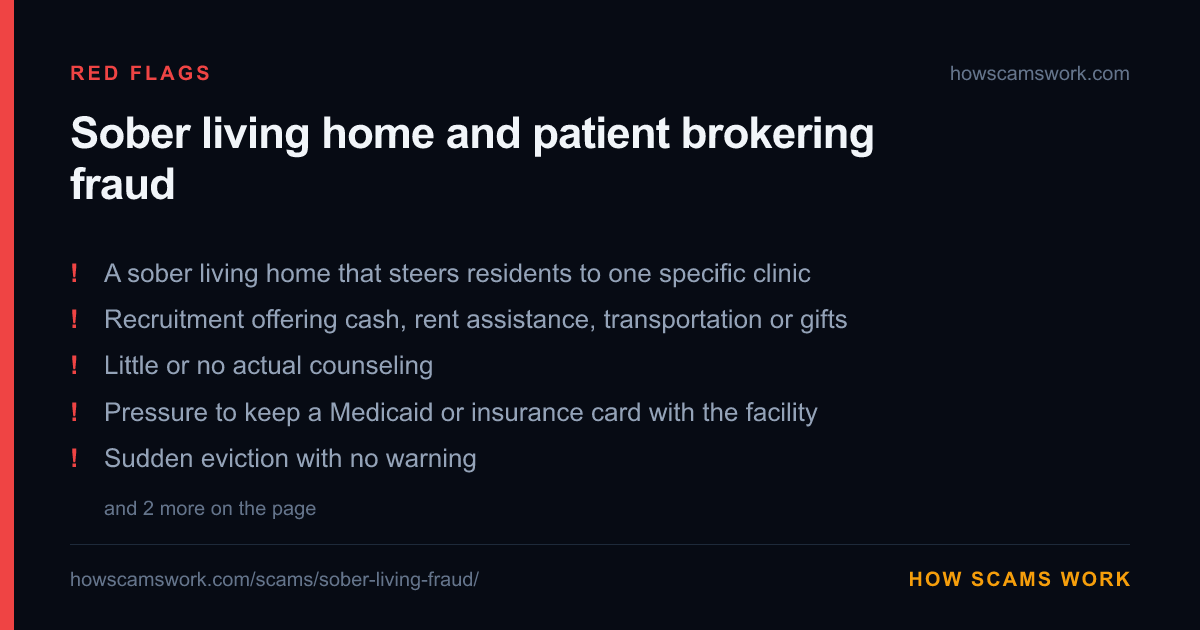
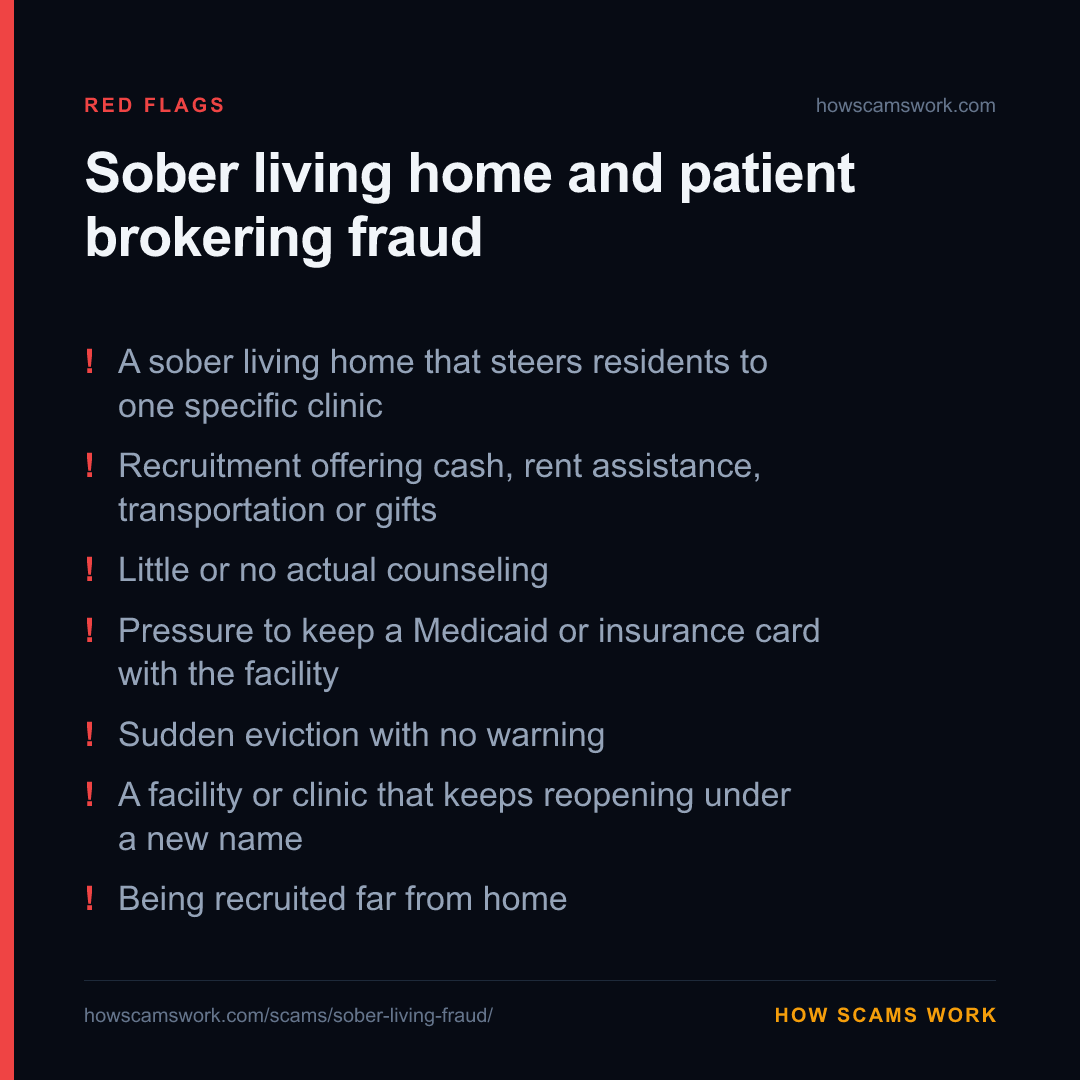
- A sober living home that steers residents to one specific clinic rather than letting them choose their own treatment provider.
- Recruitment offering cash, rent assistance, transportation or gifts in exchange for enrolling with a particular provider, a pattern HHS-OIG names explicitly as a warning sign.
- Little or no actual counseling, or sessions that run far shorter than what a bill or insurance statement claims.
- Pressure to keep a Medicaid or insurance card with the facility rather than in the patient’s own possession.
- Sudden eviction with no warning, especially timed around a facility’s funding being cut off or investigated.
- A facility or clinic that keeps reopening under a new name after being shut down or having its billing privileges suspended.
- Being recruited far from home, driven a long distance to a facility with no family or community connection nearby.
If it’s happening to you
If you or someone you know is in a sober living home or clinic that fits this pattern:
- Don’t confront the operator directly, patient brokering cases are built by investigators over
time, and a confrontation can put a resident’s housing or safety at risk before help arrives.
- If someone is in immediate danger, is being denied care, or needs help with addiction right now,
contact local authorities or a crisis line first; that is a more urgent problem than the billing
fraud.
- Report what you’ve seen to your state’s Medicaid Fraud Control Unit, in Arizona, the Attorney
General’s Health Care Fraud and Abuse Section, or to the HHS Office of Inspector General at
1-800-HHS-TIPS (1-800-447-8477) or TIPS.HHS.GOV.
- Keep records of dates, the names of facilities and clinics involved, and anything in writing,
texts, intake paperwork, bills, without putting yourself or anyone else at risk to obtain them.
- If you’re choosing a sober living home or treatment provider, ask directly whether the home
receives any payment for referring residents to a specific clinic, a legitimate operator should be
able to answer plainly, and Arizona’s AHCCCS maintains a provider search to verify a clinic is
actually licensed. See where to report for agencies in other countries.
Where the money goes
Almost entirely domestic, moving from a state Medicaid program into the accounts of the businesses that
billed it, then out into real estate, forfeited bank accounts, and, in the largest pending Arizona
indictment, allegedly overseas.
The referral kickback is typically the smallest transaction in the chain, paid directly from the
clinic’s Medicaid receipts to the sober home or recruiter. The bulk of the money is the Medicaid payment
itself, which prosecutors in the cases here trace into luxury vehicles, forfeited real estate, and
business accounts used to fund further expansion, in L & L Investments’ case, into consulting fees for
“franchising” the same fraud to other operators. In the one case involving an allegation of money
leaving the country, prosecutors say Happy House Behavioral Health paid $5 million to Hope of Life
International Church, which then wired $2 million to Rwanda, an allegation the case has not yet proven
at trial.
By the numbers
No published dataset breaks this scheme out as its own category yet, so there is no chart to show.
The data page explains which agency categories exist and why some schemes are
invisible in official statistics.
Every factual claim above traces to one of these. Statistics are reported losses; see
methodology for what that does and does not measure.