Also called: FEMA fraud · disaster assistance fraud · FEMA individual assistance fraud · disaster relief benefit fraud · FEMA claims fraud
FEMA disaster assistance fraud files a false claim, a fabricated residence, invented damage or someone else's address, to collect federal aid after a declared disaster. FEMA pays on an applicant's own sworn statement rather than verified proof, and a Pennsylvania recruiter who ran this scheme for nearly 200 Hurricane Ida applicants was sentenced in January 2026 to 5 years after collecting $1.74 million.
What it is
FEMA’s Individual Assistance program is a real federal relief program, not a pretext. After a president
declares a major disaster, it pays survivors for home repairs, temporary housing and other disaster-
related needs out of federal funds, moving money fast to people who often have nowhere else to turn.
To get that money out quickly, FEMA accepts much of what an applicant says about their own situation,
where they live, what they lost, whether they already have insurance, as a self-certified statement
rather than requiring documentation before it pays. The Department of Homeland Security’s own Inspector
General found FEMA had made more than $3 billion in improper and potentially fraudulent Individual
and Households Program payments since 2003 for exactly this reason, and that FEMA told its Inspector
General it keeps the gap because tighter verification would slow down payments to survivors who need
them fast. Every documented case on this page is a version of the same move: putting a false fact,
a residence, a damage claim, an eligibility detail, into that one sworn statement, then letting FEMA’s
own speed do the rest.
How it actually works
A declared disaster opens a real, fast-moving aid program
A hurricane, wildfire or flood triggers a presidential disaster declaration, and FEMA’s Individual
Assistance program begins accepting applications for housing, repair and other disaster-related needs
from survivors in the affected area.
FEMA pays on the applicant’s word, not on verified proof
FEMA accepts a self-certified statement of residency, damage and insurance status instead of requiring a
lease, deed or insurance record before paying, a design choice the agency has defended to its own
Inspector General as necessary to get money to survivors quickly.
Where it could have stopped
The Department of Homeland Security’s Inspector General recommended FEMA verify applicants’ insurance status and collect more supporting documentation before paying home repair assistance. FEMA non-concurred with both recommendations in the report’s own account, and the gap the audit flagged is the one every documented case on this page used.
The applicant invents the one fact the grant turns on
The claim does not have to be elaborate. Daylyn Harris claimed he lived in Lahaina during the 2023
wildfire; Chelsea Johnson claimed she lived in Pacific Palisades during the January 2025 fire there, and
separately posed as Harris’s landlord; Joyce Turner claimed a Pasadena rental damaged by the Eaton Fire
was her home. None of the three actually lived in the properties they claimed.
Sometimes a recruiter runs the paperwork at scale, for a cut
Jasmine Williams offered to help disaster survivors, and people with no real claim at all, apply for
Hurricane Ida assistance, recruiting nearly 200 people through social media and building each application
herself: fake leases, forged landlord letters, falsified utility bills, fabricated earnings statements and
bogus repair estimates, in exchange for half of whatever FEMA approved.
The grant lands directly in a bank account nobody checked first
FEMA pays Individual Assistance grants straight to the applicant, so once a self-certified application
clears, the money moves immediately, with no landlord or intermediary step for an investigator to catch
before it is already spent.
The money is spent long before anyone looks twice
Williams’s scheme ran for roughly a year and a half, from October 2021 to March 2023, before FEMA’s own
$1,744,982.64 loss figure was even calculated; Harris and Johnson’s combined $60,458 and Turner’s $28,195
in FEMA payments had both long since moved on by the time investigators opened a file.
The investigation lands years after the disaster is gone from the news
The Department of Homeland Security’s Office of Inspector General investigated all three documented
schemes on this page. Harris and Johnson’s wildfire applications were filed within months of the fires;
their sentencings landed in April and June 2026, roughly a year later. Williams’s Hurricane Ida scheme
ran from 2021 to 2023; she was not sentenced until January 2026.
Why it works
Self-certification is a deliberate trade-off, not an oversight. FEMA’s own account to its Inspector
General is that verifying every applicant’s insurance status and documentation before paying would delay
help to survivors who have just lost their home. That trade-off is exactly what every documented case
here exploited: the program pays fast because it mostly takes an applicant’s word, and a false word pays
just as fast as a true one.
The lie only has to be about one thing: where the applicant was and what they lost. Nobody here had
to forge a government record or breach a database. Harris, Johnson and Turner each simply told FEMA they
lived somewhere they did not, after a disaster that was real, declared and genuinely devastating. The
underlying disaster providing cover is not incidental; it is what makes a false residency claim plausible
to a caseworker processing thousands of applications at once.
A recruiter multiplies one scheme into dozens by doing the paperwork for people who don’t have a
claim. Williams did not need victims who had actually been in Hurricane Ida’s path; she needed people
willing to put their name and bank account on an application she built herself, in exchange for a cut.
That recruitment model, not a single fabricated identity but dozens of willing or unwitting participants,
is what let one scheme reach $1.74 million rather than a few thousand dollars.
And FEMA pays the applicant directly, so there is no second check before the money moves. Unlike a
program that pays a landlord or an employer on an applicant’s behalf, FEMA’s Individual Assistance grant
lands straight in the applicant’s own account the moment the self-certified claim clears, removing the
one additional party who might otherwise notice something was wrong.
Where it comes from
Entirely domestic, and built directly on top of a real, continuously operating federal disaster program
rather than a fabricated one.
Scale runs from a single false claim to an organized recruitment mill. Harris and Johnson each filed
one false residency claim apiece, together worth $60,458; Turner filed one false FEMA claim worth $28,195
alongside a separate, unrelated unemployment fraud; Williams ran a recruitment operation that built false
paperwork for nearly 200 people and moved $1,744,982.64 through FEMA’s Individual Assistance program
alone.
The documented mechanism is always a false residency or damage claim, never a fabricated disaster.
Every case here happened after a real, federally declared disaster, the 2023 Lahaina wildfire, the
January 2025 Pacific Palisades wildfire, and Hurricane Ida in 2021. Nobody invented the catastrophe; they
invented their own relationship to it.
Enforcement is federal and criminal, run by the Department of Homeland Security’s Office of Inspector
General, and it is landing years after the underlying disaster. All three documented schemes here ended
in a guilty plea and a federal sentence, but the gap between the fraudulent filing and the courtroom
outcome ran from roughly one year to more than two.
And the money, once it moves, stays inside the ordinary US banking system. There is no offshore
network or cryptocurrency exchange in any of the documented cases here. FEMA deposits land in a US bank
account, and what happens next, Williams’s cut of the payout, or straight personal spending for Harris,
Johnson and Turner, is traceable through conventional financial records once an investigator starts
looking.
Real cases
2026 US Sentenced $60,458
Daylyn Harris, 35, and Chelsea Johnson, 32, both of Honolulu, conspired to collect FEMA disaster assistance by falsely claiming to have lived in two separate wildfire disaster zones they never actually resided in: Harris claimed Lahaina, Maui, during the August 2023 wildfire, and Johnson claimed Pacific Palisades, California, during the January 2025 wildfire there, while also posing as Harris's landlord to support his claim. Together they received more than $60,000 in FEMA disaster relief. Johnson pleaded guilty to conspiracy to commit wire fraud and was sentenced on April 2, 2026 to 4 months in prison. Harris pleaded guilty to the same conspiracy charge plus a separate obstruction of justice count, after submitting fabricated flight records to the court, and was sentenced on June 5, 2026 to 24 months. Both were ordered to pay $60,458 in restitution to FEMA.
Read the case file ·
2 sources
2026 US Sentenced $82,555
Joyce Turner, 56, of Rosharon, Texas, submitted a fraudulent FEMA disaster benefits application on January 10, 2025, three days after the Eaton Fire broke out in Los Angeles County, falsely claiming she lived in a Pasadena rental property damaged by the fire. She did not live in California and did not qualify for the benefits; FEMA paid her $28,195 on the claim. She had separately submitted a fraudulent California unemployment insurance claim in August 2020, falsely stating she had been working in California and lost work because of the COVID-19 pandemic, for which the state's Employment Development Department paid her $54,360. She pleaded guilty in September 2025 to one count of fraud involving major disaster or emergency benefits and one count of mail fraud, and was sentenced by U.S. District Judge Michael W. Fitzgerald to 21 months in federal prison and $82,555 in restitution.
Read the case file ·
1 source
2026 US Sentenced $1.7m
Jasmine Williams, 34, of Plymouth Meeting, Montgomery County, Pennsylvania, recruited nearly 200 people through social media after Hurricane Ida struck the region in 2021, offering to help them apply for FEMA disaster assistance. Between October 2021 and March 2023 she built fraudulent applications on their behalf using fake leases, forged landlord letters, falsified utility bills, fabricated earnings statements and bogus home-repair estimates, in exchange for half of whatever FEMA approved. FEMA paid $1,744,982.64 in disaster assistance based on those false representations. She was charged in April 2024 with one count of fraud in connection with a major disaster declaration, 24 counts of wire fraud and seven counts of mail fraud, pleaded guilty to all 32 counts in September 2025, and was sentenced on January 28, 2026 by U.S. District Judge Kelley Brisbon Hodge to 5 years in federal prison and 4 years of supervised release.
Read the case file ·
1 source
Red flags
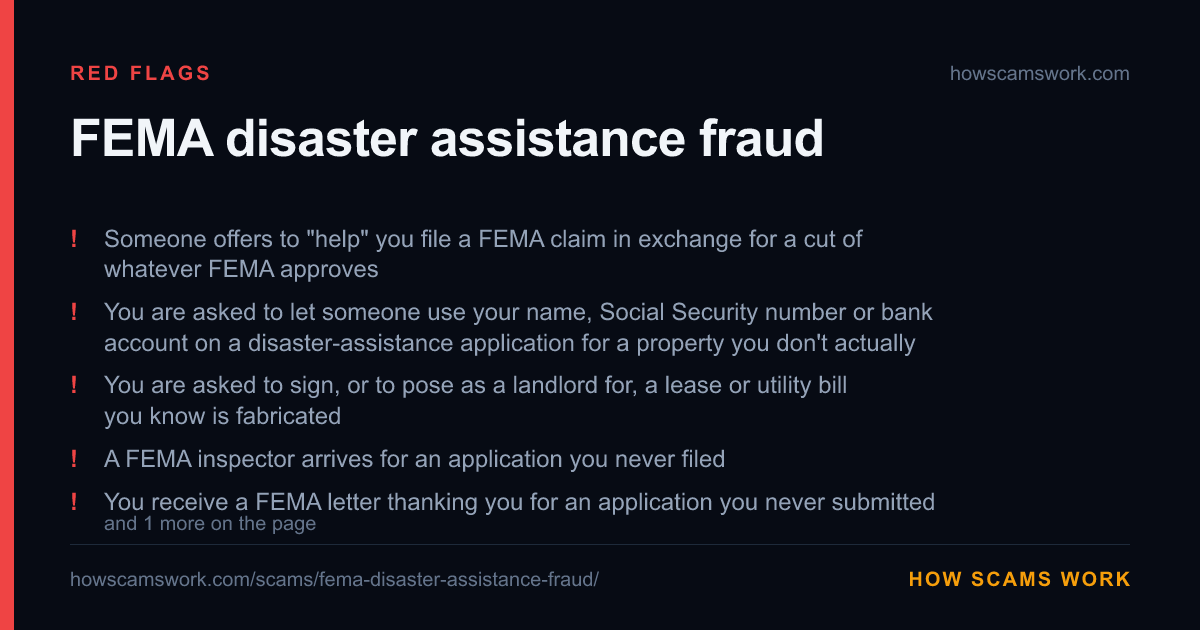
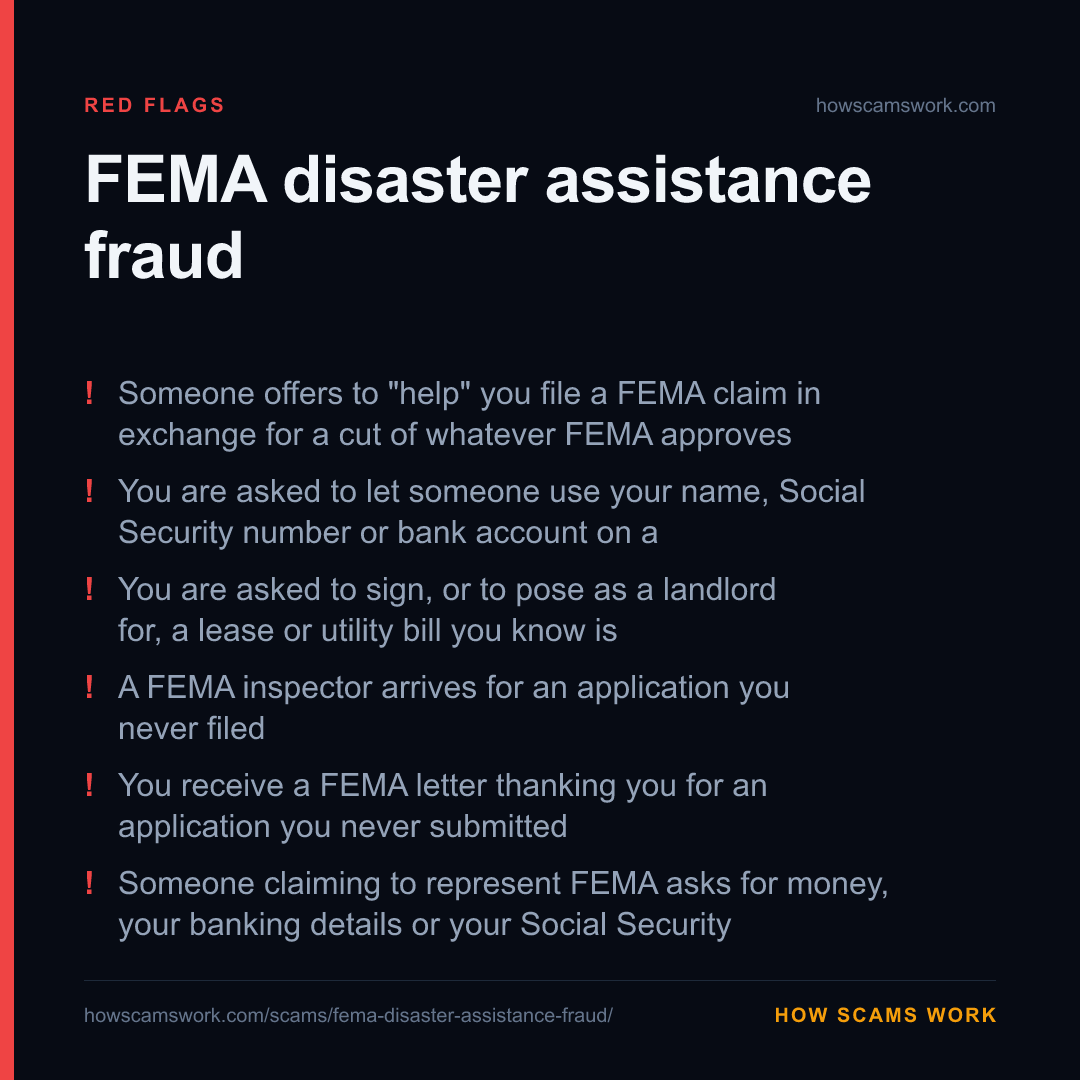
- Someone offers to “help” you file a FEMA claim in exchange for a cut of whatever FEMA approves. FEMA caseworkers and the FEMA Helpline never charge for help filing an application.
- You are asked to let someone use your name, Social Security number or bank account on a disaster-assistance application for a property you don’t actually live in.
- You are asked to sign, or to pose as a landlord for, a lease or utility bill you know is fabricated.
- A FEMA inspector arrives for an application you never filed. That can mean your identity was used without your knowledge; tell the inspector you did not apply so they can stop the processing.
- You receive a FEMA letter thanking you for an application you never submitted.
- Someone claiming to represent FEMA asks for money, your banking details or your Social Security number over the phone. FEMA staff carry photo ID and already have your application number; they do not ask for payment or financial account information.
If it’s happening to you
If someone is asking you to put your name on a disaster-assistance claim for a residence or loss that
isn’t real, decline and do not sign anything, whatever cut of the payout is offered.
- If you discover your identity was used on a FEMA application you never filed, call the FEMA
Helpline at 800-621-3362; they will stop further processing of that application and can help you file
a genuine one if you are actually entitled to assistance.
- If a FEMA inspector contacts you about an application you did not submit, tell them directly; this
is the fastest way to flag that your information may have been used without your consent.
- Keep every document connected to any disaster-assistance claim you were asked to sign or support,
including who approached you, what you were told the money was for, and any share of the payout you
were promised.
- Do not spend or move money you now have reason to doubt while you seek advice; in the documented
cases here, continued spending after an investigation begins was treated as further evidence, not a
defence.
- Report suspected FEMA fraud to the FEMA Disaster Fraud Hotline at 866-720-5721, by email to
[email protected], or to the Department of Justice’s National Center for Disaster Fraud
Hotline, also 866-720-5721. See where to report for other countries.
- If you were recruited to submit a claim without being told what it actually said about you, that
distinction, misled versus knowing, is exactly what a defence attorney needs to assess early, not
after a federal referral has already been made.
Where the money goes
Almost entirely domestic, moving directly from FEMA’s Individual Assistance program into whatever bank
account the application named, with no offshore network or cryptocurrency exchange in any of the
documented cases here.
Because FEMA pays the applicant directly rather than a landlord or employer, the fraud only has to
control that one account, the applicant’s own, or, in a recruitment scheme, dozens of recruited
participants’ accounts, each handing over a negotiated cut. What remains after that cut moves into
ordinary spending: Harris and Johnson’s combined $60,458 and Turner’s $28,195 were not shown to have gone
anywhere unusual, while Williams’s recruitment model meant her own take was roughly half of each
participant’s payout, repeated across nearly 200 people, rather than one lump sum. Because the money
stays inside the conventional US financial system throughout, recovery is also conventional: restitution
orders imposed years after the underlying disaster and the federal funds were already spent.
By the numbers
No published dataset breaks this scheme out as its own category yet, so there is no chart to show.
The data page explains which agency categories exist and why some schemes are
invisible in official statistics.
Every factual claim above traces to one of these. Statistics are reported losses; see
methodology for what that does and does not measure.