Also called: EB-5 scam · green card investment fraud · regional center fraud · immigrant investor program fraud · visa-for-investment scam
EB-5 fraud sells foreign nationals a route to US residency through an investment, then diverts the money. Investors cannot be guaranteed a visa, and a regional center's government designation is not approval of its projects. A Vermont project drew roughly $85 million from about 169 investors and was never built; its owner was sentenced to 60 months.
What it is
EB-5 is a US program that gives a foreign investor who puts money into a business that creates jobs a way to
apply for conditional lawful permanent residency. According to the SEC and USCIS, business owners apply to be
designated as regional centers, which offer investment opportunities in new commercial enterprises that may be
securities offerings. EB-5 fraud is an investment fraud that uses that program as its hook. A developer or
operator raises investor money for a project, collects administrative fees on top, and diverts the money for
other purposes, while the investors wait for a project that stalls and for a green card that may not come.
How it actually works
The pitch
A developer or regional center promises a project and a path to residency. In the Chicago case, according to
a press report, the developer fabricated a marketing package to attract investments from Chinese nationals,
and in the Utah case the SEC alleges a finder’s fee was paid to an entity that recruited investors.
The designation
The offering sits inside the regional center framework. The SEC and USCIS warn that a regional center’s
designation does not mean any government agency has approved the investments it offers.
Where it could have stopped
The investor alert says to confirm the regional center is designated by USCIS, to obtain the documents it gave USCIS, and to verify claims independently, for example by checking county records for permits. It also says guarantees about a visa or green card are warning signs of fraud.
The money goes in
Each investor pays the investment, typically $500,000 to $1 million according to Construction Dive, and an
administrative fee. In the
Vermont project about 169 investors put in roughly $85 million, and about $8 million was paid in
administrative fees.
The money goes somewhere else
In the documented cases, investor money was used for purposes unrelated to the project. The IRS account of the
Vermont case describes a $6 million payment to the IRS funded by a loan collateralized with investor funds,
and the SEC alleges in the Utah case that about $5 million was spent on a personal residence, a vacation
home, credit card bills, vehicles and a finder’s fee.
The project stalls
The Vermont facility was never built, and a judge called the project a ghost. In the Chicago case a press
report says the planned $900 million hotel and convention center never made it past the planning stages.
The visa clock
Toward the end of the two-year period of conditional residency, an investor has to be able to establish that
the job creation requirements were met. The SEC and USCIS’s alert says USCIS denies cases where eligibility
rules are not met, and in the Washington case Bisnow
reported that many investors had moved to the US on temporary visas and most had since been denied green cards.
Enforcement years later
The SEC filed the Chicago case in 2013 and froze assets, and later returned $147 million of frozen principal to
investors. The Vermont defendants were sentenced in 2022. The Utah case, filed in 2023, is an allegation with
no outcome found.
Why it works
The visa is the lure. In the Washington case, Bisnow reported that investors sold their properties in China
and many moved to the US on temporary visas. The SEC and USCIS warn that guarantees of a visa or its timing
are a sign of fraud, because investors are not guaranteed a visa.
A government designation sounds like approval. The alert states plainly that regional center designation
does not mean USCIS, the SEC or any other agency has approved the investments.
Fees are paid up front. Investors pay administrative fees on top of the investment, and in the Chicago case
the SEC and USCIS alleged that more than 90 percent of them were spent before USCIS had decided the visa
applications, despite a promise to return them if the applications were denied.
Layers of companies. The alert lists layers of companies run by the same individuals as a warning sign.
The documents look real. In the Vermont case investors received a use-of-funds chart that, according to the
IRS account, misstated the money two defendants would receive.
Where it comes from
Domestic in who runs it, international in who is recruited: the documented cases involve US developers raising
money from foreign investors, mostly Chinese nationals.
The earliest case here. The SEC filed the Chicago case in February 2013, and the SEC and USCIS issued
their joint investor alert later that year, in October 2013.
A pattern across states. The documented cases span Vermont, Illinois, Washington and Utah. The Washington
developer Lobsang Dargey, according to Bisnow, collected about $235 million from 280 Chinese investors and
diverted $24.2 million, according to prosecutors, and was sentenced to four years after pleading guilty.
Large and small. The documented amounts raised range from $18 million in the Utah case to about $158
million in Chicago.
Real cases
2023 US Ongoing $5.0m
The Securities and Exchange Commission alleges that Christofer Shurian and his entity Utah Regional Investment Fund, LLC raised $18 million between 2014 and 2020 in an EB-5 offering to Chinese investors for a resort in Garden City, Utah, and misappropriated approximately $5 million of it. The SEC says the money went on unapproved uses including a personal residence, a vacation home, personal credit card bills, vehicle purchases and a finder's fee to an entity that recruited EB-5 investors. The SEC filed its complaint in federal court in Utah on September 29, 2023. The charges are allegations, the defendants are presumed innocent unless a court finds otherwise, and this page found no outcome reported.
Read the case file ·
1 source
2022 US Sentenced $85.0m
Ariel Quiros, then of Puerto Rico and formerly of Key Biscayne, Florida, pleaded guilty in August 2020 to conspiracy to commit wire fraud, money laundering and concealing material facts from US Citizenship and Immigration Services over the AnC Vermont EB-5 project. The project aimed to raise $110 million from 220 immigrant investors to build a biotechnology facility in Newport, Vermont. From 2012 to 2016 about 169 investors put in roughly $85 million, and about $8 million was paid in administrative fees. The facility was never built. Quiros was sentenced in April 2022 to 60 months in prison, three years of supervised release and $8,338,600.77 in restitution.
Read the case file ·
1 source
2017 US Sentenced $11.0m
Anshoo Sethi, an Illinois developer, and two companies he controlled raised approximately $158 million from close to 300 foreign investors in an EB-5 offering for a hotel and convention center near O'Hare International Airport. The SEC filed suit in February 2013 and froze assets, and a federal court ordered $147 million of frozen principal returned to investors. The defendants settled the SEC's case in March 2014 without admitting or denying its allegations. Sethi separately pleaded guilty to wire fraud in 2016 and, according to a February 23, 2017 press report, was sentenced to three years in federal prison and $8.8 million in restitution.
Read the case file ·
3 sources
Red flags
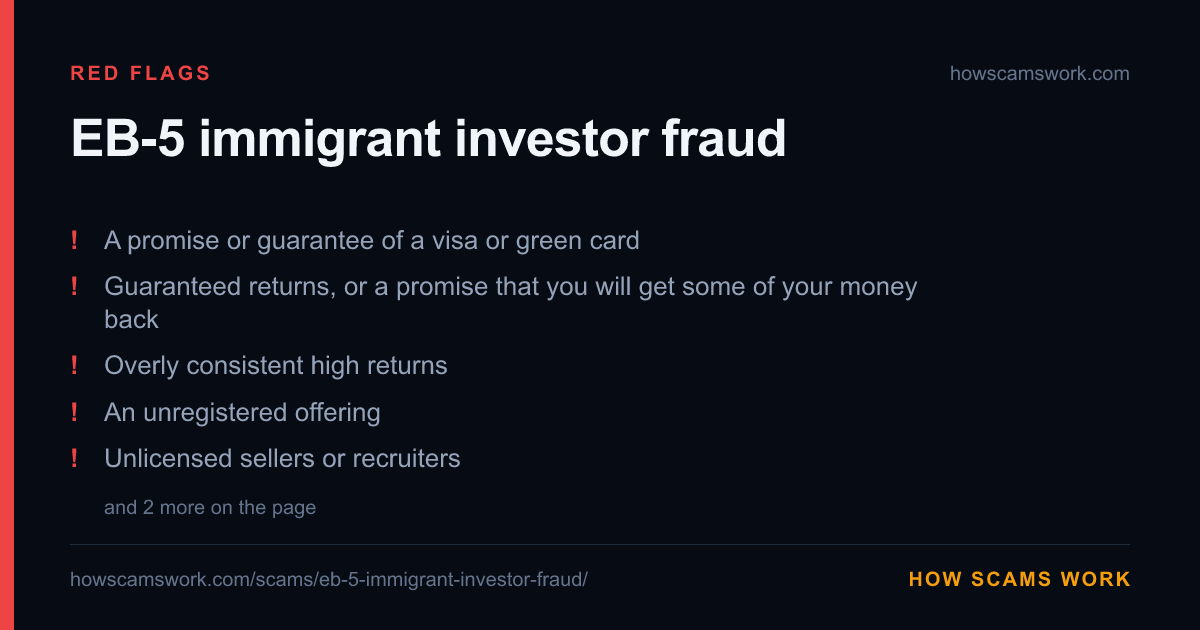
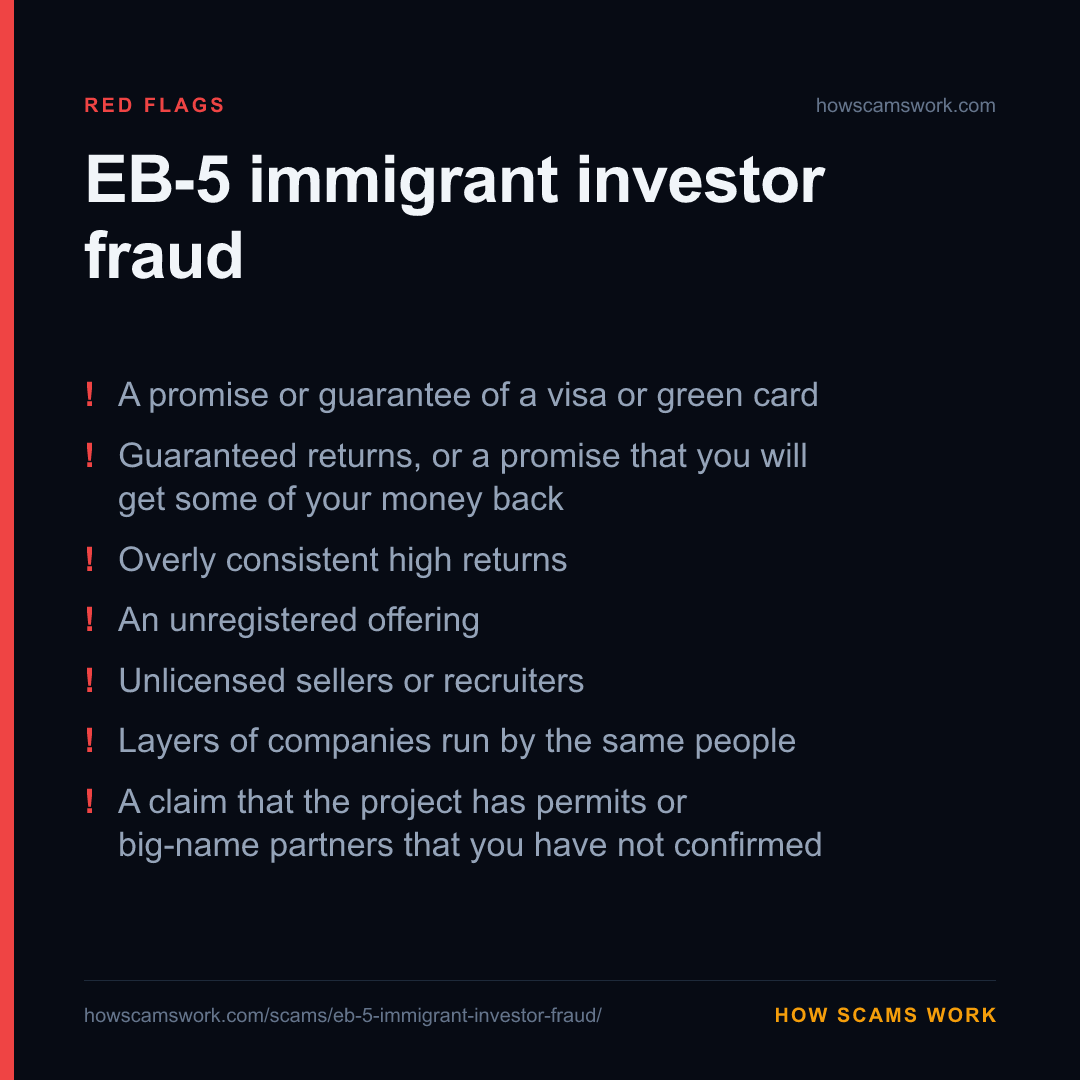
- A promise or guarantee of a visa or green card, or of when it will arrive.
- Guaranteed returns, or a promise that you will get some of your money back. The alert says EB-5 money must be at risk.
- Overly consistent high returns regardless of market conditions.
- An unregistered offering where management, products and finances are not disclosed.
- Unlicensed sellers or recruiters. The alert says regional center designation does not satisfy the licensing requirement.
- Layers of companies run by the same people.
- A claim that the project has permits or big-name partners that you have not confirmed independently.
If it’s happening to you
If you are considering an EB-5 investment, or think you were misled:
- Confirm the regional center is designated by USCIS on its list, and understand that designation is not
an endorsement.
- Ask for the documents the regional center gave USCIS and the investment terms in writing.
- Verify claims independently: check county records for permits, and go directly to any company said to be
involved.
- Be suspicious of any guarantee about a visa, returns, or refund of fees.
- Report suspected fraud to the authorities. See where to report for agencies in the
United States and in other countries.
Where the money goes
Entirely domestic once it arrives: from investors into the regional center or project company, then onward.
Investor money arrives in the project company’s accounts. In the documented cases, some of it went to uses
the project did not call for: in the Vermont case, a loan collateralized with investor funds paid $6 million to
the IRS; in the Utah case, the SEC alleges personal homes, credit card bills, vehicles and a finder’s fee; in
the Washington case, prosecutors said $24.2 million was diverted. In the Chicago case, a court ordered $147
million of frozen principal returned to investors.
By the numbers
No published dataset breaks this scheme out as its own category yet, so there is no chart to show.
The data page explains which agency categories exist and why some schemes are
invisible in official statistics.
Every factual claim above traces to one of these. Statistics are reported losses; see
methodology for what that does and does not measure.