Also called: double brokering · double-broker scheme · fictitious pickup · fake carrier cargo theft · freight identity fraud
Freight double brokering and fictitious carrier fraud is winning a shipment by posing as a legitimate trucking company or broker, then stealing the cargo or handing the load to another carrier and keeping the payment. An Illinois man was sentenced to five years after stealing more than $10.1 million in shipments.
What it is
Moving a truckload of freight usually involves three parties who may never meet. A shipper has goods, a broker finds a
carrier, and the carrier sends a driver. Each hand-off relies on a registration number, an email address and a phone
call.
These schemes use that chain. The thief takes the carrier’s place, either with an invented company or with a real one.
Once the load is released, the cargo is diverted and sold, or the load is passed to another carrier who does the
work and is never paid. The U.S. Attorney’s Office in San Diego calls the second form a double-broker scheme.
The victims differ by case: the shipper or broker whose goods vanish, the carrier that did the hauling and was never
paid, or the real company whose name was used. The sources describe the money lost, not any single victim count.
How it actually works
A carrier identity is obtained
The cases show four ways. In Illinois, the U.S. Attorney’s Office said the defendant used aliases to pose as an
employee of real and fictitious carriers and brokers, and Transport Topics said he used Department of Transportation
and motor carrier numbers tied to sham companies. In Los Angeles, the Justice Department said the conspirators
bought or fraudulently used real trucking companies, and one defendant met the owner of a Texas carrier to buy it for
approximately $22,000. In San Diego, the defendant stole the identity of
a real carrier. In Massachusetts, prosecutors allege a co-conspirator hacked a carrier’s email account.
A load is booked
The identity is used to bid on a real shipment. The Justice Department said the Los Angeles conspirators bid on
authentic shipping contracts. Transport Topics wrote that prosecutors said the Illinois scheme exploited load boards, and that
the defendant used the fictitious carriers to secure shipments.
The booking looks ordinary
In Massachusetts, prosecutors allege a co-conspirator, using the hacked account of a carrier, contracted with a
transportation business to ship goods to a customer in Florida. The booking came from a real carrier’s own email
account.
Where it could have stopped
In the cases here, the carrier on the booking was either real with new people behind it, entirely invented, or reached through a hijacked email account. A registration number or email address belonging to a real company did not show who was actually behind the booking.
Someone picks up the freight
In Massachusetts, prosecutors allege a driver arrived at a Worcester warehouse pretending to work for the carrier,
loaded 33,750 pounds of frozen snow crabs worth $325,000 and drove off. In Los Angeles, the Justice Department said a
co-conspirator picked up a load of televisions in Fontana on behalf of a carrier the ring had just bought.
The load goes somewhere else
The Illinois defendant, according to the U.S. Attorney’s Office, diverted loads to other locations and stole them. The
Los Angeles conspirators stole the cargo instead of delivering it. In the Massachusetts allegations, the crab went to a
grocery store business in Queens rather than to Florida.
Or the load is re-brokered and the haulers go unpaid
In the San Diego case, the defendant posed as a shipper and re-brokered the same loads to other carriers who
delivered them and who were unaware of the scheme. He collected payment and did not pay them.
The money and the case come later
The Illinois conduct ran from 2020 to 2023 and ended in a sentence in May 2026. The Los Angeles thefts ran from March 2024 to
June 2025, with verdicts in September 2026 and sentencing set for January 20, 2027. The San Diego defendant was arrested in
Italy and extradited in May 2022.
Why it works
A real number is not a real carrier. Registration numbers belong to companies, and the cases show them being
bought, copied, invented or reached through someone else’s mailbox. The sources describe what was done, not which
checks the victims ran.
The freight is valuable and easy to sell. The goods in these cases were electronics, appliances, liquor,
commercial-grade copper, seafood and cologne.
The work is spread across strangers. A broker hires a carrier, the carrier hires a driver, and the person who
pays is often a different person from the person who hauled. In San Diego the carriers that delivered were
unaware.
Some of it happens abroad. The San Diego defendant ran most of his scheme from Tijuana and was arrested in Italy.
Enforcement lags. The Illinois conduct ended in 2023 and the sentence came in 2026. The Los Angeles conduct ended in June 2025
and the verdict came in September 2026.
Where it comes from
The cases here are in Illinois, California and Massachusetts, with one defendant working from Mexico. The Justice
Department’s Trade Fraud Task Force investigated the Illinois case. The Department of Transportation’s Office of
Inspector General investigated the San Diego case. IRS Criminal Investigation and the FBI’s Inland Violent Crime
Suppression Task Force were among the agencies on the Los Angeles case.
The start date is not established. The earliest conduct in the four cases below is from 2020. This page does not
claim the scheme began then, only that it is the earliest date these sources document.
Scale ranges widely. The Los Angeles ring’s estimated loss was at least $2 million, the San Diego restitution
$239,904 and the Illinois theft more than $10.1 million.
The industry totals are estimates. Insurance Journal cited Verisk CargoNet estimates of nearly $725 million in
losses and an average theft value of $273,990, and Transport Topics cited $6.6 billion a year for cargo theft overall.
These counts are not limited to the fraud described here.
Real cases
2026 US Charged (allegation, not conviction)
Federal prosecutors in Massachusetts charged a New York man in February 2026 with conspiring to use the hacked email accounts of legitimate truckload carriers to book cargo, then take it and sell it. They allege that on July 15, 2025 he loaded 33,750 pounds of frozen snow crab worth $325,000 at a Worcester warehouse by pretending to work for a carrier. These are allegations. He is presumed innocent unless and until proven guilty.
Read the case file ·
1 source
2026 US Convicted $2.0m
A federal jury in Los Angeles found two Indian nationals guilty on September 29, 2026 of conspiring to steal cargo from warehouses by buying or fraudulently using legitimate trucking companies to bid on authentic shipping contracts, picking up the loads and never delivering them. The Justice Department said the thefts ran from March 2024 to June 2025, with an estimated loss of at least $2 million. Sentencing is set for January 20, 2027.
Read the case file ·
1 source
2026 US Sentenced $10.1m
An Elk Grove Village, Illinois man used aliases from 2020 to 2023 to pose as an employee of real and fictitious motor carriers and freight brokers. He persuaded companies to release loads to him, then diverted them and stole them. The U.S. Attorney's Office said he and others intended to steal at least $14.6 million in goods and stole more than $10.1 million, including liquor and commercial-grade copper. He pleaded guilty to wire fraud in December 2025 and was sentenced on May 6, 2026 to five years.
Read the case file ·
2 sources
2023 US · MX Sentenced $239,904
Alexis Castillo Padilla, a Tijuana resident, stole the identity of a Spring Valley, California interstate carrier, agreed to make deliveries as that carrier, then posed as a shipper and re-brokered the same loads to other carriers who delivered them. He collected the payments and did not pay those carriers. He pleaded guilty to four counts of wire fraud in October 2022 and was sentenced on February 23, 2023 to 30 months, with restitution of $239,904.
Read the case file ·
2 sources
Red flags
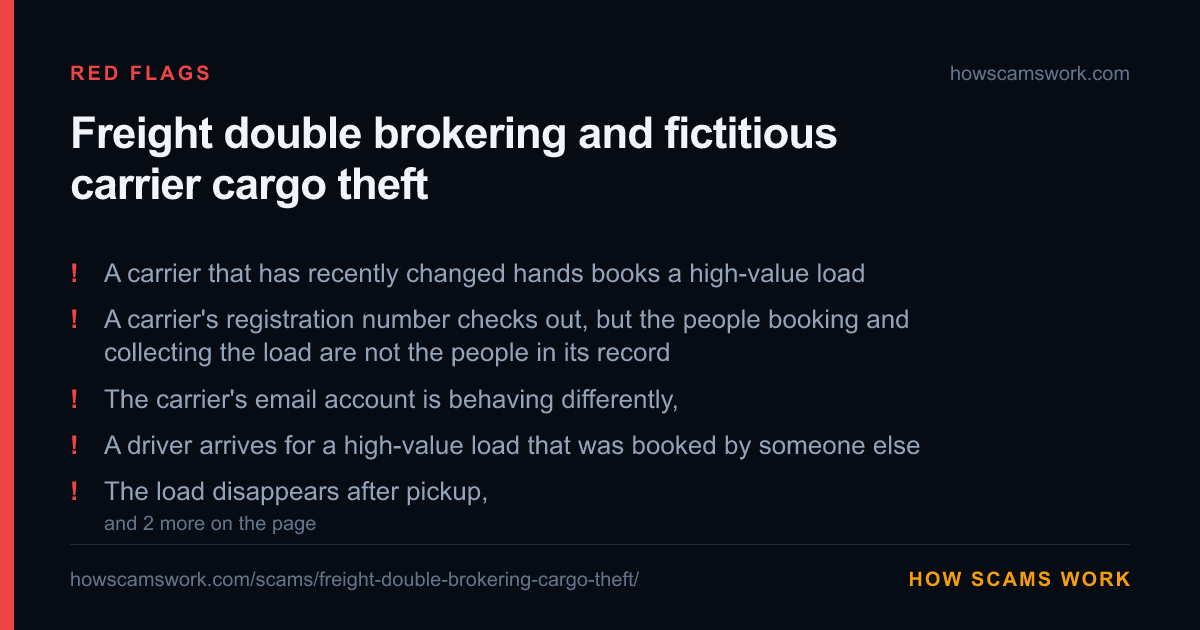
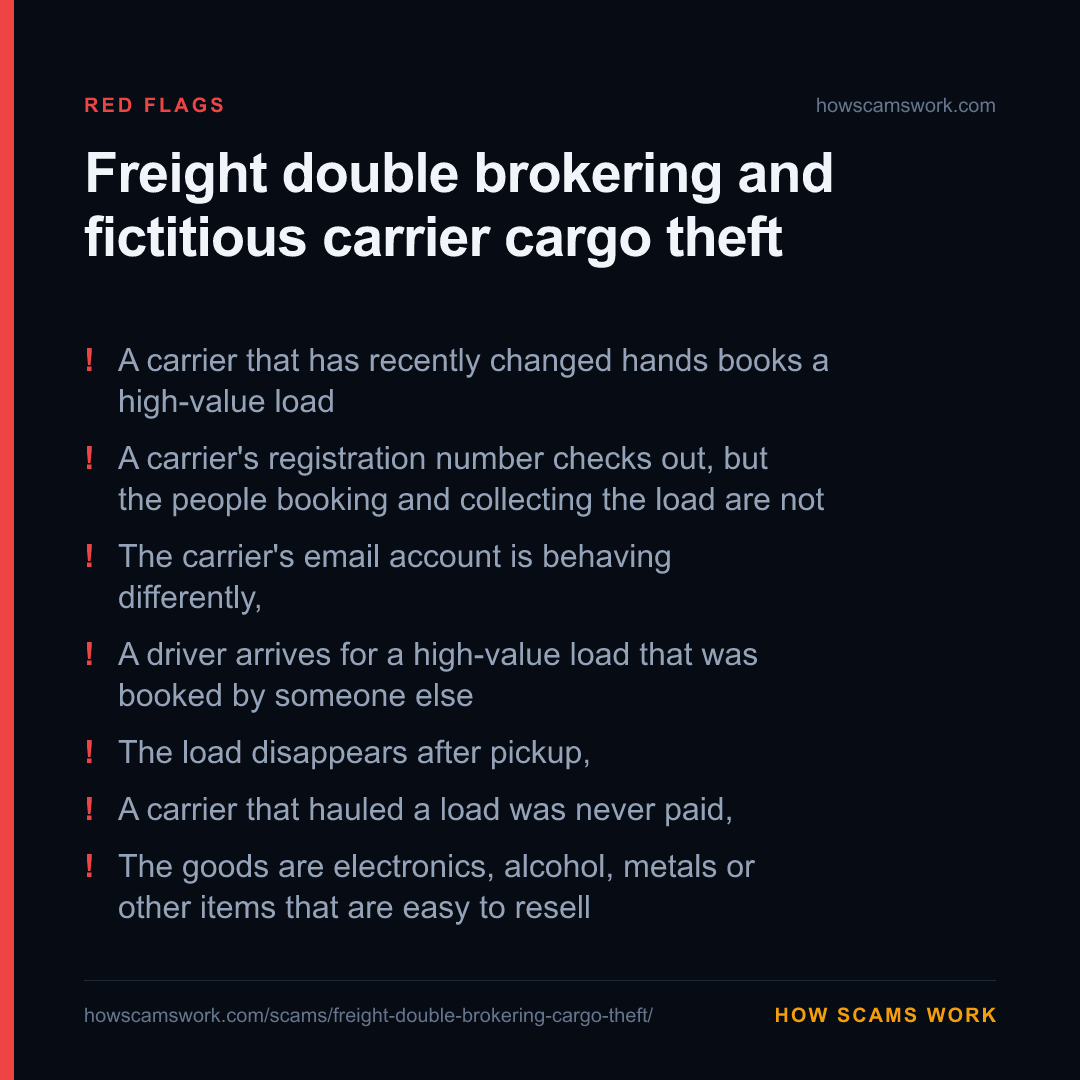
- A carrier that has recently changed hands books a high-value load. The Los Angeles ring bought established carriers and used them within weeks.
- A carrier’s registration number checks out, but the people booking and collecting the load are not the people in its record. The Illinois case used numbers tied to sham companies.
- The carrier’s email account is behaving differently, since prosecutors in Massachusetts allege a hacked mailbox was used to book a load.
- A driver arrives for a high-value load that was booked by someone else.
- The load disappears after pickup, as in the Los Angeles and Illinois cases.
- A carrier that hauled a load was never paid, as in San Diego.
- The goods are electronics, alcohol, metals or other items that are easy to resell.
If it’s happening to you
- If you are a shipper or broker, stop releasing further loads to the carrier in question, and keep the booking
emails, documents and payment records exactly as they are.
- If you are a carrier whose name was used, tell the brokers and shippers you work with, and review who has access to your
email account. Check whether anyone is booking loads in your name.
- If you hauled a load and were not paid, keep the dispatch, delivery and invoice records. The San Diego case shows the hauler
may be a victim of someone using another carrier’s name.
- Report it to the police where the cargo was taken, and to the FBI’s Internet Crime Complaint Center at
ic3.gov. The FMCSA registration page lists a Fraud Alerts section and a Contact Us option. See
where to report for other countries.
- Tell your insurer promptly. This page does not say what a given policy covers.
Where the money goes
The sources document little of the money trail. In the San Diego case the defendant collected payments for deliveries
other carriers performed and did not pay them; he agreed to restitution of $239,904. In the Massachusetts
allegations, the stolen crab was taken to a grocery store business in Queens and the other goods were offered or sold
to a phone contact. In Illinois, the sentence carried $10.3 million in restitution to 24 companies, according to
Transport Topics.
The Los Angeles verdicts came in September 2026 and the sources do not state a restitution figure. None of the
sources say how much of any court-ordered amount has been collected.
By the numbers
No published dataset breaks this scheme out as its own category yet, so there is no chart to show.
The data page explains which agency categories exist and why some schemes are
invisible in official statistics.
Every factual claim above traces to one of these. Statistics are reported losses; see
methodology for what that does and does not measure.
Common questions
What is double brokering?
In the San Diego case, the U.S. Attorney's Office described it this way: the defendant stole the identity of a carrier and agreed to deliver loads in its name, then posed as a shipper and re-brokered the same loads to other carriers, who delivered the freight. He collected the payments and did not pay them. That is a fraud on the carriers who hauled the load and on the carrier whose identity was used.
How do thieves get a load released to them?
The four cases here describe four routes: posing as employees of real and invented carriers and brokers with registration numbers tied to sham companies, buying established trucking companies and bidding on real contracts, stealing a carrier's identity, and using a carrier's hacked email account to book a shipment. Each gives the shipper or broker a carrier that looks real.
Who loses money?
Several parties, depending on the case. In the Chicago case the companies whose cargo was stolen were ordered to receive $10.3 million in restitution, according to Transport Topics. In the San Diego case the carriers that hauled the freight were not paid. In the alleged Massachusetts case the charging documents name goods worth $325,000 and about $433,830 taken in separate thefts. This page does not measure the cost to insurers.
Is the fraud getting more common?
The sources do not settle it. Insurance Journal reported in February 2026, citing Verisk CargoNet, that estimated cargo theft losses had surged 60 percent from 2024 numbers to nearly $725 million, and that confirmed incidents had risen 18 percent. Transport Topics cited an industry estimate of $6.6 billion a year for cargo theft overall. Those figures come from industry trackers, not from a count of fictitious carrier cases, and this page does not verify them.
Has anything changed to make it harder?
The Federal Motor Carrier Safety Administration's registration page says it partnered with IDEMIA to perform identity document capture and verification, and will require new registrants to pass an identity proofing check. It also says its new USDOT Registration System, Motus, launched in May 2026 and takes over from its legacy registration systems. This page has no measurement of whether fraud has fallen since.
I think a load was stolen using my company's name. What should I do?
Tell the brokers and shippers you work with, keep the load records and any emails, and report it to the police where the cargo was taken and to the FBI's Internet Crime Complaint Center at ic3.gov. The FMCSA registration page also lists a Fraud Alerts section and a Contact Us option. See where to report for other countries.