Also called: solar panel scam · predatory solar loans · free solar scam · rooftop solar bait-and-switch · solar savings scam
Home solar sales fraud sells rooftop panels with false promises, "free" systems, tax credits that don't apply, savings that never arrive, while the real cost sits in a long loan the homeowner signed on a tablet. In 2026 New York sued a solar company and two lenders, alleging about $275 million was generated this way in the state.
What it is
A homeowner is offered rooftop solar, sometimes a “free” roof, sometimes a system that will “replace” the
electric bill, and ends up with a loan they didn’t understand, for a system that saves less than
promised or doesn’t work as promised at all.
Selling solar is legal. What the enforcement cases below describe is the way it was sold: false claims
about savings and government incentives, callers implying a link to a utility or an agency, contracts
signed on a tablet without being reviewed, and financing costs folded into the price. Everything about
individual companies on this page is drawn from government announcements or press reports of them, and
they are allegations unless a case says otherwise.
The scale in the biggest recent case is large. New York’s Attorney General alleges that Attyx, formerly
SUNco, generated about $275 million in the state through the conduct described in the complaint.
How it actually works
The hook
An ad on social media offers a free roof or free solar panels, or a phone call arrives, in the Arizona
and FTC case, the alleged call volume ran to tens of millions of calls to numbers on the Do Not Call
Registry.
The borrowed authority
According to the FTC and Arizona, some callers falsely claimed an affiliation with a utility or a
government agency, and told consumers their monthly payment would replace their electric bill.
The visit and the tablet
A salesperson visits and has the homeowner e-sign on a tablet. New York’s complaint alleges contracts were
unsigned or not reviewed with the customer.
Where it could have stopped
This is the moment to stop: no signature on the day of the pitch. Connecticut’s Vision Solar judgment makes a ban on same-day contract signing an industry standard, and a real offer can survive a night of reading the loan terms.
The loan behind the offer
The “free” or “no-cost” system is financed. New York alleges lending fees were hidden inside inflated
prices, and reporting describes one homeowner’s loan at $160,000.
The claimed incentives
Buyers are told that government incentives and tax credits will offset the cost. New York alleges these were
misrepresented, and that the targets were households unlikely to qualify.
Installation, delay or failure
Connecticut’s judgment cites unpermitted work that left systems unable to connect to the grid and, in some
cases, systems never activated. Arizona’s release alleges installation delays meant customers paid for
financing and their old utility bill at once.
The bill keeps coming
The loan payments continue regardless. Texas’s 2026 lawsuit against CAM Solar alleges customers kept being
charged for panels that had been removed or damaged; the suit seeks civil penalties and compensation.
Why it works
The pitch fits a real worry. Electric bills are a genuine pressure on households, and Connecticut’s
Attorney General framed his warning to homeowners around exactly that.
“Free” and “no money down” hide a financing decision. The price is spread over a loan, so the number
that gets discussed at the door is a monthly payment, not the total repaid.
A tablet moves faster than reading. Signing on a screen at the kitchen table, in the alleged New York
cases, replaced the pause in which a buyer might have read the terms.
Incentives sound official. Talk of government programs and tax credits, or a caller implying a utility
link, borrows credibility the seller doesn’t have, and the FTC and Arizona say some callers falsely
claimed affiliations.
The targets are less able to recover. New York alleges older and fixed-income households were
deliberately sought out; a large loan is hardest to absorb for exactly those homeowners.
Where it comes from
This is a domestic sales-practices problem, enforced mostly through state attorneys general and civil suits
rather than criminal prosecution.
Enforcement is state by state. New York, Connecticut, Arizona and Texas are each cited here, and
Connecticut lists further pending suits against other companies, including Sunrun Inc. Those are pending
and are not findings.
Lenders are being drawn in. New York names two lenders as defendants, and Connecticut settled with a
lender to Vision Solar’s customers in 2025.
Judgments can be hollow. Connecticut’s $5 million judgment against Vision Solar can’t be paid from company
assets after its bankruptcy, which is why the state pointed consumers to its Home Improvement Guaranty Fund.
Complaint volumes vary. In the Texas coverage cited here, CAM Solar drew 8 complaints to the Texas
Attorney General’s office over five years, compared with 123 for Sunrun and 81 for Sunnova in the same
period as reported; a complaint count is not a finding.
Real cases
2026 US Ongoing
On March 17, 2026, New York Attorney General Letitia James sued Attyx LLC (formerly SUNco), two of its CEOs, and the lenders Solar Mosaic and WebBank, alleging the company sold solar systems and home repairs as free, misrepresented government incentives, and left homeowners, many of them elderly or on fixed incomes, with loans they had not understood. The complaint puts the amount generated in New York at approximately $275 million. The case is a pending civil lawsuit; none of the allegations have been decided by a court.
Read the case file ·
2 sources
2024 US Settled
In October 2024 a Hartford Superior Court judge entered a $5 million stipulated judgment in the Connecticut Attorney General's suit against Vision Solar, which had been accused of high-pressure sales tactics, misrepresentations, delays and unpermitted work that left some systems unable to connect to the grid, and of pressuring consumers into loans they could not afford. Vision Solar had filed for bankruptcy and is not reorganizing, so it does not have assets to pay the judgment.
Read the case file ·
2 sources
2023 US Settled
In July 2023 the FTC and the Arizona Attorney General sued Vision Solar LLC, Solar Xchange LLC (also doing business as Energy Exchange) and Solar Xchange's owner, Mark Getts. The complaint alleged tens of millions of calls to numbers on the Do Not Call Registry, callers who falsely claimed affiliation with a utility or government agency, and misstated energy-bill savings. Solar Xchange and Getts agreed to a proposed order with a $13.8 million civil penalty, partially suspended.
Read the case file ·
2 sources
Red flags
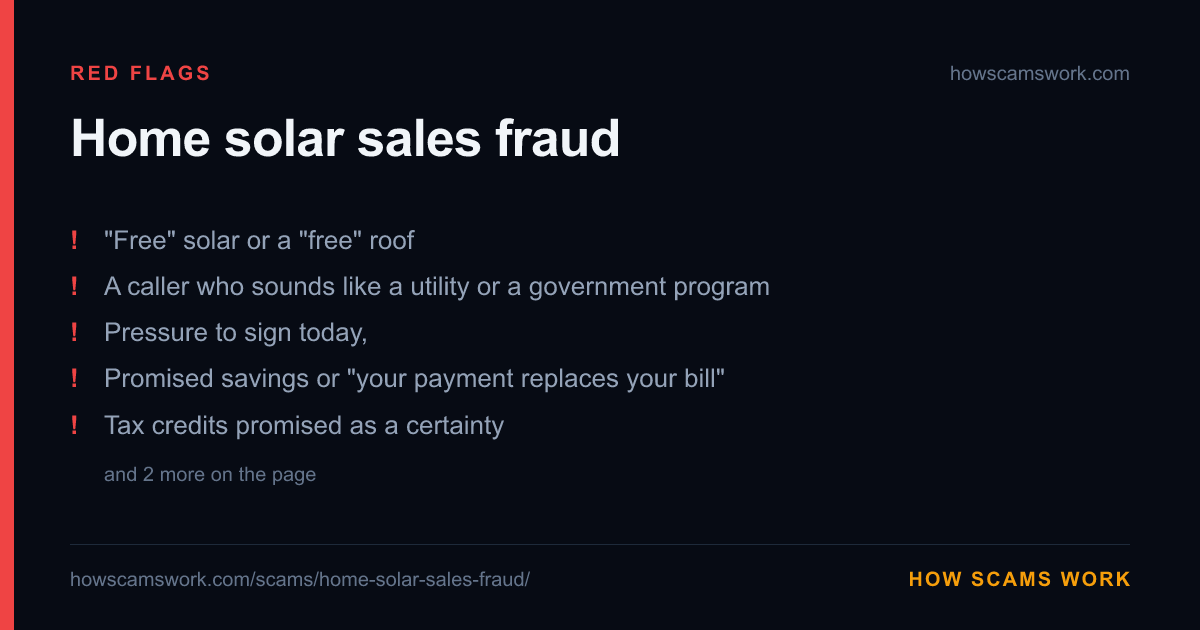
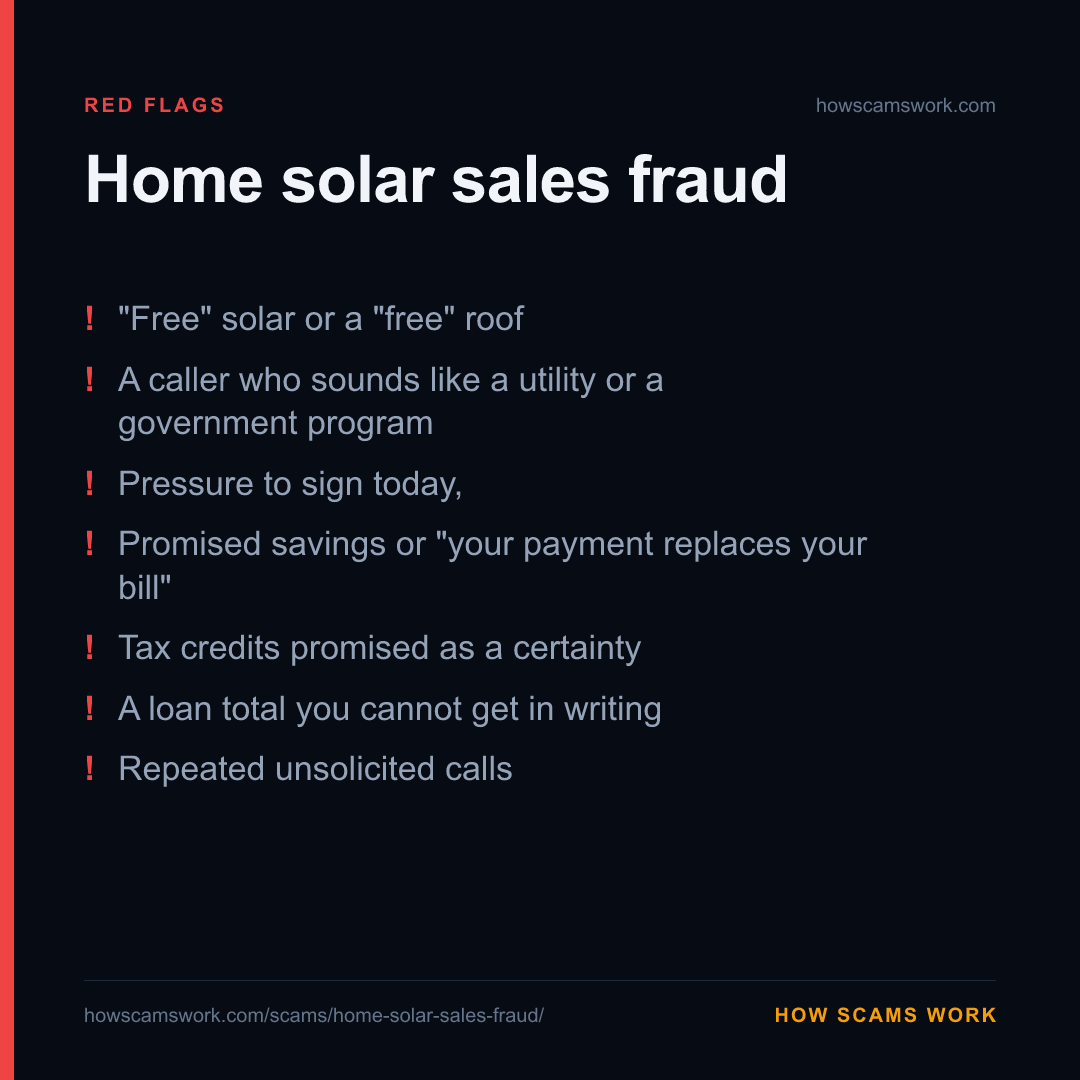
- “Free” solar or a “free” roof. Someone is paying; ask who, and where the loan is.
- A caller who sounds like a utility or a government program. Hang up and call your utility using the number on your bill.
- Pressure to sign today, or a tablet handed over before you’ve seen the full loan terms.
- Promised savings or “your payment replaces your bill” with nothing in writing to support it.
- Tax credits promised as a certainty. Whether you qualify depends on your own tax situation, not on the salesperson.
- A loan total you cannot get in writing before signing.
- Repeated unsolicited calls to a number on the Do Not Call Registry.
If it’s happening to you
Don’t sign anything on the day it is offered, and don’t sign anything on a screen you haven’t been able to read in full.
- Ask for the total you’ll repay and the loan terms in writing, separate from the sales pitch.
- Check the company against your state attorney general’s press releases and complaint records.
- Ask a tax professional about any incentive you’re being promised before you rely on it.
- If you’ve already signed, read your contract for cancellation rights and act quickly; look up your state’s rules for home-improvement contracts and ask your attorney general’s office what applies.
- Keep everything: the ad, texts, contract, loan documents and payment records.
- Report it to your state attorney general’s consumer protection division and to the FTC at ReportFraud.ftc.gov. Unwanted sales calls can also be reported to the FTC. See where to report for other countries.
- Look for a state relief fund or settlement. Connecticut, for example, has a Home Improvement Guaranty Fund with up to $25,000 per eligible consumer.
Where the money goes
Mostly through ordinary lending and contracting channels, not a laundering chain. The homeowner’s loan
pays the installer and the lender, and the alleged harm is in the price and terms rather than in hidden
movement of funds.
New York alleges lending fees were concealed inside inflated prices, so part of what the homeowner repays
goes to the lender as a fee the customer wasn’t told about. When a company fails, as Vision Solar did,
there may be nothing left to pay a judgment, and what recovery exists comes from a state fund or from a
separate lender settlement.
By the numbers
No published dataset breaks this scheme out as its own category yet, so there is no chart to show.
The data page explains which agency categories exist and why some schemes are
invisible in official statistics.
Every factual claim above traces to one of these. Statistics are reported losses; see
methodology for what that does and does not measure.