Also called: fake nursing diploma scheme · nursing diploma mill · Operation Nightingale · fraudulent nursing credential scheme · fake RN diploma scheme
Nursing diploma mill fraud sells a diploma and transcript claiming coursework and clinical hours that never happened, letting a buyer sit the national nursing licensing exam without the required training. The Justice Department's 2023 Operation Nightingale found Florida schools had sold more than 7,600 fake diplomas for $10,000 to $17,000 each, and about 2,400 buyers went on to pass the exam and work as nurses.
What it is
A school sells a nursing diploma and a transcript showing classroom coursework and hundreds of hours of
supervised clinical training. None of it happened. The buyer pays, takes the paperwork to a state board
of nursing, and sits for the same national licensing exam a real graduate would sit for.
The federal government’s name for this, when it broke open in Florida in 2023, was Operation
Nightingale: three nursing schools that had sold more than 7,600 fraudulent diplomas and
transcripts to people who paid $10,000 to $17,000 each for them. About 2,400 of those buyers went
on to pass the licensing exam and take jobs as registered or practical nurses, among them a Georgia
hospital, a New Jersey assisted living facility, and Department of Veterans Affairs medical centers in
Maryland and New York.
The schools were real, and briefly licensed by Florida to issue nursing diplomas. That is what made the
paperwork hard to catch: a transcript from an accredited program is exactly what an employer, and a state
licensing board, are built to trust.
How it actually works
The pitch
A recruiter finds someone who is struggling to finish or pass an accredited nursing program, and offers a
shortcut: a diploma and transcript from a school that will show the coursework and clinical hours as
already complete.
The fee
The buyer pays, in cash in the documented Florida cases, $10,000 for a practical nurse (LPN/VN) diploma or
$17,000 for a registered nurse (RN) diploma, according to prosecutors and an undercover purchase by
federal agents.
Backdated paperwork
School staff fabricate a transcript showing specific coursework and hundreds of supervised clinical hours
that the buyer never completed, dated as though they happened over months or years of real attendance.
A warning sign already on the record
Where it could have stopped
Florida’s own state licensing review had already flagged suspiciously low pass rates on the national nursing exam at these schools years before any federal charge was filed, which is part of why the state terminated the Palm Beach School of Nursing’s license to issue diplomas in 2017. A pattern visible to a state regulator took years longer to become a federal fraud case.
The exam the buyer still has to pass
The diploma does not grant a license by itself. It only gets the buyer registered to sit the National
Council Licensure Examination, which every candidate still has to pass on their own.
A license, a real patient
About 2,400 of the roughly 7,600 buyers, just under a third, passed the exam and went to work as nurses in
multiple states, including at hospitals, assisted living facilities and VA medical centers, with none of
the clinical training their paperwork claimed.
The federal takedown
An FBI tip in 2019 led to an undercover purchase of a fraudulent diploma for $17,000. On January 25, 2023,
the Justice Department charged 25 people; three went to trial and were convicted by a jury that December.
Sorting the real from the fake
After the charges, state boards in New York, Washington, Delaware, Georgia and Texas moved against
hundreds of license holders tied to the closed schools, a process complicated by the fact that some
people who attended the same schools had completed real coursework and were not part of the fraud.
Why it works
The underlying need is real. Nursing programs have demanding, expensive clinical requirements, and
some students who cannot finish or pass them are specifically the audience a recruiter looks for.
A real school’s name does the trust-building. The diploma and transcript came from institutions
Florida had actually licensed to issue nursing credentials, not from an obviously fake website. An
employer checking a transcript against an accredited school’s name has no reason, on paper, to doubt it.
The exam is a real obstacle, which makes the fraud look smaller than it is. Because about two-thirds
of buyers never passed the National Council Licensure Examination at all, it can look like the exam itself
is the safeguard working. For the roughly 2,400 who did pass, the exam tested their book knowledge, not
whether they had ever actually performed a single hour of the clinical training their transcript claimed.
No one was independently checking clinical hours against attendance. A transcript’s hours are
self-reported by the school that issued it. Nothing in the licensing process cross-checks those hours
against an independent attendance record, which is precisely the gap a corrupt school is positioned to
exploit from the inside.
A known warning sign moved slowly. Low exam pass rates at these schools were visible to Florida’s own
regulators years before any criminal charge, triggering an administrative license termination rather than
an immediate fraud investigation.
Where it comes from
Entirely domestic, built on real institutions rather than hidden overseas operations.
The schools were real, briefly. Florida had licensed the Palm Beach School of Nursing, Siena College
and Sacred Heart International Institute to issue nursing diplomas. The fraud was not a fake school
invented from nothing; it was a real school’s own staff selling its real paperwork for coursework that
never happened.
The investigation began with a single tip, in a different state. An FBI undercover operation that
led to the 2023 charges traced back to a 2019 tip out of Maryland, years before the Justice Department’s
public takedown.
Recruiting ran through at least three states beyond Florida. Search warrants in the federal
investigation were executed in Delaware, New York, New Jersey and Texas, as well as Florida, reflecting a
buyer network that traveled to Florida-licensed schools specifically to obtain the fraudulent paperwork.
Enforcement here is criminal, not civil. Unlike some fraud schemes pursued only through fines and
bans, the Justice Department charged the operators and recruiters in this case with wire fraud and
conspiracy to commit wire fraud, carrying a 20-year statutory maximum per count, and three defendants were
convicted at trial.
Real cases
2024 US Sentenced $1.4m
Vilaire Duroseau owned and operated the Center for Advance Training and Studies in West Orange, New Jersey, which the Justice Department's "Operation Nightingale" investigation identified as another recruiting operation feeding candidates toward fraudulent Florida nursing diplomas. A federal jury convicted Duroseau of wire fraud in December 2023 after trial alongside co-defendants Gail Russ and Cassandre Jean. On April 2, 2024, US District Judge Raag Singhal sentenced Duroseau to 33 months in federal prison, three years of supervised release, and ordered forfeiture of $1,381,913.40, with instructions to surrender to authorities in Newark on April 5, 2024.
Read the case file ·
3 sources
2024 US Sentenced $861,672
Gail Russ was the registrar of the now-closed Palm Beach School of Nursing in Lake Worth Beach, Florida, one of the schools at the center of the Justice Department's "Operation Nightingale" investigation into fraudulent nursing diplomas. A federal jury in Fort Lauderdale convicted Russ of wire fraud in December 2023 after a roughly three-week trial, finding she had helped produce and sell fraudulent diplomas and transcripts showing nursing coursework and clinical hours that were never completed. On April 2, 2024, US District Judge Raag Singhal sentenced Russ to 78 months in federal prison, three years of supervised release, and ordered her to forfeit $861,672.
Read the case file ·
3 sources
2024 US Sentenced $4.7m
Cassandre Jean owned and operated Success Nursing Review in Brooklyn, New York, which the Justice Department's "Operation Nightingale" investigation identified as a recruiting hub funneling out-of-state candidates toward fraudulent Florida nursing diplomas. A federal jury convicted Jean of wire fraud in December 2023 after trial. On April 2, 2024, US District Judge Raag Singhal sentenced Jean to 36 months in federal prison, three years of supervised release, a $20,000 fine, and ordered forfeiture of $4,698,828, the largest individual forfeiture among the three defendants sentenced that day.
Read the case file ·
3 sources
2023 US Sentenced $3.5m
Johanah Napoleon was the former president and owner of the Palm Beach School of Nursing in Lake Worth Beach, Florida, one of the schools at the center of the Justice Department's "Operation Nightingale" investigation. Rather than face trial, Napoleon pleaded guilty in 2022 to conspiracy to commit health care fraud and wire fraud, and to a related wire fraud count, and began cooperating with prosecutors. On July 18, 2023, a federal judge in Fort Lauderdale sentenced her to one year and nine months in prison and ordered her to pay approximately $3.5 million, roughly $2.6 million of which she had already paid from the sale of three real estate properties before sentencing. Her cooperation included testifying as the prosecution's main witness in the later trial of three co-defendants, Gail Russ, Cassandre Jean and Vilaire Duroseau.
Read the case file ·
3 sources
Red flags
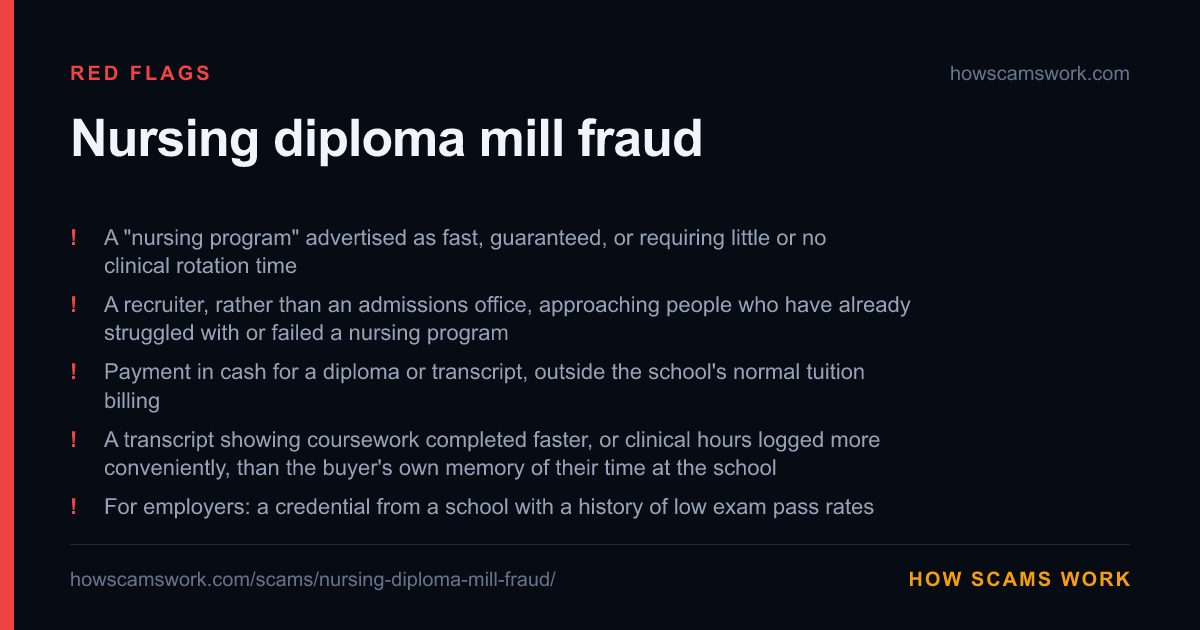
- A “nursing program” advertised as fast, guaranteed, or requiring little or no clinical rotation time. Every accredited RN or LPN/VN program has a clinical-hours requirement set by the state board of nursing; there is no lawful way around it.
- A recruiter, rather than an admissions office, approaching people who have already struggled with or failed a nursing program. Legitimate schools do not need to recruit people out of other schools’ failing students.
- Payment in cash for a diploma or transcript, outside the school’s normal tuition billing. Both documented price points in this scheme, $10,000 and $17,000, were paid this way.
- A transcript showing coursework completed faster, or clinical hours logged more conveniently, than the buyer’s own memory of their time at the school.
- For employers: a credential from a school with a history of low exam pass rates, the exact pattern Florida’s own licensing review flagged at all three schools in this case before any federal charge.
If it’s happening to you
If you were sold a fraudulent diploma or transcript, stop using it immediately and speak to a lawyer
before contacting any licensing board yourself. The federal cases here charged sellers and recruiters with
wire fraud and conspiracy; buyers’ own legal exposure has depended on what they knew and when, which is a
fact-specific question a lawyer, not a licensing board call center, should help answer first.
If you are an employer verifying a nurse’s credentials, use Nursys, the national licensure database run
by the National Council of State Boards of Nursing. Its free Licensure QuickConfirm tool for employers and
recruiters shows a nurse’s current license status and any public discipline, and its e-Notify service
sends an automatic alert if that status changes. It confirms the license is real; it does not independently
verify that the training behind it happened, which is the specific gap this scheme exploited.
If you are a patient wanting to confirm a nurse’s license, ask the facility, which should already be
using Nursys or your state board of nursing’s own public license lookup.
- Report suspected credential fraud to the HHS Office of Inspector General at 1-800-HHS-TIPS
(1-800-447-8477) or TIPS.HHS.GOV, since federal benefit programs and the national exam system are both
implicated.
- Report it to your state board of nursing directly if you have specific, firsthand knowledge of a
fraudulent credential, rather than relying on a licensing board to catch it through a routine audit
alone, the gap that let this scheme run for years.
- See where to report for agencies outside the United States.
Where the money goes
Straight from the buyer’s own pocket to the school, in cash, with no laundering chain or overseas transfer
in any of the documented cases here. A buyer paid $10,000 or $17,000 directly to the school’s operators and
recruiters, who split the proceeds between themselves and the school’s own accounts.
What moved afterward was the reverse: courts ordered the convicted operators to forfeit a share of what
they had collected. Gail Russ, the Palm Beach School of Nursing’s registrar, forfeited $861,672;
Cassandre Jean, who ran a Brooklyn school, forfeited nearly $4.7 million; Vilaire Duroseau, who ran a
New Jersey school, forfeited over $1.3 million; and Johanah Napoleon, the Palm Beach school’s former
president, was ordered to pay $3.5 million, which she had begun satisfying by selling three real estate
properties even before sentencing.
That forfeiture money goes to the US Treasury’s Assets Forfeiture Fund, not back to any individual victim,
since the scheme has no discrete class of people who lost a specific dollar amount the way a romance scam
or an investment fraud victim does.
By the numbers
No published dataset breaks this scheme out as its own category yet, so there is no chart to show.
The data page explains which agency categories exist and why some schemes are
invisible in official statistics.
Every factual claim above traces to one of these. Statistics are reported losses; see
methodology for what that does and does not measure.