Also called: pill mill · pain clinic pill mill · shots-for-pills scheme · cash-pay pill mill · rogue pain clinic
Pill mill fraud is a pain clinic or doctor's office that writes medically unnecessary prescriptions for opioids and other controlled substances, for cash or to feed a billing scheme, rather than for any real medical need. One Michigan doctor's "shots-for-pills" protocol sat behind more than $250 million in false Medicare and Medicaid claims; a Texas clinic shut down in 2025 had sold prescriptions for over 3 million opioid pills, priced by the drug and strength like a menu.
What it is
A pill mill is a pain clinic or doctor’s office that exists to write prescriptions for opioids and other
controlled substances to people who do not need them, rather than to treat pain. It shows up in two
overlapping forms in the cases documented here. In the purest version, the clinic is a storefront:
patients, often recruited by a crew leader and including people with no plausible pain complaint at all,
pay cash for a prescription priced by the drug and its strength, and a captured or indifferent pharmacy
fills it. In the other, the opioid prescription is paired with a medically unnecessary office visit or
injection, and it is that visit, not the prescription, that gets billed to Medicare or Medicaid, turning
the same underlying fraud into a claim against a federal health program rather than, or in addition to,
a cash transaction.
Both versions share the same design flaw they exploit: a prescription written by a licensed doctor, on
its face, looks exactly like legitimate medical care, right up until the volume, the pricing or the
patient population gives it away.
How it actually works
A clinic that exists to prescribe, not to treat
The office looks like a pain clinic; sometimes it is run day to day by a non-medical owner who hires a
doctor to be the face and the signature on the prescription pad. Dr. Maryam Qayum’s Recare Health Clinic
in Kingwood, Texas, and Dr. Oscar Lightner’s Jomori Health and Wellness in Houston both operated this way,
built around one prescriber.
Patients who aren’t exactly patients
Crew leaders bring in people with no real pain condition, sometimes recruited from homeless shelters, to
pose as patients and obtain prescriptions for someone else to resell. At Recare, street-level drug dealers
referred to in court documents as “providers” bought the prescriptions outright.
An exam that isn’t one
Qayum, according to court documents, issued prescriptions “often without ever interacting with the
patient” at all. There is no independent physical exam, no review of outside medical records, nothing
that would surface in a real pain evaluation.
A price list, not a prescription
Recare charged as much as $500 for an oxycodone 30mg prescription and $300 for hydrocodone, with staff
taking cash “tips” from drug dealers to fast-track their prescriptions; Jomori charged $250 to $500 per
visit. The price tracks the drug’s street value, not any cost of care.
The combination chosen for resale value, not medical need
Lightner prescribed hydrocodone, carisoprodol (a muscle relaxant) and alprazolam (a benzodiazepine)
together, a combination with real sedative and street-resale value and no legitimate reason to prescribe
as a set.
A database nobody has to check
Where it could have stopped
Every state runs a Prescription Drug Monitoring Program (PDMP), an electronic database logging every controlled-substance prescription filled. The CDC says a PDMP is “only useful to healthcare providers if they check the system before prescribing,” and only some states require that check. A clinic distributing hundreds of thousands or millions of pills is visible in that data from its first prescription; what’s missing, until an investigation starts, is anyone required to look.
Some clinics add a second layer: billing the visit, not just the drug
In Michigan, Dr. Francisco Patino pioneered what prosecutors called a “shots-for-pills” protocol: patients
received an unnecessary back injection, billed to Medicare and Medicaid, and the opioid prescription was
withheld if they refused it. The injection, not the pill, is what generated the fraudulent claim, over
$250 million of them across the wider scheme, with more than $120 million attributed to Patino alone.
Enforcement, built from the prescribing data itself
DEA diversion investigators, the Justice Department’s Health Care Fraud Section and, where billing is
involved, HHS-OIG, build cases from exactly the data a PDMP would have surfaced earlier: outlier
prescribing volume, a known pattern of drug combinations, and, in the billing variant, claims data
showing a provider billing more of one procedure than anyone else in the state. In the cases documented
here, that process took one to several years to reach an indictment.
Why it works
A prescription is, on its face, legitimate medical care. Unlike a street sale, it is signed by a
licensed doctor and filled at a real pharmacy, which is exactly why a drug dealer would pay cash for one
rather than simply selling pills already in hand.
The regulatory tool that would catch it only works if someone uses it. A Prescription Drug Monitoring
Program logs every controlled-substance prescription in a state, but the CDC’s own description says it is
useful only if a provider checks it, and checking is mandatory only in some states for some prescriptions.
A pill mill’s outlier volume sits in that database the entire time it operates.
Cash payment hides in plain sight. A cash-only medical practice is not illegal on its own, and plenty
of legitimate doctors run one; that same ordinary cover is what let Jomori collect $1.2 million in cash
over just 14 months without a bank flagging a single transaction as suspicious.
The billing variant hides inside a real insurance claim. When a clinic pairs the prescription with a
billed injection or office visit, the fraud against Medicare or Medicaid looks, in the claims system,
exactly like a legitimate procedure, the same gap exploited on this site’s hospice-fraud and
medicare-health-insurance pages.
The patient population is, by design, unlikely to complain. People buying a prescription to resell,
or recruited from a shelter to pose as a patient, have no incentive to report a clinic that is giving them
exactly what they came for.
Where it comes from
Entirely domestic in the cases documented here: a pill mill exploits the US system of licensed
prescribers, state-run Prescription Drug Monitoring Programs and federal health insurance billing, a
structure that does not exist in this form outside the United States.
South Florida’s pain-clinic boom around 2007 to 2010 gave the term its modern meaning, and Texas and
Michigan produced the largest documented schemes here. The pain-clinic network behind Patino’s “shots for
pills” scheme operated from 2007 to 2018, with 21 other defendants eventually sentenced alongside him.
The cash-only storefront and the insurance-billing scheme are different scales of the same fraud.
Jomori and Recare each centered on a single prescriber and a handful of staff. Patino’s network layered
opioid prescribing on top of a much larger billing-fraud operation, reaching more than $250 million in
false claims across a conspiracy the Justice Department’s Health Care Fraud Section, which runs a
dedicated Strike Force Model across nine federal districts, spent years building from prescribing and
billing data.
National opioid dispensing has fallen for years, but unevenly. CDC data show the national dispensing
rate dropping from 46.8 to 35.4 prescriptions per 100 people between 2019 and 2024, with Southern states
including Arkansas and Alabama still dispensing roughly three times the rate of the lowest states, Hawaii
and California, a gap that tracks where pill-mill prosecutions have concentrated.
Real cases
2026 US Sentenced
Dr. Maryam Qayum, 68, of Montgomery County, Texas, owned, operated and was the sole prescriber at Recare Health Clinic in Kingwood, which she ran as a cash-only pill mill, selling controlled-substance prescriptions to street-level drug dealers referred to in court documents as "providers." Qayum issued prescriptions for high-strength, highly addictive oxycodone and hydrocodone without a legitimate medical purpose and, according to court documents, often without ever interacting with the patient, issuing prescriptions for more than 3 million opioid pills between 2022 and 2025 before law enforcement shut the clinic down. Prescriptions were priced by drug and strength, as much as $500 for oxycodone 30mg and often $300 for hydrocodone, and staff took cash tips from drug dealers to fast-track prescriptions. Qayum pleaded guilty in March 2026 to conspiracy to unlawfully distribute controlled substances and was sentenced on August 5, 2026 to 12.5 years in federal prison. Four co-defendants, including a nurse practitioner, a security guard, a street-level dealer and a pharmacist, were also sentenced in the case.
Read the case file ·
1 source
2023 US Sentenced $1.2m
Dr. Oscar Lightner, 73, of Laredo, Texas, and his stepson Andres Martinez Jr., 29, also of Laredo, operated Jomori Health and Wellness, a purported Houston pain management clinic, as a pill mill. Lightner, the clinic's owner and physician, unlawfully prescribed combinations of hydrocodone, carisoprodol and alprazolam without a legitimate medical purpose in exchange for cash payments of $250 to $500. Martinez, the office manager, coordinated with crew leaders to bring in people, including individuals living in homeless shelters, to pose as patients and obtain the prescriptions. Over 14 months, Jomori took in more than $1.2 million in cash, and the scheme resulted in the unlawful distribution of more than 600,000 opioids and other controlled substances. A federal jury convicted Lightner on April 11, 2023 of unlawfully distributing and dispensing controlled substances and conspiracy; he was sentenced on December 4, 2023 to seven years in federal prison. Martinez was separately sentenced to 84 months.
Read the case file ·
1 source
2023 US Sentenced $120.0m
Dr. Francisco Patino, 68, of Wayne County, Michigan, ran a "shots-for-pills" protocol at pain clinics in which patients received unnecessary back injections, billed to Medicare and Medicaid, in exchange for high-dose opioid prescriptions; patients who refused the injections had their prescriptions withheld. In 2016 and 2017 he prescribed more 30-milligram oxycodone pills than any other provider in Michigan, and he also took kickbacks for referring patient lab samples to a diagnostic laboratory. A federal jury convicted him in September 2021 of conspiracy to commit health care fraud and wire fraud, health care fraud, conspiracy to defraud the United States and pay and receive health care kickbacks, conspiracy to commit money laundering, and money laundering. The wider conspiracy, run through pain clinics operating from 2007 to 2018, generated more than $250 million in false claims to Medicare, Medicaid and other health insurers; prosecutors attributed more than $120 million of fraudulent bills specifically to Patino. He was sentenced on January 30, 2023 to 16.5 years in federal prison.
Read the case file ·
2 sources
Red flags
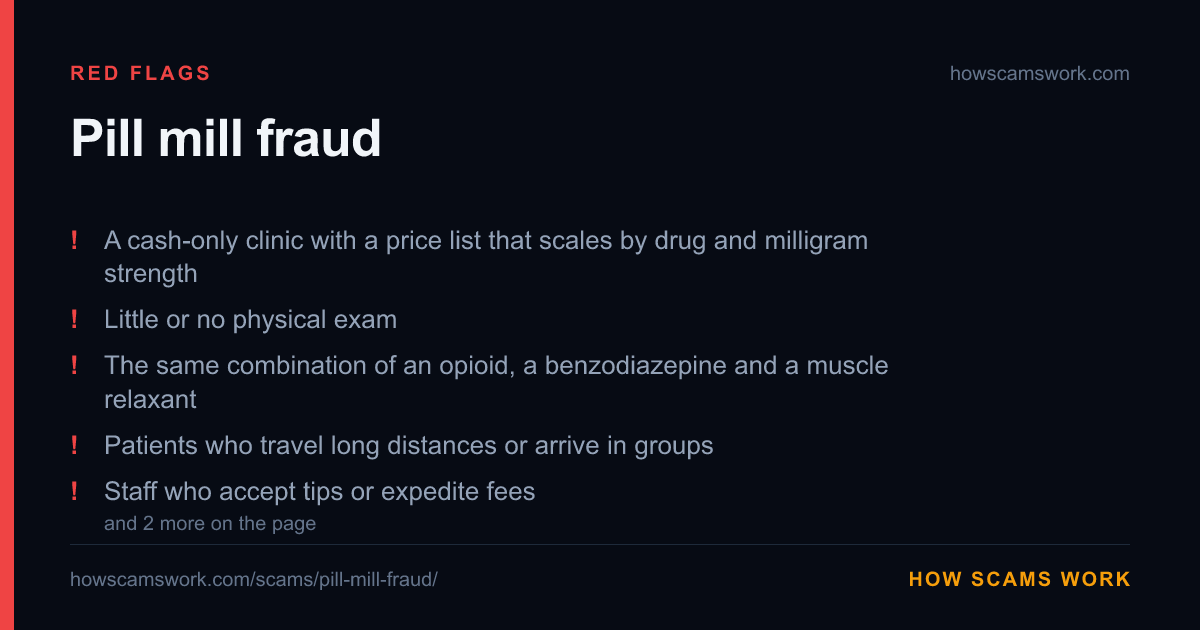
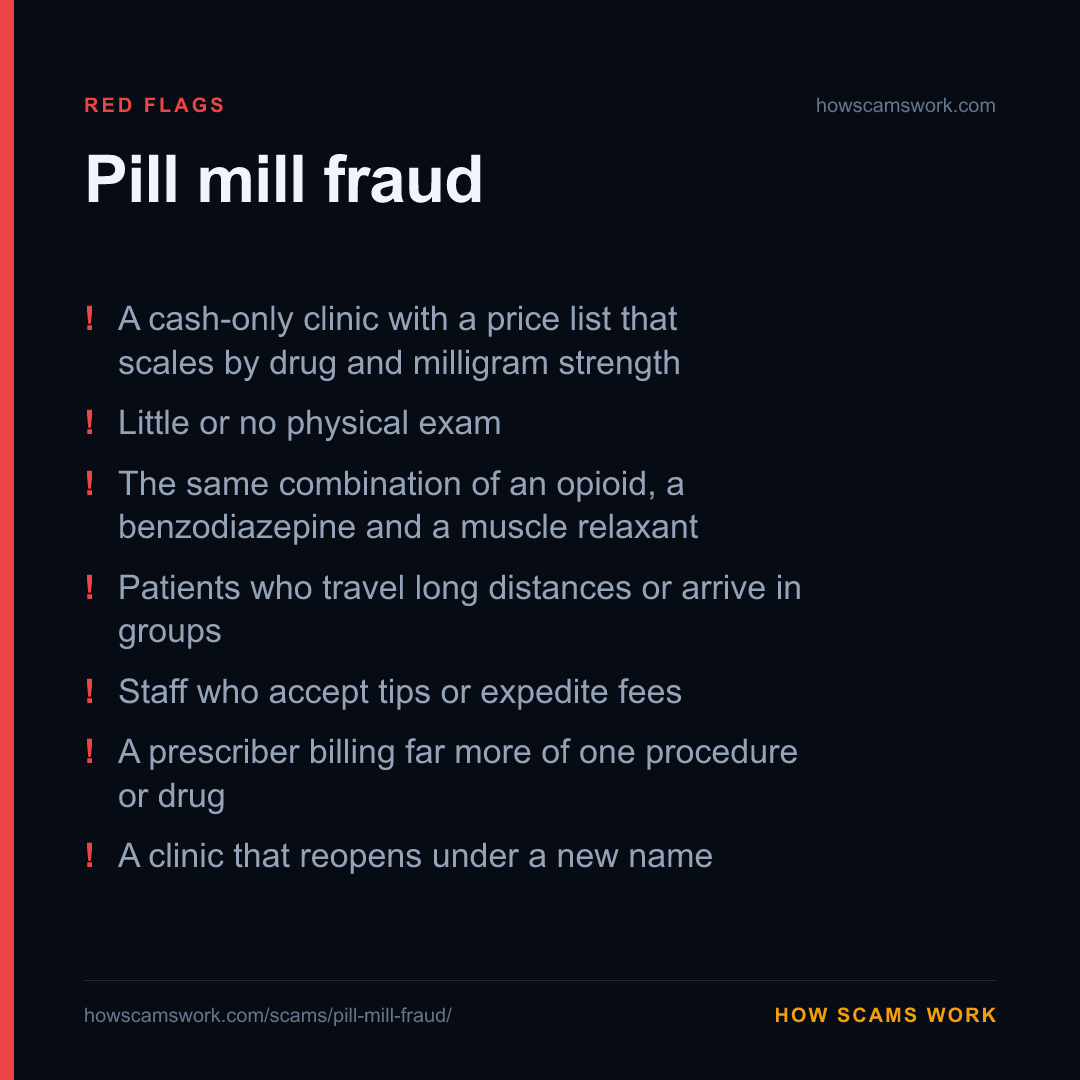
- A cash-only clinic with a price list that scales by drug and milligram strength, rather than by the service provided.
- Little or no physical exam, and no request for prior medical records or imaging.
- The same combination of an opioid, a benzodiazepine and a muscle relaxant prescribed to most or all patients regardless of their stated complaint.
- Patients who travel long distances or arrive in groups, sometimes brought by the same driver or “crew leader.”
- Staff who accept tips or expedite fees to move a prescription through faster.
- A prescriber billing far more of one procedure or drug than any comparable provider in the state.
- A clinic that reopens under a new name shortly after losing a doctor’s license or a billing privilege.
If it’s happening to you
If you suspect a clinic near you is operating as a pill mill:
- Don’t confront the clinic directly; report it instead. Contact the DEA’s tip line at
877-792-2873 or its online diversion complaint form.
- If Medicare or Medicaid billing may be involved, report it to the HHS Office of Inspector General
at 1-800-HHS-TIPS (1-800-447-8477) or TIPS.HHS.GOV, or to the Justice Department’s Health Care Fraud
Section at [email protected].
- See where to report for agencies in other countries.
If someone you know is being supplied by one:
- A conversation about treatment is more useful than a confrontation. People buying from a pill mill
are very often already struggling with addiction, not simply looking for cheap pills.
- SAMHSA’s National Helpline, 1-800-662-4357, is free, confidential and available 24 hours a day, and
can refer to local treatment options.
- If a clinic suddenly closes or a prescriber loses their license, patients genuinely dependent on
treatment can be left without care; a primary care provider or a local Federal Qualified Health Center
(findahealthcenter.hrsa.gov) is the safer route to continued care than seeking out another pill mill.
Where the money goes
Mostly domestic and mostly cash at the point of collection, which is what makes it hard to trace until an
investigation is already looking at the clinic specifically.
In the cash-only version, money moves directly from the patient or the street-level dealer to the clinic’s
front desk, in cash, the same ordinary cover any legitimate cash-pay medical practice has. From there it
moves into the operator’s own accounts, property and spending, exactly the kind of cash-intensive business
flow investigators have to reconstruct after the fact rather than trace in real time. In the billing variant,
Medicare or Medicaid pays the clinic directly into a bank account for the billed procedure, a payment
that, unlike the cash collected at the front desk, leaves a federal paper trail from the moment it is paid,
which is why prosecutors were able to attribute $120 million of the Patino scheme’s false billings to him
individually, a figure traced directly from the claims data rather than estimated.
By the numbers
No published dataset breaks this scheme out as its own category yet, so there is no chart to show.
The data page explains which agency categories exist and why some schemes are
invisible in official statistics.
Every factual claim above traces to one of these. Statistics are reported losses; see
methodology for what that does and does not measure.
Common questions
Isn't writing a prescription just a medical decision? How is this fraud rather than bad medicine?
A prescription is fraud when it is written for no legitimate medical purpose, which is itself a federal controlled-substances offense, not merely a malpractice question. Courts have found a pattern across the cases here: cash payments scaled to the drug's street value, no real exam, no review of outside records, and a known class of patients with no plausible pain condition at all. That pattern is what separates a pill mill from a doctor practicing medicine badly.
Where does the fraud against Medicare or Medicaid come in, if the patient is just paying cash for a prescription?
Not every documented case here bills insurance; Jomori Health and Wellness and Recare Health Clinic ran purely as cash-only prescription sellers. But a second, well-documented variant pairs the opioid prescription with a sham office visit or an unnecessary procedure billed to Medicare or Medicaid, which is what Dr. Francisco Patino's 'shots-for-pills' scheme in Michigan did: a patient got the opioid prescription only after accepting an unneeded back injection, and that injection, not the prescription itself, is what got billed.
Why would a drug dealer go to a doctor's office instead of just selling pills they already have?
Because a legitimate-looking prescription, filled at a real pharmacy, launders a controlled substance into a form that is far harder to trace back to diversion than a street sale. In the Texas cases here, street-level dealers paid cash for prescriptions specifically so they could resell the pills with a paper trail that, on its face, looked like ordinary medical care.
How does a doctor get away with this for months or years before getting caught?
Every state operates a Prescription Drug Monitoring Program, an electronic database logging every controlled-substance prescription filled, but the CDC's own description of it notes that checking it is only mandatory in some states and for some prescriptions. A clinic's prescribing volume is visible in that data from the first prescription; the delay is in who is looking; and in the documented cases here, it took one to several years of accumulated prescribing data and often an undercover investigation before charges followed.
Is a cash-only medical practice always a red flag?
No. Plenty of legitimate practices, including many psychiatrists, are cash-only for reasons that have nothing to do with fraud, and cash payment alone is not illegal. Investigators and prosecutors treat it as one signal among several, not a standalone violation; the cases on this page all combine cash payment with a price list tied to drug strength, little or no real exam, and a patient population that includes known street-level resellers.
I think someone I know is being supplied by a pill mill. What should I do?
Don't confront the clinic directly. Report what you know to the DEA's tip line at 877-792-2873 or its online form, or to the HHS Office of Inspector General at 1-800-HHS-TIPS (1-800-447-8477) or TIPS.HHS.GOV if Medicare or Medicaid billing is involved. See <a href="/report/">where to report</a> for agencies in other countries. If the person is in active addiction, a conversation about treatment, not an accusation, is the more useful next step; SAMHSA's National Helpline (1-800-662-4357) is free and confidential.