Also called: SSDI fraud mill · disability judge bribery scheme · Social Security ALJ bribery scheme · Conn disability fraud scandal
A Social Security disability fraud mill is a lawyer, a judge and a doctor working together: the lawyer recruits claimants and prepares the medical paperwork, a paid judge approves the lawyer's cases without real review, and a paid doctor signs forms describing conditions never actually examined. Eric Conn's Kentucky scheme ran this way for over a decade, obligating Social Security to pay out more than $550 million before a near-100% approval rate drew scrutiny.
What it is
A Social Security disability fraud mill is a law firm, a cooperating judge and one or more paid doctors
working together to manufacture approved disability claims rather than win them on the medical evidence.
The attorney recruits and represents the claimants, directs which judge the case lands in front of, and
arranges for a doctor to sign medical paperwork the attorney’s own staff has already filled out. The
judge approves the case, sometimes without a hearing. None of this requires forging a claimant’s identity
or stealing a payment after the fact, the other benefit-fraud pattern documented on this site; it
corrupts the approval decision itself, before a single disability check has gone out, by making sure the
decision was never really in doubt.
How it actually works
The retainer
A claimant signs on with the firm, often after seeing its advertising in the region it works, to pursue
a disability claim. Nothing about this step looks different from hiring any ordinary disability lawyer.
The reassignment
Rather than let the case go to whichever judge is next on the docket, a cooperating administrative law
judge searches the pending caseload for cases where this specific firm represents the claimant and
reassigns them to himself.
Before any real examination takes place, the firm’s staff fills out a medical evaluation form describing
the condition and conclusions the claim will need. A doctor paid by the firm signs it.
Where it could have stopped
A medical certification is only worth anything if the person signing it actually examined the patient first. In the documented cases here, the doctor signed forms the law firm had already completed, without reviewing them, let alone examining the claimant independently. That signature, not the judge’s later approval, is the moment a real medical finding became a fabricated one.
The approval, sometimes without a hearing
The cooperating judge approves the case. In the scheme documented here, one judge approved every single
case brought to him by this one firm, in some instances without holding a hearing at all.
The cash, paid monthly
The firm pays the judge in person, in cash, on a running monthly basis rather than through a single lump
sum, specifically because cash leaves no bank record a wire or check would create.
A bill nobody re-checked
Once approved, each case obligates the Social Security Administration to pay that claimant benefits for
life. The agency separately pays the attorney his own capped representative fee on the same approval, a
legitimate payment sitting directly on top of the fraudulent one.
The unwind, and a second round of victims
The approval rate itself, far above any individual judge’s ordinary range, eventually draws scrutiny,
years before any criminal charge follows. Once the fraud is confirmed, the agency moves to cut off
benefits in bulk for the firm’s former clients, whether or not any individual claimant knew their case
had ever involved a bribe.
Why it works
Social Security pays on a judge’s decision, not on an independent re-review of the medical file
behind it. An administrative law judge’s approval is treated as final enough to start lifetime
payments immediately; the kind of detailed audit that might catch a fabricated medical file, if it
happens at all, comes later, which is exactly the gap this scheme exploited for over a decade.
Letting a judge pull his own cases defeated the one structural safeguard built to prevent this.
Random assignment exists so that no single judge can be a predictable destination for any one attorney’s
cases. Nothing stopped Daugherty from searching the pending docket for Conn’s cases and reassigning them
to himself before that safeguard ever applied.
Cash eliminates the one paper trail a bank-fraud investigation would catch fastest. Paying a bribe by
check or wire creates an immediate, traceable record. Paying it in cash, in person, every month, removes
that record entirely, which is why the documented case here ran for roughly six and a half years before
any of the underlying payments surfaced.
The claimants had no reason to question what their own lawyer told them. Many of the people
represented in this scheme had real, documented health conditions and a genuine need for the income
disability benefits provide; being told a particular doctor visit was routine, or that their case was
simply moving faster than most, gave them no obvious reason to suspect the process itself had been
corrupted.
No single approval looks wrong by itself. A judge granting one more disability claim is, on its own,
an unremarkable event. What exposed this scheme was not any one decision but a statistical pattern, an
approval rate far outside the normal range, that only became visible once someone compared one judge’s
numbers against everyone else’s.
Where it comes from
Entirely domestic: this scheme exploits the Social Security Disability Insurance program’s own hearing
and appeals process, which exists only in the United States in this form, so every documented case here
is a US case.
The scheme was centered on eastern Kentucky and the Social Security hearing office across the state
line in Huntington, West Virginia. Eric Conn’s law firm operated out of Floyd County, Kentucky, while
David Daugherty sat as an administrative law judge in the agency’s Huntington hearing office, a region
where disability claims are a common and often legitimate part of the local economy, given the area’s
history of coal-mining injury and chronic illness.
A Senate subcommittee found the pattern years before any prosecutor did. An October 2013 staff
report from the Senate Homeland Security and Governmental Affairs Committee, built from approval-rate
statistics rather than a tip or a whistleblower complaint, found Daugherty had approved nearly 100% of
the cases he considered against a national average of about 62%, and that his firm had been paid more
than $4.5 million in Social Security attorney fees between 2006 and 2010 alone. Neither man had been
criminally charged at the time that report was released.
The surrounding institutions had their own fallout. Daugherty retired from the bench in 2011, before
any criminal case, once questions about his relationship with Conn began circulating. The criminal
charges, convictions and sentences that followed years later, documented in the cases on this page, were
a separate process from the earlier congressional scrutiny.
Real cases
2018 US Sentenced $550.0m
From October 2004 to April 2016, Kentucky disability attorney Eric Christopher Conn worked with former Social Security administrative law judge David B. Daugherty and several doctors, including clinical psychologist Alfred Bradley Adkins, to submit thousands of falsified medical documents in support of disability claims. Conn paid Daugherty about $10,000 a month in cash from December 2004 through April 2011 to approve benefits for claimants Conn represented, obligating the Social Security Administration to pay more than $550 million in lifetime benefits. Conn pleaded guilty in March 2017 to theft of government money and payment of gratuities, then fled the country rather than appear for sentencing, cutting off his ankle monitor and crossing into Mexico with help from Curtis Lee Wyatt. He was sentenced in absentia in July 2017 to 12 years and over $106 million in restitution, captured by Honduran authorities and returned to the US in December 2017, then convicted in June 2018 of conspiracy to defraud the United States, conspiracy to escape, and conspiracy to retaliate against an informant who had reported the scheme. In September 2018 he received a consecutive 15-year sentence and was ordered to pay $72,574,609 in restitution, for a combined 27 years in prison.
Read the case file ·
2 sources
2017 US Sentenced $550.0m
Alfred Bradley Adkins, a clinical psychologist from Shelbiana, Kentucky, performed perfunctory evaluations of disability claimants referred to him by attorney Eric Conn and signed medical evaluation forms Conn's office had already filled out, without reviewing them first, even though the claimants were not necessarily disabled. Conn forwarded the forms to the Social Security Administration, primarily to administrative law judge David B. Daugherty, to support disability findings in a scheme that obligated the SSA to pay more than $550 million in benefits. Conn paid Adkins almost $200,000 for signing the forms. A federal jury convicted Adkins in June 2017 of conspiracy to commit mail and wire fraud, mail fraud, wire fraud and making false statements, and he was sentenced in September 2017 to 300 months, 25 years, in prison and ordered to pay more than $93 million in restitution. The Sixth Circuit later affirmed both his conviction and his sentence on appeal.
Read the case file ·
1 source
2017 US Sentenced $550.0m
David Black Daugherty, a Social Security administrative law judge assigned to the agency's Huntington, West Virginia hearing office, spent from 2004 until his 2011 retirement seeking out pending disability cases in which Kentucky attorney Eric Christopher Conn represented the claimant, reassigning those cases to himself, and awarding benefits in every one, in some instances without ever holding a hearing. Conn paid Daugherty roughly $8,000 a month in cash until about April 2011, totaling more than $609,000 for approximately 3,149 decided cases, obligating the Social Security Administration to pay more than $550 million in lifetime benefits. A 2013 Senate subcommittee investigation had already found that Daugherty approved nearly 100% of the cases he considered, against a national average of 62%, years before any criminal charge was filed. Daugherty pleaded guilty in May 2017 to two counts of receiving illegal gratuities and was sentenced in August 2017 to four years in prison and ordered to pay more than $93 million in restitution to the SSA and HHS.
Read the case file ·
2 sources
Red flags
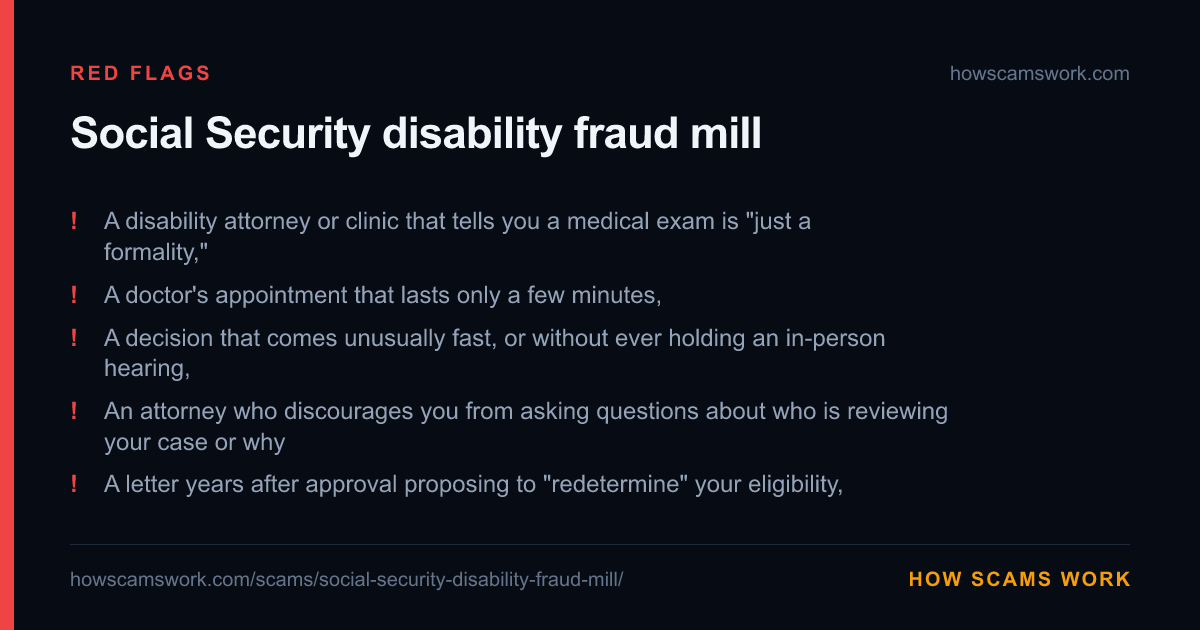
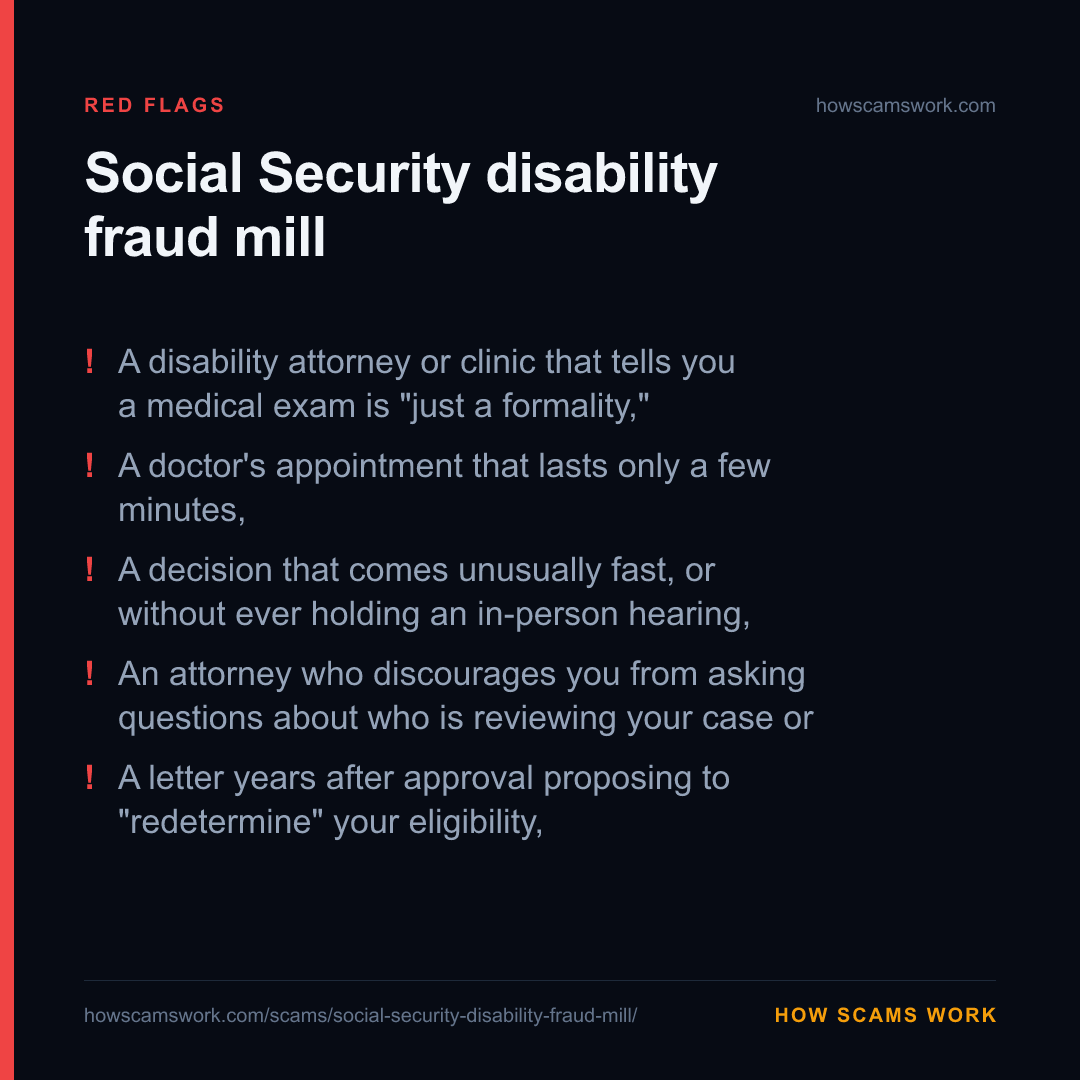
- A disability attorney or clinic that tells you a medical exam is “just a formality,” or that steers you toward one specific doctor rather than letting you see your own.
- A doctor’s appointment that lasts only a few minutes, with no real physical examination, before paperwork is signed.
- A decision that comes unusually fast, or without ever holding an in-person hearing, for a claim of real complexity.
- An attorney who discourages you from asking questions about who is reviewing your case or why.
- A letter years after approval proposing to “redetermine” your eligibility, citing a specific prior attorney, doctor or judge you worked with.
If it’s happening to you
If an attorney or clinic is pressuring you toward a doctor who barely examines you:
- Say no, and see your own treating physician or an independent specialist instead; a legitimate
disability claim does not depend on using one specific doctor.
- Ask for a copy of anything signed on your behalf, including medical evaluation forms, before it is
submitted.
- Contact your local legal aid organization or the National Organization of Social Security Claimants’
Representatives (NOSSCR) for a second opinion on your representation.
If you’ve received a notice proposing to cut off or “redetermine” benefits you were already approved
for:
- Respond within the deadline the notice gives you; missing it can forfeit your right to challenge
the decision.
- Keep every medical record from your original claim, including anything from your own treating
physicians independent of whoever the notice names.
- Ask for, and keep, a copy of your full case file.
- Seek legal help immediately through legal aid, a disability advocacy group, or NOSSCR; courts have
found in similar cases that claimants are entitled to challenge a fraud finding made against them, not
simply accept it.
- Report any bribery or kickback solicitation you encounter to the Social Security Administration’s
Office of Inspector General at oig.ssa.gov or 1-800-269-0271. See where to report
for agencies in other countries.
Where the money goes
Entirely domestic, moving from the Social Security Trust Fund into the law firm’s own accounts, then out
again as cash the firm’s principal paid directly to the officials and professionals whose cooperation the
scheme depended on.
Social Security pays its capped representative fee directly into the attorney’s own account on every
approved claim, exactly as it would for a legitimate case, which is what makes this leg of the money trail
look routine on paper. From there, the firm’s principal paid the cooperating judge roughly $8,000 to
$10,000 a month in cash, specifically to avoid the bank record a check or wire would leave, and paid a
cooperating doctor almost $200,000 over the life of the scheme for signing forms without examining the
patients they described. Unlike schemes built around shell companies or offshore transfers, there is no
elaborate laundering chain to trace here: the money moved from a federal trust fund to a law firm to two
people’s pockets, in cash, which is also exactly what made it so hard to trace until investigators
started comparing approval statistics instead of bank records.
By the numbers
No published dataset breaks this scheme out as its own category yet, so there is no chart to show.
The data page explains which agency categories exist and why some schemes are
invisible in official statistics.
Every factual claim above traces to one of these. Statistics are reported losses; see
methodology for what that does and does not measure.