Also called: mortgage fraud for profit · straw borrower scheme · occupancy fraud · fake buyer mortgage scheme · property flipping fraud
Straw buyer mortgage fraud puts a name on a loan application that is not the real buyer, or promises to live in a home when that is untrue, so a lender funds a loan it would otherwise refuse. In the four cases here, prosecutors put lender losses at more than $200,000 in one and about $8 million in another.
What it is
A mortgage lender decides whether to lend on a handful of statements: who the borrower is, what they earn, where the down payment came from and whether they will live in the home. The Federal Housing Finance Agency defines mortgage fraud as a material misstatement, misrepresentation or omission in relation to a mortgage loan that a lender relies on. This page covers one family of it, in which the person named on the loan is not the real buyer, or the promise to live in the home is untrue.
The agency describes a straw buyer as someone who falsely appears as the applicant and purchaser while acting on behalf of another person, and occupancy fraud as falsely stating an intent to live in the property. It also splits mortgage fraud into “fraud for profit”, which usually involves industry insiders such as appraisers, brokers and loan originators, and “fraud for housing”, which is committed by borrowers who want a home. In three of the four cases here a mortgage broker, a loan officer or a closing agent was among those charged or sentenced. This page does not say how common any of it is.
How it actually works
A borrower the lender will approve is needed
The Federal Housing Finance Agency says a straw buyer with good credit may be used to get a loan for someone whose credit may be disqualifying, or may take part in a profit scheme such as flipping. The Texas ring, according to the U.S. Attorney’s release, recruited people with poor credit, falsely reported identity theft to inflate their credit histories and submitted fraudulent pay stubs.
The buyer is found, recruited or simply written in
In Texas, the release said, the group used straw buyers to acquire homes. In Florida, a report on the indictment says two defendants recruited straw buyers. In Virginia, prosecutors said two people sold their clients’ homes without their knowledge, including to straw buyers, and used the clients’ personal information to obtain loans in the clients’ names.
The application says what the lender needs to hear
The Federal Housing Finance Agency lists false statements about employment, income, the source of a down payment and the intent to occupy. In New Jersey, prosecutors said the mortgage documents falsely stated that a short sale was an arm’s-length deal, that the two parties had no business relationship, that the seller would leave and that the buyer would live there. In Florida, the indictment alleges false borrower names and inflated sale prices.
Where it could have stopped
For lenders, the Federal Housing Finance Agency requires Fannie Mae, Freddie Mac and the Federal Home Loan Banks to run programs to detect and report fraud, and in a FinCEN case example banks’ reports noted applicants who may have overstated their employment and lied about living in the home. For anyone asked to put a name or a signature on a loan for a home they will not own or live in, the Texas release counts multiple straw buyers among the 17 people convicted. Being the named buyer is not a bystander’s role.
The closing papers are made to match
In Florida, prosecutors allege that a settlement agent gave sellers and lenders two different settlement statements, one with false information and omitting the sale price, the purchaser’s identity and the receipt and disbursement of funds. In the FinCEN example, the buyers were helped to get 100 percent financing through a business the lead defendant set up.
The money is taken out
In Texas, the release said that once loans were approved the group skimmed the proceeds. In Virginia, prosecutors said the two stripped out the equity and used it to pay their own expenses, and one withdrew hundreds of thousands of dollars from accounts she controlled. In New Jersey, the original lender discharged the mortgage on the strength of the false statements.
The payments stop
The Texas release said the group collected millions in rent and pandemic-era assistance on the straw-bought homes while failing to pay the mortgages, which led to foreclosures. In the FinCEN example, the straw buyers frequently defaulted, with losses above $2,500,000 to banks and commercial lenders.
Detection comes from the lender’s records and from investigators
In the FinCEN example, banks’ suspicious activity reports led investigators to the defendant. The Texas, Virginia and New Jersey cases were investigated with the Federal Housing Finance Agency’s Office of Inspector General, and the Florida defendant was arrested in Nigeria in 2024 on an indictment filed in 2014. Sentences in the three concluded cases ran from eight months of home confinement to 121 months in prison.
Why it works
The lender relies on the paper. The Federal Housing Finance Agency’s definition turns on a statement that a lender relies on. If the borrower’s name, income or intent is wrong, the loan is still made.
An intention to live in a house is a promise, not a fact. In the New Jersey case the documents said the seller would leave and the buyer would move in, and prosecutors said the seller stayed. The lie was about the future.
People who know the process help. The agency says fraud for profit usually involves insiders. In these cases they included mortgage brokers in Texas, a licensed loan officer in Virginia and, in Florida, a licensed attorney said to have acted as settlement agent.
The loss lands on a distant lender. The Texas release quoted a special agent in charge of the Federal Housing Finance Agency’s Office of Inspector General saying those who defraud Fannie Mae and Freddie Mac put the housing finance system at risk, and the New Jersey loss was to a government-sponsored enterprise. The people who took part did not face a lender across a counter.
It can take years to come to light. The Florida conduct ended around 2008, and the defendant was extradited in 2025. The New Jersey conspiracy ended in June 2017 and the sentence came in June 2026.
Where it comes from
The earliest conduct in the cases here is the Florida period, from December 2005 to about May 2008. A FinCEN case example from 2009 describes a Mid-Atlantic scheme that ran for about three years and ended in a sentence of more than five years. The cases from 2025 and 2026 are the Texas, Virginia and New Jersey sentencings and the Florida extradition.
The loss is measured per property, in the lender’s books. In New Jersey the loss was more than $200,000 on one home. In Florida, prosecutors put the loss at about $8 million across about 20 properties, which is roughly $400,000 each by this page’s own division of the two figures. The $200,000 to $400,000 range above comes from those two cases and is an estimate from a small sample. The Texas release gave no loss figure.
What this page could not find. It did not read the court records or the U.S. Attorney’s own pages, which were read through copies, and it did not read the FBI’s mortgage fraud statistics. The Florida case is an allegation with no reported outcome. The red flags below come from the cases and the Federal Housing Finance Agency’s definitions.
Real cases
2026 US Sentenced $200,000
On June 1, 2026 a federal judge in Trenton sentenced Nathaniel Anderson, a Willingboro, New Jersey councilman and former mayor, to 12 months and one day in prison, and his business associate Chrisone Anderson to eight months of home confinement. A jury had convicted them of conspiracy to commit wire fraud affecting a financial institution, bank fraud and making false statements on a mortgage application over a short sale of his home that cost a government-sponsored enterprise more than $200,000.
Read the case file ·
4 sources
2026 US Sentenced
In January 2026 a federal court in the Eastern District of Virginia sentenced Roberta Leigh Dawson, a licensed loan officer, to two years and six months, and Edward Fitzgerald, who presented himself as a financial adviser with real estate expertise, to five years. Both had pleaded guilty in September 2025 to conspiracy to commit mail and wire fraud affecting financial institutions. Prosecutors said they used clients' information to get fraudulent loans and sold clients' homes without their knowledge, in some cases to straw buyers.
Read the case file ·
2 sources
2025 US Sentenced
In a release dated November 5, 2025, the U.S. Attorney for the Southern District of Texas announced that Steven Morizono of Mission Viejo, California, had been sentenced to 121 months in federal prison. He had pleaded guilty to 34 counts, including conspiracy to commit bank fraud, wire fraud and mortgage fraud. Through a company called Jeff Funding, the group used falsified loan applications, shell companies and straw buyers, and the conspiracy, which dates back to 2017, led to 17 convictions.
Read the case file ·
2 sources
2025 US · NG Charged (allegation, not conviction) $8.0m
In March 2025 Okechukwu Josiah Odunna, a Nigerian national and then a licensed attorney, was extradited to Miami and charged with wire fraud and conspiracy to commit wire fraud affecting a financial institution. The U.S. Attorney's Office alleges that between December 2005 and about May 2008 he and others obtained loans for about 20 Florida properties with false borrower names, inflated prices and two sets of settlement statements, for a loss of about $8 million. These are allegations: he is presumed innocent unless and until proven guilty. Two co-defendants were sentenced earlier.
Read the case file ·
2 sources
Red flags
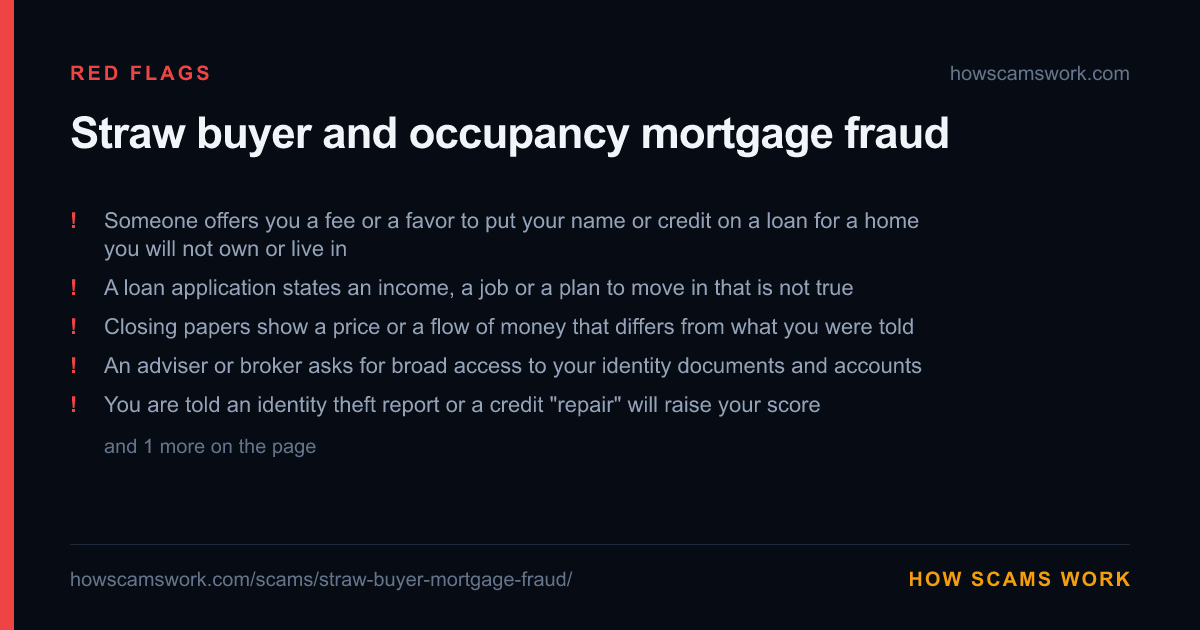
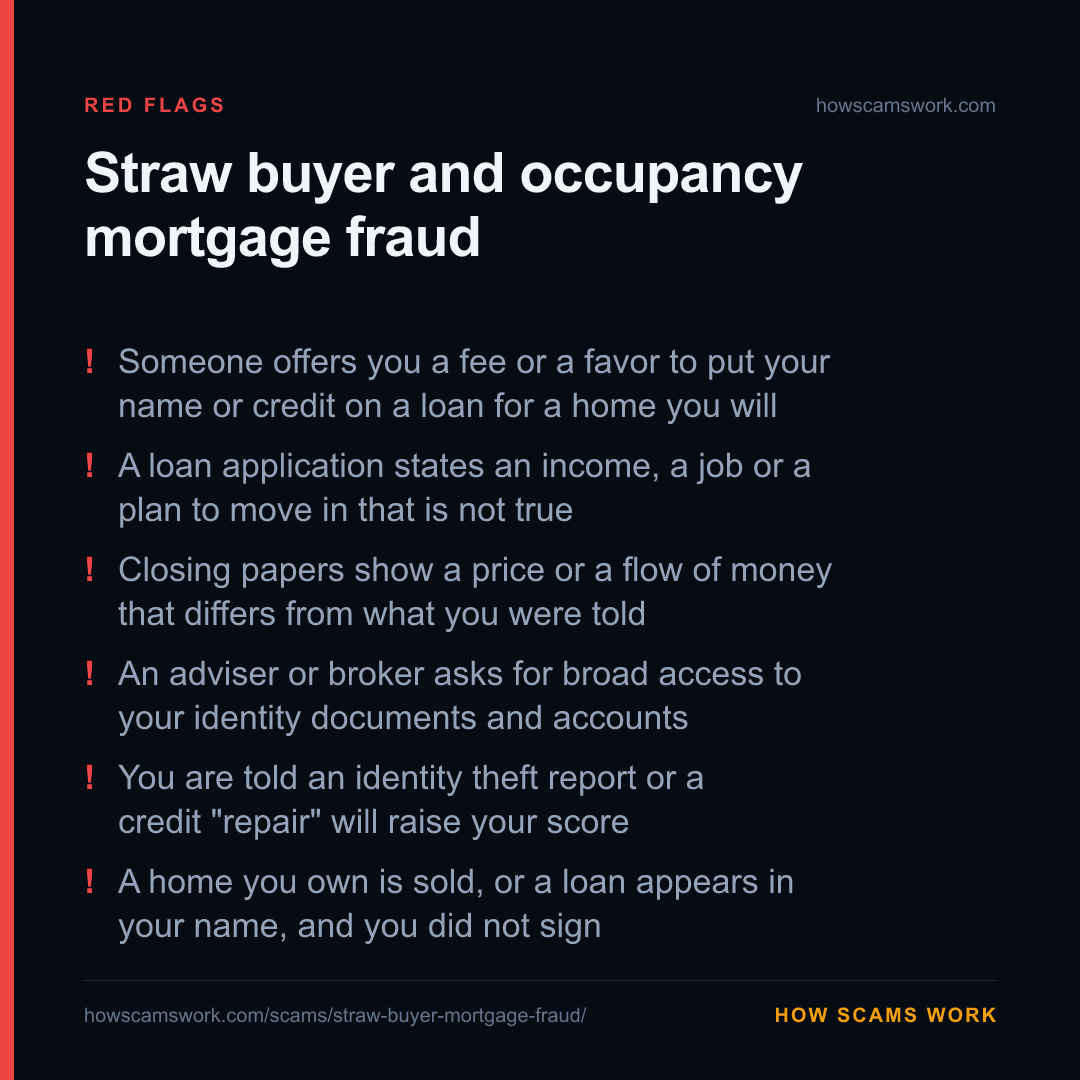
- Someone offers you a fee or a favor to put your name or credit on a loan for a home you will not own or live in. The Federal Housing Finance Agency describes exactly that as a straw buyer, and the Texas release counts straw buyers among the convicted.
- A loan application states an income, a job or a plan to move in that is not true. These are the statements the agency lists and that the New Jersey jury convicted on.
- Closing papers show a price or a flow of money that differs from what you were told. The Florida indictment alleges two sets of settlement statements.
- An adviser or broker asks for broad access to your identity documents and accounts. In Virginia, prosecutors said an adviser’s clients gave him access and that he passed it on to a loan officer.
- You are told an identity theft report or a credit “repair” will raise your score. In Texas, the release said the group falsely reported identity theft to inflate clients’ credit histories.
- A home you own is sold, or a loan appears in your name, and you did not sign. That was the Virginia pattern.
If it’s happening to you
If you are being asked to sign for a home you will not own, or you think a loan or sale was made in your name:
- Do not sign a statement you know is untrue. The cases here include convictions for false statements on a mortgage application.
- Check what is recorded in your name. Look at the county property record for your home and pull your credit reports for loans you do not recognize.
- If you already signed, get advice from a lawyer before you speak to investigators. The Texas release shows that straw buyers were prosecuted.
- Keep every document: the application, the closing statements, the messages and the names of the people who asked.
- Report it to the FBI and the Federal Housing Finance Agency’s Office of Inspector General. See where to report for other countries.
Where the money goes
The money comes from the lender at closing, as loan proceeds. In Texas the release said proceeds were skimmed and the straw-bought homes collected millions in rent and pandemic-era assistance while the mortgages went unpaid. In Virginia, prosecutors said the equity was stripped from clients’ homes, hundreds of thousands of dollars were withdrawn from accounts one defendant controlled and more than $1 million was paid onto an adviser’s credit card for travel, luxury items and daily expenses. In the FinCEN example, bank reports noted structured withdrawals and cashier’s checks, and wires from title companies into the personal account of a man who ran a mortgage lending business.
By the numbers
No published dataset breaks this scheme out as its own category yet, so there is no chart to show.
The data page explains which agency categories exist and why some schemes are
invisible in official statistics.
Every factual claim above traces to one of these. Statistics are reported losses; see
methodology for what that does and does not measure.
Common questions
What is a straw buyer?
The Federal Housing Finance Agency says a straw buyer falsely appears as the mortgage applicant and purchaser although they are acting on behalf of another person. It adds that a straw buyer with good credit may be used to obtain a loan for someone whose credit may be disqualifying, or may take part in a profit scheme such as flipping.
What is occupancy fraud?
Occupancy fraud is falsely stating the borrower's intent to live in a property in order to get better terms than a second or investment home would get, according to the Federal Housing Finance Agency. In the New Jersey case here, the paperwork said the buyer would live in the home and the seller would leave, and prosecutors said the seller stayed.
Is the straw buyer a victim or an offender?
It depends on what they knew. In the Texas case the U.S. Attorney's release counts multiple straw buyers among the 17 people convicted. In the Virginia case, prosecutors described clients whose details were used without their knowledge as victims.
How is this different from home title fraud?
In home title fraud a deed is forged or recorded without the owner's knowledge, according to the Federal Housing Finance Agency. In the cases here the loan paperwork was real in form and the false statements were made to the lender about who the buyer was, what they earned or where they would live.
How does a lender find it?
In a case example published by the Treasury's FinCEN, banks' suspicious activity reports noted applicants who may have overstated employment and lied about living in the home, and investigators followed them. The Federal Housing Finance Agency requires Fannie Mae, Freddie Mac and the Federal Home Loan Banks to run programs to detect and report fraud.
What happened to the people responsible?
Sentences in the cases here ran from eight months of home confinement to 121 months in prison. The fourth case, in Florida, is a set of allegations against a defendant extradited in 2025, and this page found no report of how it ended.
Where do I report it?
The FBI and the Federal Housing Finance Agency's Office of Inspector General, which investigated the Texas, Virginia and New Jersey cases here. See where to report for other countries.