Also called: merchant services scam · credit card terminal lease scam · payment processing switch scam · POS equipment lease fraud · card processor savings scam
A card processing and equipment lease scam sells small businesses cheaper card payments, then binds them to costly multi-year processing contracts and equipment leases that are hard to cancel. In November 2026 the FTC and Washington announced a settlement with one processor; a New York court earlier voided leases at Northern Leasing.
What it is
Every business that takes cards needs a processor, a company that moves the money from the customer’s card to the merchant’s
account, and usually a terminal to read the card. This scheme sells small businesses a “better deal” on both, then locks
them in.
The FTC’s 2018 guidance describes the pattern: a business is promised savings and told it can cancel at any time, then
finds itself paying thousands of dollars for a lease on equipment worth a few hundred, unable to cancel, and in some cases
personally responsible for the debt. The cases here add three more ingredients: fees that were not in the quote, contract
terms hidden in long documents, and a lessor that sues merchants far from home.
This is a civil-enforcement story. The people behind these firms were not convicted in the cases on this page, which end in
settlements, stipulated judgments and a court order.
How it actually works
In the Oregon case the FTC alleged that sales representatives called and visited merchants, promising savings of hundreds to
thousands of dollars a year through lower rates. In the Riverside case the FTC and Washington alleged the promise was savings of 40 to 60 percent.
The existing setup is made to look like a problem
In the 2014 case the FTC alleged that agents implied an affiliation with the merchant’s current processor, Visa or MasterCard,
or its bank, and told merchants their swipe terminals were outdated or incompatible. In the Oregon case the FTC alleged merchants
were told they had to replace their systems to get the low rate.
A binding contract is presented as something else
The FTC alleged that agents in the 2014 case presented contracts as price-quote applications or routine account updates. In the
Oregon case, it alleged merchants often got no copies and that fine print was concealed until after they signed. In the Riverside case the complaint
points to a 26-page electronic agreement.
Where it could have stopped
The 2014 order requires a separate document disclosing all fees, charges and rates before any contract is signed, and a complete copy of anything the merchant signs. A merchant who insists on both before signing has the facts the alleged tactics withheld.
The terminal comes on a separate lease
In 2014 the FTC alleged merchants were led into leasing new terminals for two to four years. In the Oregon case the FTC alleged the firm promised to buy out
existing leases and did not. In the Riverside case the equipment leases through Cascade extended one year beyond the processing agreement.
The costs turn out higher
In Riverside, the complaint says businesses that switched typically ended up paying more than they had before, and that sales quotes
left out activation fees, batch fees and charges tied to data security compliance or inactive processing. In the Oregon case the FTC alleged undisclosed fees.
Leaving is hard and expensive
The Oregon complaint says merchants often paid on two leases or spent thousands of dollars getting out of the old one, and that cancelling
the new service carried a large, undisclosed fee. In Riverside, the complaint says the contract renewed automatically after three years, carried a $695
early termination fee, and that businesses seeking to leave faced repeated calls and delays despite a “no-risk” guarantee.
Collection, then enforcement years later
The New York court found that Northern Leasing sued merchants in New York City Civil Court, won over 29,000 default judgments,
and that most of those sued lived outside the state. The FTC’s Oregon case was filed in 2007, reached stipulated judgments in 2008 and refunds in 2011.
The New York case was filed in 2016 and decided in 2020. The Riverside settlement was announced in November 2026.
Why it works
Merchants are busy and the product is hard to compare. Processing prices are made of many parts. The Riverside complaint lists activation,
batch and compliance charges that were allegedly missing from quotes.
It can look like routine paperwork. The FTC’s 2018 guidance says some scammers pretend to be the business’s current card processor, and
the 2014 complaint alleged agents presented new contracts as account updates.
The lease is separate from the processing. The business can stop using a processor and still owe on a lease. In Riverside the lease allegedly ran one year
beyond the processing agreement.
The lessor can pick the battlefield. The New York court found Northern Leasing required merchants nationwide to defend suits in New York County Civil Court, and that
ineffective service provisions allowed papers to go to obsolete addresses, which blocked merchants from defending themselves.
New entities can carry on. In February 2021 the court barred two successor companies run by former Northern Leasing officers and owned by trusts
benefiting the families of two of its principals, finding that their differences did not “negate their liability.”
The sales force is also sold a story. The Riverside complaint says the company told prospective agents they could earn $75,000 to $95,000 a year; the average agent earned $3,787.
Where it comes from
A US scheme in the cases found here. The Oregon and New York cases involve merchants across the country. The New York Attorney General said Northern Leasing
operated from 1991 until the office’s proceeding halted it, but the earliest case this page cites in full is the FTC’s 2007 complaint.
Scale shows only in a few numbers. The New York court rescinded what the AG called hundreds of thousands of leases, and the AG received over 5,600 complaints from 2010.
The FTC’s refunds in the Oregon case went to 100 merchants. This page found no overall count.
The money is small per merchant, large in total. Refund payments in the Oregon case ranged from about $100 to more than $25,000 depending on what each merchant paid.
Riverside faces a $32.1 million judgment, suspended after a $600,000 payment because of the defendants’ alleged inability to pay.
Real cases
2026 US Settled
On November 2, 2026 the FTC and the State of Washington filed a complaint and a proposed order against payment processor Riverside Payments, its affiliate Cascade Equipment Leasing and their two owners. They allege Riverside promised small businesses savings of 40 to 60 percent, that customers typically paid more, and that cancelling was very difficult. The proposed order includes a $32.1 million judgment, suspended after the defendants pay $600,000. It is not final until the court approves it.
Read the case file ·
2 sources
2020 US Sanctioned
The New York Attorney General sued Northern Leasing Systems and affiliates in April 2016 over leases for credit card processing equipment sold to small businesses. On June 8, 2020 a New York court found the company's method of getting leases signed deceptive, voided the leases, vacated and dismissed 29,617 default judgments it had won against merchants, and permanently barred it from equipment finance leasing. In February 2021 the court extended the order to two successor companies. The Attorney General's releases give no restitution total.
Read the case file ·
2 sources
2014 US Settled
On October 27, 2014 the FTC announced settlements with Merchant Services Direct LLC, which did business as Sphyra Inc., and related defendants, who sold small businesses the ability to accept card payments. The FTC alleged agents presented binding contracts as price-quote applications, implied a link to the merchant's current processor, falsely said terminals were outdated and falsely said merchants could cancel anytime. The defendants agreed to pay $175,000 across two settlements.
Read the case file ·
1 source
2008 US Settled
In April 2007 the FTC sued Merchant Processing, Inc. of Beaverton, Oregon, its owner and affiliated companies, alleging they sold card processing to thousands of small businesses on false promises of savings and of buying out existing equipment leases. A court froze assets and appointed a receiver. Stipulated judgments were entered on May 15, 2008, and in September 2011 the FTC announced about $345,000 in refunds to 100 merchants.
Read the case file ·
3 sources
Red flags
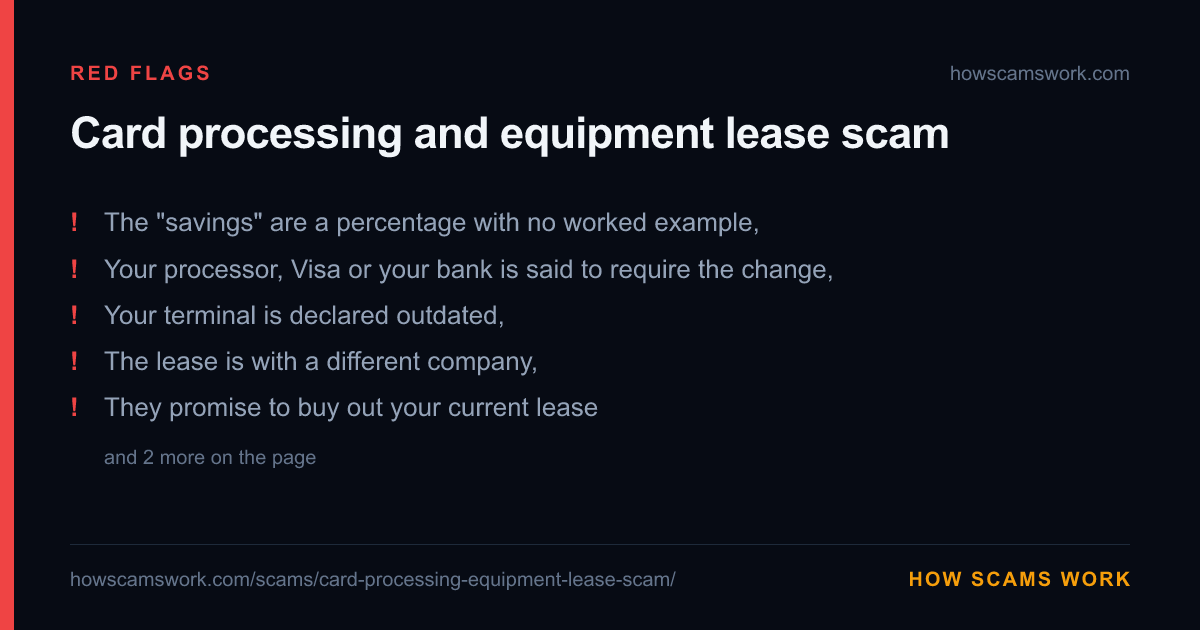
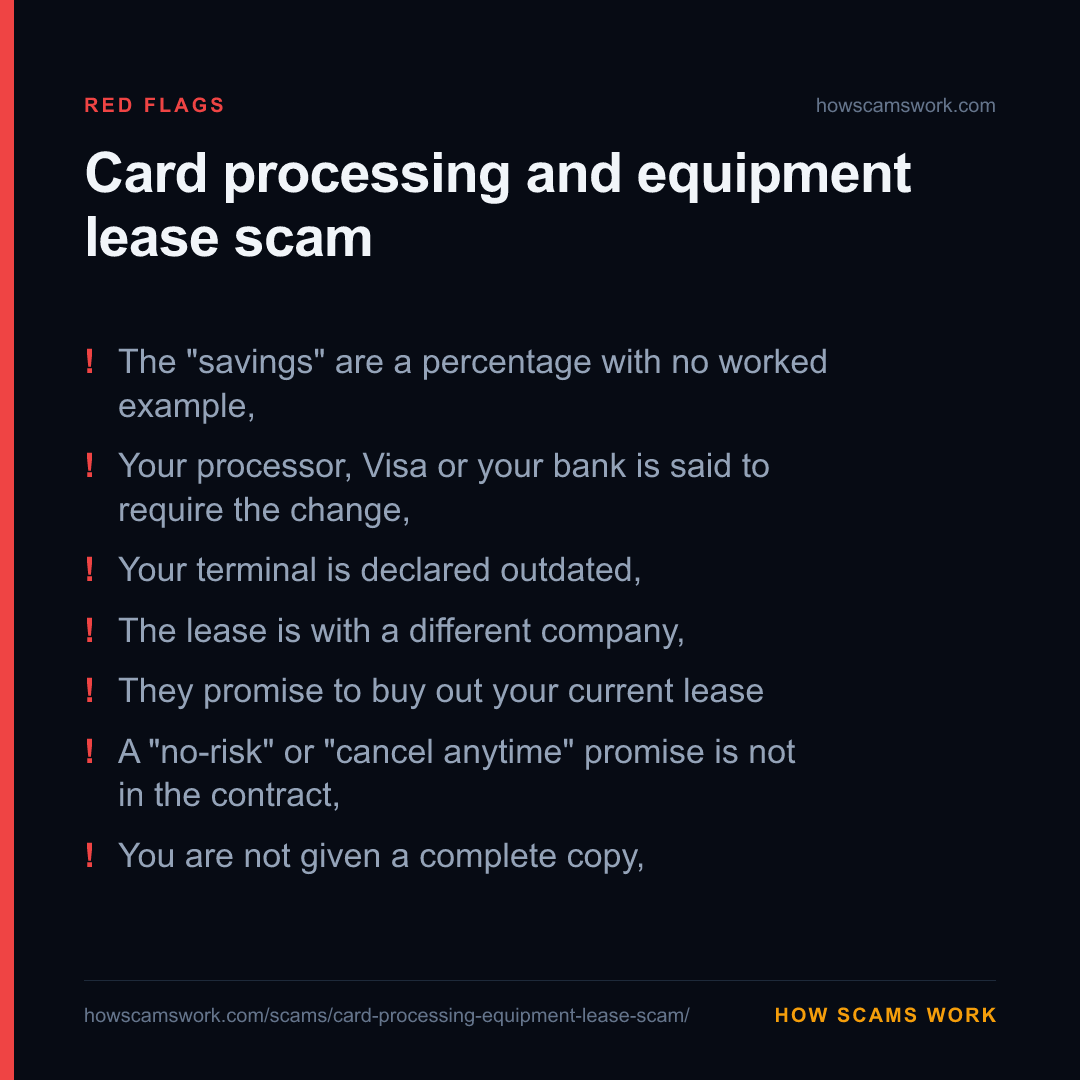
- The “savings” are a percentage with no worked example, or the quote omits activation, batch, compliance or inactivity fees.
- Your processor, Visa or your bank is said to require the change, or the call is presented as an account update.
- Your terminal is declared outdated, and a new one must be leased for two to four years.
- The lease is with a different company, and runs longer than the processing agreement.
- They promise to buy out your current lease. The Oregon complaint says the buyout did not happen.
- A “no-risk” or “cancel anytime” promise is not in the contract, or the contract renews automatically with an early termination fee.
- You are not given a complete copy, or you are pushed to decide at once.
If it’s happening to you
- Ask for the full contract and a separate list of every fee before you sign, and read the lease and the processing agreement as two documents.
- Check the term, the cancellation fee, the renewal and who holds the lease. The FTC’s guidance says some leases make the signer personally liable.
- Search the company name with “complaint” or “scam” before signing, as the FTC advises.
- Do not ignore court papers. The New York court vacated over 29,000 default judgments, but that came years after the suits.
- Report it to the FTC and your state attorney general’s consumer protection office, and keep every contract and statement.
See where to report for other countries.
Where the money goes
The documented money moves from the merchant to a processor and a lessor, month after month. The Riverside complaint says processing costs rose for businesses that switched,
and the Oregon complaint says merchants sometimes paid on two leases.
Recovery is partial and comes years later. In the Oregon case, about $345,000 was returned to 100 merchants in 2011. The 2014 settlements total $175,000. Riverside will pay
$600,000 against a $32.1 million judgment that is suspended. In New York the court ordered the leases void and restitution, but the Attorney General’s release gave no total.
By the numbers
No published dataset breaks this scheme out as its own category yet, so there is no chart to show.
The data page explains which agency categories exist and why some schemes are
invisible in official statistics.
Every factual claim above traces to one of these. Statistics are reported losses; see
methodology for what that does and does not measure.
Common questions
Is switching card processors a scam?
No. Merchants switch processors for legitimate reasons, and the cases here concern sales practices, not switching. The FTC and state officials alleged that firms misstated savings, hid fees and contract terms, or made cancelling very difficult. This page is not advice on any particular provider or contract.
Why is the equipment lease a separate problem?
In several of the cases the terminal is leased from a different company than the one processing payments. The FTC's 2018 guidance says businesses can pay thousands to lease equipment that would cost a few hundred dollars to buy, and that a lease may hold the signer personally responsible. In the Riverside case the FTC and Washington alleged the lease ran a year beyond the processing agreement.
What did the New York court find about Northern Leasing?
In June 2020 a New York court found that Northern Leasing's way of getting small businesses to sign leases for card processing equipment was deceptive and 'created an enterprise conducive to fraud,' according to the Attorney General's Office. It voided the leases, vacated 29,617 default judgments and permanently barred the company from equipment finance leasing. The AG's release gave no restitution total.
What if I am sued over a lease in a court far away?
Do not ignore court papers. In the Northern Leasing case the court vacated 29,617 default judgments, and found that service provisions allowed papers to go to obsolete addresses. Contact your state attorney general's office or a lawyer promptly. This page is not legal advice.
Were the people behind these firms convicted?
The cases here are civil. The FTC and state actions ended in settlements, stipulated judgments or court orders, and the FTC's complaint in the Oregon case said it had reason to believe the law was being broken, which is not a finding. This page does not describe anyone as convicted.
Where do I report one?
Report to the FTC and to your state attorney general's consumer protection office. New York's Attorney General received over 5,600 complaints about Northern Leasing between 2010 and 2020. See where to report for other countries.