Contract-for-deed scams

Also called: contract for deed fraud · land contract scam · rent-to-own home scam · bond for deed scam · installment land contract fraud · seller-financed home scam

A contract for deed finances a home sale privately, letting the seller keep legal title until every payment clears. Sellers inflate prices, hide defects, and evict buyers over one missed payment, keeping every dollar paid and reselling the same house. One Minnesota company bought homes with ordinary mortgages and resold them the same day for double the price.

Key facts

Category
Purchase & marketplace
First documented
2013
Typical loss
$40k–$170k USD, per victim
Main channels
same-language and community-targeted advertising, religious-leader and community endorsements, door-to-door and in-person sales representatives, listings for foreclosed or distressed homes
Who is targeted
Buyers who cannot qualify for a conventional mortgage because of damaged or thin credit, often recently out of foreclosure or already renting the home in question; Devout Muslim buyers recruited with 'interest-free' or sharia-compliant marketing, for a contract that documented cases allege actually carried hidden interest; Residents already living in a foreclosed or neglected rental home when the 'rent to own' or 'contract for deed' pitch arrives; Somali-American and other immigrant communities targeted through same-language advertising, community testimonials and religious-leader endorsements
Documented origins
United States
Main targets
United States
Case files
3 documented cases
Last reviewed
2026-10-17
Anatomy of a contract-for-deed scamAnatomy of a contract-for-deed scam. The seller finances the sale, keeps the deed, and gets to sell the same house again if you miss one payment. 1. The listing: A home, often bought cheaply out of foreclosure, is advertised through community channels: a same-language website, a testimonial, sometimes a religious-leader endorsement. 2. The paperwork, not a mortgage: The buyer signs a contract for deed, not a mortgage application. The seller plays lender, appraiser and title-holder all at once, and keeps legal title until every payment clears. 3. The markup: The price is set well above comparable mortgage-financed sales, not by an appraisal the buyer can see. One documented case alleges a home bought for $399,900 resold the same day for $931,950. 4. The hidden rate: Contracts are sometimes marketed as interest-free, aimed at buyers who avoid interest on religious grounds, while the real cost is buried in the schedule or balloon size; one documented contract carried 6.5% against a 5.3% market rate. 5. All the risk, none of the title: The buyer pays property taxes, insurance and every repair on a home the seller still legally owns, often with no inspection or defect disclosure. 6. The balloon or the missed payment: A six-figure balloon payment falls due at the end of a short term, or a single missed installment triggers default, putting everything paid so far at risk. 7. Forfeiture and resale: The buyer is evicted and loses every payment and every repair made. The seller keeps the home and, in several documented cases, simply resells it to the next buyer. 8. Enforcement, years later: State attorneys general and the CFPB bring civil cases, often years after the conduct began. One 2019 lawsuit did not produce deeds for Pennsylvania tenants until 2021, and restitution checks took until 2024 and 2025. The diagram marks stage 2 as the point where the scheme can still be stopped: The CFPB's August 2024 advisory opinion says contracts for deed from larger, repeat sellers are credit under the Truth in Lending Act: the seller must assess whether the buyer can actually repay, disclose the true annual cost, and cannot structure most balloon payments on higher-cost deals. A seller skipping any of this has already broken the same federal mortgage rules a bank would have to follow.Anatomy of a contract-for-deed scamThe seller finances the sale, keeps the deed, and gets to sell the same house again if you miss one payment.1The listingA home, often boughtcheaply out of foreclosure,is advertised throughcommunity channels: asame-language website, atestimonial, sometimes areligious-leaderendorsement.Days to weeks2The paperwork, not amortgageThe buyer signs a contractfor deed, not a mortgageapplication. The sellerplays lender, appraiser andtitle-holder all at once,and keeps legal title untilevery payment clears.At signing3The markupThe price is set well abovecomparablemortgage-financed sales,not by an appraisal thebuyer can see. Onedocumented case alleges ahome bought for $399,900resold the same day for$931,950.Set before signing4The hidden rateContracts are sometimesmarketed as interest-free,aimed at buyers who avoidinterest on religiousgrounds, while the realcost is buried in theschedule or balloon size;one documented contractcarried 6.5% against a 5.3%market rate.Hidden in the schedule5All the risk, none ofthe titleThe buyer pays propertytaxes, insurance and everyrepair on a home the sellerstill legally owns, oftenwith no inspection ordefect disclosure.Ongoing, for years6The balloon or themissed paymentA six-figure balloonpayment falls due at theend of a short term, or asingle missed installmenttriggers default, puttingeverything paid so far atrisk.End of term, or any missed month7Forfeiture and resaleThe buyer is evicted andloses every payment andevery repair made. Theseller keeps the home and,in several documentedcases, simply resells it tothe next buyer.Immediate on default8Enforcement, yearslaterState attorneys general andthe CFPB bring civil cases,often years after theconduct began. One 2019lawsuit did not producedeeds for Pennsylvaniatenants until 2021, andrestitution checks tookuntil 2024 and 2025.Years laterWhere it can still be stopped: stage 2The CFPB's August 2024 advisory opinion says contracts for deed from larger, repeat sellers are credit under the Truth in Lending Act: the seller must assesswhether the buyer can actually repay, disclose the true annual cost, and cannot structure most balloon payments on higher-cost deals. A seller skipping any ofthis has already broken the same federal mortgage rules a bank would have to follow.Stages drawn from Pennsylvania's 2019 to 2025 case against Vision Property Management, Minnesota's 2024 to 2026 case against Chadwick Banken, Minnesota's September 2026 lawsuit against C4D, LLC, and the CFPB's August 2024 advisory opinion on contract-for-deed lending. The C4D allegations are unproven; the Banken case found civil liability with penalties still undetermined; the Vision Property Management settlements resolved most, but not all, of that case.howscamswork.com
The stages of the scheme, in order, with the point where it can still be stopped.

What it is

A contract for deed sells a home the way a mortgage does, in installments, over years, except the seller finances it personally instead of a bank, and keeps the legal title the entire time. The buyer moves in, pays monthly, and is told ownership transfers once every payment clears, sometimes in five years, sometimes in thirty. Until then, on paper, the buyer owns nothing.

That structure is legal. It becomes a scam when the price is inflated above what the home is actually worth, when the seller never checks whether the buyer can afford it, and when a single missed or balloon payment forfeits every dollar the buyer already paid, after which the seller simply resells the same house to someone else. The Consumer Financial Protection Bureau’s own 2024 research found these products concentrated specifically in low-income, Black, Hispanic, immigrant and religious communities, the people least able to qualify for, or least likely to be offered, an ordinary mortgage.

How it actually works

  1. The listing

    A home, often bought cheaply out of foreclosure, is advertised through community channels: a same-language website, a testimonial from a satisfied buyer, sometimes an endorsement from a local religious or community leader.

  2. The paperwork, not a mortgage

    The buyer signs a contract for deed, not a mortgage application. No separate lender reviews the deal; the seller plays lender, appraiser and title-holder all at once, and keeps legal title until every payment clears.

    Where it could have stopped

    The CFPB’s August 2024 advisory opinion says contracts for deed from larger, repeat sellers are credit under the Truth in Lending Act: the seller must assess whether the buyer can actually repay, disclose the true annual cost, and cannot structure most balloon payments on higher-cost deals. A seller skipping any of this has already broken the same federal mortgage rules a bank would have to follow.

  3. The markup

    The price is set well above comparable mortgage-financed sales, not by an appraisal the buyer can see. One documented case alleges a home bought for $399,900 and resold, the same day, for $931,950.

  4. The hidden rate

    Contracts are sometimes marketed as interest-free, aimed at buyers who avoid interest on religious grounds, while the real cost is buried in the payment schedule or the size of the balloon payment; one documented contract carried a 6.5% rate against a 5.3% market rate.

  5. All the risk, none of the title

    The buyer pays property taxes, insurance and every repair on a home the seller, not the buyer, still legally owns, often without the inspection or defect disclosure a mortgage sale would require.

  6. The balloon or the missed payment

    A six-figure balloon payment falls due at the end of a short contract term, or a single missed installment triggers default, either way putting everything paid so far at risk of forfeiture.

  7. Forfeiture and resale

    The buyer is evicted and loses every payment made and every repair funded. The seller keeps the home and, in several documented cases, simply resells it to the next buyer under a new contract.

  8. Enforcement, years later

    State attorneys general and the CFPB bring civil cases, often years after the conduct began. A 2019 lawsuit did not produce deeds for Pennsylvania tenants until 2021, and restitution checks did not go out until 2024 and 2025.

Why it works

The need is real. Someone who cannot qualify for a conventional mortgage, because of damaged credit, a recent foreclosure, or no credit history at all, still wants, reasonably, to own a home rather than rent one forever. A contract for deed answers that need on its face.

It borrows the shape of something legitimate. Seller financing is legal, and installment land contracts have an honest use between parties who trust each other. A buyer with no reason to distrust a smiling seller, a community endorsement, or a familiar language on the website has little reason to suspect the structure itself is the trap.

Religious framing defeats the normal warning signs. Marketing a contract as interest-free to a buyer who avoids interest on religious grounds reframes a financial red flag, an unusually structured payment schedule, as a benefit specifically tailored to them.

No third party checks the math. A mortgage lender has its own regulators checking whether a loan makes sense; in a contract for deed, the seller is the only party doing any checking at all, and has every incentive to approve a deal designed to fail.

And forfeiture resets the clock for free. Because the seller never transferred title, evicting a defaulting buyer costs the seller nothing but the buyer everything, and leaves a resold, re-marketable house ready for the next contract.

Where it comes from

Entirely domestic in the documented cases on this page, run through ordinary business structures rather than hidden offshore networks.

These are licensed US real estate operators, not fly-by-night strangers. Vision Property Management operated nationally, with affiliates in multiple states; Minnesota’s cases name a licensed real estate broker and a pair of self-described “developers.” None of this required anonymity to run.

The CFPB and Pew Charitable Trusts both describe this as a growing, not shrinking, practice. Pew’s research counted tens of thousands of land contracts recorded in Minnesota alone over roughly two decades, and the CFPB issued its first advisory opinion specifically addressing contract-for-deed lending only in August 2024, well after the practice had already spread.

Enforcement so far is civil, not criminal, in every documented case on this page. State attorneys general and the CFPB pursue consumer-protection, fair-housing and truth-in-lending statutes, fines, restitution and bans, not prison sentences, which is part of why the same basic structure keeps reappearing under new company names once an older one is shut down.

Real cases

A Minnesota jury finds broker Chad Banken liable in a contract-for-deed scheme targeting Muslim buyers

2026 US Sanctioned

Minnesota Attorney General Keith Ellison sued real estate broker Chadwick Banken and several of his companies in 2024, alleging he sold roughly 160 homes between 2019 and 2024 through contracts for deed that were marketed as interest-free to Muslim buyers while actually carrying interest, inflated prices and six-figure balloon payments designed to push buyers into default. A Hennepin County jury found Banken and his companies liable on June 22, 2026, after a two-week trial, under the Minnesota Human Rights Act and the Consumer Financial Protection Act; the court had not yet set restitution or penalties as of the most recent reporting reviewed here.

Read the case file · 3 sources

Minnesota sues C4D, LLC over same-day contract-for-deed resales to Somali Muslim buyers

2026 US Ongoing

Minnesota Attorney General Keith Ellison sued C4D, LLC, Five Points Properties, LLC, and co-owners Travis Benoit and Steven Legatt in Hennepin County District Court in September 2026, alleging the pair bought homes with ordinary 30-year mortgages, resold them the same day, often within hours, at roughly double the price through contracts for deed marketed as interest-free to Somali Muslim buyers, and skipped legally required cost disclosures. The complaint says the roughly 74 known customers' contracts failed at more than 20 times the national foreclosure rate. The lawsuit was filed only weeks before this page was last reviewed and remains unresolved; none of the allegations below has been proven in court.

Read the case file · 2 sources

Pennsylvania's rent-to-own case against Vision Property Management ends in deeds and restitution

2025 US Settled

Pennsylvania Attorney General Josh Shapiro sued Vision Property Management LLC and its affiliates in October 2019, alleging the national "rent to own" operator misled more than 650 low-income Pennsylvania families into contract-for-deed and lease-option deals on dilapidated, foreclosed homes whose defects were never disclosed. An Allegheny County judge found the company in contempt in 2020, then in November 2021 ordered 285 of the homes deeded outright to the families living in them. By June 2025 a related settlement with affiliate ACM Vision V, LLC added $992,000 in restitution on top of an earlier $800,000 in cash payments, while litigation against Vision itself and its owners, Alexander and Antoni Szkaradek, continued.

Read the case file · 4 sources

Red flags

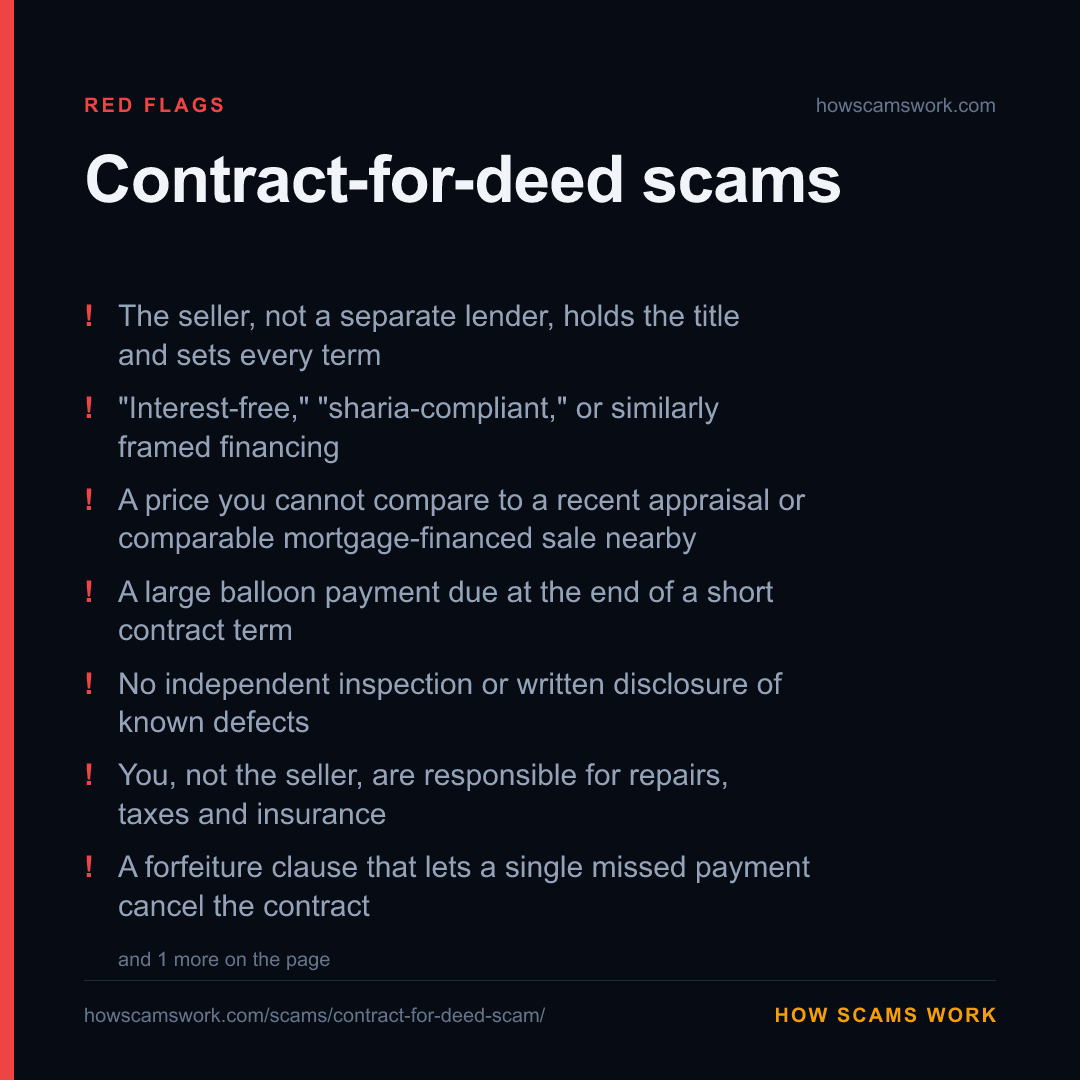
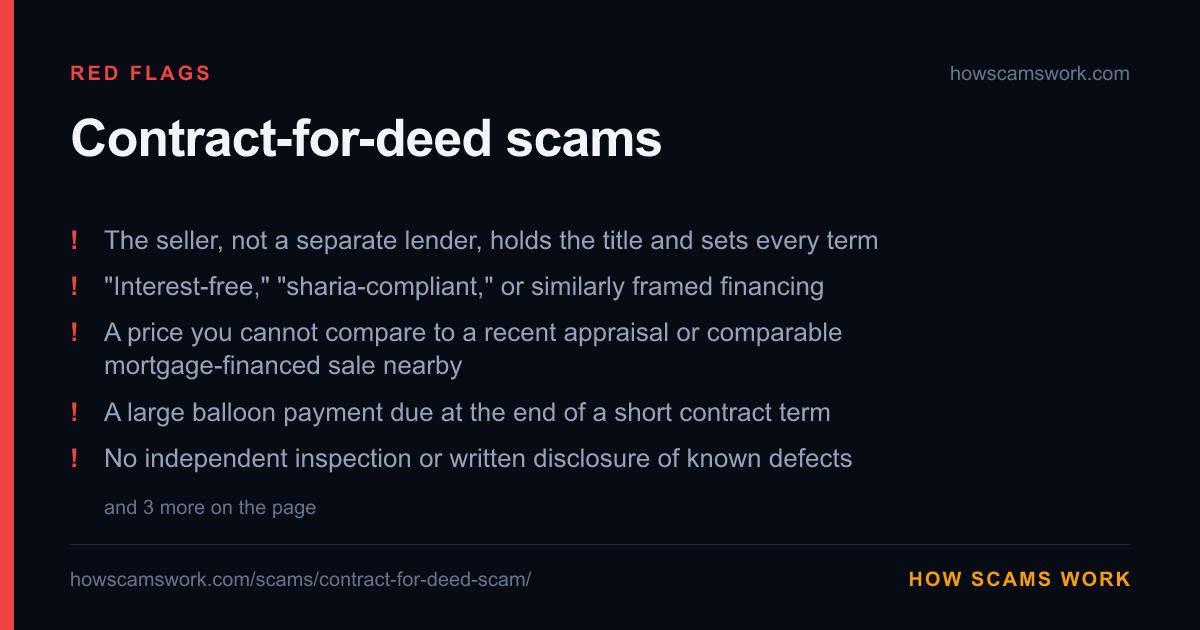
  • The seller, not a separate lender, holds the title and sets every term. There is no outside party checking whether the deal makes sense for you.
  • “Interest-free,” “sharia-compliant,” or similarly framed financing on a contract whose actual cost you cannot independently verify.
  • A price you cannot compare to a recent appraisal or comparable mortgage-financed sale nearby.
  • A large balloon payment due at the end of a short contract term, rather than a level payment schedule running the full length of the deal.
  • No independent inspection or written disclosure of known defects before you sign.
  • You, not the seller, are responsible for repairs, taxes and insurance on a home you do not yet legally own.
  • A forfeiture clause that lets a single missed payment cancel the contract and keep everything you have already paid.
  • Marketing or testimonials aimed at your specific community or faith, rather than terms you could find printed the same way for any buyer.

If it’s happening to you

Stop before you sign anything you have not had independently reviewed. Once you have signed, the contract itself, not your intentions, controls what happens if you fall behind.

  1. Get an independent inspection and an independent lawyer’s review before signing, paid for and chosen by you, not recommended by the seller.
  2. Ask directly whether the seller verified you can afford the payments, and request the written disclosure of the annual cost, fees and any balloon payment; federal rules require this from larger or repeat sellers.
  3. If you are already behind on payments, do not sign anything releasing your claims against the seller before getting independent legal advice; several documented cases involved a buyer signing away their right to sue on the way out the door.
  4. Check the seller’s name and every company name attached to the deal for prior lawsuits, with your state attorney general’s office and in county court records.
  5. Report it to your state Attorney General’s consumer protection division and to the CFPB at consumerfinance.gov/complaint. See where to report for other countries.
  6. If you believe you were targeted because of your religion, national origin or language, your state’s human rights or civil rights agency may have a separate claim beyond ordinary consumer protection law.

Where the money goes

Straight into the seller’s own accounts, through whichever company name is convenient, with no overseas network to disrupt.

The buyer’s down payment and monthly installments go directly to the seller’s operating entity. In the documented same-day resale allegations on this page, that entity used the proceeds, or a conventional mortgage taken out hours earlier, to cover its own purchase of the home, pocketing the markup immediately rather than waiting years for installment payments to add up. When a buyer defaults, the seller keeps every dollar already paid and the house itself, ready to resell under a new contract and a fresh round of payments.

This is also why civil enforcement, not criminal prosecution, is the tool used in every documented case here. State consumer-protection and fair-housing statutes can order restitution, fines and bans, but the underlying business model, buy cheap, finance privately, keep the title, forfeit on default, resell, does not require moving money anywhere a regulator cannot already see it.

The other half of this story

Our sibling site Clean on Paper explains why the same operator buys, resells and evicts under a different LLC every time, the same liability-shielding structure documented on this page across dozens of affiliated entities in the largest case.

By the numbers

No published dataset breaks this scheme out as its own category yet, so there is no chart to show. The data page explains which agency categories exist and why some schemes are invisible in official statistics.

Sources

Every factual claim above traces to one of these. Statistics are reported losses; see methodology for what that does and does not measure.
  1. Pennsylvania sues rent-to-own operator Vision Property Management for preying on low-income renters. HousingWire. Accessed 2026-10-17. Supports: The 2019 Pennsylvania lawsuit, the Szkaradek brothers as named owners, the 650-family scope, and the undisclosed-defect and eviction-and-re-lease allegations.
  2. A judge ordered Vision Property Management to give homes to Pa. tenants who were misled by a 'rent to own' scheme. The Philadelphia Inquirer. Accessed 2026-10-17. Supports: The November 2021 court order deeding homes to tenants, and the Daniel Ramos example's dollar figures.
  3. Settlement Reached in Vision Property Management Lawsuit, $992,000 Restitution for Consumers. MyChesCo. Accessed 2026-10-17. Supports: The 2025 $992,000 settlement, the earlier $800,000 in cash restitution, and continuing litigation against Vision and its owners.
  4. In a first-of-its-kind trial, a Minnesota jury finds a predatory home-financing scheme violated anti-discrimination and consumer-protection laws. ProPublica, with reporting from Sahan Journal. Accessed 2026-10-17. Supports: The June 2026 jury verdict against Chad Banken, the liability findings, the 160 homes sold, and the Abdinoor Igal example.
  5. Chad Banken contract-for-deed trial coverage. Sahan Journal. Accessed 2026-10-17. Supports: The civil nature of the Banken case, the defense argument, and Igal's $170,000 loss and his 'I did not have a choice' testimony.
  6. Minnesota attorney general sues real estate investors over contract-for-deed scheme targeting Somali Muslim buyers. Sahan Journal. Accessed 2026-10-17. Supports: The September 2026 lawsuit against C4D, LLC, Five Properties, LLC, Travis Benoit and Steven Legatt, the same-day resale figures, and Ellison's quotes.
  7. Attorney General Ellison sues C4D over predatory and illegal contracts for deed. KNSI Radio. Accessed 2026-10-17. Supports: The full detail of the C4D complaint: the 2017 to 2025 conduct period, the same-day resale prices, the 74 known customers, the HomeHelpMN application rate, the 20-times foreclosure-rate claim, and the marketing and community-liaison allegations.
  8. CFPB Takes Action to Stop Contract-for-Deed Investors from Setting Borrowers Up to Fail. Consumer Financial Protection Bureau. Accessed 2026-10-17. Supports: The August 2024 advisory opinion applying Truth in Lending Act protections to contracts for deed, the ability-to-repay and disclosure requirements, the forfeiture and failure-rate risks described, and Director Rohit Chopra's quotes.

Common questions

Is a contract for deed always a scam?

No. Seller financing is legal in every state, and some are used honestly, between family, or when a buyer and seller both understand and can afford the terms. What the documented cases on this page share is a specific structure: a price above what a mortgage would support, a disclosure the buyer never received, and a forfeiture clause that lets the seller keep both the home and every dollar already paid. The CFPB's August 2024 advisory opinion exists precisely because that structure, not seller financing itself, is the problem.

How is this different from a mortgage?

A mortgage lender is a separate, licensed party with its own regulatory obligations, an appraisal, an ability-to-repay check, and recorded title that transfers to the buyer at closing. In a contract for deed, the seller plays all of those roles itself, keeps the title the entire time, and in the documented cases on this page, often skipped the appraisal, the ability-to-repay assessment and the cost disclosure a mortgage lender would have been legally required to provide.

If I miss one payment, do I really lose everything?

In the cases documented here, yes. One buyer paid roughly $170,000 over about a year before abandoning the home and signing away his right to sue; another nearly lost $39,500 paid over six years before a court order, not the contract itself, restored his path to the deed. The CFPB's 2024 advisory opinion exists because this forfeiture risk, losing a home and every payment made to it over one missed installment, is exactly what federal mortgage protections are supposed to prevent once a seller's financing is large or common enough to count as credit under the Truth in Lending Act.

Does it matter if the contract says it's interest-free?

Not if the math says otherwise. Two of the three documented cases on this page allege contracts marketed as interest-free specifically to Muslim buyers that, according to the state, carried a real rate hidden in the payment schedule or the size of the balloon payment. A Minnesota jury found a seller liable in one of those cases regardless of what the marketing claimed.

What should I check before signing a contract for deed?

Get an independent home inspection and an independent lawyer's review before signing anything, neither paid for or chosen by the seller. Compare the price to what similar homes sell for with a conventional mortgage; a price built around what you can be made to owe, rather than what the home is worth, is the pattern every documented case on this page shares. Ask directly whether the seller verified you can actually afford the payments, and search the seller's name and company for prior lawsuits before signing.

Where the payments actually goWhere the payments actually go. No laundering chain to trace, the seller keeps the house along with the money. Where the payments actually goNo laundering chain to trace, the seller keeps the house along with the money.A buyer, paying yearsof installments on ahome they don't yetownA down payment andmonthly installments,priced well abovemarket, paid straightto the seller'scompanyThe seller's company,which keeps legaltitle the entire timeThe seller keeps legaltitle throughout; amissed payment orballoon defaultforfeits the buyer'sentire stake in itThe house itself, keptby the seller afterany forfeitureThe same house,improvements included,is resold under abrand-new contract fordeed to someone elseThe next buyer, oncethe first is evictedand the contractstarts overReversibilityA recall is realistically possible only at the first hop, and only in the first hours. After the money is converted it becomes an investigation, not a refund.Why the same operator buys, resells and evicts under a different LLC every time: Clean on Paper, our sibling sitehttps://cleanonpaper.com/techniques/shell-companies/There is no overseas network to disrupt in any of this scheme's documented cases; the money and the house both stay with a US company operating in the open, which is also why civil enforcement, not criminal prosecution, is the tool used against it.howscamswork.com
Where the money goes after it leaves, and where it becomes hard to recover.

Report it

Reporting is what produces the enforcement data on this page. Find the right agency and phone number for your country on the report page. If money moved in the last few hours, call your bank first.