Also called: home warranty fraud · service contract denial scam · extended home warranty scam · home warranty claim denial
A home warranty scam sells a service contract that promises to cover repairs or replacement of a home's major systems and appliances, then uses undisclosed exclusions, low payment caps, and manufactured excuses to avoid paying claims. Four state attorney general actions since 2015 have produced more than $14 million in settlements against repeat offenders, and one case is still being litigated.
What it is
A home warranty is a real, legal product: an annual service contract that promises to repair or
replace a home’s major systems and appliances, air conditioning, water heaters, plumbing, electrical,
kitchen appliances, when they fail from normal wear. Hundreds of companies sell them, and most claims on
most contracts get paid.
The scheme on this page is the version where the company sells the promise and then works to avoid
keeping it. Four state attorney general actions since 2015, three from Arizona alone, describe a
repeated pattern: marketing that promises coverage the written contract excludes or caps, service
timelines defined internally so they can almost never be met, and in one case, fabricated five-star
reviews used to keep new customers signing up despite it.
One company shows how little a settlement sometimes changes. Choice Home Warranty paid New Jersey
$780,000 in 2015 over exactly this conduct. Arizona’s attorney general says the same practices
continued anyway, and sued in 2019. The case ended in January 2026 with an $11.8 million settlement,
the largest home warranty settlement in Arizona’s history.
How it actually works
The pitch
A telemarketing call, a mailer or a renewal notice sells “peace of mind” coverage of a home’s major
systems and appliances for a few hundred dollars a year.
The fine print
The written contract excludes items the sales pitch promised, or caps what it will pay. Arizona’s
2019 complaint against Choice Home Warranty alleges air conditioners and refrigerators were excluded
despite marketing promising coverage, with a $1,500 cap on repairs and a separate $500 cap for
plumbing.
Something breaks, on the worst possible day
The air conditioner fails in a summer heatwave, or a furnace dies in winter, exactly the moment a slow
or denied claim does the most damage.
The service promise gets redefined
A contract phrase like “reasonable efforts to expedite service within 24 hours” gets an internal
definition almost no one can meet. Arizona’s attorney general alleged Landmark Home Warranty defined
its trigger, “extreme temperatures,” as a low of 100 degrees or a sustained 100-plus-degree day, a
threshold that had never been recorded in the state.
Where it could have stopped
A company’s internal definition of its own promise does not have to match the promise’s plain English meaning, and the gap between the two is where a provable deception lives. A state attorney general can read the written sales script against the company’s own internal standard, exactly what happened in both the Choice Home Warranty and Landmark Home Warranty cases, and that comparison is what turned a consumer complaint into a civil fraud lawsuit.
The wait
By Landmark’s own records, cited by Arizona’s attorney general, about half its Arizona customers who
requested air conditioning service in the summers of 2018 and 2019 waited more than a week for a
technician.
The cap, or the denial
An approved claim pays out only up to the contract’s cap, often a fraction of the real repair or
replacement cost. Others are refused outright as outside the “covered” list, or as a “pre-existing
condition” the consumer had no way to know about.
The reviews
Arizona’s attorney general alleged Amazon Home Warranty, a company unrelated to Amazon.com, posted at
least 20 fabricated five-star reviews to the Better Business Bureau’s website in a single day in
October 2020, some copied or repurposed from a competing company’s actual customers, to keep new
sign-ups coming despite its own complaint history.
The regulator, years later
State attorneys general in New Jersey, Arizona and Ohio have sued four companies since 2015 over this
pattern. One of them, Choice Home Warranty, settled with two different states a decade apart for the
same underlying conduct.
Why it works
The product sounds like insurance, and isn’t regulated like it in every state. A home warranty
promises to cover exactly the expensive, unpredictable failures homeowners fear most, then is sold and
enforced through consumer-fraud statutes rather than the stricter claims-handling rules that apply to
licensed insurers in most states.
The gap between the sales pitch and the contract is hard to notice until a claim is denied. A
telephone sales call promising “full coverage” and a 20-page contract excluding the specific item that
later breaks are read by two different people, the eager buyer and the frustrated claimant, months
apart.
An internal definition can make a public promise unmeetable without ever looking like a lie on
paper. Landmark’s alleged internal “100 degrees” standard for “extreme temperatures” never had to
appear in a customer’s contract to make the published promise almost impossible to trigger.
A manufactured five-star review record defeats the one check a skeptical buyer is likely to do.
Checking reviews before signing up for an annual contract feels like due diligence, until the reviews
themselves are the product of the same company’s marketing department.
And the harm per consumer is usually too small to litigate alone. A denied $1,500 repair, or a
wait that cost one more week without air conditioning, rarely clears the bar for an individual lawsuit,
which is why every documented resolution here came from a state attorney general’s office rather than a
single homeowner’s case.
Where it comes from
Entirely domestic, and run in the open as ordinary registered businesses, not hidden operations.
Every documented case on this page is a US company selling to US homeowners. Choice Home Warranty
is based in New Jersey and operates nationwide; Landmark Home Warranty and Amazon Home Warranty were
both sued in Arizona; First Premier Home Warranty is run from Brooklyn, New York. None of the conduct
described involves a call centre overseas, a cryptocurrency payment or a cross-border wire.
Enforcement runs state by state, through consumer-fraud statutes, not federal law or criminal
charges. Every resolved case here is a state attorney general’s civil action, Arizona three times,
New Jersey once, under each state’s own Consumer Fraud Act or Consumer Sales Practices Act. None of the
four companies has faced a criminal charge in any source reviewed for this page.
That state-by-state structure is also why the same company can keep operating after a settlement.
A consumer-fraud settlement in one state does not bind a company’s conduct in the other 49, which is
part of why Choice Home Warranty’s $780,000 New Jersey settlement in 2015 did not, according to
Arizona’s attorney general, stop the practices that led to Arizona’s own $11.8 million settlement
eleven years later.
And an owner, not just a company, can resurface. Arizona’s attorney general alleged Amazon Home
Warranty’s primary owner had a substantial, undisclosed connection to an earlier home warranty company
whose business authority New Jersey had already revoked, a pattern this site’s sibling site on money
laundering recognises under a different name: using a new corporate shell to outrun a sanction on the
last one.
Real cases
2026 US Settled $11.8m
Arizona's Attorney General sued Choice Home Warranty, a New Jersey-based service contract company operating nationwide, in October 2019, alleging telephone sales representatives promised coverage the written contract then excluded or capped. The case settled in January 2026 for $11.8 million, the largest home warranty settlement in Arizona's history. New Jersey had already settled with the same company in 2015 for $780,000 over similar allegations.
Read the case file ·
2 sources
2024 US Charged (allegation, not conviction)
Ohio Attorney General Dave Yost sued First Premier Home Warranty and the man who runs it from Brooklyn, New York, Albert Sayegh, in August 2024, alleging the company rarely covered claims, manipulated its own online reviews, and sold warranties by phone in Ohio without registering as the state's telemarketing law requires. The lawsuit is Ohio's allegation; it had not been resolved by a verdict or settlement as of this page's last review.
Read the case file ·
1 source
2021 US Settled $150,000
Arizona's Attorney General alleged that Amazon Home Warranty, LLC, a company with no connection to Amazon.com, and its officers posted fabricated five-star reviews copied or repurposed from a competing company's actual customers, while concealing that its primary owner had a previously revoked home warranty business in New Jersey. The company agreed to a $150,000 consent judgment in late 2021, plus a separate $15,000 cost to administer consumer restitution.
Read the case file ·
2 sources
2021 US Settled $1.8m
Arizona's Attorney General alleged Landmark Home Warranty promised to "make reasonable efforts to expedite service within 24 hours" when a customer's air conditioning failed in extreme temperatures, then internally defined "extreme temperatures" so narrowly that the condition had never actually occurred in the state. The company settled in 2021 for $1.75 million, and checks were mailed to more than 26,000 Arizona consumers that June.
Read the case file ·
2 sources
Red flags
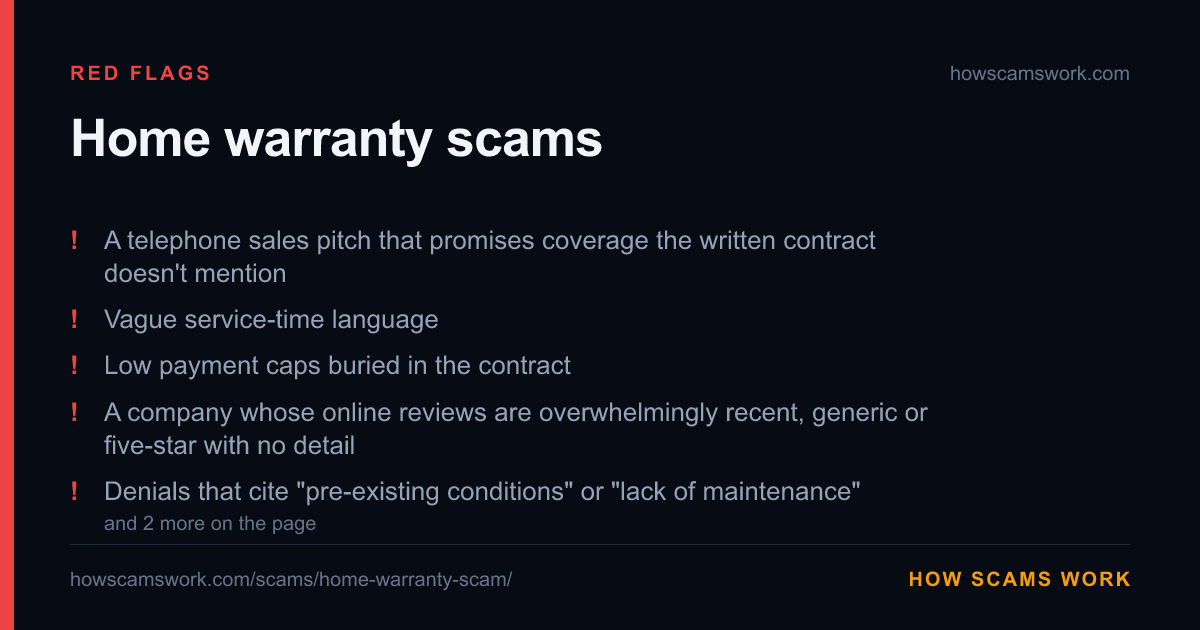
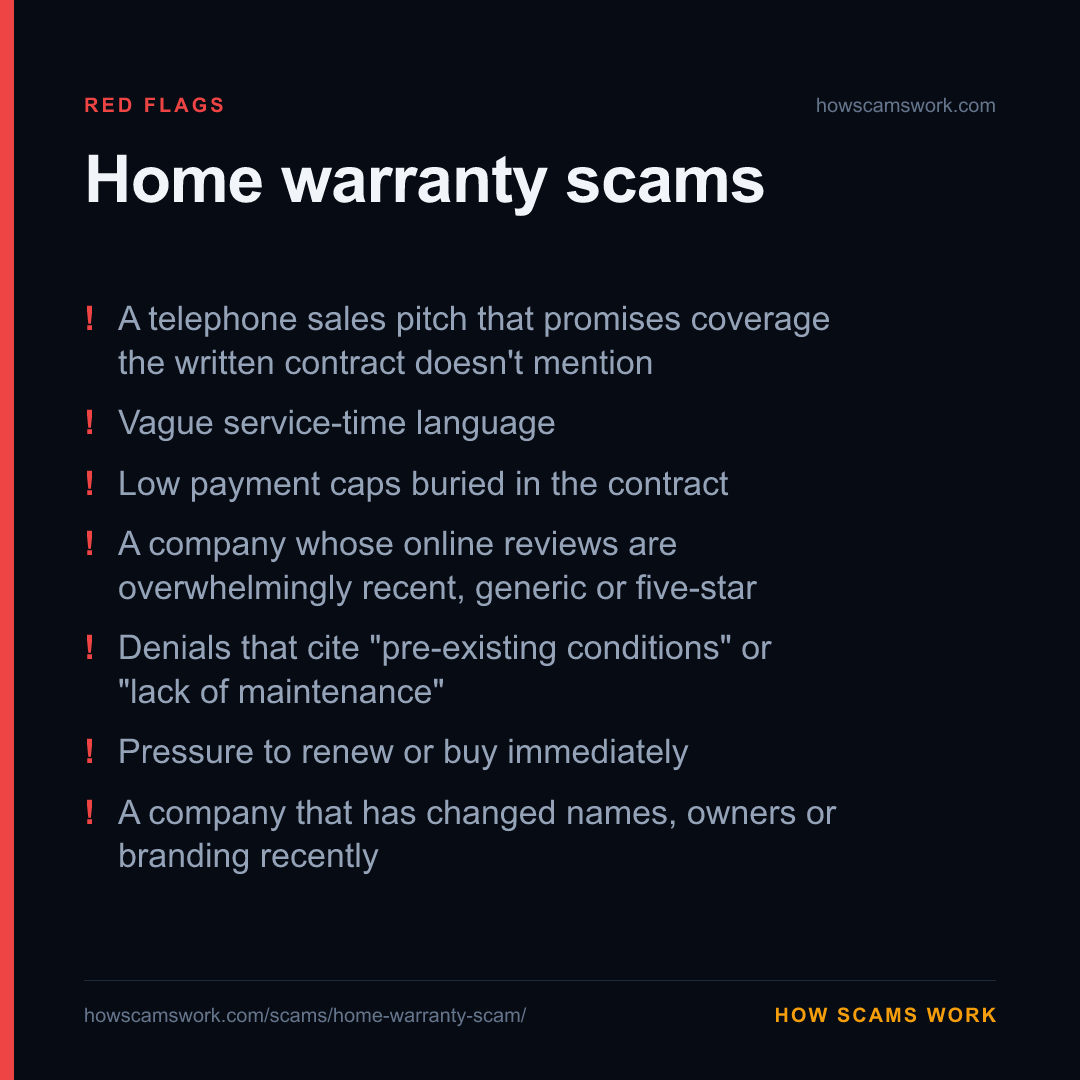
- A telephone sales pitch that promises coverage the written contract doesn’t mention. Get the exclusions list before you pay, not after.
- Vague service-time language like “reasonable efforts to expedite,” with no specific hours or days written into the contract itself.
- Low payment caps buried in the contract, such as a flat dollar limit per repair that would not cover a real replacement.
- A company whose online reviews are overwhelmingly recent, generic or five-star with no detail, a documented tactic in one of the cases on this page.
- Denials that cite “pre-existing conditions” or “lack of maintenance” on systems the company never inspected before selling the contract.
- Pressure to renew or buy immediately, before you’ve had time to compare the contract’s exclusions against what was promised on the phone.
- A company that has changed names, owners or branding recently, particularly after a state sanctioned a previous business the same people ran.
If it’s happening to you
- Get the denial, and the reason for it, in writing. A verbal refusal is harder to challenge than a
written one citing a specific exclusion or cap.
- Compare the denial against what you were told when you bought the plan. A documented gap between
the sales pitch and the written exclusion is the exact allegation behind every settlement on this
page.
- File a complaint with your state attorney general’s consumer protection office, not just the
company. These cases were built from accumulated consumer complaints, more than 1,500 against one
company in Arizona alone.
- Check whether the company is already under a state settlement or restitution program. If so, you
may be eligible for money back without filing your own lawsuit.
- Report it to the FTC at ReportFraud.ftc.gov and to your state attorney general. See
where to report for other countries.
- Keep every document: the sales call confirmation, the contract, the claim denial and any repair
estimate. Restitution in these cases has been paid years after the original complaint.
Where the money goes
Straight into the company’s own revenue, collected as an ordinary annual premium, with the fraud sitting
in what the company refuses to pay out rather than in any laundering chain.
The money moves in one direction, then stalls. A homeowner pays an annual fee, typically in the
$400 to $650 range documented in Ohio’s 2024 case against First Premier Home Warranty, for coverage
whose exclusions and dollar caps, up to $1,500 per repair in Arizona’s case against Choice Home
Warranty, mean the real cost of an uncovered or undercovered repair lands back on the homeowner. That
gap between the annual fee and the real repair cost is the basis for this page’s typical-loss estimate,
drawn from a small sample of the dollar figures these four cases actually document, not a larger survey.
A sanctioned company does not necessarily stop operating. Arizona’s attorney general alleged that
Amazon Home Warranty’s primary owner, Harry Bailey, had a substantial, undisclosed connection to an
earlier home warranty company whose business authority New Jersey had already revoked. Choice Home
Warranty itself paid two different states for the same conduct a decade apart.
Restitution, when it arrives, is a small fraction of what was collected, years later. Landmark Home
Warranty’s settlement guaranteed Arizona customers as little as $25 each, with up to $1,000 more only
for those who could document a specific loss from a delayed repair, against a $1.75 million total
recovery.
By the numbers
No published dataset breaks this scheme out as its own category yet, so there is no chart to show.
The data page explains which agency categories exist and why some schemes are
invisible in official statistics.
Every factual claim above traces to one of these. Statistics are reported losses; see
methodology for what that does and does not measure.